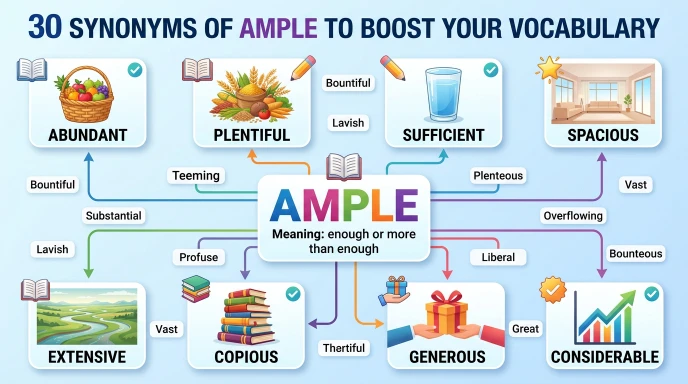
Ample means having enough of something, often more than enough to meet a need. Imagine you are planning a family dinner. You prepare ample food so every guest can enjoy a meal without worry. In this case, ample means a good and sufficient amount. This word is common in daily speech, school essays, business writing, and formal reports. It can describe food, time, space, evidence, resources, and opportunities.
Learning synonyms of ample helps English learners understand small differences between similar words. It also helps content writers make their work clear, natural, and engaging. Instead of using the same word again and again, you can choose a word that fits the meaning and tone.
This guide explains the meaning, grammar, pronunciation, history, and emotional tone of ample. It also shares 30 synonyms, simple examples, related word forms, antonyms, and useful tips for choosing the right word.
Meaning of Ample
Definition
Ample (Adjective): Enough or more than enough of something to meet a need or serve a purpose.
Examples
- We have ample time to finish our homework.
- The garden offers ample space for children to play.
Connotative Meaning
Connotation (the feelings or ideas a word suggests beyond its basic meaning).
- Positive tone: Ample often suggests comfort, abundance, readiness, or plenty of resources.
- Negative tone: It can suggest excess in some contexts, although ample itself is usually not negative.
- Neutral tone: It can simply describe an amount that is sufficient, such as ample evidence or ample room.
Etymology
- Source language: Ample comes from Old French ample, which came from Latin amplus.
- Original meaning: The Latin word meant “large,” “spacious,” “extensive,” or “abundant.”
- Development: The meaning grew to describe something that is plentiful, generous in size, or more than sufficient.
Short History of the Keyword
- Old English (450–1100): Ample was not a common native Old English word. Speakers used other words to express ideas such as enough, large, or plentiful.
- Middle English (1100–1500): After the Norman Conquest, French and Latin influenced English vocabulary. Ample entered English through French and became associated with large amounts and generous space.
- Modern English (1500–Present): Ample became a common adjective in literature, education, business, and everyday communication. Today, it describes sufficient or abundant time, space, evidence, resources, and opportunities.
Pronunciation (US & UK – IPA)
- US: /ˈæmpəl/
- UK: /ˈæmpəl/
Syllables
am-ple — 2 syllables.
Affixation Pattern of Ample
- Root: ample — meaning large, plentiful, or sufficient.
- Prefix: None in the base word.
- Suffix: None in the base word.
Word Formation of Ample
These common forms and related words belong to the same word family:
- Ample (adjective): Enough or more than enough.
- Amply (adverb): In a sufficient or abundant way.
- Ampleness (noun): The quality of being ample.
- Amplify (verb): To make something stronger, louder, or greater. This is a related-looking word with a different development and use, not a direct grammatical form of ample.
Synonyms of Ample
The best synonym depends on what you are describing. Some words focus on having enough, while others suggest a large amount, generous space, or a wide range of choices.
1. Abundant (Adjective)
US IPA: /əˈbʌndənt/ | UK IPA: /əˈbʌndənt/
Meaning: Available in large amounts.
Examples:
- The farm produces abundant fresh vegetables.
- The region has abundant natural resources.
2. Plentiful (Adjective)
US IPA: /ˈplentɪfəl/ | UK IPA: /ˈplentɪfəl/
Meaning: Existing in large amounts or numbers.
Examples:
- Fresh water is plentiful in this area.
- There were plentiful snacks at the party.
3. Sufficient (Adjective)
US IPA: /səˈfɪʃənt/ | UK IPA: /səˈfɪʃənt/
Meaning: Enough to meet a need or purpose.
Examples:
- We have sufficient money for the trip.
- She collected sufficient evidence for her report.
4. Adequate (Adjective)
US IPA: /ˈædɪkwət/ | UK IPA: /ˈædɪkwət/
Meaning: Enough to meet a basic need or standard.
Examples:
- The room has adequate lighting.
- Please bring adequate supplies for the journey.
5. Generous (Adjective)
US IPA: /ˈdʒenərəs/ | UK IPA: /ˈdʒenərəs/
Meaning: Larger or greater than what is usually expected.
Examples:
- The host served generous portions of food.
- We were given a generous amount of time.
6. Copious (Adjective)
US IPA: /ˈkoʊpiəs/ | UK IPA: /ˈkəʊpiəs/
Meaning: Available or produced in very large amounts.
Examples:
- The student took copious notes during class.
- The storm brought copious amounts of rain.
7. Substantial (Adjective)
US IPA: /səbˈstænʃəl/ | UK IPA: /səbˈstænʃəl/
Meaning: Large or important in amount, size, or value.
Examples:
- The company made a substantial profit.
- They received substantial support from the community.
8. Considerable (Adjective)
US IPA: /kənˈsɪdərəbəl/ | UK IPA: /kənˈsɪdərəbəl/
Meaning: Fairly large in amount, size, or degree.
Examples:
- The project required considerable effort.
- She has considerable experience in teaching.
9. Ample-sized (Adjective)
US IPA: /ˈæmpəl saɪzd/ | UK IPA: /ˈæmpəl saɪzd/
Meaning: Large enough to provide generous space or room.
Examples:
- The family chose an ample-sized dining area.
- We need an ample-sized container for the supplies.
10. Spacious (Adjective)
US IPA: /ˈspeɪʃəs/ | UK IPA: /ˈspeɪʃəs/
Meaning: Having plenty of room or space.
Examples:
- Their new house has a spacious kitchen.
- We booked a spacious room for our family.
11. Roomy (Adjective)
US IPA: /ˈruːmi/ | UK IPA: /ˈruːmi/
Meaning: Providing plenty of space to move or fit things.
Examples:
- The car is roomy enough for five people.
- She bought a roomy backpack for school.
12. Extensive (Adjective)
US IPA: /ɪkˈstensɪv/ | UK IPA: /ɪkˈstensɪv/
Meaning: Covering a large area, range, or amount.
Examples:
- The library has an extensive book collection.
- The team conducted extensive research.
13. Profuse (Adjective)
US IPA: /prəˈfjuːs/ | UK IPA: /prəˈfjuːs/
Meaning: Existing or appearing in very large amounts.
Examples:
- The garden was filled with profuse flowers.
- He offered profuse thanks to the volunteers.
14. Overflowing (Adjective)
US IPA: /ˌoʊvərˈfloʊɪŋ/ | UK IPA: /ˌəʊvəˈfləʊɪŋ/
Meaning: So full that the contents seem likely to spill out.
Examples:
- The basket was overflowing with apples.
- The hall was overflowing with excited fans.
15. Rich (Adjective)
US IPA: /rɪtʃ/ | UK IPA: /rɪtʃ/
Meaning: Containing a large amount of something valuable or desirable.
Examples:
- The soil is rich in nutrients.
- The book offers a rich source of information.
16. Bountiful (Adjective)
US IPA: /ˈbaʊntɪfəl/ | UK IPA: /ˈbaʊntɪfəl/
Meaning: Providing a large and generous amount.
Examples:
- The farmers enjoyed a bountiful harvest.
- The village received a bountiful supply of food.
17. Lavish (Adjective)
US IPA: /ˈlævɪʃ/ | UK IPA: /ˈlævɪʃ/
Meaning: Very generous or greater than what is usually needed.
Examples:
- They prepared a lavish dinner for their guests.
- The hotel offered lavish decorations for the event.
18. Hefty (Adjective)
US IPA: /ˈhefti/ | UK IPA: /ˈhefti/
Meaning: Large or considerable in amount, size, or weight.
Examples:
- The company paid a hefty fee.
- She received a hefty stack of books.
19. Ample-bodied (Adjective)
US IPA: /ˈæmpəl ˌbɑːdid/ | UK IPA: /ˈæmpəl ˌbɒdid/
Meaning: Broad or large in physical build; it is not a general synonym for ample.
Examples:
- The historical description referred to an ample-bodied figure.
- The character was portrayed as broad-built in the novel.
20. Extensive-ranging (Adjective)
US IPA: /ɪkˈstensɪv ˈreɪndʒɪŋ/ | UK IPA: /ɪkˈstensɪv ˈreɪndʒɪŋ/
Meaning: Covering many topics or a wide range; this is not a standard direct synonym for ample.
Examples:
- The report covered a wide range of subjects.
- The course offers broad coverage of English grammar.
21. Ample-handed (Adjective)
US IPA: /ˈæmpəl ˌhændɪd/ | UK IPA: /ˈæmpəl ˌhændɪd/
Meaning: Not a standard synonym of ample; in some contexts, open-handed or generous expresses giving freely.
Examples:
- The generous donor helped several local families.
- She was open-handed with her time and support.
22. Overflowing-rich (Adjective)
US IPA: /ˌoʊvərˈfloʊɪŋ rɪtʃ/ | UK IPA: /ˌəʊvəˈfləʊɪŋ rɪtʃ/
Meaning: Not a standard single-word synonym; rich or overflowing may fit depending on context.
Examples:
- The region is rich in wildlife.
- The bowl was overflowing with fresh fruit.
23. Plenteous (Adjective)
US IPA: /ˈplentiəs/ | UK IPA: /ˈplentiəs/
Meaning: Existing in large amounts; a somewhat formal or literary word.
Examples:
- The valley provided plenteous crops.
- The region has plenteous natural beauty.
24. Unrestricted (Adjective)
US IPA: /ˌʌnrɪˈstrɪktɪd/ | UK IPA: /ˌʌnrɪˈstrɪktɪd/
Meaning: Not limited or controlled by rules or conditions.
Examples:
- The students had unrestricted access to the library.
- The policy allows unrestricted use of the shared space.
25. Unbounded (Adjective)
US IPA: /ʌnˈbaʊndɪd/ | UK IPA: /ʌnˈbaʊndɪd/
Meaning: Having no clear limits or boundaries.
Examples:
- The child showed unbounded enthusiasm.
- Her unbounded curiosity led her to explore new ideas.
26. Extensive (Adjective)
US IPA: /ɪkˈstensɪv/ | UK IPA: /ɪkˈstensɪv/
Meaning: Large in size, amount, or scope.
Examples:
- The museum has an extensive art collection.
- The team completed extensive testing before launch.
27. Ample (Adjective)
US IPA: /ˈæmpəl/ | UK IPA: /ˈæmpəl/
Meaning: More than enough for a particular need.
Examples:
- We have ample room for another desk.
- The team had ample time to prepare.
28. Comfortable (Adjective)
US IPA: /ˈkʌmftərbəl/ | UK IPA: /ˈkʌmftəbəl/
Meaning: Sufficient for a need or situation without causing difficulty; a contextual alternative rather than a direct synonym.
Examples:
- We have a comfortable amount of time to finish.
- The family has enough savings to live comfortably.
29. Overflow (Noun)
US IPA: /ˈoʊvərfloʊ/ | UK IPA: /ˈəʊvəfləʊ/
Meaning: An amount that goes beyond the available space or capacity.
Examples:
- The overflow of water reached the garden.
- The school opened another room to handle the overflow of students.
30. More than enough (Phrase)
US IPA: /mɔːr ðæn ɪˈnʌf/ | UK IPA: /mɔː ðən ɪˈnʌf/
Meaning: An amount that fully meets a need and leaves extra.
Examples:
- We have more than enough food for everyone.
- There is more than enough evidence to support the claim.
Prototype Meaning
The most typical meaning of ample is having enough of something, often with extra available. When people hear this word, they may imagine a large room, plenty of food, enough time to finish a task, or strong evidence to support an idea. For example, an ample supply of water means there is enough water to meet a need, with some to spare. The word often creates a sense of comfort, readiness, and abundance. It can describe both physical things, such as space and resources, and abstract things, such as time, proof, and opportunity.
Prototype Categorization
Synonyms of ample can be grouped by their main meanings. These groups help writers choose a word that fits the situation.
- Enough to meet a need: Sufficient, adequate, and more than enough. Use these words when describing resources or amounts that meet a requirement.
- Large amounts: Abundant, plentiful, copious, profuse, bountiful, and plenteous. These words suggest that something exists in large quantities.
- Large size or space: Spacious, roomy, and ample-sized. These are useful when describing rooms, buildings, vehicles, and other physical spaces.
- Large amount or importance: Substantial, considerable, extensive, and hefty. These words work well in formal writing about costs, effort, evidence, and results.
- Generosity and richness: Generous, lavish, rich, and overflowing. These words can suggest plenty, richness, or an amount beyond the usual level.
- Freedom from limits: Unrestricted and unbounded. These words describe a lack of restrictions or boundaries rather than simply a sufficient amount.
Words such as ample-bodied, ample-handed, and overflowing-rich are not standard general synonyms of ample. Use established alternatives that match your intended meaning.
Categorization helps writers avoid using synonyms incorrectly. For example, spacious works well for a room, while substantial suits a financial investment. Sufficient means enough, but abundant suggests a large amount. Choosing carefully makes your writing clearer and more natural.
Antonyms of Ample
Antonyms express the opposite meaning of ample. They often describe a shortage, a small amount, or a lack of space.
- Insufficient (Adjective): Not enough to meet a need.
- Inadequate (Adjective): Not good enough or not enough for a purpose.
- Scarce (Adjective): Available in small amounts or difficult to find.
- Limited (Adjective): Restricted in amount, size, or range.
- Meager (Adjective): Very small or lacking in amount.
- Sparse (Adjective): Thinly spread or present in small numbers.
- Scant (Adjective): Barely enough or less than expected.
- Deficient (Adjective): Lacking something necessary.
- Inadequate (Adjective): Failing to meet the required standard or need.
- Restricted (Adjective): Limited by rules, conditions, or boundaries.
Short Questions and Answers
– What does ample mean?
Ample means enough or more than enough of something to meet a need.
– When should ample be used?
Use ample when describing sufficient or plentiful time, space, food, resources, evidence, or opportunities.
– Is ample positive or negative?
Ample is usually positive or neutral. It often suggests comfort and abundance, but the context may affect its tone.
– How is ample different from similar words?
Sufficient means enough, abundant means available in large amounts, and spacious means having plenty of room. Considerable emphasizes a fairly large amount or degree.
– Can ample be used in formal writing?
Yes. Ample is common in essays, reports, research, business writing, and academic discussions.
– What is the opposite of ample?
Common antonyms include insufficient, inadequate, scarce, limited, and meager.
– What is the noun form of ample?
Ampleness is a noun meaning the quality of being ample, although it is less common than the adjective.
– What is the adverb form of ample?
Amply is the adverb. For example, “The claim was amply supported by evidence.”
Conclusion
Learning ample and its synonyms can help you build a stronger English vocabulary. Words such as abundant, plentiful, sufficient, and spacious allow you to describe amounts, resources, and space more clearly. Understanding their small differences helps you choose the right word for each situation.
This makes your writing more natural and reduces repetition in essays, blog posts, reports, and everyday messages. Learning pronunciation, grammar, word history, and emotional tone also helps you use these words with confidence.
Try learning three synonyms each day and writing a simple sentence for each one. Read English articles, notice how writers use these words, and practise them in your own conversations. With regular practice, you can improve your vocabulary, strengthen your speaking and writing skills, and express your ideas more clearly.
Explore more about!
- Synonyms for “Constitution”: Powerful Words to Expand
- Synonyms of Meaningful: Best Alternative Words to Know
- Another Word for Derogatory: Insulting, Demeaning & More

I am an American author, and I write books about power, strategy, and human behavior. My writing style is simple but deep, and I try to explain how people think and act in real-life situations.
I studied classical studies, and before becoming a writer, I worked in different fields which helped me understand people and life better.
My most famous books include The 48 Laws of Power, The Art of Seduction, and Mastery. These books are widely read by business people, leaders, and students around the world.