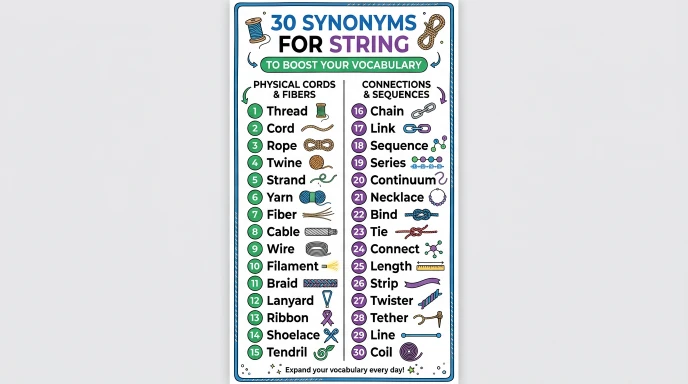
A string is a thin piece of cord made from twisted fibers. People use string to tie boxes, wrap gifts, hang decorations, and hold things together. For example, you may use a piece of string to tie a gift before giving it to a friend.
The word string is common in daily life, crafts, cooking, music, and computer science. It can also mean a series of things joined together, such as a string of lights or a string of words.
Learning synonyms for string helps English learners describe objects more clearly. It also helps students and content writers avoid repeating the same word. However, words such as cord, thread, rope, and twine are not always interchangeable.
This guide explains the meaning, history, pronunciation, grammar, and tone of string. It also presents 30 related words with simple meanings and examples to help you choose the right word.
Meaning of String
Definition
String (noun): A thin piece of twisted fiber or material used for tying, fastening, or joining things.
String (verb): To put things on a string or arrange them in a line.
Examples
- She used a string to tie the box.
- We hung colorful lights on a string.
Connotative Meaning
(Connotation is the feeling or idea a word suggests beyond its basic meaning.)
- Positive tone: String may suggest creativity, craftwork, or connection, as in a string of beautiful lights.
- Negative tone: It may suggest something weak, cheap, or easy to break.
- Neutral tone: String usually names a simple material used for tying or joining things.
Etymology
- Origin: String comes from Old English streng, meaning a cord or rope.
- Germanic roots: It is related to words in other Germanic languages that refer to a cord or line.
- Related verb: The verb string developed with the meaning of putting things on a cord or arranging them in a line.
Short History of String
- Old English (450–1100): The form streng referred to a cord or rope used for tying things.
- Middle English (1100–1500): The word developed into forms closer to modern string. It continued to describe a cord or narrow line of material.
- Modern English (1500–Present): String gained more uses. It can describe a physical cord, a series of events or objects, a musical string, or a sequence of characters in computing.
Pronunciation (US & UK – IPA)
- US: /strɪŋ/
- UK: /strɪŋ/
Syllables
string — one syllable
Affixation Pattern of String
- Root: string
- Prefix: None in the base word.
- Suffix: None in the base word. Inflected forms can use -s, -ed, and -ing.
Word Formation of String
- String (noun): A thin cord used for tying.
- Strings (plural noun): More than one string.
- String (verb): To put things on a cord or arrange them in a line.
- Strings (verb): Present-tense form used with he, she, or it.
- Stringed (verb/adjective): Past tense of string; also used in terms such as stringed instrument.
- Stringing (verb/noun): The act of putting things on a string.
- Stringer (noun): A person who supplies news or reports to a publication on a flexible or occasional basis; it also has specialized meanings in construction and sports.
- Stringy (adjective): Made of long, thin strands.
- Stringiness (noun): The quality of being stringy.
- Stringless (adjective): Without strings.
- String-like (adjective): Similar to a string in shape or form.
- Stringed (adjective): Having strings, as in a stringed musical instrument.
Synonyms for String
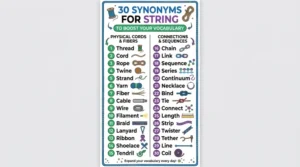
The best synonym depends on the type of string and how it is used. Some words describe thin fibers, while others refer to thicker cords, strong ropes, or lines of connected things.
1. Cord (Noun)
US IPA: /kɔːrd/ | UK IPA: /kɔːd/
Meaning: A strong, thin rope made from twisted or braided fibers.
Examples:
- He used a cord to secure the package.
- The lamp has a long power cord.
2. Thread (Noun)
US IPA: /θred/ | UK IPA: /θred/
Meaning: A very thin strand of cotton, silk, or another material used for sewing.
Examples:
- She used blue thread to repair the shirt.
- The needle had a piece of thread in it.
3. Twine (Noun)
US IPA: /twaɪn/ | UK IPA: /twaɪn/
Meaning: Strong thread made by twisting several smaller strands together.
Examples:
- He tied the herbs with twine.
- The parcel was wrapped with brown twine.
4. Rope (Noun)
US IPA: /roʊp/ | UK IPA: /rəʊp/
Meaning: A thick, strong cord made from twisted or braided fibers.
Examples:
- The climber held the rope tightly.
- They used a rope to pull the boat.
5. Yarn (Noun)
US IPA: /jɑːrn/ | UK IPA: /jɑːn/
Meaning: Fibers spun together for knitting, weaving, or crocheting.
Examples:
- She bought soft yarn for a scarf.
- The basket held several balls of yarn.
6. Filament (Noun)
US IPA: /ˈfɪl.ə.mənt/ | UK IPA: /ˈfɪl.ə.mənt/
Meaning: A very thin strand of material.
Examples:
- A fine filament hung from the web.
- The lamp used a thin metal filament.
7. Strand (Noun)
US IPA: /strænd/ | UK IPA: /strænd/
Meaning: A single thin piece of hair, fiber, or thread-like material.
Examples:
- A strand of hair fell across her face.
- One strand of rope had broken.
8. Line (Noun)
US IPA: /laɪn/ | UK IPA: /laɪn/
Meaning: A long, narrow mark or piece of material used for a particular purpose.
Examples:
- He tied the boat to a line.
- A washing line stretched across the yard.
9. Lacing (Noun)
US IPA: /ˈleɪ.sɪŋ/ | UK IPA: /ˈleɪ.sɪŋ/
Meaning: A cord or lace used to fasten or join things.
Examples:
- The shoe’s lacing came loose.
- She replaced the old lacing on her boots.
10. Shoelace (Noun)
US IPA: /ˈʃuː.leɪs/ | UK IPA: /ˈʃuː.leɪs/
Meaning: A thin cord used to fasten a shoe.
Examples:
- My shoelace came undone.
- He tied each shoelace carefully.
11. Cable (Noun)
US IPA: /ˈkeɪ.bəl/ | UK IPA: /ˈkeɪ.bəl/
Meaning: A thick group of wires or strands joined together.
Examples:
- The worker checked the cable.
- A strong cable held the equipment in place.
12. Wire (Noun)
US IPA: /waɪr/ | UK IPA: /waɪə/
Meaning: A thin, flexible strand of metal.
Examples:
- She used a wire to secure the frame.
- The electrician replaced the damaged wire.
13. Filament Fiber (Noun Phrase)
US IPA: /ˈfɪl.ə.mənt ˈfaɪ.bɚ/ | UK IPA: /ˈfɪl.ə.mənt ˈfaɪ.bə/
Meaning: A long, thin fiber that forms part of a material.
Examples:
- The fabric was made from fine filament fiber.
- The scientist studied the strength of the filament fiber.
14. Lanyard (Noun)
US IPA: /ˈlæn.jɚd/ | UK IPA: /ˈlæn.jəd/
Meaning: A cord worn around the neck or wrist to hold a small item.
Examples:
- She wore her ID card on a lanyard.
- He attached the key to a short lanyard.
15. Drawstring (Noun)
US IPA: /ˈdrɔː.strɪŋ/ | UK IPA: /ˈdrɔː.strɪŋ/
Meaning: A cord used to pull an opening closed.
Examples:
- He tightened the bag’s drawstring.
- The hoodie has a drawstring at the neck.
16. Fishing Line (Noun Phrase)
US IPA: /ˈfɪʃ.ɪŋ laɪn/ | UK IPA: /ˈfɪʃ.ɪŋ laɪn/
Meaning: A thin, strong line used for catching fish.
Examples:
- The fisherman checked his fishing line.
- The fishing line became tangled in the weeds.
17. Clothesline (Noun)
US IPA: /ˈkloʊz.laɪn/ | UK IPA: /ˈkləʊz.laɪn/
Meaning: A line used for hanging clothes to dry.
Examples:
- She hung the wet shirts on the clothesline.
- The clothesline was full of towels.
18. Stringer (Noun)
US IPA: /ˈstrɪŋ.ɚ/ | UK IPA: /ˈstrɪŋ.ə/
Meaning: A person who contributes reports to a news organization without being a full-time staff member; in other contexts, a structural or supporting part.
Examples:
- The newspaper hired a local stringer.
- The builder checked the stair stringer.
19. Braid (Noun)
US IPA: /breɪd/ | UK IPA: /breɪd/
Meaning: A length of material made by weaving strands together.
Examples:
- The craft used a colorful braid.
- She tied the bundle with a strong braid.
20. Lashing (Noun)
US IPA: /ˈlæʃ.ɪŋ/ | UK IPA: /ˈlæʃ.ɪŋ/
Meaning: A cord or rope used to tie or secure objects together.
Examples:
- The sailor checked the lashing on the load.
- The poles were held together with lashing.
21. Binding (Noun)
US IPA: /ˈbaɪn.dɪŋ/ | UK IPA: /ˈbaɪn.dɪŋ/
Meaning: Material used to tie, hold, or cover things together.
Examples:
- The binding held the pages together.
- She added a fabric binding to the edge.
22. Tape (Noun)
US IPA: /teɪp/ | UK IPA: /teɪp/
Meaning: A narrow strip of material used to stick, fasten, or mark things.
Examples:
- He used tape to close the box.
- The tape held the loose paper in place.
23. Ribbon (Noun)
US IPA: /ˈrɪb.ən/ | UK IPA: /ˈrɪb.ən/
Meaning: A narrow strip of fabric used for tying or decoration.
Examples:
- She tied a ribbon around the gift.
- The ribbon made the package look pretty.
24. Lace (Noun)
US IPA: /leɪs/ | UK IPA: /leɪs/
Meaning: A thin cord used for fastening, or a delicate fabric made from threads.
Examples:
- He pulled the lace through the shoe holes.
- The dress had a lace edge.
25. Tendril (Noun)
US IPA: /ˈten.drəl/ | UK IPA: /ˈten.drəl/
Meaning: A thin, curling part of a plant that helps it climb or attach itself.
Examples:
- A tendril curled around the fence.
- The vine sent out a new tendril.
26. Fiber (Noun)
US IPA: /ˈfaɪ.bɚ/ | UK IPA: /ˈfaɪ.bə/
Meaning: A thin strand that can form part of cloth, rope, or another material.
Examples:
- The cloth contains natural fiber.
- The rope was made from plant fiber.
27. Filament Thread (Noun Phrase)
US IPA: /ˈfɪl.ə.mənt θred/ | UK IPA: /ˈfɪl.ə.mənt θred/
Meaning: A very fine thread made from a continuous strand of material.
Examples:
- The fabric used a delicate filament thread.
- The filament thread was hard to see.
28. Stringing (Noun)
US IPA: /ˈstrɪŋ.ɪŋ/ | UK IPA: /ˈstrɪŋ.ɪŋ/
Meaning: The act of putting objects on a string or arranging them in a row.
Examples:
- Stringing beads takes patience.
- She enjoyed stringing flowers into a garland.
29. Sequence (Noun)
US IPA: /ˈsiː.kwəns/ | UK IPA: /ˈsiː.kwəns/
Meaning: A set of things arranged in a particular order.
Examples:
- The code contains a sequence of letters.
- A string of events led to the change.
30. Series (Noun)
US IPA: /ˈsɪr.iːz/ | UK IPA: /ˈsɪə.riːz/
Meaning: A number of related things that follow one another.
Examples:
- She faced a series of challenges.
- A series of lights decorated the garden.
Prototype Meaning
The most typical meaning of string is a thin, flexible cord used to tie, fasten, or connect things. People often imagine a piece of twine wrapped around a parcel or a cord holding a tag. A string can be made from cotton, plastic, or other fibers.
The word also has broader meanings: it can describe a line of connected objects, a sequence of events, a musical string, or a set of characters in computing.
Prototype Categorization
Synonyms for string can be grouped by material, purpose, and context:
- Thin fibers and strands: Thread, strand, filament, fiber. Use these when describing very thin pieces of material.
- Twisted or stronger cords: Cord, twine, rope, cable. Use these when discussing tying, pulling, or securing objects.
- Fastening cords: Shoelace, drawstring, lacing, lanyard. Use these for clothing, bags, shoes, or ID cards.
- Lines for specific tasks: Fishing line, clothesline, wire. Use these for fishing, drying clothes, or electrical work.
- Decorative or woven materials: Ribbon, braid, lace. Use these for crafts, clothing, and decoration.
- Ways of holding things together: Lashing, binding, tape. Use these when the focus is fastening or joining.
- Plants and natural forms: Tendril. Use this when describing a thin, curling part of a plant.
- A series of connected things: Sequence, series. Use these when string has a figurative meaning, such as a string of events.
Grouping synonyms helps writers choose words that fit the context. For example, twine may suit a parcel, thread suits sewing, and sequence suits a series of events. The right choice makes a sentence more precise.
Antonyms of String
There is no single direct antonym for string as a physical cord. Depending on the meaning, these words may express an opposite idea:
- Gap (noun): An empty space between two things.
- Separation (noun): The state of being apart rather than joined.
- Disconnection (noun): The state of not being linked or connected.
- Untie (verb): To loosen or undo a knot.
- Unfasten (verb): To open or release something that has been secured.
- Break (verb): To split or cause something to stop being whole.
- Scatter (verb): To spread things apart in different directions.
These are contextual opposites, not exact antonyms in every use of string.
Short Questions and Answers
- What does string mean?
A string is a thin cord used for tying, fastening, or joining things. - When should string be used?
Use string when talking about a thin cord, a musical string, or a connected series, depending on the context. - Is string positive or negative?
It is usually neutral. Its tone depends on the sentence. - How is string different from rope?
String is usually thin and light, while rope is thicker and stronger. - How is string different from thread?
Thread is usually finer and used for sewing, while string is often used for tying objects. - Is cord a synonym for string?
Often, yes. A cord is usually stronger or thicker, but the two words can overlap. - What is the plural of string?
The plural is strings. - Can string have a meaning in computing?
Yes. In computing, a string is a sequence of characters, such as letters, numbers, or symbols.
Conclusion
Learning the meaning of string and its synonyms can improve your English vocabulary and help you describe things more clearly. Words such as cord, thread, twine, rope, and strand refer to similar materials, but each has its own use. For example, thread is common in sewing, while rope is used for heavier tasks. Words such as sequence and series can describe a string of events or items.
Understanding these differences helps students and content writers avoid repetition and choose more precise words. Learning pronunciation, grammar, word history, and tone can also strengthen your speaking and writing skills.
Try using a few new synonyms each day. Write short examples, read English texts, and notice how each word is used. With regular practice, you can build confidence and express ideas more naturally.
Explore more about!
- Synonyms for A Lot: Alternative Words & Meanings
- Synonyms of Frequent: Best Alternative Words to Know
- Synonyms for Intense: Alternative Words & Meanings

I am an American writer and speaker who focuses on habits, productivity, and self-improvement.
I study how small daily habits can create big changes in life. I try to write in a very simple and practical way so anyone can apply my ideas.
My most popular book is Atomic Habits, which is read around the world.