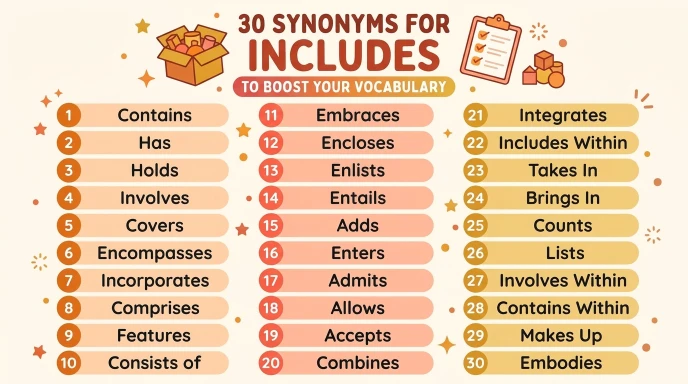
The word includes means that something contains, covers, or has something as part of a whole. Imagine a school bag that includes books, pencils, notebooks, and a water bottle. Each item is part of what the bag holds. We use “includes” in daily conversations, schoolwork, business writing, and online articles because it helps us explain what belongs to a group or list.
Learning synonyms for includes can help English learners build a stronger vocabulary. It also helps content writers avoid repeating the same word in every sentence. However, not all synonyms have the same meaning. For example, “contains” focuses on what is inside something, while “covers” often refers to topics or ideas.
In this guide, you will learn the meaning, pronunciation, history, grammar, and tone of “includes.” You will also explore 30 synonyms with simple definitions and examples, related words, antonyms, and tips for choosing the best word in different situations.
Meaning of Includes
Definition
Includes (verb): Includes is the third-person singular form of “include.” It means to have something as part of a whole, group, list, or activity.
Examples
- The school bag includes three notebooks and a pencil case.
- The price includes breakfast and free Wi-Fi.
Connotative Meaning
Connotation is the feeling or idea that a word suggests beyond its basic meaning.
- Positive tone: “Includes” can suggest value, care, or completeness. Example: The package includes free gifts.
- Negative tone: It may suggest an unwanted item or extra cost when used in a negative situation. Example: The plan includes several hidden fees.
- Neutral tone: It can simply state what is part of something. Example: The report includes five sections.
Etymology
- Origin: “Include” comes from the Latin word includere.
- Original meaning: To shut in, enclose, or confine.
- Word development: The word entered English through French and Latin influences.
- Modern meaning: Today, “include” usually means to make something part of a group, list, set, or whole.
Short History of the Keyword
- Old English (450–1100): The modern word “include” was not commonly used in Old English. People used other words to express ideas such as enclosing or holding something inside.
- Middle English (1100–1500): English vocabulary gained many words from French and Latin after the Norman Conquest. Latin-based words related to enclosing and containing became more familiar.
- Modern English (1500–Present): “Include” became common in writing and speech. Today, “includes” appears in education, business, science, websites, and everyday communication.
Pronunciation (US & UK – IPA)
- US: /ɪnˈkluːdz/
- UK: /ɪnˈkluːdz/
Syllables
in-cludes — 2 syllables.
Affixation Pattern of Includes
- Root/base word: include
- Prefix: None in the modern English word “include.”
- Suffix: -s, added to form the third-person singular present-tense verb “includes.”
Word Formation of Includes
The base word “include” can form several related words and grammatical forms:
- Include (verb): To make something part of a whole.
- Includes (verb): Present-tense form used with he, she, it, or a singular noun.
- Included (verb/adjective): Made part of a group or set.
- Including (verb/preposition): Showing that something is part of a group or list.
- Inclusion (noun): The act of making something part of a group.
- Inclusive (adjective): Covering a wide range or not leaving people out.
- Inclusively (adverb): In a way that includes people or things.
- Inclusiveness (noun): The quality of welcoming or covering different people or things.
- Exclusion (noun): The act of leaving something or someone out; an opposite-related word.
Synonyms of Includes
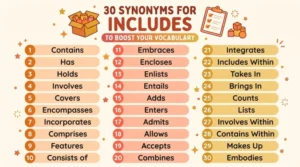
The following 30 words are useful alternatives to “includes.” Some work best for objects, while others suit lists, services, topics, or activities. Choose the word that matches your sentence.
1. Contains (Verb)
US IPA: /kənˈteɪnz/ | UK IPA: /kənˈteɪnz/
Meaning: Has something inside it or as one of its parts.
Examples:
- The bottle contains fresh water.
- This book contains useful tips for students.
2. Comprises (Verb)
US IPA: /kəmˈpraɪzɪz/ | UK IPA: /kəmˈpraɪzɪz/
Meaning: Consists of or is made up of several parts.
Examples:
- The team comprises ten skilled players.
- The course comprises six short lessons.
3. Encompasses (Verb)
US IPA: /ɪnˈkʌmpəsɪz/ | UK IPA: /ɪnˈkʌmpəsɪz/
Meaning: Covers a wide range of things or ideas.
Examples:
- The subject encompasses art and history.
- Her work encompasses many different skills.
4. Covers (Verb)
US IPA: /ˈkʌvərz/ | UK IPA: /ˈkʌvəz/
Meaning: Deals with or includes a topic, area, or range of things.
Examples:
- The lesson covers basic grammar.
- This guide covers several useful study methods.
5. Involves (Verb)
US IPA: /ɪnˈvɑlvz/ | UK IPA: /ɪnˈvɒlvz/
Meaning: Has something as a necessary part of an activity or process.
Examples:
- The job involves working with children.
- Learning a language involves regular practice.
6. Incorporates (Verb)
US IPA: /ɪnˈkɔrpəˌreɪts/ | UK IPA: /ɪnˈkɔːpəreɪts/
Meaning: Adds something to a larger whole.
Examples:
- The teacher incorporates games into each lesson.
- The design incorporates modern features.
7. Features (Verb)
US IPA: /ˈfiːtʃərz/ | UK IPA: /ˈfiːtʃəz/
Meaning: Presents or has something as an important or noticeable part.
Examples:
- The website features helpful name guides.
- The film features several famous actors.
8. Offers (Verb)
US IPA: /ˈɔfərz/ | UK IPA: /ˈɒfəz/
Meaning: Provides or makes something available.
Examples:
- The package offers free delivery.
- The course offers lessons for beginners.
9. Lists (Verb)
US IPA: /lɪsts/ | UK IPA: /lɪsts/
Meaning: Names items one by one.
Examples:
- The page lists popular baby names.
- The notice lists the exam dates.
10. Mentions (Verb)
US IPA: /ˈmɛnʃənz/ | UK IPA: /ˈmenʃənz/
Meaning: Refers to something briefly in speech or writing.
Examples:
- The report mentions three main problems.
- She mentions her favorite books in the article.
11. Presents (Verb)
US IPA: /prɪˈzɛnts/ | UK IPA: /prɪˈzents/
Meaning: Shows or puts forward information, ideas, or items.
Examples:
- The report presents new findings.
- The website presents several naming ideas.
12. Consists of (Verb phrase)
US IPA: /kənˈsɪsts əv/ | UK IPA: /kənˈsɪsts əv/
Meaning: Is made up of particular parts or items.
Examples:
- The meal consists of rice and vegetables.
- The course consists of four main units.
13. Embraces (Verb)
US IPA: /ɪmˈbreɪsɪz/ | UK IPA: /ɪmˈbreɪsɪz/
Meaning: Includes or accepts a wide range of ideas, people, or things.
Examples:
- The program embraces different learning styles.
- Her work embraces many creative ideas.
14. Entails (Verb)
US IPA: /ɪnˈteɪlz/ | UK IPA: /ɪnˈteɪlz/
Meaning: Involves something as a necessary part or result.
Examples:
- The role entails daily communication.
- The project entails careful planning.
15. Adds (Verb)
US IPA: /ædz/ | UK IPA: /ædz/
Meaning: Puts something extra into a group or whole.
Examples:
- The update adds new features to the app.
- The recipe adds fresh herbs to the sauce.
16. Holds (Verb)
US IPA: /hoʊldz/ | UK IPA: /həʊldz/
Meaning: Has something inside or has space for it.
Examples:
- The box holds several small toys.
- The hall holds up to two hundred people.
17. Carries (Verb)
US IPA: /ˈkæriz/ | UK IPA: /ˈkæriz/
Meaning: Contains, supports, or has something with it.
Examples:
- The store carries many book titles.
- This bag carries all my school supplies.
18. Houses (Verb)
US IPA: /ˈhaʊzɪz/ | UK IPA: /ˈhaʊzɪz/
Meaning: Provides space for or contains something.
Examples:
- The building houses a public library.
- The website houses a large collection of articles.
19. Accommodates (Verb)
US IPA: /əˈkɑməˌdeɪts/ | UK IPA: /əˈkɒmədeɪts/
Meaning: Has enough room for someone or something, or adjusts to their needs.
Examples:
- The room accommodates twenty guests.
- The plan accommodates different learning needs.
20. Takes in (Verb phrase)
US IPA: /teɪks ɪn/ | UK IPA: /teɪks ɪn/
Meaning: Includes or allows something within a larger space, group, or view.
Examples:
- The tour takes in several historic sites.
- The study takes in a wide range of examples.
21. Counts (Verb)
US IPA: /kaʊnts/ | UK IPA: /kaʊnts/
Meaning: Considers someone or something as part of a group.
Examples:
- The club counts many students among its members.
- The award counts as part of her achievements.
22. Brings in (Verb phrase)
US IPA: /brɪŋz ɪn/ | UK IPA: /brɪŋz ɪn/
Meaning: Introduces or adds someone or something to a group or process.
Examples:
- The project brings in new ideas.
- The teacher brings in extra activities for practice.
23. Integrates (Verb)
US IPA: /ˈɪntəˌɡreɪts/ | UK IPA: /ˈɪntɪɡreɪts/
Meaning: Combines something with a larger whole so it works as part of it.
Examples:
- The school integrates technology into its lessons.
- The design integrates nature with modern living.
24. Incorporates into (Verb phrase)
US IPA: /ɪnˈkɔrpəˌreɪts ˈɪntuː/ | UK IPA: /ɪnˈkɔːpəreɪts ˈɪntuː/
Meaning: Adds something as a part of a particular system or whole.
Examples:
- The writer incorporates examples into the guide.
- The chef incorporates local flavors into the dish.
25. Spans (Verb)
US IPA: /spænz/ | UK IPA: /spænz/
Meaning: Extends across a range, period, or area.
Examples:
- The book spans three centuries of history.
- The course spans several levels of English.
26. Subsumes (Verb)
US IPA: /səbˈsuːmz/ | UK IPA: /səbˈsjuːmz/
Meaning: Includes something within a larger category or idea.
Examples:
- The broad term subsumes several related concepts.
- This category subsumes many smaller groups.
27. Embodies (Verb)
US IPA: /ɪmˈbɑdiz/ | UK IPA: /ɪmˈbɒdiz/
Meaning: Represents or expresses an idea or quality in a clear way.
Examples:
- The design embodies simplicity and beauty.
- Her work embodies the values of the school.
28. Enlists (Verb)
US IPA: /ɪnˈlɪsts/ | UK IPA: /ɪnˈlɪsts/
Meaning: Gets people to join or take part in an activity.
Examples:
- The project enlists local volunteers.
- The teacher enlists students to help with the event.
29. Enrolls (Verb)
US IPA: /ɪnˈroʊlz/ | UK IPA: /ɪnˈrəʊlz/
Meaning: Registers or accepts someone into a course, school, or program.
Examples:
- The school enrolls new students each year.
- The program enrolls learners from many countries.
30. Has (Verb)
US IPA: /hæz/ | UK IPA: /hæz/
Meaning: Possesses or contains something as part of a whole.
Examples:
- The article has five useful sections.
- The package has a free gift inside.
Prototype Meaning
The most typical meaning of “includes” is to have something as part of a larger whole. When people hear this word, they often imagine a list of items, parts of a product, topics in a lesson, or services in a package.
For example, if a school kit includes books, pencils, and notebooks, all these items are part of the kit. The word is useful because it tells readers what belongs to something without giving a long explanation. Its exact meaning depends on the context, so writers should choose synonyms carefully.
Prototype Categorization
Synonyms for “includes” can be grouped by meaning. These categories help writers select the right word for each sentence.
- Containing something: contains, holds, houses, carries, has. These words often describe objects, spaces, or collections.
- Making up a whole: comprises, consists of, encompasses. These words explain the parts of a group or system.
- Covering topics or ideas: covers, encompasses, spans, subsumes. These are useful in articles, reports, and academic writing.
- Adding something: incorporates, integrates, adds, brings in. These words describe adding parts to an existing whole.
- Showing information: lists, mentions, presents, features. These words are useful for websites, guides, and reports.
- Involving an activity: involves, entails. These words explain what a task or process requires.
- Welcoming or making room: embraces, accommodates. These words can describe people, ideas, needs, or spaces.
- Representing a quality: embodies. This word describes something that expresses a particular idea or value.
- Accepting people into a group: enlists, enrolls. These words suit participation, recruitment, and education.
Categorization helps writers avoid using a synonym that sounds correct but changes the meaning. For example, “contains” works well for a bottle, while “covers” is usually better for a lesson or topic.
Antonyms of Includes
Antonyms express the opposite meaning of a word. The best opposite of “includes” depends on the sentence.
1. Excludes (Verb)
Meaning: Leaves someone or something out.
- The price excludes delivery charges.
- The list excludes old products.
2. Omits (Verb)
Meaning: Leaves something out, often by mistake or choice.
- The report omits an important detail.
- She omits the final step from the instructions.
3. Removes (Verb)
Meaning: Takes something away from a place or group.
- The editor removes repeated words.
- The update removes an old feature.
4. Rejects (Verb)
Meaning: Refuses to accept someone or something.
- The school rejects incomplete applications.
- The team rejects the proposed plan.
5. Leaves Out (Verb Phrase)
Meaning: Does not include a person or thing.
- The writer leaves out two examples.
- The invitation leaves out the meeting time.
6. Exempts (Verb)
Meaning: Frees someone or something from a rule, duty, or requirement.
- The policy exempts young children from the fee.
- The rule exempts certain groups from the test.
7. Excludes From (Verb Phrase)
Meaning: Prevents someone or something from being part of a group or activity.
- The rule excludes visitors from the restricted area.
- The club excludes non-members from the private event.
8. Lacks (Verb)
Meaning: Does not have something that is needed or expected.
- The article lacks clear examples.
- The plan lacks enough detail.
Formal and Casual Alternatives
The best synonym for “includes” depends on the audience, subject, and tone of your writing.
Formal Alternatives
Use these words in academic papers, professional reports, business documents, and formal articles.
- Comprises: The committee comprises twelve members.
- Encompasses: The research encompasses several important themes.
- Incorporates: The proposal incorporates recent findings.
- Entails: The position entails regular travel.
- Subsumes: The framework subsumes several related concepts.
- Integrates: The program integrates practical training with theory.
Casual Alternatives
These words sound natural in everyday speech and simple writing.
- Has: The bag has three pockets.
- Contains: The box contains some old photos.
- Covers: The video covers basic cooking tips.
- Offers: The app offers free lessons.
- Lists: The page lists popular names.
- Adds: The new version adds more options.
Example Sentence and Meaning Table
The table below shows how “includes” and its synonyms work in different contexts.
| Word | Example sentence | Meaning |
| Includes | The kit includes a notebook. | Has something as part of a set. |
| Contains | The bottle contains milk. | Has something inside. |
| Comprises | The team comprises ten players. | Is made up of parts or members. |
| Encompasses | The course encompasses several subjects. | Covers a wide range. |
| Covers | The lesson covers grammar. | Deals with a topic. |
| Involves | The job involves travel. | Requires an activity. |
| Incorporates | The plan incorporates new ideas. | Adds something to a whole. |
| Features | The website features name lists. | Shows something important. |
| Offers | The school offers free classes. | Makes something available. |
| Lists | The page lists ten names. | Names items one by one. |
| Mentions | The report mentions a problem. | Refers to something briefly. |
| Presents | The article presents new facts. | Shows information. |
| Consists of | The meal consists of rice and fish. | Is made up of parts. |
| Embraces | The policy embraces diversity. | Accepts a broad range. |
| Entails | The task entails careful work. | Involves something necessary. |
Related Words
Related words help you understand the grammar and wider meaning of “includes.”
- Include (verb): To make something part of a whole.
- Included (verb/adjective): Already made part of something.
- Including (verb/preposition): Used to show that something is part of a group.
- Inclusion (noun): The act of making someone or something part of a group.
- Inclusive (adjective): Covering a range of people or things.
- Inclusively (adverb): In a way that includes a wide range.
- Inclusiveness (noun): The quality of being open to different people or things.
- Exclusion (noun): The act of leaving someone or something out.
- Exclusive (adjective): Limited to certain people or things.
- Exclusively (adverb): Only, without including anything else.
Short Questions and Answers (FAQ)
– What does “includes” mean?
“Includes” means to have something as part of a larger whole, group, list, or activity.
– When should “includes” be used?
Use “includes” when explaining the items, features, topics, or activities that belong to something.
– Is “includes” positive or negative?
It is usually neutral. Its tone depends on the situation. It can describe helpful features or unwanted costs.
– What is a common synonym for “includes”?
“Contains” is a common synonym, especially when something has items inside it. “Covers” works better for topics.
– What is the difference between “includes” and “contains”?
“Includes” can describe items, services, features, or activities. “Contains” often focuses on what is inside something.
– What is the difference between “includes” and “comprises”?
“Includes” identifies parts that belong to a whole. “Comprises” usually describes the parts or members that make up the whole.
– Can “includes” be used in formal writing?
Yes. It is clear and suitable for formal, academic, business, and everyday writing.
– What is the opposite of “includes”?
“Excludes” is a common antonym. Other alternatives include “omits” and “leaves out.”
– How can I improve my vocabulary with synonyms for “includes”?
Learn a few words each day, study their meanings, and write your own example sentences.
– Why should writers learn synonyms for “includes”?
Synonyms help writers reduce repetition, express ideas more clearly, and choose words that suit each context.
Conclusion
Learning “includes” and its synonyms can improve your English vocabulary and help you communicate more clearly. Words such as “contains,” “comprises,” “covers,” and “incorporates” may have similar meanings, but each has a different use. Choosing the right word helps you write better sentences and express your ideas with greater accuracy.
These synonyms are useful for students, English learners, teachers, bloggers, and content writers. They can make articles more natural, reduce repetition, and improve both speaking and writing skills. Understanding pronunciation, grammar, tone, and word history can also help you use each word with confidence.
Make vocabulary practice part of your daily routine. Learn three new synonyms each day, read examples, and write your own sentences. With regular practice, you can build stronger English skills and express yourself more confidently.
Explore more about!
- Synonyms of Boring: Best Alternative Words to Know
- Synonyms of Anarchy: Best Alternative Words to Know
- Synonyms of Desolate: The Ultimate Visual Guide

I am an American writer and speaker who focuses on habits, productivity, and self-improvement.
I study how small daily habits can create big changes in life. I try to write in a very simple and practical way so anyone can apply my ideas.
My most popular book is Atomic Habits, which is read around the world.