The word constitution refers to a system of rules, principles, structure, or the physical makeup of a person or organization. Imagine a group of people creating rules for a new club. They write down the rights, duties, and procedures that everyone must follow. This set of rules works like a constitution.
The word is commonly used in government, law, politics, education, and even health-related discussions.
Learning synonyms of constitution helps English learners, students, and content writers improve vocabulary and avoid repeating the same word. Different synonyms can express ideas more accurately in different contexts.
In this article, you will learn the meaning of constitution, its pronunciation, history, grammar, connotative meaning, and useful synonyms. You will also explore related words, example sentences, and vocabulary categories to strengthen your English skills.
Meaning of Constitution
Definition
Constitution (Noun):
A set of fundamental rules, principles, laws, or structures that guide a government, organization, or system. It can also mean a person’s physical or mental makeup.
Examples
- The country’s constitution protects basic rights.
- She has a strong constitution and rarely gets sick.
Connotative Meaning
(Connotation: the emotional or cultural feeling associated with a word beyond its dictionary meaning.)
- Positive Tone: Stability, order, protection, structure, fairness.
- Negative Tone: May suggest rigidity, restrictions, or bureaucracy in some contexts.
- Neutral Tone: Refers to a system of rules, principles, or physical makeup.
Etymology
- Origin: Latin.
- Derived from the Latin word constitutio.
- Comes from constituere, meaning “to establish” or “to set up.”
- Original meaning: An arrangement, establishment, or organization.
Short History of the Keyword
Old English (450–1100)
- The exact word constitution was not commonly used.
- Similar ideas were expressed through words related to law and order.
Middle English (1100–1500)
- The word entered English through Old French and Latin influence.
- It referred to laws, decrees, and arrangements.
Modern English (1500–Present)
- The meaning expanded to include national governing documents, organizational structures, and physical health conditions.
Pronunciation (US & UK – IPA)
US: /ˌkɑːnstəˈtuːʃən/
UK: /ˌkɒnstɪˈtjuːʃən/
Syllables
con-sti-tu-tion
Affixation Pattern of Constitution
Root
- constitut (from Latin constituere)
Prefix
- None
Suffix
- -ion (noun-forming suffix)
Word Formation
- constitute (verb) – to form or establish
- constitution (noun) – system of rules or structure
- constitutional (adjective) – related to a constitution
- constitutionally (adverb) – according to a constitution
- constituent (noun/adjective) – a member or component
- reconstitute (verb) – to form again
Related Words
- law
- charter
- framework
- structure
- code
- regulation
- government
- policy
- statute
- principle
Formal and Casual Alternatives
| Formal | Casual |
|---|---|
| Charter | Rules |
| Framework | System |
| Statute | Law |
| Code | Guidelines |
| Structure | Setup |
Meaning Column
| Word | Meaning |
|---|---|
| Constitution | Fundamental rules or structure |
| Charter | Official document of rights or rules |
| Framework | Basic supporting structure |
| Code | System of rules |
| Statute | Written law |
Example Sentence Column
| Word | Example Sentence |
|---|---|
| Constitution | The constitution protects citizens’ rights. |
| Charter | The organization adopted a new charter. |
| Framework | The framework supports decision-making. |
| Code | Employees follow the company code. |
| Statute | The statute was approved by lawmakers. |
Synonyms of Constitution
1. Charter (Noun)
US: /ˈtʃɑːrtər/ | UK: /ˈtʃɑːtə/
Meaning: An official document that grants rights or establishes rules.
Examples:
- The city received a royal charter.
- The charter outlines the organization’s goals.
2. Framework (Noun)
US: /ˈfreɪmwɜːrk/ | UK: /ˈfreɪmwɜːk/
Meaning: A basic structure that supports a system or idea.
Examples:
- The framework guides the project.
- The law provides a framework for action.
3. Code (Noun)
US: /koʊd/ | UK: /kəʊd/
Meaning: A set of rules or standards.
Examples:
- The company follows a strict code.
- The code explains acceptable behavior.
4. Statute (Noun)
US: /ˈstætʃuːt/ | UK: /ˈstætjuːt/
Meaning: A written law passed by a government.
Examples:
- The statute protects workers.
- Parliament approved the statute.
5. Regulation (Noun)
US: /ˌreɡjəˈleɪʃən/ | UK: /ˌreɡjʊˈleɪʃən/
Meaning: An official rule controlling behavior or activity.
Examples:
- New regulations improved safety.
- The regulation applies to all businesses.
6. Law (Noun)
US: /lɔː/ | UK: /lɔː/
Meaning: A rule established by authority.
Examples:
- Everyone must obey the law.
- The law protects public safety.
7. Policy (Noun)
US: /ˈpɑːləsi/ | UK: /ˈpɒləsi/
Meaning: A plan or rule adopted by an organization or government.
Examples:
- The school introduced a new policy.
- Company policy encourages teamwork.
8. Ordinance (Noun)
US: /ˈɔːrdɪnəns/ | UK: /ˈɔːdɪnəns/
Meaning: A local law or regulation.
Examples:
- The city passed a noise ordinance.
- The ordinance limits construction hours.
9. Rulebook (Noun)
US: /ˈruːlbʊk/ | UK: /ˈruːlbʊk/
Meaning: A book containing rules and procedures.
Examples:
- Players followed the rulebook carefully.
- The rulebook explains competition rules.
10. Guideline (Noun)
US: /ˈɡaɪdlaɪn/ | UK: /ˈɡaɪdlaɪn/
Meaning: A recommendation that helps guide actions.
Examples:
- Follow the guideline when writing reports.
- The guideline promotes safety.
11. Principle (Noun)
US: /ˈprɪnsəpəl/ | UK: /ˈprɪnsəpəl/
Meaning: A fundamental rule, belief, or truth.
Examples:
- Honesty is an important principle.
- The organization follows clear principles.
12. Structure (Noun)
US: /ˈstrʌktʃər/ | UK: /ˈstrʌktʃə/
Meaning: The arrangement or organization of parts.
Examples:
- The structure of the company is simple.
- A strong structure supports success.
13. System (Noun)
US: /ˈsɪstəm/ | UK: /ˈsɪstəm/
Meaning: A group of connected parts working together.
Examples:
- The education system serves millions.
- The system helps manage information.
14. Foundation (Noun)
US: /faʊnˈdeɪʃən/ | UK: /faʊnˈdeɪʃən/
Meaning: The base or support of something.
Examples:
- Trust is the foundation of friendship.
- The constitution is the foundation of government.
15. Agreement (Noun)
US: /əˈɡriːmənt/ | UK: /əˈɡriːmənt/
Meaning: A shared understanding or arrangement.
Examples:
- The countries signed an agreement.
- The agreement resolved the dispute.
16. Covenant (Noun)
US: /ˈkʌvənənt/ | UK: /ˈkʌvənənt/
Meaning: A formal promise or agreement.
Examples:
- The covenant outlined responsibilities.
- Members respected the covenant.
17. Doctrine (Noun)
US: /ˈdɑːktrɪn/ | UK: /ˈdɒktrɪn/
Meaning: A set of beliefs or principles.
Example
18. Protocol (Noun)
US: /ˈproʊtəkɔːl/ | UK: /ˈprəʊtəkɒl/
Meaning: A system of official procedures or rules.
Examples:
- Staff followed safety protocols.
- The protocol ensures consistency.
19. Standard (Noun)
US: /ˈstændərd/ | UK: /ˈstændəd/
Meaning: A level or rule used as a guide.
Examples:
- The standard applies to all employees.
- High standards improve quality.
20. Framework Agreement (Noun)
US: /ˈfreɪmwɜːrk əˈɡriːmənt/ | UK: /ˈfreɪmwɜːk əˈɡriːmənt/
Meaning: A broad agreement that sets general rules.
Examples:
- The parties signed a framework agreement.
- The framework agreement guided future decisions.
21. Bylaw (Noun)
US: /ˈbaɪlɔː/ | UK: /ˈbaɪlɔː/
Meaning: A rule made by an organization or local authority.
Examples:
- The club adopted a new bylaw.
- Members must follow every bylaw.
22. Act (Noun)
US: /ækt/ | UK: /ækt/
Meaning: A law passed by a legislative body.
Examples:
- The Act improved public services.
- Parliament approved the new Act.
23. Canon (Noun)
US: /ˈkænən/ | UK: /ˈkænən/
Meaning: An accepted rule, principle, or standard.
Examples:
- The canon influenced legal thought.
- Scholars discussed the canon.
24. Mandate (Noun)
US: /ˈmænˌdeɪt/ | UK: /ˈmænˌdeɪt/
Meaning: An official order or authority to act.
Examples:
- The agency received a clear mandate.
- The mandate defined its responsibilities.
25. Blueprint (Noun)
US: /ˈbluːprɪnt/ | UK: /ˈbluːprɪnt/
Meaning: A detailed plan or framework.
Examples:
- The constitution serves as a blueprint for governance.
- The blueprint guided future development.
26. Articles (Noun)
US: /ˈɑːrtɪkəlz/ | UK: /ˈɑːtɪkəlz/
Meaning: Written sections of a legal or governing document.
Examples:
- The articles define members’ rights.
- Lawyers reviewed the articles carefully.
27. Establishment (Noun)
US: /ɪˈstæblɪʃmənt/ | UK: /ɪˈstæblɪʃmənt/
Meaning: The act of creating or organizing something.
Examples:
- The establishment of rules improved order.
- The establishment of the institution took years.
28. Organization (Noun)
US: /ˌɔːrɡənəˈzeɪʃən/ | UK: /ˌɔːɡənaɪˈzeɪʃən/
Meaning: A structured arrangement of people or parts.
Examples:
- Good organization increases efficiency.
- The organization follows clear procedures.
29. Composition (Noun)
US: /ˌkɑːmpəˈzɪʃən/ | UK: /ˌkɒmpəˈzɪʃən/
Meaning: The arrangement or makeup of something.
Examples:
- Scientists studied the composition of the material.
- The constitution describes the composition of government bodies.
30. Makeup (Noun)
US: /ˈmeɪkʌp/ | UK: /ˈmeɪkʌp/
Meaning: The structure or combination of parts.
Examples:
- The team’s makeup changed this year.
- Her physical makeup is very strong.
Prototype Meaning
The most common meaning of constitution is a set of fundamental rules and principles that organize and govern a country, institution, or system.
When people hear the word constitution, they often think of an important legal document that protects rights, defines powers, and establishes order within a society.
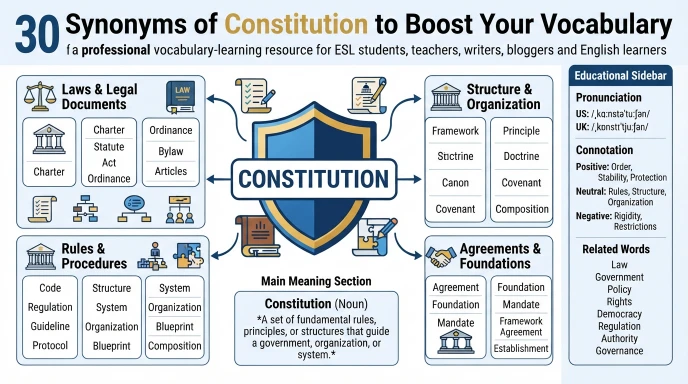
Prototype Categorization
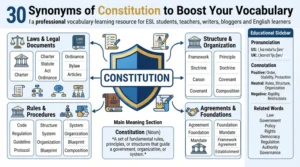
- Laws & Legal Documents
- Charter
- Statute
- Act
- Ordinance
- Bylaw
- Rules & Procedures
- Code
- Regulation
- Guideline
- Protocol
- Standard
- Structures & Systems
- Framework
- Structure
- System
- Organization
- Blueprint
- Principles & Beliefs
- Principle
- Doctrine
- Canon
- Covenant
- Agreements & Foundations
- Agreement
- Foundation
- Framework Agreement
- Mandate
Categorization helps writers choose the most suitable synonym. For example, statute fits legal contexts, while framework works better for business, education, or planning discussions.
Antonyms of Constitution
- Disorder (Noun) – Lack of organization or control.
- Chaos (Noun) – Complete confusion and absence of order.
- Anarchy (Noun) – Absence of governing authority or rules.
- Confusion (Noun) – Lack of clarity or structure.
- Disorganization (Noun) – Poor arrangement or management.
- Lawlessness (Noun) – Lack of laws or legal control.
- Instability (Noun) – Lack of stability or order.
- Breakdown (Noun) – Failure of a system or structure.
Short Questions and Answers
- What does constitution mean?
A constitution is a set of fundamental rules, principles, or structures that guide a government, organization, or system. - When should constitution be used?
Use it when discussing laws, governance, organizational structures, principles, or a person’s physical makeup. - Is constitution positive or negative?
It is generally positive because it suggests order, stability, and structure, but context can affect its tone. - How is it different from similar words?
A constitution is broader than a law. It provides the basic framework, while laws are specific rules created under that framework.
Conclusion
The word constitution is an important term in English that refers to rules, principles, structures, and systems that create order and stability. Learning its synonyms such as charter, framework, code, statute, and protocol helps improve vocabulary and makes writing more precise.
Using different words prevents repetition and allows writers to express ideas clearly in legal, academic, business, and everyday contexts.
Understanding pronunciation, history, connotation, and semantic categories also strengthens communication skills. Regular vocabulary practice helps learners become more confident readers, writers, and speakers.
Try using these synonyms in daily writing and conversations to build a stronger and more versatile English vocabulary.
Read more about!
- Synonyms for Valuable: Powerful Words to Use Instead
- 30 Synonyms for ‘Impactful’ to Boost Your Vocabulary
- Synonyms for Major: Alternative Words & Meanings

I am a linguist with 17 years of experience in English language teaching, including postgraduate-level instruction. My expertise includes English grammar, and I contribute as a content and blog writer, producing scholarly and educational language resources.