Adaptability means the ability to adjust to new situations, changes, or challenges. Imagine you are a student who moves to a new school. You meet new teachers, make new friends, and learn different rules. At first, things may feel difficult, but you slowly adjust. This ability is called adaptability. The word is common in education, business, personal growth, and daily life because change is a normal part of life.
Learning synonyms of adaptability helps English learners express ideas in different ways. It also helps students and content writers avoid repeating the same words. Terms such as flexibility, versatility, and adjustability have related meanings, but they are not always interchangeable.
In this guide, you will explore the meaning, pronunciation, grammar, history, and tone of adaptability. You will also learn 30 related words, see simple examples, and discover how to choose the best word for each situation.
Meaning of Adaptability
Definition
Adaptability (noun): The ability to adjust to new conditions, changes, or challenges.
Examples
- Her adaptability helped her succeed in a new school.
- Adaptability is an important skill in a changing workplace.
Connotative Meaning
(Connotation is the feeling or idea that a word suggests beyond its basic meaning.)
- Positive tone: Adaptability suggests openness, resilience, resourcefulness, and the ability to grow through change.
- Negative tone: In some contexts, too much adaptability may suggest changing too easily to please others or lacking firm principles.
- Neutral tone: The word can simply describe the ability of a person, system, or organism to adjust to different conditions.
Etymology
- Origin: Adaptability comes from adaptable, which is formed from adapt and the suffix -able, followed by -ity.
- Latin source: Adapt comes through French from Latin adaptare, meaning “to fit” or “to adjust.”
- Root meaning: The Latin word combines ad- (“to” or “toward”) with aptare (“to fit” or “make suitable”).
- Modern meaning: Adaptability refers to the quality or ability of adjusting to new needs and conditions.
Short History of Adaptability
- Old English (450–1100): The modern word adaptability was not established in English during this period. English speakers used other words to describe fitting, changing, and making things suitable.
- Middle English (1100–1500): Words related to adapt entered English through French and Latin influence. They expressed the idea of making something suitable for a purpose.
- Modern English (1500–Present): Adapt and its related forms became more widely used. Adaptability is now common in discussions of education, work, technology, biology, and personal development.
Pronunciation (US & UK – IPA)
- US: /əˌdæp.təˈbɪl.ə.t̬i/
- UK: /əˌdæp.təˈbɪl.ə.ti/
Syllables
a-dapt-a-bil-i-ty — 6 syllables.
Affixation Pattern of Adaptability
- Root: apt, from Latin aptus, meaning “fit” or “suitable.”
- Prefix: ad-, meaning “to” or “toward” in the original Latin formation.
- Suffixes: -able, meaning “capable of”; and -ity, meaning “the state or quality of.”
- Base word: adapt (verb).
Word Formation
- Adapt (verb): To adjust to new conditions.
- Adapts (verb): Adjusts to new conditions.
- Adapted (verb/adjective): Changed to suit a purpose or situation.
- Adapting (verb): Changing to suit new conditions.
- Adaptable (adjective): Able to adjust to change.
- Adaptability (noun): The ability to adjust.
- Adaptation (noun): A change made to suit a new situation.
- Adaptive (adjective): Able to change in response to conditions.
- Adaptively (adverb): In a way that allows adjustment.
- Readapt (verb): To adapt again after a change.
- Readaptation (noun): The process of adapting again.
- Maladaptation (noun): An adjustment that does not work well in a particular environment.
Synonyms of Adaptability
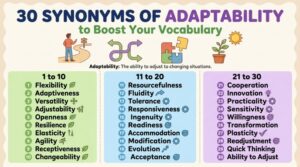
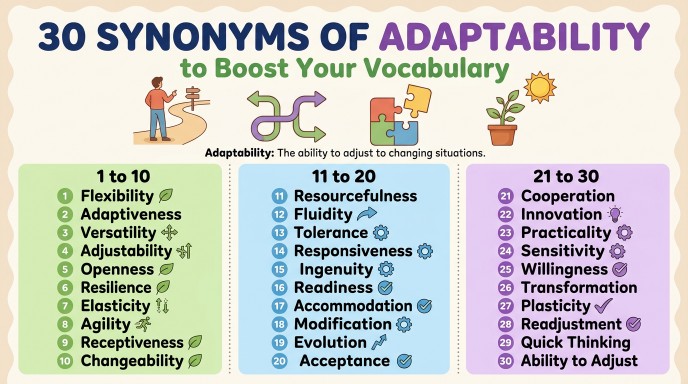
These 30 synonyms and related expressions describe the ability to adjust, respond to change, or work well in different situations. Some are close synonyms, while others describe specific aspects of adaptability.
1. Flexibility (Noun)
US IPA: /ˌflek.səˈbɪl.ə.t̬i/ | UK IPA: /ˌflek.səˈbɪl.ə.ti/
Meaning: The ability to change or adjust easily when needed.
Examples:
- Flexibility helps workers handle new tasks.
- Her flexibility made the group project easier.
2. Versatility (Noun)
US IPA: /ˌvɝː.səˈtɪl.ə.t̬i/ | UK IPA: /ˌvɜː.səˈtɪl.ə.ti/
Meaning: The ability to do many different things or work in different roles.
Examples:
- His versatility makes him a valuable team member.
- The tool is known for its versatility.
3. Adjustability (Noun)
US IPA: /əˌdʒʌs.təˈbɪl.ə.t̬i/ | UK IPA: /əˌdʒʌs.təˈbɪl.ə.ti/
Meaning: The ability to be changed to suit different needs.
Examples:
- The chair’s adjustability improves comfort.
- Adjustability is useful in changing work settings.
4. Resilience (Noun)
US IPA: /rɪˈzɪl.jəns/ | UK IPA: /rɪˈzɪl.i.əns/
Meaning: The ability to recover and keep going after difficulties.
Examples:
- Her resilience helped her overcome failure.
- Resilience is important during hard times.
5. Elasticity (Noun)
US IPA: /ˌiː.læsˈtɪs.ə.t̬i/ | UK IPA: /ˌiː.læsˈtɪs.ə.ti/
Meaning: The ability to stretch, change, or respond to pressure and return to a previous state.
Examples:
- The elasticity of the material makes it useful.
- Economic elasticity can affect market behavior.
6. Adaptiveness (Noun)
US IPA: /əˈdæp.tɪv.nəs/ | UK IPA: /əˈdæp.tɪv.nəs/
Meaning: The quality of responding effectively to changing conditions.
Examples:
- The team’s adaptiveness helped it meet new demands.
- Adaptiveness is valuable in a changing environment.
7. Agility (Noun)
US IPA: /əˈdʒɪl.ə.t̬i/ | UK IPA: /əˈdʒɪl.ə.ti/
Meaning: The ability to move or respond quickly and easily.
Examples:
- The company’s agility helped it respond to new trends.
- Mental agility can help students solve problems.
8. Resourcefulness (Noun)
US IPA: /rɪˈsɔːrs.fəl.nəs/ | UK IPA: /rɪˈzɔːs.fəl.nəs/
Meaning: The ability to find clever ways to deal with challenges.
Examples:
- Her resourcefulness helped solve the problem.
- Resourcefulness is useful when resources are limited.
9. Open-mindedness (Noun)
US IPA: /ˌoʊ.pənˈmaɪn.dɪd.nəs/ | UK IPA: /ˌəʊ.pənˈmaɪn.dɪd.nəs/
Meaning: A willingness to consider new ideas and different views.
Examples:
- Open-mindedness helped him accept new teaching methods.
- Good teamwork often requires open-mindedness.
10. Malleability (Noun)
US IPA: /ˌmæl.i.əˈbɪl.ə.t̬i/ | UK IPA: /ˌmæl.i.əˈbɪl.ə.ti/
Meaning: The ability to be shaped or changed without breaking; figuratively, the ability to change.
Examples:
- The metal’s malleability makes it easy to shape.
- The plan’s malleability allowed useful changes.
11. Plasticity (Noun)
US IPA: /plæsˈtɪs.ə.t̬i/ | UK IPA: /plæsˈtɪs.ə.ti/
Meaning: The ability to change form or structure in response to conditions.
Examples:
- Brain plasticity helps people learn new skills.
- The material’s plasticity makes it easy to shape.
12. Modifiability (Noun)
US IPA: /ˌmɑː.dɪ.faɪ.əˈbɪl.ə.t̬i/ | UK IPA: /ˌmɒd.ɪ.faɪ.əˈbɪl.ə.ti/
Meaning: The ability to be changed or improved.
Examples:
- The software’s modifiability makes updates easier.
- Modifiability is useful when needs change.
13. Changeability (Noun)
US IPA: /ˌtʃeɪn.dʒəˈbɪl.ə.t̬i/ | UK IPA: /ˌtʃeɪn.dʒəˈbɪl.ə.ti/
Meaning: The quality of being able to change.
Examples:
- The changeability of the weather makes planning hard.
- Changeability can be useful in a changing market.
14. Versedness (Noun)
US IPA: /ˈvɝːst.nəs/ | UK IPA: /ˈvɜːst.nəs/
Meaning: Knowledge or skill in a particular subject or activity.
Examples:
- Her technical versedness helped the team solve problems.
- His versedness in several subjects was impressive.
Usage note: Versedness is uncommon and is not a direct synonym for adaptability. In most writing, use versatility, experience, or expertise where appropriate.
15. Responsiveness (Noun)
US IPA: /rɪˈspɑːn.sɪv.nəs/ | UK IPA: /rɪˈspɒn.sɪv.nəs/
Meaning: The ability to react quickly and appropriately to changes or needs.
Examples:
- The team’s responsiveness improved customer service.
- Responsiveness matters when plans change quickly.
16. Receptiveness (Noun)
US IPA: /rɪˈsep.tɪv.nəs/ | UK IPA: /rɪˈsep.tɪv.nəs/
Meaning: The willingness to accept new ideas or suggestions.
Examples:
- Her receptiveness to feedback helped her improve.
- Receptiveness makes communication more effective.
17. Accommodating Nature (Noun Phrase)
US IPA: /əˈkɑː.məˌdeɪ.tɪŋ ˈneɪ.tʃɚ/ | UK IPA: /əˈkɒm.əˌdeɪ.tɪŋ ˈneɪ.tʃə/
Meaning: A willingness to adjust plans or behavior to meet others’ needs.
Examples:
- His accommodating nature helped the new employee feel welcome.
- An accommodating nature can make group work easier.
18. Open-mindedness (Noun)
US IPA: /ˌoʊ.pənˈmaɪn.dɪd.nəs/ | UK IPA: /ˌəʊ.pənˈmaɪn.dɪd.nəs/
Meaning: The habit of considering different opinions before making a judgment.
Examples:
- Open-mindedness helped the team explore new solutions.
- Teachers can encourage open-mindedness through discussion.
19. Tolerance (Noun)
US IPA: /ˈtɑː.lɚ.əns/ | UK IPA: /ˈtɒl.ər.əns/
Meaning: The ability or willingness to accept differences or difficult conditions.
Examples:
- Tolerance helps people work with different viewpoints.
- The plant has a high tolerance for heat.
20. Amenability (Noun)
US IPA: /əˌmiː.nəˈbɪl.ə.t̬i/ | UK IPA: /əˌmiː.nəˈbɪl.ə.ti/
Meaning: The willingness to accept suggestions or be guided by others.
Examples:
- Her amenability to feedback helped improve the plan.
- The manager showed amenability to reasonable changes.
21. Transformability (Noun)
US IPA: /trænsˌfɔːr.məˈbɪl.ə.t̬i/ | UK IPA: /trænsˌfɔː.məˈbɪl.ə.ti/
Meaning: The ability to change into a different form or state.
Examples:
- The design’s transformability makes it useful in small spaces.
- Transformability allows the system to meet new needs.
22. Mutability (Noun)
US IPA: /ˌmjuː.təˈbɪl.ə.t̬i/ | UK IPA: /ˌmjuː.təˈbɪl.ə.ti/
Meaning: The quality of being able to change.
Examples:
- The mutability of fashion makes trends hard to predict.
- The story explores the mutability of human feelings.
23. Plasticity of Mind (Noun Phrase)
US IPA: /plæsˈtɪs.ə.t̬i əv maɪnd/ | UK IPA: /plæsˈtɪs.ə.ti əv maɪnd/
Meaning: The ability to change one’s thinking in response to new ideas or experiences.
Examples:
- Plasticity of mind helps learners consider new views.
- The course encouraged plasticity of mind through debate.
24. Adaptation (Noun)
US IPA: /ˌæd.æpˈteɪ.ʃən/ | UK IPA: /ˌæd.æpˈteɪ.ʃən/
Meaning: A change that helps someone or something fit new conditions.
Examples:
- Adaptation helped the animals survive the cold.
- Moving abroad required adaptation to a new culture.
25. Coping Ability (Noun Phrase)
US IPA: /ˈkoʊ.pɪŋ əˌbɪl.ə.t̬i/ | UK IPA: /ˈkəʊ.pɪŋ əˌbɪl.ə.ti/
Meaning: The ability to manage stress, problems, or difficult situations.
Examples:
- Strong coping ability helped her handle exam pressure.
- Coping ability can improve with practice and support.
26. Resiliency (Noun)
US IPA: /rɪˈzɪl.jən.si/ | UK IPA: /rɪˈzɪl.i.ən.si/
Meaning: The ability to recover after difficulty or change.
Examples:
- The community showed resiliency after the storm.
- Resiliency helped him return to training after a setback.
27. Dynamicity (Noun)
US IPA: /ˌdaɪ.nəˈmɪs.ə.t̬i/ | UK IPA: /ˌdaɪ.nəˈmɪs.ə.ti/
Meaning: The quality of being active, changing, or developing over time.
Examples:
- The dynamicity of the market creates new challenges.
- The report explores the dynamicity of social change.
Usage note: Dynamicity is a specialized and uncommon word. Dynamism or capacity for change may sound more natural in general writing.
28. Interchangeability (Noun)
US IPA: /ˌɪn.t̬ɚˌtʃeɪn.dʒəˈbɪl.ə.t̬i/ | UK IPA: /ˌɪn.təˌtʃeɪn.dʒəˈbɪl.ə.ti/
Meaning: The ability of parts or things to be exchanged and used in each other’s place.
Examples:
- The interchangeability of the parts makes repairs easier.
- Interchangeability gives the system more options.
Usage note: This word applies to replaceable parts or alternatives, not adaptability in every context.
29. Evolution (Noun)
US IPA: /ˌev.əˈluː.ʃən/ | UK IPA: /ˌiː.vəˈluː.ʃən/
Meaning: A gradual process of change or development over time.
Examples:
- The evolution of the business reflects changing needs.
- Language evolution shows how communication changes over time.
30. Flexibility of Thought (Noun Phrase)
US IPA: /ˌflek.səˈbɪl.ə.t̬i əv θɔːt/ | UK IPA: /ˌflek.səˈbɪl.ə.ti əv θɔːt/
Meaning: The ability to change ideas or consider different ways to solve a problem.
Examples:
- Flexibility of thought helped her find a new solution.
- Flexibility of thought is useful when old methods fail.
Prototype Meaning
The most typical meaning of adaptability is the ability to adjust to new situations without losing the ability to work well. When people hear this word, they may imagine a student learning a new subject, a worker using new technology, or a family settling into a different home.
Adaptability includes being open to change, learning new skills, and finding ways to solve problems. It is useful in education, work, relationships, and everyday life. Although flexibility and resilience are closely related, adaptability focuses on adjusting to new conditions.
Prototype Categorization
The synonyms and related expressions can be grouped into several categories.
- Flexibility and adjustment: Flexibility, adjustability, changeability, and modifiability describe the ability to change to meet new needs.
- Strength during challenges: Resilience, resiliency, and coping ability describe the ability to recover and manage difficulties.
- Quick responses: Agility and responsiveness describe the ability to react quickly to new conditions.
- Learning and new ideas: Open-mindedness, receptiveness, and plasticity of mind describe a willingness to consider different ideas and ways of thinking.
- Versatility and usefulness: Versatility and resourcefulness describe the ability to handle different tasks or find solutions.
- Acceptance and cooperation: Tolerance, amenability, and an accommodating nature describe the ability or willingness to work with different people, ideas, or needs.
- Structural change: Elasticity, malleability, plasticity, transformability, and interchangeability describe different ways that materials, systems, or parts can change.
- Long-term development: Adaptation, evolution, and mutability describe processes or qualities related to change over time.
Categorization helps writers select words that match their exact meaning. For example, resilience is useful when discussing recovery after a setback, while versatility suits someone who can perform many tasks. Open-mindedness is better when describing a willingness to consider new ideas. Choosing precise words makes your writing clearer and more natural.
Antonyms of Adaptability
There is no single perfect antonym for adaptability in every context. The following words describe an inability or unwillingness to adjust.
- Rigidity (noun): The quality of being unwilling or unable to change. Example: Rigidity made it difficult for the team to accept new methods.
- Inflexibility (noun): The inability or unwillingness to adjust. Example: Inflexibility can create problems in a changing workplace.
- Inadaptability (noun): The inability to adjust to new conditions. Example: Inadaptability can make sudden changes harder to manage.
- Resistance (noun): Opposition to a change or new idea. Example: Resistance to change slowed the project.
- Stubbornness (noun): The refusal to change one’s opinion or behavior. Example: His stubbornness prevented him from trying a better method.
- Fixedness (noun): The quality of remaining unchanged. Example: The fixedness of the old rules limited progress.
- Inflexible (adjective): Unwilling or unable to change. Example: The inflexible plan could not meet the team’s new needs.
- Rigid (adjective): Strict and difficult to change. Example: The rigid system did not allow new ideas.
Short Questions and Answers
– What does adaptability mean?
Adaptability means the ability to adjust to new situations, conditions, or challenges.
– When should adaptability be used?
Use adaptability when discussing how people, organizations, animals, or systems respond to change. For example, “Adaptability is important when learning new skills.”
– Is adaptability positive or negative?
Adaptability is usually positive because it suggests flexibility and the ability to handle change. However, adjusting too much to please others can sometimes have negative effects.
– How is adaptability different from similar words?
Flexibility focuses on the ability to change. Versatility means being able to handle different tasks. Resilience focuses on recovering from difficulties, while adaptability focuses on adjusting to new conditions.
– What is the most common synonym for adaptability?
Flexibility is one of the closest and most common alternatives. However, adjustability may fit technical contexts, while versatility suits people with many skills.
– Why is adaptability important?
Adaptability helps people learn new skills, solve problems, handle change, and work with others in unfamiliar situations.
– What is the adjective form of adaptability?
The adjective is adaptable. For example, “She is adaptable and learns new tasks quickly.”
– What is the difference between adaptability and resilience?
Adaptability means adjusting to new conditions. Resilience means recovering after difficulties. Both skills can help people manage change.
Conclusion
Learning adaptability and its synonyms can improve your English vocabulary and help you express ideas more clearly. Words such as flexibility, versatility, resilience, and agility describe different ways people and systems respond to change. Understanding these differences helps you avoid repetition in essays, articles, schoolwork, and daily conversations.
Learning the pronunciation, grammar, word history, and tone of these terms also helps you use them correctly. For example, flexibility suits a discussion about changing plans, while resilience fits a story about overcoming difficulties. The right word makes your writing more precise and natural.
Practice a few new words each day. Write simple sentences, read English articles, and use new vocabulary in conversations. With regular practice, you can strengthen your speaking and writing skills, express your ideas with confidence, and become a more effective English learner.
Explore more about!
- Synonyms for “Availability”: Powerful Words to Expand
- Synonyms of Abhor: Best Alternative Words to Know
- Another Word for Flawless: Perfect, Impeccable & More

I am an American author, and I write books about power, strategy, and human behavior. My writing style is simple but deep, and I try to explain how people think and act in real-life situations.
I studied classical studies, and before becoming a writer, I worked in different fields which helped me understand people and life better.
My most famous books include The 48 Laws of Power, The Art of Seduction, and Mastery. These books are widely read by business people, leaders, and students around the world.