Greetings are an important part of daily life. Learning synonyms for greetings helps English learners speak with confidence and choose the right words for different situations.
However, some greetings are formal, while others are casual or friendly. In this guide, you will learn the meaning, pronunciation, history, grammar, and tone of greetings. You will also discover 30 alternatives, with simple meanings and examples, to improve your vocabulary and communication skills.
Connotative Meaning
Connotation is the feeling or idea that a word suggests beyond its basic meaning.
- Positive tone: Greetings can show kindness, respect, warmth, and welcome. Example: The host offered warm greetings to every guest.
- Negative tone: In some situations, greetings may feel cold, forced, or unfriendly. Example: He gave a stiff greeting and walked away.
- Neutral tone: Greetings can simply mark the start of a conversation. Example: The meeting began with brief greetings.
Etymology
- Source language: “Greet” comes from Old English grētan, a verb associated with approaching, addressing, or meeting someone.
Short History of the Keyword
- Old English (450–1100): The Old English verb grētan was used for approaching or addressing someone.
- Middle English (1100–1500): The word developed through Middle English forms. Meeting and addressing people remained central to its meaning.
- Today, it appears in daily speech, formal letters, emails, cards, and digital messages.
Pronunciation (US & UK – IPA)
- US: /ˈɡriːtɪŋz/
- UK: /ˈɡriːtɪŋz/
Syllables
greet-ings : 2 syllables.
Affixation Pattern of Greetings
- Root/base word: greet
- Prefix: None.
- Suffix: -ing forms “greeting”; -s marks the plural noun “greetings.”
- Word structure: greet + ing + s.
Word Formation of Greetings
These related forms show how the word family works in English:
- Greet (verb): To welcome or address someone.
- Greets (verb): The present-tense form used with he, she, or it.
- Greeted (verb): The past-tense form of greet.
- Greetings (plural noun): Expressions of welcome or acknowledgment.
- Greeting (verb form): The act of welcoming or addressing someone.
- Greeting card (compound noun): A card sent to share a message for a special occasion.
- Greeter (noun): A person who welcomes visitors or customers.
- Ungreeted (adjective): Not greeted or welcomed; an uncommon form.
Synonyms of Greetings
These 30 synonyms and related expressions can help you choose the right greeting for formal, casual, friendly, and special situations.
1. Salutations (Noun)
US IPA: /ˌsæl.jəˈteɪ.ʃənz/ | UK IPA: /ˌsæl.jʊˈteɪ.ʃənz/
Meaning: Words or phrases used to greet someone or begin a message.
Examples:
- The letter opened with formal salutations.
- The speaker offered salutations to the guests.
2. Hellos (Noun)
US IPA: /həˈloʊz/ | UK IPA: /həˈləʊz/
Meaning: Expressions used to say hello to people.
Examples:
- We exchanged hellos outside the school.
- Her cheerful hellos made everyone smile.
3. Welcomes (Noun)
US IPA: /ˈwel.kəmz/ | UK IPA: /ˈwel.kəmz/
Meaning: Expressions or actions that make someone feel accepted or invited.
Examples:
- The visitors received warm welcomes.
- The team gave new members friendly welcomes.
4. Hails (Noun)
US IPA: /heɪlz/ | UK IPA: /heɪlz/
Meaning: Calls or expressions used to attract attention or greet someone.
Examples:
- The sailors exchanged hails from their boats.
- The old story describes friendly hails between travelers.
5. Acknowledgments (Noun)
US IPA: /əkˈnɑː.lɪdʒ.mənts/ | UK IPA: /əkˈnɒl.ɪdʒ.mənts/
Meaning: Words or actions that show you have noticed or recognized someone.
Examples:
- The guests exchanged brief acknowledgments.
- A nod served as an acknowledgment in the quiet room.
6. Regards (Noun)
US IPA: /rɪˈɡɑːrdz/ | UK IPA: /rɪˈɡɑːdz/
Meaning: Expressions of respect, care, or goodwill, often used in messages.
Examples:
- Please send my regards to your family.
- The email ended with kind regards.
7. Salutes (Noun)
US IPA: /səˈluːts/ | UK IPA: /səˈluːts/
Meaning: Formal signs or expressions of respect or greeting.
Examples:
- The officers exchanged salutes.
- The ceremony began with respectful salutes.
8. Greetings of Welcome (Noun Phrase)
US IPA: /ˈɡriː.tɪŋz əv ˈwel.kəm/ | UK IPA: /ˈɡriː.tɪŋz əv ˈwel.kəm/
Meaning: Words used to welcome a person or group.
Examples:
- The principal gave greetings of welcome to the new students.
- The host prepared greetings of welcome for the guests.
9. Good Mornings (Noun)
US IPA: /ˌɡʊd ˈmɔːr.nɪŋz/ | UK IPA: /ˌɡʊd ˈmɔː.nɪŋz/
Meaning: Expressions used to greet someone in the morning.
Examples:
- Our good mornings became a daily habit.
- The neighbors exchanged cheerful good mornings.
10. Good Afternoons (Noun Phrase)
US IPA: /ˌɡʊd ˌæf.tərˈnuːnz/ | UK IPA: /ˌɡʊd ˌɑːf.təˈnuːnz/
Meaning: Polite expressions used to greet someone in the afternoon.
Examples:
- She offered polite good afternoons to the visitors.
- Their good afternoons marked the start of the meeting.
11. Good Evenings (Noun Phrase)
US IPA: /ˌɡʊd ˈiːv.nɪŋz/ | UK IPA: /ˌɡʊd ˈiːv.nɪŋz/
Meaning: Polite expressions used to greet someone in the evening.
Examples:
- The host greeted each guest with good evenings.
12. His (Interjection)
US IPA: /hɪz/ | UK IPA: /hɪz/
Meaning: An uncommon or playful written expression sometimes used to represent a greeting; not a standard synonym for “greetings.”
Examples:
- The character used a playful greeting in the comic.
- The writer chose a made-up expression for the fantasy scene.
13. Hi (Interjection)
US IPA: /haɪ/ | UK IPA: /haɪ/
Meaning: A short, informal word used to greet someone.
Examples:
- I said hi to my best friend.
- She waved and said hi to the teacher.
14. Hey (Interjection)
US IPA: /heɪ/ | UK IPA: /heɪ/
Meaning: An informal expression used to greet someone or get attention.
Examples:
- Hey, how was your weekend?
15. Howdy (Interjection)
US IPA: /ˈhaʊ.di/ | UK IPA: /ˈhaʊ.di/
Examples:
- The farmer smiled and said howdy.
- “Howdy, folks!” the host called cheerfully.
16. Bonjour (Interjection)
US IPA: /bɑːnˈʒʊr/ | UK IPA: /bɒnˈʒʊə/
Meaning: A French greeting that means “hello” or “good day.”
Examples:
- She greeted her French teacher with bonjour.
17. Salve (Interjection)
US IPA: /ˈsæl.veɪ/ | UK IPA: /ˈsæl.veɪ/
Meaning: A Latin greeting meaning “hello” or “be well,” often used in historical or academic contexts.
Examples:
- The Latin lesson began with the word salve.
- The student used salve in a Roman history presentation.
18. Welcome (Interjection/Noun)
US IPA: /ˈwel.kəm/ | UK IPA: /ˈwel.kəm/
Meaning: An expression used to greet someone warmly or show that they are accepted.
Examples:
- Welcome to our school!
- The guests heard a warm welcome at the door.
19. Cheer (Noun)
US IPA: /tʃɪr/ | UK IPA: /tʃɪə/
Meaning: A lively expression of happiness or goodwill that may accompany a greeting.
Examples:
- A loud cheer greeted the winning team.
- The crowd raised a cheer as the guests arrived.
20. Acknowledgment of Presence (Noun Phrase)
US IPA: /əkˈnɑː.lɪdʒ.mənt əv ˈprez.əns/ | UK IPA: /əkˈnɒl.ɪdʒ.mənt əv ˈprez.əns/
Meaning: A word, gesture, or action that shows you have noticed someone.
Examples:
- A small wave was her acknowledgment of his presence.
- He gave a nod as an acknowledgment of presence.
21. Reception (Noun)
US IPA: /rɪˈsep.ʃən/ | UK IPA: /rɪˈsep.ʃən/
Meaning: The way someone is welcomed or received.
Examples:
- The new teacher received a warm reception.
- The visitors enjoyed a friendly reception at the event.
22. Welcome Message (Noun Phrase)
US IPA: /ˈwel.kəm ˈmes.ɪdʒ/ | UK IPA: /ˈwel.kəm ˈmes.ɪdʒ/
Meaning: A message that greets or welcomes someone.
Examples:
- The website displays a welcome message.
- Each new member receives a welcome message by email.
23. Opening Remarks (Noun Phrase)
Examples:
- The speaker began with opening remarks.
- Her opening remarks welcomed everyone to the conference.
24. Words of Welcome (Noun Phrase)
US IPA: /wɝːdz əv ˈwel.kəm/ | UK IPA: /wɜːdz əv ˈwel.kəm/
Meaning: Spoken or written words that warmly receive a person or group.
Examples:
- The principal shared words of welcome with the new class.
- His words of welcome made the visitors feel comfortable.
25. Expressions of Goodwill (Noun Phrase)
US IPA: /ɪkˈspreʃ.ənz əv ˌɡʊdˈwɪl/ | UK IPA: /ɪkˈspreʃ.ənz əv ˌɡʊdˈwɪl/
Meaning: Words or actions that show friendly feelings and good intentions.
Examples:
- The message included expressions of goodwill.
- They exchanged expressions of goodwill after the meeting.
26. Best Wishes (Noun Phrase)
US IPA: /ˌbest ˈwɪʃ.ɪz/ | UK IPA: /ˌbest ˈwɪʃ.ɪz/
Meaning: Words that express hope for someone’s happiness or success, often in a message.
Examples:
- She sent best wishes to her friend.
- The card ended with best wishes for the new year.
27. Compliments (Noun)
US IPA: /ˈkɑːm.plə.mənts/ | UK IPA: /ˈkɒm.plɪ.mənts/
Examples:
- The host offered compliments to the visiting speaker.
28. Courtesies (Noun)
US IPA: /ˈkɝː.tə.siz/ | UK IPA: /ˈkɜː.tə.siz/
Meaning: Polite words or actions used to show respect toward others.
Examples:
- The guests exchanged the usual courtesies.
- Simple courtesies helped the meeting begin smoothly.
29. Introductions (Noun)
US IPA: /ˌɪn.trəˈdʌk.ʃənz/ | UK IPA: /ˌɪn.trəˈdʌk.ʃənz/
Examples:
- The event began with introductions.
- Their introductions helped everyone learn each other’s names.
30. Farewells (Noun)
US IPA: /ˌferˈwelz/ | UK IPA: /ˌfeəˈwelz/
Examples:
- The friends exchanged farewells after the party.
- Their warm farewells ended the evening.
Usage note: “Hi,” “hello,” “salutations,” and “welcome” are direct greeting options.
Prototype Meaning
The most common meaning of “greetings” is words or expressions used to say hello, welcome someone, or begin a conversation.
People often imagine a friendly smile, a wave, or Greetings can be spoken, written, or shown through gestures.
Prototype Categorization
Synonyms and related expressions for greetings can be grouped by purpose.
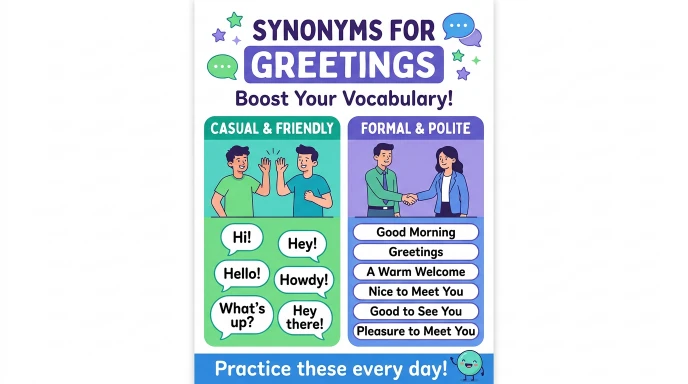
- Everyday greetings: Hi, hey, hellos, howdy. These suit casual conversations with friends and familiar people.
- Formal greetings: Salutations, greetings of welcome, opening remarks. These fit business letters, meetings, and official events.
- Warm welcomes: Welcomes, reception, welcome message, words of welcome. These show kindness to guests or new members.
- Respectful expressions: Regards, salutes, courtesies, acknowledgments. These show politeness or recognition.
- Time-based greetings: Good mornings, good afternoons, good evenings. These are linked to the time of day.
- Friendly messages: Best wishes, expressions of goodwill.
- Social introductions: Introductions, acknowledgment of presence.
- Special or foreign-language greetings: Bonjour, salve. These can be useful in language learning, travel, or historical settings.
- Expressions used at parting: Farewells.
Grouping words by purpose helps writers choose expressions that match their audience.
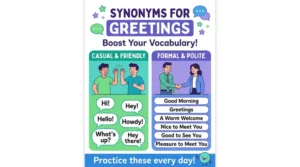
Casual Greetings
Casual greetings are suitable for friends, family members, classmates, and informal messages.
- Hi: A simple and friendly greeting.
- Hey: An informal greeting used with familiar people.
- Hello: A common greeting suitable for many everyday situations.
- What’s up?: An informal way to ask how someone is doing.
- How’s it going?: A friendly question used to start a conversation.
Example Sentence and Meaning Table
| Greeting or related word | Example sentence | Meaning |
| Hello | Hello, how are you today? | A common greeting. |
| Hi | Hi, nice to see you! | A casual greeting. |
| Hey | Hey, are you ready? | An informal greeting or attention-getter. |
| Salutations | Salutations to all our guests. | A formal expression of greeting. |
| Welcome | Welcome to our classroom. | A warm reception. |
| Good morning | Good morning, everyone. | A greeting used in the morning. |
| Good evening | Good evening, ladies and gentlemen. | A greeting used in the evening. |
| Howdy | Howdy, partner! | A friendly regional greeting. |
| Regards | Please send my regards to your family. | An expression of respect or goodwill. |
| Best wishes | Best wishes for your new job. | A message of goodwill or hope for success. |
| Courtesies | They exchanged polite courtesies. | Polite social words or actions. |
| Introductions | The meeting began with introductions. | Presenting people to each other. |
| Farewell | She said farewell before leaving. | A parting expression, not a greeting. |
| Reception | The guests received a warm reception. | The way someone is welcomed. |
| Welcome message | The app displayed a welcome message. | A message that greets someone. |
Short Questions and Answers (FAQ)
– What does “greetings” mean?
Greetings are words, phrases, or actions used to say hello, welcome someone, or recognize their presence.
– Are greetings positive or negative?Their tone can feel cold or unfriendly in some situations.
“Salutations” is a formal alternative. “Hellos” is a common casual alternative.
– What is the difference between greetings and salutations?
Both refer to expressions used to greet people. “Salutations” sounds more formal and is often used in writing.
– What is the difference between greetings and welcomes?
Greetings acknowledge or say hello to someone. Welcomes express that a person is accepted or invited.
– Can greetings be used in formal writing?
Yes.
– What are some casual greetings?
“Hi,” “hey,” “hello,” “howdy,” and “what’s up?” are common casual greetings.
– Are “greetings” and “farewells” synonyms?
– How can I improve my vocabulary with greeting synonyms?
Conclusion
Learning the meaning of “greetings” and its synonyms can improve your English vocabulary and everyday communication. Understanding their meanings, pronunciation, history, and tone helps you choose the right expression.
For students and content writers, a wider vocabulary makes speaking and writing clearer and more natural. Start by learning three new greeting expressions each day.
Explore more about!
- Synonyms of Desolate: The Ultimate Visual Guide
- Synonyms of Anarchy: Best Alternative Words to Know
- Synonyms of Boring: Best Alternative Words to Know

I am a British-American author, speaker, and motivational thinker. I focus on leadership and inspiration.
My main idea is that great leaders and successful organizations start with “why”.
I studied cultural anthropology and communication. My well-known books include Start With Why, Leaders Eat Last, and The Infinite Game.