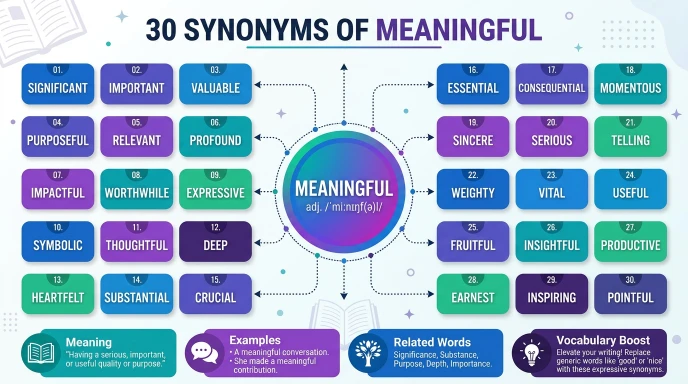
Meaningful means having a clear purpose, value, or deep importance. Imagine a student receiving a short note from a teacher before an important exam. The note may have only a few words, but it gives the student hope and confidence.
That small message is meaningful because it has a strong personal value. The word meaningful is common in daily English because people often talk about meaningful conversations, relationships, experiences, gifts, work, and memories.
Learning synonyms for meaningful helps English learners express ideas with more detail and avoid using the same word again and again. It also helps content writers create clear and engaging content. In this guide, we explore the meaning, synonyms, examples, grammar, history, pronunciation, emotional tone, and semantic categories of meaningful.
Meaning of Meaningful
Meaningful
describes something that has value, purpose, importance, or a strong personal meaning.
Definition
Meaningful (Adjective):
Having a useful purpose, deep importance, or special value to a person or situation.
Examples
- Her advice was very meaningful to me.
- We had a meaningful conversation about our future.
Connotative Meaning
Connotation means the feeling or idea that a word suggests beyond its basic dictionary meaning.
- Positive tone: Meaningful often suggests value, purpose, importance, love, wisdom, or emotional depth.
- Negative tone: In some contexts, calling something “meaningful” can sound forced or overly serious.
- Neutral tone: It can simply describe something that has a clear purpose or importance.
Etymology
- Meaningful is formed from the English word meaning + the suffix -ful.
- Meaning comes from the Old English mǣnan, meaning “to mean, intend, or signify.”
- The suffix -ful means “full of” or “having.”
- Therefore, meaningful literally suggests something “full of meaning.”
Short History of the Keyword
Old English (450–1100):
The modern word meaningful did not exist in its current form. Old English used related words connected with meaning, intention, purpose, and significance. The verb mǣnan expressed ideas such as intending or signifying.
Middle English (1100–1500):
The idea of “meaning” continued to develop. English speakers used related forms to discuss what words, actions, or signs represented. The vocabulary of purpose and significance became more varied.
Modern English (1500–Present):
The adjective meaningful developed as English became more flexible in forming adjectives with -ful. Today, meaningful can describe conversations, relationships, work, experiences, actions, messages, and personal memories.
Pronunciation (US & UK – IPA)
US: /ˈmiːnɪŋfəl/
UK: /ˈmiːnɪŋfəl/
Syllables
mean-ing-ful
Affixation Pattern of Meaningful
- Root: meaning
- Prefix: None
- Suffix: -ful
- Base word: mean
- Related noun: meaning
- Adjective: meaningful
- Adverb: meaningfully
- Opposite adjective: meaningless
- Opposite adverb: meaninglessly
- Noun related to the opposite: meaninglessness
The suffix -ful helps create adjectives that describe something as being “full of” a particular quality.
Synonyms of Meaningful
1. Significant (Adjective)
US: /sɪɡˈnɪfɪkənt/ | UK: /sɪɡˈnɪfɪkənt/
Meaning: Important enough to have a noticeable effect or value.
Examples:
- Her research made a significant contribution to science.
- That day was significant in his life.
2. Important (Adjective)
US: /ɪmˈpɔːrtənt/ | UK: /ɪmˈpɔːtənt/
Meaning: Having great value, influence, or importance.
Examples:
- Education is important for personal growth.
- She gave me an important piece of advice.
3. Valuable (Adjective)
US: /ˈvæljuəbəl/ | UK: /ˈvæljuəbəl/
Meaning: Having great worth or usefulness.
Examples:
- Your feedback was valuable to our team.
- She shared some valuable life lessons.
4. Purposeful (Adjective)
US: /ˈpɜːrpəsfəl/ | UK: /ˈpɜːpəsfəl/
Meaning: Done with a clear purpose or goal.
Examples:
- He made a purposeful choice.
- Her work is purposeful and focused.
5. Profound (Adjective)
US: /prəˈfaʊnd/ | UK: /prəˈfaʊnd/
Meaning: Very deep, thoughtful, or strongly felt.
Examples:
- The book had a profound effect on me.
- His words carried a profound message.
6. Impactful (Adjective)
US: /ɪmˈpæktfəl/ | UK: /ɪmˈpæktfəl/
Meaning: Having a strong effect or influence.
Examples:
- Her speech was impactful.
- The campaign delivered an impactful message.
7. Consequential (Adjective)
US: /ˌkɑːnsəˈkwenʃəl/ | UK: /ˌkɒnsɪˈkwenʃəl/
Meaning: Producing an important result or effect.
Examples:
- It was a consequential decision.
- The meeting led to several consequential changes.
8. Relevant (Adjective)
US: /ˈreləvənt/ | UK: /ˈreləvənt/
Meaning: Closely connected to the subject or situation.
Examples:
- She gave relevant advice.
- The teacher provided relevant examples.
9. Valuable (Adjective)
US: /ˈvæljuəbəl/ | UK: /ˈvæljuəbəl/
Meaning: Worthwhile or useful because of its importance.
Examples:
- The experience was valuable for my career.
- He offered valuable information.
10. Worthwhile (Adjective)
US: /ˌwɜːrθˈwaɪl/ | UK: /ˌwɜːθˈwaɪl/
Meaning: Worth the time, effort, or attention given to it.
Examples:
- Volunteering can be a worthwhile experience.
- We had a worthwhile discussion.
11. Symbolic (Adjective)
US: /sɪmˈbɑːlɪk/ | UK: /sɪmˈbɒlɪk/
Meaning: Representing a deeper idea or feeling.
Examples:
- The gift was symbolic of their friendship.
- The ceremony had a symbolic meaning.
12. Expressive (Adjective)
US: /ɪkˈspresɪv/ | UK: /ɪkˈspresɪv/
Meaning: Clearly showing thoughts, feelings, or ideas.
Examples:
- Her letter was deeply expressive.
- The painting is simple but expressive.
13. Valuable (Adjective)
US: /ˈvæljuəbəl/ | UK: /ˈvæljuəbəl/
Meaning: Important or useful because it provides benefit.
Examples:
- The lesson was valuable for young learners.
- His experience is valuable to the company.
14. Inspirational (Adjective)
US: /ˌɪnspəˈreɪʃənəl/ | UK: /ˌɪnspɪˈreɪʃənəl/
Meaning: Making people feel motivated or hopeful.
Examples:
- Her story was inspirational.
- The teacher gave an inspirational speech.
15. Thoughtful (Adjective)
US: /ˈθɔːtfəl/ | UK: /ˈθɔːtfəl/
Meaning: Showing careful thought, care, or consideration.
Examples:
- He gave me a thoughtful gift.
- Her thoughtful words made me smile.
16. Deep (Adjective)
US: /diːp/ | UK: /diːp/
Meaning: Strong or serious in emotional or intellectual meaning.
Examples:
- We had a deep conversation.
- The poem has a deep message.
17. Substantial (Adjective)
US: /səbˈstænʃəl/ | UK: /səbˈstænʃəl/
Meaning: Large or important enough to matter.
Examples:
- The project made a substantial difference.
- She provided substantial support.
18. Notable (Adjective)
US: /ˈnoʊtəbəl/ | UK: /ˈnəʊtəbəl/
Meaning: Worth noticing because of importance or quality.
Examples:
- She made a notable contribution.
- His achievement was notable.
19. Valuable (Adjective)
US: /ˈvæljuəbəl/ | UK: /ˈvæljuəbəl/
Meaning: Having worth, usefulness, or importance.
Examples:
- This book contains valuable information.
- The meeting gave us valuable insights.
20. Serious (Adjective)
US: /ˈsɪriəs/ | UK: /ˈsɪəriəs/
Meaning: Important and deserving careful attention.
Examples:
- They had a serious discussion.
- This is a serious matter.
21. Purposeful (Adjective)
US: /ˈpɜːrpəsfəl/ | UK: /ˈpɜːpəsfəl/
Meaning: Having a clear aim or reason.
Examples:
- Every action in the project was purposeful.
- She lives a purposeful life.
22. Resonant (Adjective)
US: /ˈrezənənt/ | UK: /ˈrezənənt/
Meaning: Creating a strong emotional or personal response.
Examples:
- The story was resonant with young readers.
- His message was emotionally resonant.
23. Moving (Adjective)
US: /ˈmuːvɪŋ/ | UK: /ˈmuːvɪŋ/
Meaning: Causing strong feelings, especially emotion.
Examples:
- It was a moving speech.
- She shared a moving story.
24. Touching (Adjective)
US: /ˈtʌtʃɪŋ/ | UK: /ˈtʌtʃɪŋ/
Meaning: Creating warm or emotional feelings.
Examples:
- His message was very touching.
- It was a touching moment between the friends.
25. Significant (Adjective)
US: /sɪɡˈnɪfɪkənt/ | UK: /sɪɡˈnɪfɪkənt/
Meaning: Having special importance or influence.
Examples:
- The event was significant for the community.
- She made a significant discovery.
26. Relevant (Adjective)
US: /ˈreləvənt/ | UK: /ˈreləvənt/
Meaning: Important to the topic or situation.
Examples:
- His example was relevant to the lesson.
- Please include only relevant details.
27. Genuine (Adjective)
US: /ˈdʒenjuɪn/ | UK: /ˈdʒenjuɪn/
Meaning: Real, sincere, and not false.
Examples:
- She showed genuine concern for others.
- His apology sounded genuine.
28. Valuable (Adjective)
US: /ˈvæljuəbəl/ | UK: /ˈvæljuəbəl/
Meaning: Having useful, emotional, or practical worth.
Examples:
- Friendship is valuable in difficult times.
- Her advice was valuable to me.
29. Memorable (Adjective)
US: /ˈmemərəbəl/ | UK: /ˈmemərəbəl/
Meaning: Worth remembering because it is special or important.
Examples:
- It was a memorable experience.
- She gave us a memorable farewell.
30. Fulfilling (Adjective)
US: /fʊlˈfɪlɪŋ/ | UK: /fʊlˈfɪlɪŋ/
Meaning: Giving a strong sense of satisfaction or purpose.
Examples:
- Teaching can be a fulfilling career.
- Helping others gives her a fulfilling sense of purpose.
Prototype Meaning
The most typical meaning of meaningful is something that has real value, purpose, or emotional importance.
When people hear this word, they often imagine a heartfelt conversation, a special memory, a useful experience, a thoughtful gift, or an action that makes a difference. A meaningful thing does not have to be large or expensive. Even a small action can be meaningful when it has a strong personal or emotional value.
Prototype Categorization
Synonyms of meaningful can be grouped according to the type of meaning they express:
- Importance: significant, important, notable, consequential
- Value: valuable, worthwhile, substantial
- Purpose: purposeful, fulfilling
- Emotional depth: profound, deep, moving, touching
- Emotional expression: expressive, resonant, genuine
- Influence: impactful, consequential
- Representation: symbolic
- Inspiration: inspirational
- Connection to a topic: relevant
- Memory and experience: memorable
This categorization helps writers choose the right word for each situation. For example, significant works well in formal writing, while touching is better for an emotional event. Purposeful focuses on goals, while valuable focuses on worth or benefit.
Antonyms of Meaningful
- Meaningless (Adjective): Having no clear meaning, purpose, or value.
- Pointless (Adjective): Having no useful purpose or reason.
- Insignificant (Adjective): Not important or noticeable.
- Trivial (Adjective): Having little importance or value.
- Worthless (Adjective): Having little or no value.
- Empty (Adjective): Lacking real meaning, feeling, or substance.
- Irrelevant (Adjective): Not connected with the topic or situation.
- Purposeless (Adjective): Having no clear aim or purpose.
Short Questions and Answers
- What does meaningful mean?
Meaningful describes something that has value, purpose, importance, or deep personal significance. - When should meaningful be used?
Use meaningful when you want to describe an action, experience, relationship, conversation, message, or object that has real importance or value. - Is meaningful positive or negative?
Meaningful usually has a positive tone, but its exact tone depends on context. - How is meaningful different from significant?
Meaningful often focuses on personal, emotional, or purposeful value. Significant usually focuses more on importance, influence, or measurable effect. - How is meaningful different from valuable?
Valuable focuses on worth or usefulness, while meaningful often includes personal or emotional importance. - Can meaningful describe a person?
Yes. For example, someone may have a meaningful role, meaningful relationship, or meaningful influence.
Conclusion
Learning meaningful and its synonyms can greatly improve your English vocabulary. Words such as significant, valuable, purposeful, profound, thoughtful, inspirational, memorable, and fulfilling help you express different types of importance and value.
Instead of using meaningful in every sentence, you can choose a synonym that matches your exact idea. This makes your writing clearer and more natural. These words are useful in essays, blogs, conversations, speeches, emails, and academic writing. Understanding their tone and meaning also helps you communicate with greater accuracy.
Practice one or two synonyms each day and use them in your own sentences. Regular vocabulary practice can reduce repetition, strengthen both writing and speaking skills, and build greater confidence in English.
Explore more about!
- Synonyms for Valuable: Powerful Words to Use Instead
- Synonyms for Major: Alternative Words & Meanings
- Synonyms for “Constitution”: Powerful Words to Expand

I am an American writer and speaker who focuses on habits, productivity, and self-improvement.
I study how small daily habits can create big changes in life. I try to write in a very simple and practical way so anyone can apply my ideas.
My most popular book is Atomic Habits, which is read around the world.