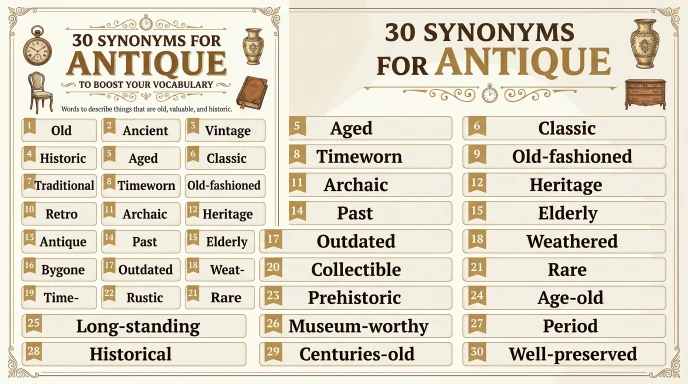
This article explains the meaning of antique, its history, pronunciation, grammar, and 30 useful synonyms. You will also learn how to use these words in everyday English, academic writing, and descriptions of old objects.
The word antique describes something old, often valuable because of its age, beauty, or history. Imagine visiting your grandmother’s house and finding a wooden chair that has been in your family for more than a hundred years. The chair may be an antique because it is old and has historical or artistic value.
People often use the word antique when talking about furniture, jewelry, paintings, clocks, and other objects from the past. Learning synonyms for antique helps English learners describe old things in more precise ways. It also helps writers avoid repeating the same word in articles, stories, and product descriptions.
In this guide, you will explore 30 synonyms for antique, with simple meanings, pronunciation, and example sentences. You will also learn about its origins, emotional tone, word formation, related words, and antonyms. These details will help you choose the right word for each situation.
Meaning of Antique
Definition
Antique (Noun): An object that is old and often valued because of its age, rarity, beauty, or historical importance.
Antique (Adjective): Belonging to an earlier period and valued for its age, style, or history.
Examples
- My grandmother owns an antique clock.
- We visited a shop that sells antique furniture.
Connotative Meaning
(Connotation is the feeling or idea that a word suggests beyond its basic meaning.)
- Positive tone: Antique can suggest beauty, craftsmanship, rarity, and historical value.
- Negative tone: It can suggest that something is outdated, worn, or no longer useful.
- Neutral tone: It can simply describe an old object or something from an earlier period.
Etymology
- Source language: The word comes from Old French antique and Latin antiquus.
- Original meaning: The Latin word meant “ancient,” “old,” or “belonging to the past.”
- Word development: The term entered English through French and became associated with ancient objects and, later, collectible old items.
Short History of Antique
- Old English (450–1100): The exact modern word antique was not a common Old English term. English speakers used other words to describe old things and the past.
- Middle English (1100–1500): French and Latin influenced English vocabulary. Forms related to antique became established through French, especially in discussions of ancient art and history.
- Modern English (1500–Present): The word became widely used for ancient art, old furniture, collectibles, and objects valued for their age or craftsmanship.
Pronunciation (US & UK – IPA)
- US: /ænˈtiːk/
- UK: /ænˈtiːk/
Syllables
an-tique : 2 syllables.
Affixation Pattern of Antique
- Root: antique :an established word meaning old or ancient.
- Prefix: None in the modern English word.
- Suffix: None in the modern English word.
- Word formation: Antique can function as a noun or adjective without changing its spelling.
Common related forms include:
- Antique (noun): A valuable old object.
- Antique (adjective): Old and often historically valuable.
- Antiquity (noun): The ancient past or the quality of being ancient.
- Antiquarian (noun/adjective): A person who studies or collects old objects, or something related to such study.
- Antiquated (adjective): Old-fashioned or no longer suitable for modern use.
- Antiquarianism (noun): The study or collection of objects from the past.
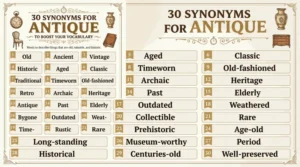
30 Synonyms for Antique
Not every synonym below has exactly the same meaning as antique. Some describe age, while others describe old-fashioned styles, historical importance, or collectible objects. Choose the word that best fits your sentence.
1. Ancient (Adjective)
US IPA: /ˈeɪnʃənt/ | UK IPA: /ˈeɪnʃənt/
Meaning: Belonging to a very distant time in history.
Examples:
- We explored an ancient temple.
- The museum displays ancient coins.
2. Old (Adjective)
US IPA: /oʊld/ | UK IPA: /əʊld/
Meaning: Having existed for a long time.
Examples:
- They bought an old wooden table.
- This old book belonged to my grandfather.
3. Vintage (Adjective)
US IPA: /ˈvɪntɪdʒ/ | UK IPA: /ˈvɪntɪdʒ/
Meaning: From an earlier period and valued for its style or quality.
Examples:
- She wore a vintage dress to the party.
- The shop sells vintage watches.
4. Historic (Adjective)
US IPA: /hɪˈstɔːrɪk/ | UK IPA: /hɪˈstɒrɪk/
Meaning: Important because of its connection to history.
Examples:
- We visited a historic building.
- The museum protects historic objects.
5. Historical (Adjective)
US IPA: /hɪˈstɔːrɪkəl/ | UK IPA: /hɪˈstɒrɪkəl/
Meaning: Connected with the past or the study of history.
Examples:
- She collects historical documents.
- The book describes historical events.
6. Archaic (Adjective)
US IPA: /ɑːrˈkeɪɪk/ | UK IPA: /ɑːˈkeɪɪk/
Meaning: Very old-fashioned or no longer commonly used.
Examples:
- Some archaic words are hard to understand.
- The writer used archaic language in the poem.
7. Obsolete (Adjective)
US IPA: /ˌɑːbsəˈliːt/ | UK IPA: /ˌɒbsəˈliːt/
Meaning: No longer used because something newer has replaced it.
Examples:
- The factory stored obsolete machines.
- Many people no longer use obsolete technology.
8. Aged (Adjective)
US IPA: /eɪdʒd/ | UK IPA: /eɪdʒd/
Meaning: Having grown old or been kept for a period of time.
Examples:
- The room contained aged wooden furniture.
- They admired the aged painting.
9. Timeworn (Adjective)
US IPA: /ˈtaɪmˌwɔːrn/ | UK IPA: /ˈtaɪmˌwɔːn/
Meaning: Worn or changed by the passage of time.
Examples:
- We walked along a timeworn stone path.
- The book had a timeworn cover.
10. Old-fashioned (Adjective)
US IPA: /ˌoʊld ˈfæʃənd/ | UK IPA: /ˌəʊld ˈfæʃənd/
Meaning: Made or designed in a style from an earlier period.
Examples:
- The house has old-fashioned furniture.
- He prefers old-fashioned clocks.
11. Traditional (Adjective)
US IPA: /trəˈdɪʃənəl/ | UK IPA: /trəˈdɪʃənəl/
Meaning: Following customs or styles passed down through generations.
Examples:
- The room has traditional wooden furniture.
- They decorated the house in a traditional style.
12. Classic (Adjective)
US IPA: /ˈklæsɪk/ | UK IPA: /ˈklæsɪk/
Meaning: Recognized as a lasting example of quality or style.
Examples:
- She bought a classic leather handbag.
- The design has a classic look.
13. Collectible (Adjective)
US IPA: /kəˈlɛktəbəl/ | UK IPA: /kəˈlɛktəbəl/
Meaning: Worth collecting because of its rarity, interest, or value.
Examples:
- The store sells collectible toy cars.
- He found a collectible old coin.
14. Rare (Adjective)
US IPA: /rɛr/ | UK IPA: /reə/
Meaning: Not common or difficult to find.
Examples:
- The museum owns a rare antique vase.
- She discovered a rare book at the market.
15. Precious (Adjective)
US IPA: /ˈprɛʃəs/ | UK IPA: /ˈprɛʃəs/
Meaning: Very valuable or deeply treasured.
Examples:
- The antique ring was precious to her.
- He kept the precious family heirloom safe.
16. Valuable (Adjective)
US IPA: /ˈvæljuəbəl/ | UK IPA: /ˈvæljuəbəl/
Meaning: Worth a lot of money or having great importance.
Examples:
- They sold a valuable antique painting.
- The collection contains valuable old coins.
17. Heirloom (Noun)
US IPA: /ˈɛrˌluːm/ | UK IPA: /ˈeəˌluːm/
Meaning: An object passed down through generations of a family.
Examples:
- This silver spoon is a family heirloom.
- She received an antique necklace as an heirloom.
18. Relic (Noun)
US IPA: /ˈrɛlɪk/ | UK IPA: /ˈrɛlɪk/
Meaning: An object that remains from an earlier time.
Examples:
- The museum displayed a relic from the past.
- They found a historic relic beneath the floor.
19. Artifact (Noun)
US IPA: /ˈɑːrtɪfækt/ | UK IPA: /ˈɑːtɪfækt/
Meaning: An object made or used by people in the past, often of historical interest.
Examples:
- The archaeologist examined an ancient artifact.
- The museum protects artifacts from early civilizations.
20. Curio (Noun)
US IPA: /ˈkjʊrioʊ/ | UK IPA: /ˈkjʊəriəʊ/
Meaning: An unusual or interesting object, often kept as a collectible.
Examples:
- The shop displayed a strange curio.
- She bought a small curio for her desk.
21. Bygone (Adjective)
US IPA: /ˈbaɪɡɔːn/ | UK IPA: /ˈbaɪɡɒn/
Meaning: Belonging to an earlier time that has passed.
Examples:
- The museum shows life in a bygone age.
- The old photographs remind us of bygone days.
22. Ancestral (Adjective)
US IPA: /ænˈsɛstrəl/ | UK IPA: /ænˈsɛstrəl/
Meaning: Related to family members who lived in earlier generations.
Examples:
- They restored their ancestral home.
- The family displayed ancestral jewelry.
23. Time-honored (Adjective)
US IPA: /ˌtaɪm ˈɑːnərd/ | UK IPA: /ˌtaɪm ˈɒnəd/
Meaning: Respected because it has existed for a long time.
Examples:
- The family follows a time-honored tradition.
- The ceremony uses time-honored customs.
24. Patinated (Adjective)
US IPA: /ˈpætɪneɪtɪd/ | UK IPA: /ˈpætɪneɪtɪd/
Meaning: Having a surface changed in color or texture through age or exposure.
Examples:
- The patinated bronze statue looked beautiful.
- The collector admired the patinated copper bowl.
25. Weathered (Adjective)
US IPA: /ˈwɛðərd/ | UK IPA: /ˈwɛðəd/
Meaning: Changed or worn by exposure to weather or the passage of time.
Examples:
- A weathered wooden door stood at the entrance.
- The antique chest had a weathered surface.
26. Worn (Adjective)
US IPA: /wɔːrn/ | UK IPA: /wɔːn/
Meaning: Damaged or faded through long use.
Examples:
- The old chair had a worn leather seat.
- He carefully repaired the worn book cover.
27. Time-tested (Adjective)
US IPA: /ˈtaɪm ˌtɛstɪd/ | UK IPA: /ˈtaɪm ˌtɛstɪd/
Meaning: Proven to work well over a long period.
Examples:
- The craftsman used a time-tested method.
- The design is simple and time-tested.
28. Retro (Adjective)
US IPA: /ˈrɛtroʊ/ | UK IPA: /ˈrɛtrəʊ/
Meaning: Designed to look like a style from the recent past.
Examples:
- The café has a retro interior.
- She decorated her room with retro lamps.
29. Period (Adjective)
US IPA: /ˈpɪriəd/ | UK IPA: /ˈpɪəriəd/
Meaning: Belonging to or characteristic of a particular historical era.
Examples:
- The film features period costumes.
- The house contains period furniture.
30. Old-world (Adjective)
US IPA: /ˌoʊld ˈwɜːrld/ | UK IPA: /ˌəʊld ˈwɜːld/
Meaning: Having the charm, style, or customs associated with an earlier age.
Examples:
- The hotel has old-world charm.
- The antique shop has an old-world atmosphere.
Prototype Meaning
The typical meaning of antique is an old object valued for its age, beauty, rarity, craftsmanship, or historical interest. People often imagine an antique wooden cabinet, a vintage-looking clock, a silver tea set, or an old painting.
In the world of collecting, an antique is often distinguished from a newer vintage item by its age, although the exact age requirement can vary by market and country.
Prototype Categorization
Synonyms become easier to use when grouped by meaning. This helps writers choose words that fit the object and the message.
- Age: ancient, old, aged, bygone.
- Historical importance: historic, historical, ancestral, period.
- Old styles: vintage, classic, retro, old-fashioned, old-world.
- Wear and age: timeworn, weathered, worn, patinated.
- Value and rarity: rare, precious, valuable, collectible.
- Objects from the past: heirloom, relic, artifact, curio.
- Long-standing customs or methods: traditional, time-honored, time-tested.
- Outdated or no longer used: archaic, obsolete.
These categories help writers avoid using a word that changes the meaning. For example, obsolete suggests something is no longer useful or current, while valuable focuses on worth. Vintage often describes a style or period, while antique commonly describes an old object valued for its age.
Antonyms of Antique
Antonyms are words with opposite or contrasting meanings. The best antonym depends on if antique refers to age, style, or historical value.
- Modern (Adjective): Belonging to the present or recent times. Example: The room has modern furniture.
- New (Adjective): Recently made, bought, or created. Example: She bought a new wooden table.
- Contemporary (Adjective): Belonging to the present time. Example: The gallery displays contemporary art.
- Recent (Adjective): Happening or made not long ago. Example: This is a recent design.
- Current (Adjective): Existing or happening now. Example: The store follows current design trends.
- Latest (Adjective): The newest or most recent. Example: He purchased the latest model.
- Innovative (Adjective): Introducing new ideas or methods. Example: The designer created an innovative chair.
- Fresh (Adjective): New, recent, or not previously used. Example: The room has a fresh, modern look.
Formal and Casual Synonyms for Antique
The best word depends on your audience and the situation.
| Formal or academic | Casual or everyday |
| Ancient | Old |
| Historical | Old-fashioned |
| Period | Vintage |
| Ancestral | Old-world |
| Artifact | Old object |
| Obsolete | Outdated |
| Collectible | Collectible item |
| Heirloom | Family treasure |
Tip: Use artifact in a museum or history discussion. Use old-fashioned in casual conversation when you mean an outdated style. Use vintage when discussing fashion, furniture, or designs from an earlier period.
Example Sentences and Meanings
| Example sentence | Meaning |
| The museum has an antique clock. | An old clock valued for its age or history. |
| She wore a vintage dress. | A dress from an earlier fashion period. |
| We explored an ancient temple. | A temple from a very distant past. |
| He bought a rare coin. | A coin that is difficult to find. |
| The house has traditional furniture. | Furniture based on established styles. |
| They restored an ancestral home. | A home connected to earlier generations. |
| The shop sells collectible toys. | Toys people may want to collect. |
| The machine is obsolete. | The machine is no longer in common use. |
Related Words
These words can help you expand your vocabulary around antiques and historical objects.
- Antiquity (Noun): The ancient past or the quality of being ancient.
- Antiquarian (Noun): A person who studies or collects old objects.
- Antiquated (Adjective): Outdated or no longer suitable for modern needs.
- Antiquarianism (Noun): The study or collection of objects from the past.
- Antique dealer (Noun): A person who buys and sells antiques.
- Antique shop (Noun): A store that sells old collectible objects.
- Restoration (Noun): The process of repairing an old object or building.
- Provenance (Noun): The documented history of an object’s ownership or origin.
- Heirloom (Noun): An object passed from one generation to another.
- Preservation (Noun): The act of protecting something from damage or loss.
Short Questions and Answers
What does antique mean?
Antique means an old object that is often valued for its age, rarity, craftsmanship, or historical importance.
When should antique be used?
Use antique when describing old furniture, jewelry, artwork, clocks, and other objects valued for their age or history.
Is antique positive or negative?
It is often positive when describing valuable or beautiful objects. However, it can suggest something old-fashioned in certain contexts.
How is antique different from vintage?
An antique is generally an older object valued for its age or historical interest. Vintage usually refers to something from an earlier period that reflects its era’s style or quality. The exact age boundaries vary by market.
What is the best synonym for antique?
Vintage is useful when describing older fashion or design. Ancient suits objects from a very distant past, while historic emphasizes historical importance.
Is antique a noun or an adjective?
It can be both. In “This antique is valuable,” it is a noun. In “This is an antique table,” it is an adjective.
What is the opposite of antique?
Common contrasting words include modern, new, contemporary, and recent.
Can antique describe a person?
It is not usually used to describe a person directly. In informal speech, it may be used humorously to suggest that someone has old-fashioned ideas.
Conclusion
Learning synonyms for antique helps you describe old objects with greater detail and accuracy. Words such as ancient, vintage, historic, rare, and collectible each express a different idea. Some focus on age, while others highlight beauty, value, style, or historical importance.
Using these words can improve your writing, speaking, and overall English vocabulary. They also help you avoid repetition when writing articles, product descriptions, school assignments, or stories. Understanding pronunciation, word history, grammar, and connotation makes it easier to choose the right synonym for each situation.
Try learning two or three new words every day. Write your own sentences and use the words in conversation. With regular practice, you can express your ideas more clearly and build confidence in English.
Explore more about!
- Synonyms of Colony: Best Alternative Words to Know
- Synonyms of Detective: Best Alternative Words to Know
- Another Word for Coordinator: Organizer, Manager & More

I am an American author, and I write books about power, strategy, and human behavior. My writing style is simple but deep, and I try to explain how people think and act in real-life situations.
I studied classical studies, and before becoming a writer, I worked in different fields which helped me understand people and life better.
My most famous books include The 48 Laws of Power, The Art of Seduction, and Mastery. These books are widely read by business people, leaders, and students around the world.