Flawless means having no mistakes, faults, or defects. Imagine a student who checks every answer before handing in an exam. The answers are correct, the work is neat, and nothing needs to be fixed. You might describe the student’s work as flawless.
We use this word to talk about perfect work, clear writing, beautiful skin, strong performances, and well-planned events. It is common in daily speech, schoolwork, business, and online content.
Learning synonyms for flawless helps English learners express ideas in more ways. It also helps content writers avoid repeating the same word and make their writing more engaging. Still, similar words can have different meanings and tones.
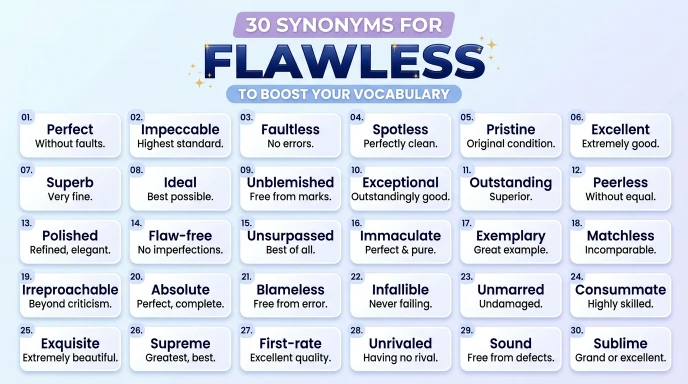
In this guide, you will learn the meaning, pronunciation, history, and word forms of flawless. You will also explore 30 synonyms with simple meanings, examples, related words, antonyms, and tips for choosing the right word.
Meaning of Flawless
Definition
Flawless (adjective): Having no mistakes, faults, defects, or visible imperfections.
Examples
- She gave a flawless performance on stage.
- His report was flawless and easy to understand.
Connotative Meaning
Connotation (the feelings or ideas a word suggests beyond its basic meaning).
- Positive tone: Suggests excellence, beauty, skill, and careful work. Example: “The team delivered a flawless performance.”
- Negative tone: In some contexts, it may suggest unrealistic standards or pressure to be perfect. Example: “She felt she had to look flawless every day.”
- Neutral tone: Simply describes something without noticeable faults. Example: “The machine completed a flawless test run.”
Etymology
- Origin: Flawless comes from the English word flaw combined with the suffix -less.
- Flaw: A defect, fault, or weakness.
- Suffix -less: From Old English -lēas, meaning “without” or “lacking.”
- Original meaning: Without flaws or defects.
Short History of the Keyword
- Old English (450–1100): The modern word flawless was not yet established. However, Old English used -lēas in words meaning “without” or “lacking.”
- Middle English (1100–1500): The word flaw developed in English, referring to a defect or imperfection. The use of words ending in -less also continued.
- Modern English (1500–Present): Flawless became a common adjective for something without faults. Today, it describes work, performances, plans, products, and appearance.
Pronunciation (US & UK – IPA)
- US: /ˈflɔːləs/
- UK: /ˈflɔːləs/
Syllables
flaw-less :2 syllables.
Affixation Pattern of Flawless
- Root: flaw :a fault or defect.
- Prefix: None.
- Suffix: -less : means without or lacking.
Word Formation of Flawless
- Flaw (noun): A fault or defect.
- Flawless (adjective): Without faults or defects.
- Flawlessly (adverb): In a way that has no mistakes or faults.
- Flawlessness (noun): The state of being flawless.
- Flawed (adjective): Having a fault or weakness.
- Flawing (verb form): A rare form related to the verb flaw; not common in everyday English.
Synonyms of Flawless
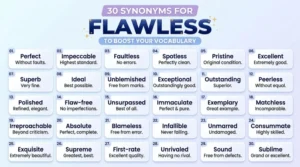
These 30 synonyms describe something perfect, correct, beautiful, or free from faults. Some fit work and performance, while others are better for appearance, quality, or accuracy. Choose the word that best matches your sentence.
1. Perfect (Adjective)
US IPA: /ˈpɝːfɪkt/ | UK IPA: /ˈpɜːfɪkt/
Meaning: Having no faults or being as good as possible.
Examples:
- She gave a perfect answer.
- The weather was perfect for our picnic.
2. Impeccable (Adjective)
US IPA: /ɪmˈpɛkəbəl/ | UK IPA: /ɪmˈpekəbəl/
Meaning: So good or careful that no faults can be found.
Examples:
- His manners were impeccable.
- She has impeccable taste in clothes.
3. Faultless (Adjective)
US IPA: /ˈfɔːltləs/ | UK IPA: /ˈfɔːltləs/
Meaning: Having no mistakes, faults, or weaknesses.
Examples:
- The singer gave a faultless performance.
- Her work was faultless from start to finish.
4. Spotless (Adjective)
US IPA: /ˈspɑːtləs/ | UK IPA: /ˈspɒtləs/
Meaning: Completely clean or free from marks and stains.
Examples:
- The kitchen was spotless.
- He wore a spotless white shirt.
5. Pristine (Adjective)
US IPA: /ˈprɪstiːn/ | UK IPA: /ˈprɪstiːn/
Meaning: In perfect condition, as if new or untouched.
Examples:
- The car was in pristine condition.
- They found a pristine beach far from the city.
6. Exemplary (Adjective)
US IPA: /ɪɡˈzɛmpləri/ | UK IPA: /ɪɡˈzɑːmpləri/
Meaning: So good that it can serve as an example for others.
Examples:
- The student showed exemplary behavior.
- Her service was exemplary throughout the event.
7. Excellent (Adjective)
US IPA: /ˈɛksələnt/ | UK IPA: /ˈeksələnt/
Meaning: Extremely good in quality or performance.
Examples:
- He did an excellent job on the project.
- The restaurant offers excellent service.
8. Outstanding (Adjective)
US IPA: /aʊtˈstændɪŋ/ | UK IPA: /aʊtˈstændɪŋ/
Meaning: Exceptionally good and better than most others.
Examples:
- She delivered an outstanding speech.
- His outstanding work earned him an award.
9. Unblemished (Adjective)
US IPA: /ʌnˈblɛmɪʃt/ | UK IPA: /ʌnˈblemɪʃt/
Meaning: Free from marks, damage, or anything that harms a good reputation.
Examples:
- The glass remained unblemished.
- She had an unblemished record at work.
10. Unmarred (Adjective)
US IPA: /ʌnˈmɑːrd/ | UK IPA: /ʌnˈmɑːd/
Meaning: Not damaged, spoiled, or made less beautiful.
Examples:
- The view remained unmarred by buildings.
- The painting was unmarred by scratches.
11. Pristine-looking (Adjective)
US IPA: /ˈprɪstiːn ˌlʊkɪŋ/ | UK IPA: /ˈprɪstiːn ˌlʊkɪŋ/
Meaning: Looking very clean, fresh, and almost new.
Examples:
- The shoes still looked pristine-looking after careful cleaning.
- The room had a pristine appearance before the guests arrived.
More natural phrasing: “The shoes still looked pristine” is usually better than “pristine-looking.”
12. Ideal (Adjective)
US IPA: /aɪˈdiːəl/ | UK IPA: /aɪˈdɪəl/
Meaning: Best suited to a particular purpose or situation.
Examples:
- This is an ideal place to study.
- The plan offers an ideal solution for the problem.
13. Unerring (Adjective)
US IPA: /ʌnˈɛrɪŋ/ | UK IPA: /ʌnˈɜːrɪŋ/
Meaning: Consistently accurate and not making mistakes.
Examples:
- She showed unerring judgment during the crisis.
- His unerring aim impressed the coach.
14. Accurate (Adjective)
US IPA: /ˈækjərət/ | UK IPA: /ˈækjərət/
Meaning: Correct and free from errors.
Examples:
- The report contains accurate information.
- Please make sure your answers are accurate.
15. Exact (Adjective)
US IPA: /ɪɡˈzækt/ | UK IPA: /ɪɡˈzækt/
Meaning: Completely correct or precise in every detail.
Examples:
- She gave the exact answer.
- We followed the exact instructions.
16. Precise (Adjective)
US IPA: /prɪˈsaɪs/ | UK IPA: /prɪˈsaɪs/
Meaning: Clear, accurate, and carefully measured or stated.
Examples:
- The engineer made precise measurements.
- His precise explanation helped the class.
17. Consummate (Adjective)
US IPA: /ˈkɑːnsəmət/ | UK IPA: /ˈkɒnsəmət/
Meaning: Showing the highest level of skill or ability.
Examples:
- She is a consummate professional.
- The pianist performed with consummate skill.
18. Peerless (Adjective)
US IPA: /ˈpɪrləs/ | UK IPA: /ˈpɪələs/
Meaning: So good that no one or nothing else can match it.
Examples:
- The chef is known for peerless cooking skills.
- Her peerless talent amazed the audience.
19. Matchless (Adjective)
US IPA: /ˈmætʃləs/ | UK IPA: /ˈmætʃləs/
Meaning: Having no equal in quality or skill.
Examples:
- The artist showed matchless creativity.
- The team played with matchless energy.
20. Unsurpassed (Adjective)
US IPA: /ˌʌnsərˈpæst/ | UK IPA: /ˌʌnsəˈpɑːst/
Meaning: Better than anything else and not exceeded by others.
Examples:
- The hotel is known for unsurpassed service.
- She has an unsurpassed knowledge of the subject.
21. Unrivaled (Adjective)
US IPA: /ʌnˈraɪvəld/ | UK IPA: /ʌnˈraɪvəld/
Meaning: Having no serious competitor or equal.
Examples:
- The company offers unrivaled customer support.
- His unrivaled skill made him famous.
22. Unparalleled (Adjective)
US IPA: /ʌnˈpærəˌlɛld/ | UK IPA: /ʌnˈpærəleld/
Meaning: So special or excellent that nothing else is quite like it.
Examples:
- The museum has an unparalleled collection of art.
- She showed unparalleled dedication to her work.
23. Unimpeachable (Adjective)
US IPA: /ˌʌnɪmˈpiːtʃəbəl/ | UK IPA: /ˌʌnɪmˈpiːtʃəbəl/
Meaning: Beyond criticism or doubt, especially in honesty or reliability.
Examples:
- The witness had an unimpeachable reputation.
- The report came from an unimpeachable source.
24. Unquestionable (Adjective)
US IPA: /ʌnˈkwɛstʃənəbəl/ | UK IPA: /ʌnˈkwestʃənəbəl/
Meaning: So clear or certain that it is not reasonably doubted.
Examples:
- Her talent is unquestionable.
- He made an unquestionable contribution to the team.
25. Unassailable (Adjective)
US IPA: /ˌʌnəˈseɪləbəl/ | UK IPA: /ˌʌnəˈseɪləbəl/
Meaning: So strong or well-supported that it cannot easily be challenged.
Examples:
- The researcher presented an unassailable argument.
- The team built an unassailable lead.
26. Irreproachable (Adjective)
US IPA: /ˌɪrɪˈproʊtʃəbəl/ | UK IPA: /ˌɪrɪˈprəʊtʃəbəl/
Meaning: So good or proper that it cannot fairly be criticized.
Examples:
- Her conduct was irreproachable.
- He maintained an irreproachable professional record.
27. Unblemished (Adjective)
US IPA: /ʌnˈblɛmɪʃt/ | UK IPA: /ʌnˈblemɪʃt/
Meaning: Having no blemishes or damage; also used for a clean record.
Examples:
- The athlete had an unblemished record.
- The surface remained unblemished after polishing.
28. Smooth (Adjective)
US IPA: /smuːð/ | UK IPA: /smuːð/
Meaning: Happening easily, without problems or interruptions.
Examples:
- The event ran smoothly from beginning to end.
- We had a smooth journey to the village.
29. Seamless (Adjective)
US IPA: /ˈsiːmləs/ | UK IPA: /ˈsiːmləs/
Meaning: Happening or working so smoothly that there are no noticeable gaps or problems.
Examples:
- The team created a seamless customer experience.
- The transition between lessons was seamless.
30. Sterling (Adjective)
US IPA: /ˈstɜːrlɪŋ/ | UK IPA: /ˈstɜːlɪŋ/
Meaning: Extremely good, trustworthy, or high in quality.
Examples:
- She has a sterling reputation.
- The volunteers did sterling work for the community.
Usage note: Not every word above is interchangeable with flawless. For example, accurate focuses on correctness, spotless on cleanliness, seamless on smooth operation, and sterling on high quality or reputation.
Prototype Meaning
The most typical meaning of flawless is having no mistakes, defects, or noticeable weaknesses. People may imagine a perfect exam paper, a beautiful diamond, a clean room, or a performance completed without errors.
The word can describe both physical things and actions. For example, a flawless surface has no visible marks, while a flawless speech has no clear mistakes. It often expresses strong praise and suggests a very high standard of quality. However, flawless does not always mean that something is truly perfect in every possible way; it may simply mean that no faults were noticed in a particular situation.
Prototype Categorization
Synonyms for flawless can be grouped by their meanings.
- Perfect quality: Perfect, impeccable, faultless, ideal. Use these words when something meets a very high standard.
- Clean and undamaged: Spotless, pristine, unblemished, unmarred, unspoiled. These words work well for objects, surfaces, and places.
- Excellent performance: Exemplary, excellent, outstanding, consummate, sterling. Use these to praise someone’s work, behavior, or skill.
- Accuracy and correctness: Accurate, exact, precise, unerring. These words fit answers, measurements, facts, and decisions.
- Unmatched quality: Peerless, matchless, unsurpassed, unrivaled, unparalleled. These words suggest that something is better than its competitors.
- Beyond criticism or doubt: Unimpeachable, unquestionable, unassailable, irreproachable. These are useful for arguments, reputations, evidence, and conduct.
- Smooth operation: Smooth, seamless. Use these words for processes, services, events, and transitions.
Categorization helps writers select a synonym that fits the context. For example, precise is better for measurements, spotless for a clean room, and impeccable for professional behavior. This makes writing more natural and avoids using the same word repeatedly.
Antonyms of Flawless
1. Flawed (Adjective)
Meaning: Having a fault, weakness, or defect.
– The plan was flawed because it ignored the budget.
2. Imperfect (Adjective)
Meaning: Not completely correct or free from faults.
– The drawing was imperfect but full of character.
3. Defective (Adjective)
Meaning: Having a fault that prevents something from working properly.
– The store replaced the defective phone.
4. Faulty (Adjective)
Meaning: Not working or performing correctly because of a mistake or defect.
– A faulty wire caused the machine to stop.
5. Blemished (Adjective)
Meaning: Having a mark, spot, or defect.
– The fruit had a blemished surface.
6. Damaged (Adjective)
Meaning: Harmed or broken in some way.
– The damaged screen needed repair.
7. Inaccurate (Adjective)
Meaning: Not correct or exact.
– The report contained inaccurate information.
8. Erroneous (Adjective)
Meaning: Containing a mistake or based on incorrect information.
– The article included an erroneous claim.
9. Mediocre (Adjective)
Meaning: Average or not very good.
– The team gave a mediocre performance.
10. Substandard (Adjective)
Meaning: Below the expected level of quality.
– The factory rejected the substandard materials.
Related Words
| Related word | Part of speech | Meaning |
| Flaw | Noun | A fault or defect |
| Flawless | Adjective | Free from faults |
| Flawlessly | Adverb | Without mistakes or defects |
| Flawlessness | Noun | The state of being flawless |
| Flawed | Adjective | Having a fault or weakness |
| Imperfection | Noun | A fault or quality that is not perfect |
| Perfection | Noun | The state of being perfect |
| Perfect | Adjective/verb | Without faults; to make something better |
| Perfectly | Adverb | In a perfect or fully satisfactory way |
| Perfectionist | Noun | A person who wants everything to be perfect |
| Impeccability | Noun | The quality of being impeccable |
| Faultless | Adjective | Free from errors or faults |
Formal and Casual Synonyms
Formal Alternatives
Use these words in academic writing, business reports, professional reviews, and formal communication.
- Impeccable: The candidate demonstrated impeccable professional conduct.
- Faultless: The report was faultless in its presentation of the findings.
- Exemplary: The employee showed exemplary dedication.
- Precise: The researcher provided precise measurements.
- Unimpeachable: The investigation relied on unimpeachable evidence.
- Irreproachable: Her professional conduct remained irreproachable.
Casual Alternatives
These words sound natural in daily conversations and informal writing.
- Perfect: Your answer is perfect!
- Spotless: Your room looks spotless.
- Amazing: You did an amazing job.
- Excellent: That was an excellent performance.
- Superb: The food was superb.
- Spot-on: Your explanation was spot-on.
Note: “Amazing,” “superb,” and “spot-on” can express praise, but they do not always mean completely free from faults.
Example Sentences and Meaning Table
| Word | Example sentence | Meaning |
| Flawless | She gave a flawless performance. | Without noticeable faults |
| Perfect | The answer was perfect. | Completely correct or ideal |
| Impeccable | His manners were impeccable. | Free from faults |
| Faultless | Her work was faultless. | Without mistakes |
| Spotless | The kitchen was spotless. | Completely clean |
| Pristine | The car remained pristine. | In excellent, almost-new condition |
| Exemplary | He showed exemplary behavior. | Worthy of being copied |
| Excellent | She did an excellent job. | Extremely good |
| Outstanding | His work was outstanding. | Exceptionally good |
| Unblemished | She had an unblemished record. | Free from marks or faults |
| Accurate | The information was accurate. | Correct and reliable |
| Precise | The measurement was precise. | Exact and carefully measured |
| Ideal | This is an ideal solution. | Best suited to the purpose |
| Peerless | Her talent was peerless. | Without an equal |
| Seamless | The service was seamless. | Smooth and without interruptions |
| Flawed | The argument was flawed. | Having a weakness or mistake |
Short Questions and Answers (FAQ)
1. What does flawless mean?
Flawless means having no mistakes, faults, or noticeable defects.
2. When should flawless be used?
Use flawless when something appears or performs without noticeable faults. It can describe work, performances, plans, products, and appearance.
3. Is flawless positive or negative?
It is usually positive because it expresses excellence and praise. In some contexts, it can suggest unrealistic expectations of perfection.
4. How is flawless different from perfect?
Flawless emphasizes the absence of faults or defects. Perfect can mean having no faults, but it can also mean being ideal for a particular purpose.
5. What is the best synonym for flawless?
Impeccable is a strong choice for behavior or quality, faultless for work without mistakes, and spotless for something completely clean.
6. What is the opposite of flawless?
Common antonyms include flawed, imperfect, faulty, defective, and inaccurate. The best opposite depends on the context.
7. What part of speech is flawless?
Flawless is an adjective. It describes a noun, as in “flawless work” or “a flawless performance.”
8. What is the adverb form of flawless?
The adverb is flawlessly. For example, “The team performed flawlessly.”
9. Can flawless describe a person?
Yes. It can describe someone’s performance, behavior, appearance, or work. It is usually more accurate to praise a specific quality than to suggest that a person has no faults at all.
10. How can learning flawless synonyms improve English?
Learning synonyms helps you avoid repetition, express different shades of meaning, and choose more precise words in essays, articles, and conversations.
Conclusion
Learning the meaning of flawless and its synonyms can strengthen your vocabulary and improve your writing and speaking skills. Words such as perfect, impeccable, and faultless help describe work or performances without noticeable mistakes. Other words, like spotless, accurate, and seamless, suit specific situations involving cleanliness, correctness, and smooth operation.
Using these alternatives makes your writing more interesting and helps you avoid repeating the same word. However, remember that similar words do not always have exactly the same meaning.
Choose each word based on the situation and the quality you want to describe. Practice by learning three new synonyms each day and writing your own examples. With regular practice, you can express your ideas more clearly, build confidence in English, and develop a stronger vocabulary.
Read more!
- Energy Synonyms: 30 Words to Elevate Your Vocabulary
- Synonyms for “Availability”: Powerful Words to Expand
- Synonyms of Abhor: Best Alternative Words to Know

I am an American author, and I write books about power, strategy, and human behavior. My writing style is simple but deep, and I try to explain how people think and act in real-life situations.
I studied classical studies, and before becoming a writer, I worked in different fields which helped me understand people and life better.
My most famous books include The 48 Laws of Power, The Art of Seduction, and Mastery. These books are widely read by business people, leaders, and students around the world.