Objects are things that we can see, touch, use, or notice around us. For example, a student may carry books, pens, and a water bottle in a school bag. At home, we use many objects every day, such as chairs, cups, phones, and tables. The word objects is common in daily speech, schoolwork, science, and writing.
Learning synonyms for objects helps English learners build a stronger vocabulary. It also helps students and content writers avoid repetition and make their writing more interesting. However, not every synonym fits every situation. Words such as items, things, belongings, and materials have slightly different meanings.
This guide explains the meaning, history, pronunciation, grammar, and tone of objects. It also shares 30 related words with simple meanings and examples to help you choose the right word in everyday English.
Meaning of Objects
Definition
Objects (noun, plural): Things that can be seen, touched, used, or thought about. The word can also mean goals or purposes when used in a different context.
Examples
- The teacher placed several objects on the desk.
- Please put all the objects back in their proper places.
Connotative Meaning
(Connotation is the feeling or idea that a word suggests beyond its basic meaning.)
- Positive tone: Objects can suggest valuable possessions, treasured items, or meaningful keepsakes.
- Negative tone: The word may suggest unwanted clutter or items that take up space.
- Neutral tone: Objects often refers to ordinary things without showing a positive or negative feeling.
Etymology
- Origin: The word comes from Latin objectum, meaning “something thrown or placed before.”
- Latin roots: It is linked to obicere, meaning “to throw before” or “to present.”
- English development: The word entered English through Old French and Latin forms.
Short History of Objects
- Old English (450–1100): The modern word object was not commonly used in its current form. English speakers used words such as thing to refer to items and matters.
- Middle English (1100–1500): Object entered English through French and Latin influence. It could refer to something presented to the mind or senses.
- Modern English (1500–Present): The word gained wider use in science, grammar, philosophy, and daily speech. Today, it can mean a physical thing, a goal, or the receiver of an action in a sentence.
Pronunciation (US & UK – IPA)
- US: /ˈɑːb.dʒekts/
- UK: /ˈɒb.dʒekts/
Syllables
ob-jects
Affixation Pattern of Objects
- Root: object
- Prefix: None in the word objects.
- Suffix: -s, which marks the plural form of the noun.
Word Formation of Object
The word object has several useful forms. Here are common forms and their grammatical categories:
- Object (noun): A thing that can be seen or touched.
- Objects (plural noun): More than one object.
- Object (verb): To disagree with or oppose something.
- Objects (verb): Third-person singular form of object.
- Objected (verb): Past tense of object.
- Objecting (verb): The act of expressing disagreement.
- Objection (noun): A statement of disagreement.
- Objectionable (adjective): Causing dislike or disapproval.
- Objective (noun): A goal or aim.
- Objective (adjective): Based on facts rather than personal feelings.
- Objectively (adverb): In a fair and fact-based way.
- Objectivity (noun): The quality of being fair and fact-based.
- Objectification (noun): Treating a person as a thing rather than as a human being.
- Objectify (verb): To treat someone as an object rather than a person.
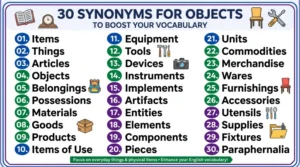
Synonyms for Objects
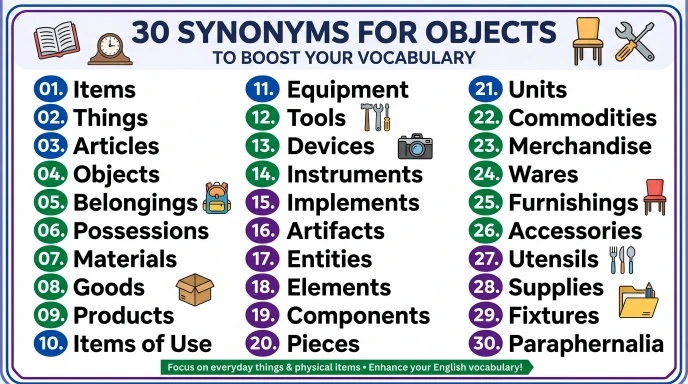
The best synonym depends on the context. Some words mean physical things, while others refer to possessions, supplies, or materials.
1. Items (Noun)
US IPA: /ˈaɪ.t̬əmz/ | UK IPA: /ˈaɪ.təmz/
Meaning: Individual things that belong to a group or list.
Examples:
- Please place the items on the table.
- The shop sells many useful items.
2. Things (Noun)
US IPA: /θɪŋz/ | UK IPA: /θɪŋz/
Meaning: A general word for objects, ideas, or matters.
Examples:
- I packed my things before leaving.
- There are many things on the shelf.
3. Articles (Noun)
US IPA: /ˈɑːr.t̬ə.kəlz/ | UK IPA: /ˈɑː.tɪ.kəlz/
Meaning: Individual objects, especially items for sale or use.
Examples:
- The store sells household articles.
- Please keep these articles in a safe place.
4. Belongings (Noun)
US IPA: /bɪˈlɔːŋ.ɪŋz/ | UK IPA: /bɪˈlɒŋ.ɪŋz/
Meaning: Things owned by a person.
Examples:
- She collected her belongings after class.
- Keep your belongings close to you.
5. Possessions (Noun)
US IPA: /pəˈzeʃ.ənz/ | UK IPA: /pəˈzeʃ.ənz/
Meaning: Things that someone owns.
Examples:
- He kept his possessions in a small box.
- Her most valuable possessions were safe.
6. Goods (Noun)
US IPA: /ɡʊdz/ | UK IPA: /ɡʊdz/
Meaning: Things made or sold for people to use.
Examples:
- The market sells fresh goods.
- The company ships goods to other countries.
7. Products (Noun)
US IPA: /ˈprɑː.dʌkts/ | UK IPA: /ˈprɒd.ʌkts/
Meaning: Things made to be sold or used.
Examples:
- The shop offers cleaning products.
- These products are made from natural materials.
8. Materials (Noun)
US IPA: /məˈtɪr.i.əlz/ | UK IPA: /məˈtɪə.ri.əlz/
Meaning: Substances or supplies used to make things.
Examples:
- We need materials to build the model.
- The artist used simple materials for the project.
9. Equipment (Noun)
US IPA: /ɪˈkwɪp.mənt/ | UK IPA: /ɪˈkwɪp.mənt/
Meaning: Tools or items needed for a task or activity.
Examples:
- The team checked its equipment.
- The lab has modern equipment.
10. Tools (Noun)
US IPA: /tuːlz/ | UK IPA: /tuːlz/
Meaning: Objects used to do a job or task.
Examples:
- The worker put the tools in a box.
- We need the right tools to fix the chair.
11. Devices (Noun)
US IPA: /dɪˈvaɪ.sɪz/ | UK IPA: /dɪˈvaɪ.sɪz/
Meaning: Objects made for a particular purpose, often using technology.
Examples:
- The students used digital devices in class.
- Keep electronic devices away from water.
12. Gadgets (Noun)
US IPA: /ˈɡædʒ.ɪts/ | UK IPA: /ˈɡædʒ.ɪts/
Meaning: Small tools or devices that perform useful tasks.
Examples:
- He enjoys buying new gadgets.
- The kitchen has several useful gadgets.
13. Utensils (Noun)
US IPA: /juːˈten.səlz/ | UK IPA: /juːˈten.səlz/
Meaning: Tools used for cooking, eating, or serving food.
Examples:
- The utensils are in the kitchen drawer.
- Wash the cooking utensils after use.
14. Implements (Noun)
US IPA: /ˈɪm.plə.mənts/ | UK IPA: /ˈɪm.plɪ.mənts/
Meaning: Tools used to carry out a task.
Examples:
- The farmer cleaned his tools and implements.
- The gardener stored the implements in a shed.
15. Instruments (Noun)
US IPA: /ˈɪn.strə.mənts/ | UK IPA: /ˈɪn.strə.mənts/
Meaning: Objects used to perform a task or measure something.
Examples:
- The scientist checked the instruments.
- The musician cleaned her instruments.
16. Furnishings (Noun)
US IPA: /ˈfɝː.nɪ.ʃɪŋz/ | UK IPA: /ˈfɜː.nɪ.ʃɪŋz/
Meaning: Furniture and other items used to equip a room.
Examples:
- The room has simple furnishings.
- They bought new furnishings for the office.
17. Furniture (Noun)
US IPA: /ˈfɝː.nɪ.tʃɚ/ | UK IPA: /ˈfɜː.nɪ.tʃə/
Meaning: Large movable items such as chairs, tables, and beds.
Examples:
- The furniture arrived this morning.
- We need new furniture for the living room.
18. Accessories (Noun)
US IPA: /əkˈses.ər.iz/ | UK IPA: /əkˈses.ər.iz/
Meaning: Extra items that add use, comfort, or style.
Examples:
- She bought accessories for her phone.
- The store sells fashion accessories.
19. Components (Noun)
US IPA: /kəmˈpoʊ.nənts/ | UK IPA: /kəmˈpəʊ.nənts/
Meaning: Parts that make up a larger object or system.
Examples:
- The machine has several small components.
- Each component must work correctly.
20. Parts (Noun)
US IPA: /pɑːrts/ | UK IPA: /pɑːts/
Meaning: Pieces of a whole object.
Examples:
- The mechanic replaced the broken parts.
- Put all the parts in one box.
21. Units (Noun)
US IPA: /ˈjuː.nɪts/ | UK IPA: /ˈjuː.nɪts/
Meaning: Individual items or sections that form part of a larger group.
Examples:
- The factory produced one hundred units.
- Each unit was checked before delivery.
22. Entities (Noun)
US IPA: /ˈen.t̬ə.t̬iz/ | UK IPA: /ˈen.tɪ.tiz/
Meaning: Things that exist as separate and distinct items, people, or organizations.
Examples:
- The program tracks digital entities.
- Each entity has a unique number.
23. Objects of Interest (Noun Phrase)
US IPA: /ˈɑːb.dʒekts əv ˈɪn.trəst/ | UK IPA: /ˈɒb.dʒekts əv ˈɪn.trəst/
Meaning: Things that attract attention or need to be examined.
Examples:
- The museum displayed several objects of interest.
- Investigators studied the objects of interest carefully.
24. Collectibles (Noun)
US IPA: /kəˈlek.tə.bəlz/ | UK IPA: /kəˈlek.tə.bəlz/
Meaning: Items people keep because they are rare, valuable, or interesting.
Examples:
- He keeps old coins as collectibles.
- The shop sells sports collectibles.
25. Keepsakes (Noun)
US IPA: /ˈkiːp.seɪks/ | UK IPA: /ˈkiːp.seɪks/
Meaning: Objects kept because they remind someone of a person or event.
Examples:
- She saved the ticket as a keepsake.
- The box held family keepsakes.
26. Trinkets (Noun)
US IPA: /ˈtrɪŋ.kɪts/ | UK IPA: /ˈtrɪŋ.kɪts/
Meaning: Small decorative objects that often have little money value.
Examples:
- The shelf was full of colorful trinkets.
- He bought a few trinkets at the market.
27. Ornaments (Noun)
US IPA: /ˈɔːr.nə.mənts/ | UK IPA: /ˈɔː.nə.mənts/
Meaning: Objects used to decorate a place or thing.
Examples:
- They placed ornaments on the tree.
- The room had several glass ornaments.
28. Artifacts (Noun)
US IPA: /ˈɑːr.t̬ə.fækts/ | UK IPA: /ˈɑː.tɪ.fækts/
Meaning: Objects made or used by people, often from the past.
Examples:
- The museum displayed ancient artifacts.
- Archaeologists found artifacts near the old town.
29. Relics (Noun)
US IPA: /ˈrel.ɪks/ | UK IPA: /ˈrel.ɪks/
Meaning: Objects that remain from an earlier time and may have historical or cultural value.
Examples:
- The castle holds relics from the past.
- The relics were kept in a glass case.
30. Specimens (Noun)
US IPA: /ˈspes.ə.mənz/ | UK IPA: /ˈspes.ɪ.mənz/
Meaning: Individual examples collected for study or examination.
Examples:
- The students examined plant specimens.
- The lab stored the specimens carefully.
Prototype Meaning
The most common meaning of objects is physical things that people can see, touch, move, or use. People may imagine everyday items such as books, cups, keys, phones, chairs, and bags.
These things can serve a purpose, belong to someone, or form part of a larger group. In other contexts, object can refer to a goal or the receiver of an action in a sentence.
Prototype Categorization
Synonyms for objects can be grouped by their use and meaning:
- General things: Things, items, articles. Use these words when you do not need to name a specific type of object.
- Owned things: Belongings, possessions, keepsakes. Use these when the objects belong to someone or have personal meaning.
- Items for sale: Goods, products. Use these in shopping, business, and trade.
- Tools and devices: Tools, equipment, gadgets, utensils, implements, instruments. Use these when objects help people perform tasks.
- Parts of a whole: Components, parts, units. Use these when discussing how something is built or organized.
- Decorative objects: Ornaments, trinkets, accessories. Use these when describing items that add beauty or style.
- Historical or collected objects: Artifacts, relics, collectibles, specimens. Use these in museums, history, science, and collecting.
- Room items: Furniture, furnishings. Use these when discussing how a room is equipped.
Categorizing synonyms helps writers choose words that match the subject. For example, artifacts fits a history article, while equipment suits a science lab. Choosing the right word makes writing clearer and more accurate.
Antonyms of Objects
There is no single direct antonym for objects when it means physical things. However, these words can express contrasting ideas in suitable contexts:
- Nothing (pronoun): Not anything; the absence of a thing.
- Nonexistence (noun): The state of not existing.
- Void (noun): An empty space or complete absence of something.
- Emptiness (noun): The state of containing nothing.
- Absence (noun): The state of something not being present.
- Intangible (adjective): Not physical or able to be touched.
- Abstract (adjective): Existing as an idea rather than as a physical thing.
These are contextual opposites, not exact antonyms in every use of objects.
Short Questions and Answers
- What does objects mean?
Objects are things that people can see, touch, use, or study. - When should objects be used?
Use objects when talking about physical things or, in another context, goals and aims. - Is objects positive or negative?
The word is usually neutral. Its tone depends on the situation. - How is objects different from items?
Both can mean individual things. Items often refers to things on a list or for sale, while objects can emphasize physical things. - Are objects and belongings the same?
Not always. Belongings specifically means things owned by someone. - What is a formal synonym for objects?
Items, articles, and entities may fit formal writing, depending on the context. - Can objects refer to goals?
Yes. In formal use, object can mean a goal or purpose, as in “The object of the lesson is to improve reading.” - What is the plural of object?
The plural is objects.
Conclusion
Learning the meaning of objects and its synonyms can help you build a stronger English vocabulary. Words such as items, things, belongings, equipment, and artifacts let you describe different kinds of objects more clearly. They also help you avoid repeating the same word in essays, articles, schoolwork, and daily conversations.
Each synonym has its own use. For example, products works well in business writing, while keepsakes describes objects with personal meaning. Knowing these differences helps you choose words that fit your message.
Learning pronunciation, grammar, tone, and word history can also improve your understanding of English. Practice a few words each day, read simple texts, and write your own examples. With regular practice, you can speak and write with more clarity and confidence.
Explore more about!
- Synonyms of Boring: Best Alternative Words to Know
- Synonyms of Anarchy: Best Alternative Words to Know
- Synonyms of Desolate: The Ultimate Visual Guide

I am an American author, and I write books about power, strategy, and human behavior. My writing style is simple but deep, and I try to explain how people think and act in real-life situations.
I studied classical studies, and before becoming a writer, I worked in different fields which helped me understand people and life better.
My most famous books include The 48 Laws of Power, The Art of Seduction, and Mastery. These books are widely read by business people, leaders, and students around the world.