A coordinator is a person who organizes people, tasks, or activities to help everything run smoothly. Imagine a school event where several students prepare decorations, arrange chairs, and welcome guests. One person makes the plan, shares duties, and checks that everything is ready on time.
That person is the coordinator. Coordinators are common in schools, offices, hospitals, businesses, and community groups. They help people work together and reach shared goals.
Learning synonyms for coordinator helps English learners build a stronger vocabulary and express ideas more clearly.
It also helps content writers avoid repeating the same word in articles, reports, and professional documents. However, similar words can have different meanings and levels of authority.
In this guide, you will explore the meaning, pronunciation, history, and word forms of coordinator. You will also learn 30 related words with simple meanings, example sentences, antonyms, and practical tips for choosing the best word.
Meaning of Coordinator
Definition
Coordinator (noun): A person who organizes people, tasks, or activities and helps them work together effectively.
Examples
- The event coordinator arranged the chairs and invited the guests.
- Our project coordinator helps the team finish its work on time.
Connotative Meaning
Connotation (the feelings or ideas a word suggests beyond its basic meaning).
- Positive tone: Suggests teamwork, organization, leadership, and responsibility. Example: “The coordinator helped everyone work together.”
- Negative tone: May suggest unnecessary control, too many rules, or poor organization when used in a critical context. Example: “The coordinator made the simple task more complicated.”
- Neutral tone: Simply describes someone responsible for arranging tasks or activities. Example: “The coordinator sent the meeting schedule.”
Etymology
- Origin: Coordinator comes from the verb coordinate, formed from the prefix co- and the Latin-derived word ordinate.
- Co-: From Latin, meaning “together” or “with.”
- Ordinate: Related to the Latin ordinare, meaning “to arrange” or “put in order.”
- Original idea: To arrange different things so they work together.
Short History of the Keyword
- Old English (450–1100): The modern word coordinator was not used in Old English. People used other words to describe arranging work and organizing groups.
- Middle English (1100–1500): French and Latin influenced English vocabulary. Words related to order, arrangement, and cooperation became part of English.
- Modern English (1500–Present): Coordinate developed into a common word for organizing people and activities. Coordinator became widely used as workplaces, schools, public services, and organizations developed more specialized roles.
Pronunciation (US & UK – IPA)
- US: /koʊˈɔːrdəˌneɪtər/
- UK: /kəʊˈɔːdɪneɪtə/
Syllables
co-or-di-na-tor — 5 syllables.
Affixation Pattern of Coordinator
- Root: ordin : linked to order and arrangement.
- Prefix: co- : means together or with.
- Suffix: -ate :helps form the verb coordinate.
- Suffix: -or : often forms a noun for a person who performs an action.
Word Formation of Coordinator
- Coordinate (verb): To organize different people or tasks so they work together.
- Coordination (noun): The process of organizing activities or people.
- Coordinator (noun): A person who organizes activities or tasks.
- Coordinated (adjective): Organized so that different parts work together.
- Coordinating (verb/adjective): Organizing activities or helping them work together.
- Coordinative (adjective): Related to coordination; uncommon in everyday English.
- Coordinately (adverb): In a way involving coordination; rare in modern usage.
- Coordination-based (adjective): Built around the process of coordinating tasks or activities.
These are related forms, not all equally common. The most useful everyday forms are coordinate, coordination, coordinator, and coordinated.
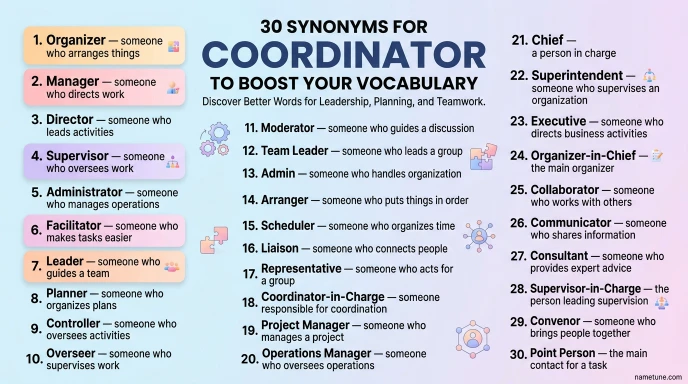
Synonyms of Coordinator
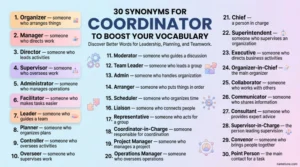
The best synonym for coordinator depends on the person’s duties. Some words describe people who plan events, while others refer to managers, team leaders, or people who connect different groups. These 30 alternatives are useful in everyday, academic, and professional English.
1. Organizer (Noun)
US IPA: /ˈɔːrɡəˌnaɪzər/ | UK IPA: /ˈɔːɡənaɪzə/
Meaning: A person who plans and arranges an event or activity.
Examples:
- The organizer prepared the school festival.
- Our organizer booked the hall for the meeting.
2. Manager (Noun)
US IPA: /ˈmænɪdʒər/ | UK IPA: /ˈmænɪdʒə/
Meaning: A person who directs work, people, or resources.
Examples:
- The manager assigned tasks to the team.
- Our office manager planned the weekly schedule.
3. Administrator (Noun)
US IPA: /ədˈmɪnɪˌstreɪtər/ | UK IPA: /ədˈmɪnɪˌstreɪtə/
Meaning: A person who manages the daily operations of an organization.
Examples:
- The administrator arranged the staff meeting.
- Our school administrator handled the new records.
4. Supervisor (Noun)
US IPA: /ˈsuːpərˌvaɪzər/ | UK IPA: /ˈsuːpəvaɪzə/
Meaning: A person who oversees workers and checks their tasks.
Examples:
- The supervisor checked the team’s progress.
- Ask your supervisor before changing the schedule.
5. Facilitator (Noun)
US IPA: /fəˈsɪləˌteɪtər/ | UK IPA: /fəˈsɪlɪteɪtə/
Meaning: A person who helps a group work together or reach a goal.
Examples:
- The facilitator guided the group discussion.
- Our facilitator helped everyone share ideas.
6. Planner (Noun)
US IPA: /ˈplænər/ | UK IPA: /ˈplænə/
Meaning: A person who prepares plans for an event or activity.
Examples:
- The planner created a schedule for the conference.
- We hired a planner for the wedding.
7. Director (Noun)
US IPA: /dəˈrɛktər/ | UK IPA: /dəˈrektə/
Meaning: A person who leads or manages an organization, department, or project.
Examples:
- The director organized the new project.
- The program director called a team meeting.
8. Liaison (Noun)
US IPA: /liˈeɪzɑːn/ | UK IPA: /liˈeɪzɒn/
Meaning: A person who helps two people or groups communicate and work together.
Examples:
- The school liaison contacted the parents.
- She works as a liaison between the two departments.
9. Scheduler (Noun)
US IPA: /ˈskɛdʒuːlər/ | UK IPA: /ˈʃedjuːlə/
Meaning: A person who arranges times for tasks, events, or appointments.
Examples:
- The scheduler booked the meeting room.
- Our scheduler updated everyone’s work hours.
10. Dispatcher (Noun)
US IPA: /dɪˈspætʃər/ | UK IPA: /dɪˈspætʃə/
Meaning: A person who sends workers, vehicles, or services where they are needed.
Examples:
- The dispatcher sent a driver to the correct address.
- The emergency dispatcher contacted the response team.
11. Team Leader (Noun)
US IPA: /ˈtiːm ˌliːdər/ | UK IPA: /ˈtiːm ˌliːdə/
Meaning: A person who guides a team and helps members complete their work.
Examples:
- The team leader divided the tasks fairly.
- Our team leader checked the final report.
12. Event Planner (Noun)
US IPA: /ɪˈvɛnt ˌplænər/ | UK IPA: /ɪˈvent ˌplænə/
Meaning: A person who plans and arranges events.
Examples:
- The event planner chose the venue.
- We met the event planner before the ceremony.
13. Convenor (Noun)
US IPA: /kənˈviːnər/ | UK IPA: /kənˈviːnə/
Meaning: A person who arranges a meeting or brings a group together.
Examples:
- The convenor invited all committee members.
- Our convenor set the date for the next meeting.
14. Moderator (Noun)
US IPA: /ˈmɑːdəˌreɪtər/ | UK IPA: /ˈmɒdəreɪtə/
Meaning: A person who guides a discussion and helps keep it orderly.
Examples:
- The moderator gave each speaker time to talk.
- Our moderator kept the discussion focused.
15. Overseer (Noun)
US IPA: /ˈoʊvərˌsiːər/ | UK IPA: /ˈəʊvəsiːə/
Meaning: A person who watches over work to make sure it is done properly.
Examples:
- The overseer checked the building work.
- An overseer monitored the daily operations.
16. Arranger (Noun)
US IPA: /əˈreɪndʒər/ | UK IPA: /əˈreɪndʒə/
Meaning: A person who organizes things or makes the necessary arrangements.
Examples:
- The arranger prepared the travel details.
- We thanked the arranger for planning the visit.
17. Orchestrator (Noun)
US IPA: /ˈɔːrkəˌstreɪtər/ | UK IPA: /ˈɔːkɪstreɪtə/
Meaning: A person who organizes several people or activities into one successful effort.
Examples:
- She was the orchestrator of the charity campaign.
- The orchestrator brought several teams together.
18. Overseer of Operations (Noun Phrase)
US IPA: /ˈoʊvərˌsiːər əv ˌɑːpəˈreɪʃənz/ | UK IPA: /ˈəʊvəsiːər əv ˌɒpəˈreɪʃənz/
Meaning: A person who monitors and manages the way an organization operates.
Examples:
- The overseer of operations reviewed the daily schedule.
- The company hired an overseer of operations for its new branch.
19. Point Person (Noun Phrase)
US IPA: /ˈpɔɪnt ˌpɜːrsən/ | UK IPA: /ˈpɔɪnt ˌpɜːsən/
Meaning: The main person to contact about a task or project.
Examples:
- Maya is the point person for the school event.
- Contact the point person if you need more details.
20. Lead (Noun)
US IPA: /liːd/ | UK IPA: /liːd/
Meaning: A person who guides a team or takes the main role in an activity.
Examples:
- The project lead shared the work plan.
- Ask the team lead about your duties.
21. Chief (Noun)
US IPA: /tʃiːf/ | UK IPA: /tʃiːf/
Meaning: A person who holds the highest position in a group or organization.
Examples:
- The chief called a meeting with the staff.
- The department chief approved the new plan.
22. Superintendent (Noun)
US IPA: /ˌsuːpərɪnˈtɛndənt/ | UK IPA: /ˌsuːpərɪnˈtendənt/
Meaning: A person who oversees a large service, organization, or group of activities.
Examples:
- The superintendent reviewed the school schedule.
- The building superintendent coordinated repair work.
23. Executive (Noun)
US IPA: /ɪɡˈzɛkjətɪv/ | UK IPA: /ɪɡˈzekjətɪv/
Meaning: A person with an important role in managing an organization.
Examples:
- The executive coordinated the department’s plans.
- A senior executive approved the project budget.
24. Representative (Noun)
US IPA: /ˌrɛprɪˈzɛntətɪv/ | UK IPA: /ˌreprɪˈzentətɪv/
Meaning: A person who speaks or acts for another person or group.
Examples:
- The staff representative shared the team’s concerns.
- A company representative contacted the new client.
25. Agent (Noun)
US IPA: /ˈeɪdʒənt/ | UK IPA: /ˈeɪdʒənt/
Meaning: A person who acts for another person or organization.
Examples:
- The travel agent arranged our tickets.
- Her agent coordinated the interview schedule.
26. Project Manager (Noun)
US IPA: /ˈprɑːdʒɛkt ˌmænɪdʒər/ | UK IPA: /ˈprɒdʒekt ˌmænɪdʒə/
Meaning: A person who plans and manages a project from start to finish.
Examples:
- The project manager set clear deadlines.
- Our project manager checked the team’s progress.
27. Operations Manager (Noun)
US IPA: /ˌɑːpəˈreɪʃənz ˌmænɪdʒər/ | UK IPA: /ˌɒpəˈreɪʃənz ˌmænɪdʒə/
Meaning: A person who manages the daily activities of a business or organization.
Examples:
- The operations manager arranged staff duties.
- Our operations manager improved the work process.
28. Coordinator of Activities (Noun Phrase)
US IPA: /koʊˈɔːrdəˌneɪtər əv ækˈtɪvətiz/ | UK IPA: /kəʊˈɔːdɪneɪtə əv ækˈtɪvɪtiz/
Meaning: A person responsible for organizing a range of activities.
Examples:
- The coordinator of activities prepared the weekly program.
- The center’s coordinator of activities planned games for children.
29. Handler (Noun)
US IPA: /ˈhændlər/ | UK IPA: /ˈhændlə/
Meaning: A person who manages or takes care of a particular task, person, or situation.
Examples:
- The event handler managed guest requests.
- A trained handler guided the service dog.
30. Collaborator (Noun)
US IPA: /kəˈlæbəˌreɪtər/ | UK IPA: /kəˈlæbəreɪtə/
Meaning: A person who works with others toward a shared goal.
Examples:
- Each collaborator helped prepare the presentation.
- She was a key collaborator on the research project.
Usage note: These words are related to the role of a coordinator, but they are not exact replacements in every sentence. For example, a collaborator works with others, while a manager may have authority over them. Choose the word that matches the person’s actual duties.
Prototype Meaning
The most typical meaning of coordinator is a person who organizes people, tasks, and activities so everything works smoothly. People often imagine someone making a schedule, assigning duties, sharing information, and checking progress.
A coordinator may work at a school, office, hospital, or event. The role usually focuses on planning, communication, and teamwork. Unlike a director or manager, a coordinator may not have authority to make every major decision.
The main goal is to keep different people and tasks connected and moving toward a shared result.
Prototype Categorization
Coordinator synonyms can be grouped by their main duties.
- Planning and organizing: Organizer, planner, event planner, arranger. These words suit people who prepare schedules, events, and activities.
- Management and supervision: Manager, administrator, supervisor, director, superintendent. These words fit roles that involve oversight or decision-making.
- Teamwork and communication: Facilitator, liaison, collaborator, representative. These describe people who help others communicate and work together.
- Scheduling and operations: Scheduler, dispatcher, operations manager, project manager. These are useful for coordinating deadlines, services, and daily work.
- Leadership and responsibility: Team leader, lead, chief, executive. These words suggest leadership or a position of authority.
- Meetings and group discussions: Convenor, moderator. These suit people who bring groups together or guide discussions.
- Task ownership and support: Point person, agent, handler, overseer, orchestrator. These terms describe people who handle responsibilities or connect different activities.
Categorizing synonyms helps writers choose the most accurate term. For example, use facilitator for someone who guides a discussion, scheduler for someone who arranges times, and project manager for someone who manages a project’s goals, resources, and deadlines.
Antonyms of Coordinator
There is no single exact antonym for coordinator. The best opposite depends on whether you mean a person who organizes work, supports teamwork, or manages activities.
1. Disorganizer (Noun)
Meaning: A person or thing that causes disorder or makes organization difficult.
– The disorganizer made it hard for the team to follow the plan.
2. Disruptor (Noun)
Meaning: A person or thing that interrupts normal work or prevents smooth progress.
– The disruptor stopped the group from finishing its task.
3. Opponent (Noun)
Meaning: A person who disagrees with or works against another person or group.
– The opponent rejected the team’s proposal.
4. Outsider (Noun)
Meaning: A person who does not belong to or participate in a particular group.
– The outsider was not involved in the planning meeting.
5. Nonparticipant (Noun)
Meaning: A person who does not take part in an activity.
– The nonparticipant did not help organize the event.
6. Follower (Noun)
Meaning: A person who follows another person’s guidance rather than leading or organizing the group.
– The follower waited for the team leader’s instructions.
7. Bystander (Noun)
Meaning: A person who watches an activity without taking part.
– The bystander watched while the volunteers arranged the room.
Formal and Casual Alternatives
Formal Alternatives
Use these words in professional emails, reports, job descriptions, and academic writing.
- Administrator: The administrator coordinated the daily operations.
- Facilitator: The facilitator guided the workshop.
- Project manager: The project manager organized the project timeline.
- Liaison: The liaison maintained communication between the departments.
- Operations manager: The operations manager arranged the team’s responsibilities.
- Convenor: The convenor organized the committee meeting.
Casual Alternatives
These words are common in everyday conversation and informal workplace communication.
- Organizer: She’s the organizer of our school trip.
- Team lead: Ask the team lead about your tasks.
- Point person: He’s the point person for the event.
- Planner: We need a planner for the party.
- Person in charge: She’s the person in charge of the meeting.
- Team leader: Our team leader helps everyone stay on track.
Writing tip: “Person in charge” is a useful casual alternative, but it often suggests more authority than coordinator. Use it only when that meaning fits.
Example Sentences and Meaning Table
| Word | Example sentence | Meaning |
| Coordinator | The coordinator arranged the meeting. | Organizes people and tasks |
| Organizer | The organizer prepared the event. | Plans and arranges activities |
| Manager | The manager assigned the work. | Directs people or resources |
| Administrator | The administrator updated the records. | Manages daily operations |
| Supervisor | The supervisor checked the work. | Oversees workers |
| Facilitator | The facilitator guided the discussion. | Helps a group work together |
| Planner | The planner created a schedule. | Prepares plans |
| Liaison | The liaison connected both teams. | Helps groups communicate |
| Scheduler | The scheduler booked appointments. | Arranges times |
| Dispatcher | The dispatcher sent a vehicle. | Sends people or services where needed |
| Team leader | The team leader shared the tasks. | Guides a team |
| Moderator | The moderator managed the discussion. | Keeps a discussion orderly |
| Project manager | The project manager tracked deadlines. | Manages a project |
| Collaborator | The collaborator shared useful ideas. | Works with others |
| Representative | The representative spoke for the staff. | Acts for a person or group |
| Disruptor | The disruptor interrupted the process. | Prevents smooth progress |
Short Questions and Answers (FAQ)
1. What does coordinator mean?
A coordinator is a person who organizes people, tasks, or activities to help them work together smoothly.
2. When should coordinator be used?
Use coordinator when describing someone who arranges tasks, shares information, manages schedules, or connects people working toward a common goal.
3. Is coordinator positive or negative?
The word is usually neutral and often has a positive tone because it suggests organization and teamwork. Its tone can become negative when the context describes poor planning or excessive control.
4. How is coordinator different from manager?
A coordinator usually focuses on organizing activities and keeping people connected. A manager often has broader responsibility for decisions, resources, performance, and results. However, duties can overlap.
5. What is the best synonym for coordinator?
It depends on the role. Organizer works well for events, facilitator for group discussions, liaison for communication between groups, and project manager for managing projects.
6. What is the opposite of coordinator?
Possible opposites include disorganizer and disruptor. Words such as bystander and nonparticipant describe people who do not actively take part in organizing work.
7. What part of speech is coordinator?
Coordinator is a noun because it names a person who organizes activities or helps people work together.
8. What is the difference between a coordinator and a facilitator?
A coordinator arranges tasks, schedules, and responsibilities. A facilitator helps a group communicate, share ideas, and reach an outcome. One person can perform both roles.
9. What are the common types of coordinators?
Common roles include project coordinator, event coordinator, school coordinator, marketing coordinator, program coordinator, and operations coordinator.
10. How can learning coordinator synonyms improve English?
Learning these synonyms helps you describe job roles more precisely, reduce repetition, write professional documents, and communicate more clearly.
Conclusion
Learning the meaning of coordinator and its synonyms can improve your vocabulary and help you communicate with confidence.
Words such as organizer, planner, and facilitator are useful for describing people who arrange tasks and support teamwork. Other terms, such as manager, supervisor, and director, may suggest greater authority or responsibility. Choosing the right word makes your writing clearer and more professional.
Using synonyms also helps you avoid repetition in essays, articles, reports, and workplace messages. However, similar words do not always have the same meaning, so consider each person’s duties before choosing an alternative.
Try learning three new words each day and writing simple sentences with them. Regular practice can strengthen your speaking and writing skills, expand your vocabulary, and build lasting confidence in English.
Read more!
- Synonyms for Park 30 Powerful Words to Improve Your Vocabulary
- Synonyms of Sweetheart: Best Alternative Words to Know
- Synonyms of Colony: Best Alternative Words to Know

I am a linguist with 17 years of experience in English language teaching, including postgraduate-level instruction. My expertise includes English grammar, and I contribute as a content and blog writer, producing scholarly and educational language resources.