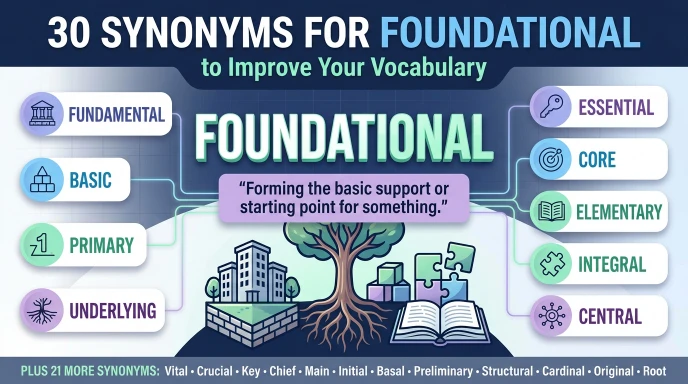
The word foundational means forming the basic support for something. For example, a student needs foundational skills in reading and writing before learning harder subjects. In the same way, a strong building needs a solid base to stand safely.
This word is common in education, business, science, and daily life. People use it to describe ideas, skills, rules, and systems that support future growth.
Learning synonyms for foundational helps English learners build a wider vocabulary. It also helps students, teachers, and content writers avoid using the same word again and again. However, not every synonym fits every sentence. Some words describe basic knowledge, while others show that something is central or essential.
This guide explains the meaning, pronunciation, history, grammar, and tone of foundational. It also shares useful synonyms, examples, related words, and antonyms to help you choose the right word.
Meaning of Foundational
Definition
Foundational (adjective): Something that forms a basic support or starting point for further learning, growth, or development.
Examples
- Reading is a foundational skill for young students.
- Trust plays a foundational role in a strong friendship.
Connotative Meaning
(Connotation means the feelings or ideas that a word suggests beyond its basic meaning.)
- Positive tone: Suggests strength, support, growth, and importance. Example: “The course teaches foundational skills for success.”
- Negative tone: May suggest that something is too basic or not advanced enough in a particular context. Example: “The report offers only foundational details.”
- Neutral tone: Simply describes something that supports or begins a larger system. Example: “The team reviewed the foundational rules.”
Etymology
- Root word: Foundation, meaning a base or support.
- Origin: From Old French fondacion and Latin fundatio, related to fundare, meaning “to lay a base” or “to establish.”
- Suffix: The suffix -al changes foundation into the adjective foundational, meaning “related to a foundation.”
Short History of the Keyword
- Old English (450–1100): The modern word foundational was not in common use. Related ideas were expressed through words for bases, grounds, and supports.
- Middle English (1100–1500): English adopted words related to foundation through French and Latin. These words described the act or result of laying a base.
- Modern English (1500–Present): Foundational developed as an adjective for basic principles, skills, ideas, and structures. Today, it is common in education, research, business, and technology.
Pronunciation (US & UK – IPA)
- US: /faʊnˈdeɪʃənəl/
- UK: /faʊnˈdeɪʃənəl/
Syllables
foun-da-tion-al — 4 syllables.
Affixation Pattern of Foundational
- Root: Found — related to establishing or setting something up.
- Base word: Foundation — a basic support or starting point.
- Prefix: None in foundational.
- Suffix: -al — forms an adjective meaning “related to.”
Word formation and grammatical categories
- Found (verb): To establish something.
- Founder (noun): A person who establishes an organization or project.
- Founding (noun/adjective): The act of establishing something, or relating to its beginning.
- Foundation (noun): The base or support of something.
- Foundational (adjective): Forming a basic support or starting point.
- Foundationally (adverb): In a way that relates to basic principles; uncommon in everyday English.
Synonyms for Foundational
The best synonym depends on what you are describing. Some words mean “basic,” while others mean “necessary,” “central,” or “forming a starting point.”
1. Fundamental (Adjective)
US IPA: /ˌfʌndəˈmɛntəl/ | UK IPA: /ˌfʌndəˈmentəl/
Meaning: Essential to the nature or basic structure of something.
Examples:
- Reading is a fundamental skill for children.
- Trust is fundamental to a healthy relationship.
2. Basic (Adjective)
US IPA: /ˈbeɪsɪk/ | UK IPA: /ˈbeɪsɪk/
Meaning: Forming the simplest or most important starting level of something.
Examples:
- Students must learn basic grammar first.
- The course teaches basic computer skills.
3. Essential (Adjective)
US IPA: /ɪˈsɛnʃəl/ | UK IPA: /ɪˈsenʃəl/
Meaning: Completely necessary or very important.
Examples:
- Clear writing is essential for good communication.
- Water is essential for life.
4. Primary (Adjective)
US IPA: /ˈpraɪˌmɛri/ | UK IPA: /ˈpraɪməri/
Meaning: First in order, importance, or development.
Examples:
- Safety is the primary concern.
- Primary skills help children learn more complex ideas.
5. Core (Adjective)
US IPA: /kɔr/ | UK IPA: /kɔː/
Meaning: Forming the central or most important part of something.
Examples:
- Communication is a core skill at work.
- The course covers core concepts in science.
6. Central (Adjective)
US IPA: /ˈsɛntrəl/ | UK IPA: /ˈsentrəl/
Meaning: Most important to the main idea or purpose.
Examples:
- Trust is central to their friendship.
- The central idea guides the whole project.
7. Key (Adjective)
US IPA: /kiː/ | UK IPA: /kiː/
Meaning: Very important for understanding or achieving something.
Examples:
- Practice is a key part of learning.
- Teamwork is a key skill for success.
8. Principal (Adjective)
US IPA: /ˈprɪnsəpəl/ | UK IPA: /ˈprɪnsəpəl/
Meaning: Most important or main.
Examples:
- The principal goal is to improve reading.
- Safety is the principal concern of the team.
9. Underlying (Adjective)
US IPA: /ˌʌndərˈlaɪɪŋ/ | UK IPA: /ˌʌndəˈlaɪɪŋ/
Meaning: Existing beneath the surface and helping explain or support something.
Examples:
- The teacher explained the underlying rules.
- We need to understand the underlying cause of the problem.
10. Basic-level (Adjective)
US IPA: /ˈbeɪsɪk ˌlɛvəl/ | UK IPA: /ˈbeɪsɪk ˌlevəl/
Meaning: At the simplest stage of knowledge or skill.
Examples:
- The course offers basic-level English lessons.
- Basic-level training helps new workers get started.
11. Bedrock (Noun)
US IPA: /ˈbɛdˌrɑːk/ | UK IPA: /ˈbɛdrɒk/
Meaning: The strongest basic support on which something depends.
Examples:
- Trust is the bedrock of a strong friendship.
- Fair rules form the bedrock of a good system.
12. Underpinning (Noun)
US IPA: /ˈʌndərˌpɪnɪŋ/ | UK IPA: /ˈʌndəˌpɪnɪŋ/
Meaning: A basic idea or support that helps something work.
Examples:
- Evidence is an underpinning of good research.
- The theory has strong scientific underpinnings.
13. Structural (Adjective)
US IPA: /ˈstrʌktʃərəl/ | UK IPA: /ˈstrʌktʃərəl/
Meaning: Related to the way something is built or organized.
Examples:
- The engineer checked the structural supports.
- Structural changes improved the organization.
14. Founding (Adjective)
US IPA: /ˈfaʊndɪŋ/ | UK IPA: /ˈfaʊndɪŋ/
Meaning: Related to the beginning or establishment of something.
Examples:
- She was a founding member of the group.
- The founding principles still guide the team.
15. Preparatory (Adjective)
US IPA: /prɪˈpærəˌtɔːri/ | UK IPA: /prɪˈpærətri/
Meaning: Done to prepare someone for a later task or stage.
Examples:
- Students took a preparatory course before the exam.
- Preparatory lessons helped her learn advanced math.
16. Preliminary (Adjective)
US IPA: /prɪˈlɪməˌnɛri/ | UK IPA: /prɪˈlɪmɪnəri/
Meaning: Happening before the main part or final stage.
Examples:
- The team held a preliminary meeting.
- Preliminary lessons introduced the main topic.
17. Elementary (Adjective)
US IPA: /ˌɛləˈmɛntri/ | UK IPA: /ˌelɪˈmentri/
Meaning: Basic and suitable for an early stage of learning.
Examples:
- The book explains elementary math.
- She learned elementary French at school.
18. Rudimentary (Adjective)
US IPA: /ˌruːdəˈmɛnˌtɛri/ | UK IPA: /ˌruːdɪˈmentəri/
Meaning: Basic and not yet fully developed.
Examples:
- He has rudimentary knowledge of coding.
- The guide gives a rudimentary explanation of the process.
19. Formative (Adjective)
US IPA: /ˈfɔːrmətɪv/ | UK IPA: /ˈfɔːmətɪv/
Meaning: Helping shape the growth or development of someone or something.
Examples:
- Her school years were formative experiences.
- Early lessons play a formative role in learning.
20. Integral (Adjective)
US IPA: /ˈɪntəɡrəl/ | UK IPA: /ˈɪntɪɡrəl/
Meaning: Necessary to make something complete or effective.
Examples:
- Practice is integral to language learning.
- Good planning is an integral part of the project.
21. Inherent (Adjective)
US IPA: /ɪnˈhɪrənt/ | UK IPA: /ɪnˈhɪərənt/
Meaning: Existing as a natural or basic part of something.
Examples:
- Every plan has inherent limits.
- Curiosity is inherent in many young children.
22. Pivotal (Adjective)
US IPA: /ˈpɪvətəl/ | UK IPA: /ˈpɪvətəl/
Meaning: Extremely important in making something develop or change.
Examples:
- Her advice played a pivotal role in the decision.
- The discovery was pivotal to the research.
23. Cornerstone (Noun)
US IPA: /ˈkɔːrnərˌstoʊn/ | UK IPA: /ˈkɔːnəstəʊn/
Meaning: A key principle or part on which something is built.
Examples:
- Honesty is the cornerstone of trust.
- Education is a cornerstone of social progress.
24. Base (Noun)
US IPA: /beɪs/ | UK IPA: /beɪs/
Meaning: The bottom or starting part that supports something.
Examples:
- The building has a strong base.
- Good habits provide a base for future success.
25. Basis (Noun)
US IPA: /ˈbeɪsɪs/ | UK IPA: /ˈbeɪsɪs/
Meaning: The main facts, ideas, or conditions on which something depends.
Examples:
- Evidence forms the basis of the report.
- Respect is the basis of a healthy relationship.
26. Root (Noun)
US IPA: /ruːt/ | UK IPA: /ruːt/
Meaning: The basic source or origin of something.
Examples:
- The lesson explores the root of the problem.
- The root of the idea came from an old story.
27. Original (Adjective)
US IPA: /əˈrɪdʒənəl/ | UK IPA: /əˈrɪdʒənəl/
Meaning: Existing from the beginning or created first.
Examples:
- The original plan shaped the project.
- Researchers studied the original document.
28. Preliminary-level (Adjective)
US IPA: /prɪˈlɪməˌnɛri ˌlɛvəl/ | UK IPA: /prɪˈlɪmɪnəri ˌlevəl/
Meaning: Relating to an early stage before more advanced work begins.
Examples:
- The students completed preliminary-level exercises.
- Preliminary-level training introduced the main skills.
29. Basic principle (Noun phrase)
US IPA: /ˈbeɪsɪk ˈprɪnsəpəl/ | UK IPA: /ˈbeɪsɪk ˈprɪnsəpəl/
Meaning: A main rule or idea that supports further thought or action.
Examples:
- Fairness is a basic principle of the policy.
- The lesson explains a basic principle of physics.
30. Groundwork (Noun)
US IPA: /ˈɡraʊndˌwɜːrk/ | UK IPA: /ˈɡraʊndwɜːk/
Meaning: The early work that prepares the way for future progress.
Examples:
- The team laid the groundwork for a new project.
- Daily reading lays the groundwork for stronger writing.
Usage note: The closest direct synonyms for foundational are fundamental, basic, essential, core, and underlying. Words such as preliminary and formative are useful only when their specific meanings fit the sentence.
Prototype Meaning
The most typical meaning of foundational is something that provides the basic support for further growth, learning, or development. People often imagine the base of a building, the first lessons a student learns, or the main ideas that support a theory.
These things may not be the most advanced parts of a system, but they help everything else work. For example, basic reading skills are foundational because they help students understand more complex texts. The word often suggests importance, stability, and a strong starting point.
Prototype Categorization
Synonyms for foundational can be grouped by their main meanings.
- Basic knowledge: Basic, elementary, rudimentary, basic-level.
- Essential importance: Fundamental, essential, integral, key.
- Central support: Core, central, principal, underlying, bedrock.
- Beginning and preparation: Founding, original, preparatory, preliminary, groundwork.
- Growth and development: Formative, pivotal.
- Structure and support: Structural, base, basis, underpinning, cornerstone.
- Natural or original source: Inherent, root.
Antonyms of Foundational
Antonyms are words with opposite or contrasting meanings. Foundational describes something that supports or forms a base, so its opposites often describe advanced, secondary, nonessential, or superficial things. These are contextual opposites, not exact opposites in every sentence.
- Advanced (adjective): At a high or developed level. Example: “She joined an advanced English class.”
- Secondary (adjective): Less important than the main thing, or coming after it. Example: “The team discussed secondary concerns.”
- Nonessential (adjective): Not necessary. Example: “The guide removes nonessential details.”
- Superficial (adjective): Concerned only with the surface, not deeper meaning. Example: “The review offered a superficial explanation.”
- Trivial (adjective): Of little importance. Example: “They spent time on trivial details.”
- Optional (adjective): Not required. Example: “The final activity is optional.”
- Peripheral (adjective): Related to the outer part or less central to a subject. Example: “The report mentions peripheral issues.”
- Tertiary (adjective): Third in order or level. Example: “The program provides tertiary education.”
- Developed (adjective): Having grown or progressed beyond an early stage. Example: “The team presented a developed plan.”
- Superfluous (adjective): More than is needed. Example: “The editor removed superfluous words.”
Short Questions and Answers
– What does foundational mean?
Foundational means forming the basic support or starting point for something.
– When should foundational be used?
Use it when describing basic skills, ideas, principles, or systems that support further learning or development.
– Is foundational positive or negative?
It is usually neutral or positive. It can suggest importance and strength, but it may imply a basic level when used in contrast with advanced work.
– How is foundational different from fundamental?
Both describe something basic and important. Foundational often stresses the base on which further growth depends, while fundamental stresses a basic principle or essential truth.
– What is a simple synonym for foundational?
Basic is a simple alternative, although fundamental may be closer in formal writing.
– Can foundational describe a person?
It can describe a person’s role or contribution, such as “a foundational figure in the field,” but it is more commonly used for ideas, skills, principles, and systems.
– What is the noun form of foundational?
The noun form is foundation.
– What is the opposite of foundational?
There is no single perfect opposite. Depending on the sentence, words such as advanced, nonessential, or superficial may express a contrasting idea.
Conclusion
Learning the meaning of foundational and its synonyms can improve your English vocabulary and make your writing clearer. Words such as fundamental, basic, essential, core, and underlying help you explain important ideas without repeating the same word. Each synonym has a slightly different meaning, so it is important to choose one that fits the sentence. For example, fundamental suits important principles, while preliminary describes work done before a main task.
Using these words in speaking, schoolwork, and articles can help you express ideas with greater confidence. Read the examples, practise writing your own sentences, and review a few new words each day. With regular practice, you can build stronger vocabulary, improve your communication, and become a more confident English learner.
Explore more about!
- Another Word for Derogatory: Insulting, Demeaning & More
- Synonyms of Meaningful: Best Alternative Words to Know
- Synonyms for “Constitution”: Powerful Words to Expand

I am an American writer and speaker who focuses on habits, productivity, and self-improvement.
I study how small daily habits can create big changes in life. I try to write in a very simple and practical way so anyone can apply my ideas.
My most popular book is Atomic Habits, which is read around the world.