Confused means feeling unable to understand something clearly or decide what to do. Imagine you are taking a test and come across a question you do not understand. You read it again, but the answer still seems unclear. You may feel confused. This word is common in daily conversations, school lessons, books, and online articles. It helps us describe moments when we feel unsure or have trouble understanding something.
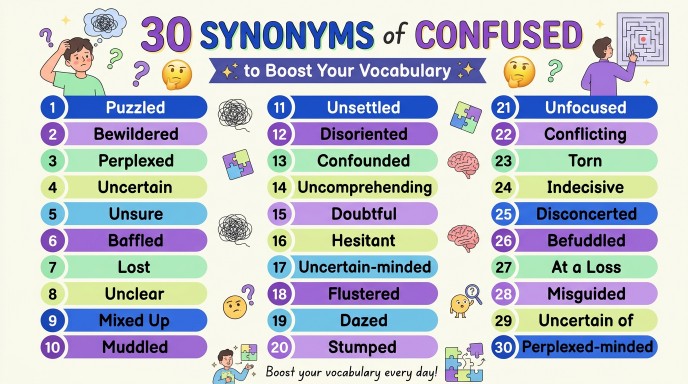
Learning synonyms of confused can help English learners express their thoughts in more precise ways. It also helps students and content writers avoid repeating the same word. Words such as puzzled, bewildered, uncertain, and perplexed have similar meanings, but each can express a different feeling.
In this guide, you will learn the meaning, grammar, history, pronunciation, and tone of confused. You will also explore 30 synonyms, simple examples, antonyms, and useful categories to help you choose the right word.
Meaning of Confused
Definition
Confused (adjective): Unable to understand something clearly, think clearly, or decide what to do.
Confused is also the past tense and past participle of the verb confuse.
Examples
- I felt confused when the teacher explained the difficult question.
- She looked confused because nobody told her about the change.
Connotative Meaning
(Connotation is the feeling or idea that a word suggests beyond its basic meaning.)
- Positive tone: Confused can describe a temporary stage of learning that leads to curiosity and discovery.
- Negative tone: It may suggest stress, worry, frustration, or a lack of understanding.
- Neutral tone: It can simply describe someone who does not understand a situation. For example, “I was confused by the instructions.”
Etymology
- Origin: Confused comes from the Latin verb confundere, meaning “to mix together” or “to mingle.”
- Latin roots: Con- means “together,” while fundere means “to pour.”
- English development: The word entered English through Old French and Latin-influenced forms.
- Modern meaning: It developed the sense of mixing things up, making them unclear, or causing someone to lose understanding.
Short History of Confused
- Old English (450–1100): The modern word confused was not yet established in English. People used other words to describe disorder, uncertainty, and a lack of understanding.
- Middle English (1100–1500): Forms related to confuse entered English through French and Latin influence. The word was associated with mixing things together and creating disorder.
- Modern English (1500–Present): Confused became widely used for both physical disorder and mental uncertainty. Today, it describes people who struggle to understand information, make decisions, or follow instructions.
Pronunciation (US & UK – IPA)
- US: /kənˈfjuːzd/
- UK: /kənˈfjuːzd/
Syllables
con-fused : 2 syllables.
Affixation Pattern of Confused
- Root: fuse, related to the Latin fundere, meaning “to pour.”
- Prefix: con-, meaning “together.”
- Suffix: -ed, used to form the past tense and past participle of the verb confuse and also to form the adjective confused.
- Base word: confuse.
Word Formation
- Confuse (verb): To make someone unsure or unable to understand.
- Confused (adjective/verb form): Unable to understand clearly; or the past form of confuse.
- Confuses (verb): Makes someone unsure or unclear.
- Confusing (adjective/verb form): Difficult to understand; or the present participle of confuse.
- Confusion (noun): A state of uncertainty or lack of understanding.
- Confusingly (adverb): In a way that causes confusion.
- Confusional (adjective): Relating to confusion, mainly in technical or medical contexts.
- Unconfused (adjective): Clear or not confused; an uncommon word.
Synonyms of Confused
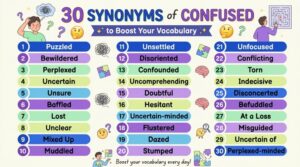
The following 30 synonyms can help you describe different kinds of confusion. Some express mild uncertainty, while others suggest deep confusion or shock.
1. Puzzled (Adjective)
US IPA: /ˈpʌz.əld/ | UK IPA: /ˈpʌz.əld/
Meaning: Unable to understand something or explain why it happened.
Examples:
- I was puzzled by the strange question.
- She looked puzzled when she saw the empty box.
2. Bewildered (Adjective)
US IPA: /bɪˈwɪl.dɚd/ | UK IPA: /bɪˈwɪl.dəd/
Meaning: Very confused because something is difficult to understand.
Examples:
- He felt bewildered by the complex instructions.
- The sudden change left everyone bewildered.
3. Perplexed (Adjective)
US IPA: /pɚˈplekst/ | UK IPA: /pəˈplekst/
Meaning: Confused because something is hard to explain or solve.
Examples:
- The teacher looked perplexed by my answer.
- I was perplexed by the unusual result.
4. Baffled (Adjective)
US IPA: /ˈbæf.əld/ | UK IPA: /ˈbæf.əld/
Meaning: Completely unable to understand something.
Examples:
- The difficult puzzle left me baffled.
- Scientists were baffled by the unexpected result.
5. Uncertain (Adjective)
US IPA: /ʌnˈsɝː.tən/ | UK IPA: /ʌnˈsɜː.tən/
Meaning: Not sure about something or what to do.
Examples:
- I am uncertain about the correct answer.
- She felt uncertain about her next step.
6. Bewildered (Adjective : Strong Confusion)
US IPA: /bɪˈwɪl.dɚd/ | UK IPA: /bɪˈwɪl.dəd/
Meaning: Deeply confused and unsure how to react.
Examples:
- He stood bewildered in the crowded station.
- The unexpected news left her bewildered.
7. Disoriented (Adjective)
US IPA: /dɪsˈɔːr.i.en.t̬ɪd/ | UK IPA: /dɪsˈɔː.ri.en.tɪd/
Meaning: Unable to understand where you are or what is happening.
Examples:
- I felt disoriented after waking from a long nap.
- The traveler became disoriented in the unfamiliar streets.
8. Perplexed (Adjective : Formal)
US IPA: /pɚˈplekst/ | UK IPA: /pəˈplekst/
Meaning: Unsure how to understand or solve a difficult matter.
Examples:
- The manager was perplexed by the conflicting reports.
- Researchers remained perplexed by the findings.
9. Flustered (Adjective)
US IPA: /ˈflʌs.tɚd/ | UK IPA: /ˈflʌs.təd/
Meaning: Confused or upset because of pressure or embarrassment.
Examples:
- I became flustered when everyone looked at me.
- She felt flustered while answering the questions.
10. Disconcerted (Adjective)
US IPA: /ˌdɪs.kənˈsɝː.tɪd/ | UK IPA: /ˌdɪs.kənˈsɜː.tɪd/
Meaning: Worried or confused because something unexpected has happened.
Examples:
- He seemed disconcerted by the sudden question.
- The strange reply left her disconcerted.
11. Uncertain (Adjective : Doubtful)
US IPA: /ʌnˈsɝː.tən/ | UK IPA: /ʌnˈsɜː.tən/
Meaning: Having doubts about a fact, choice, or outcome.
Examples:
- She was uncertain if to accept the offer.
- We are uncertain about tomorrow’s plans.
12. Confounded (Adjective)
US IPA: /kənˈfaʊn.dɪd/ | UK IPA: /kənˈfaʊn.dɪd/
Meaning: Greatly confused or surprised by something difficult to explain.
Examples:
- I was confounded by the complicated instructions.
- The unexpected question left him confounded.
13. Nonplussed (Adjective)
US IPA: /ˌnɑːnˈplʌst/ | UK IPA: /ˌnɒnˈplʌst/
Meaning: So surprised or confused that you do not know how to respond.
Examples:
- She was nonplussed by his unusual request.
- He looked nonplussed when the plan changed.
14. At a Loss (Adjective Phrase)
US IPA: /æt ə lɔːs/ | UK IPA: /æt ə lɒs/
Meaning: Unable to think of what to say or do.
Examples:
- I was at a loss for words.
- She was at a loss about how to solve the problem.
15. Unclear (Adjective)
US IPA: /ˌʌnˈklɪr/ | UK IPA: /ˌʌnˈklɪə/
Meaning: Difficult to understand because information is not clear.
Examples:
- The instructions were unclear to me.
- His explanation was unclear, so I asked again.
16. Uncertain-Minded (Adjective)
US IPA: /ʌnˈsɝː.tən ˈmaɪn.dɪd/ | UK IPA: /ʌnˈsɜː.tən ˈmaɪn.dɪd/
Meaning: Unsure about what to believe or decide.
Examples:
- He seemed uncertain-minded about the choice.
- She was uncertain-minded when asked to choose a subject.
Usage note: Uncertain-minded is uncommon and often sounds unnatural. In everyday English, use uncertain, indecisive, or unsure instead.
17. Stumped (Adjective)
US IPA: /stʌmpt/ | UK IPA: /stʌmpt/
Meaning: Unable to find an answer or solve a problem.
Examples:
- The final question left me stumped.
- Even the expert was stumped by the puzzle.
18. Flummoxed (Adjective)
US IPA: /ˈflʌm.əkst/ | UK IPA: /ˈflʌm.əkst/
Meaning: Completely confused and unsure what to do.
Examples:
- I was flummoxed by the strange directions.
- The unexpected result left the team flummoxed.
19. Mystified (Adjective)
US IPA: /ˈmɪs.tə.faɪd/ | UK IPA: /ˈmɪs.tɪ.faɪd/
Meaning: Unable to understand why something happens or how it works.
Examples:
- We were mystified by the missing keys.
- She felt mystified by his sudden silence.
20. Befuddled (Adjective)
US IPA: /bɪˈfʌd.əld/ | UK IPA: /bɪˈfʌd.əld/
Meaning: Confused and unable to think clearly.
Examples:
- He looked befuddled by the long explanation.
- I felt befuddled after reading the difficult passage.
21. Discombobulated (Adjective)
US IPA: /ˌdɪs.kəmˈbɑː.bjə.leɪ.t̬ɪd/ | UK IPA: /ˌdɪs.kəmˈbɒb.jə.leɪ.tɪd/
Meaning: Confused, unsettled, or thrown off balance.
Examples:
- The sudden schedule change left me discombobulated.
- She felt discombobulated in the unfamiliar building.
22. Perplexing (Adjective)
US IPA: /pɚˈplek.sɪŋ/ | UK IPA: /pəˈplek.sɪŋ/
Meaning: Difficult to understand or explain.
Examples:
- The case presented a perplexing problem.
- We received a perplexing message from the office.
Usage note: Perplexing usually describes the thing that causes confusion, while perplexed describes the person who feels confused.
23. Uncomprehending (Adjective)
US IPA: /ˌʌn.kɑːm.prɪˈhen.dɪŋ/ | UK IPA: /ˌʌn.kɒm.prɪˈhen.dɪŋ/
Meaning: Failing to understand what someone says or what is happening.
Examples:
- He gave me an uncomprehending look.
- The child listened with an uncomprehending expression.
24. Distracted (Adjective)
US IPA: /dɪˈstræk.tɪd/ | UK IPA: /dɪˈstræk.tɪd/
Meaning: Unable to focus because your attention is elsewhere.
Examples:
- I felt distracted during the lesson.
- She was distracted by the noise outside.
Usage note: Being distracted can cause confusion, but the two words are not exact synonyms.
25. Indecisive (Adjective)
US IPA: /ˌɪn.dɪˈsaɪ.sɪv/ | UK IPA: /ˌɪn.dɪˈsaɪ.sɪv/
Meaning: Unable to make a choice easily.
Examples:
- He was indecisive about which course to take.
- She felt indecisive when choosing a gift.
26. Doubtful (Adjective)
US IPA: /ˈdaʊt.fəl/ | UK IPA: /ˈdaʊt.fəl/
Meaning: Unsure that something is true or likely to happen.
Examples:
- I was doubtful about the accuracy of the report.
- She looked doubtful when she heard the claim.
27. Hesitant (Adjective)
US IPA: /ˈhez.ə.tənt/ | UK IPA: /ˈhez.ɪ.tənt/
Meaning: Slow to act or speak because of uncertainty.
Examples:
- He was hesitant to answer the question.
- She felt hesitant about joining the group.
28. Unsettled (Adjective)
US IPA: /ʌnˈset̬.əld/ | UK IPA: /ʌnˈset.əld/
Meaning: Worried or uncomfortable because something feels uncertain.
Examples:
- The unexpected news left me unsettled.
- She felt unsettled by the unclear message.
29. Confounded (Adjective :Frustrated)
US IPA: /kənˈfaʊn.dɪd/ | UK IPA: /kənˈfaʊn.dɪd/
Meaning: Confused or frustrated by something that is difficult to work out.
Examples:
- The confounded puzzle took hours to solve.
- He was confounded by the repeated errors.
30. Unsure (Adjective)
US IPA: /ʌnˈʃʊr/ | UK IPA: /ʌnˈʃɔː/
Meaning: Not certain about something or not knowing what to do.
Examples:
- I am unsure which answer is correct.
- She felt unsure about speaking in front of the class.
Prototype Meaning
The most typical meaning of confused is being unable to understand something clearly or decide what to do. When people hear this word, they may imagine a student who cannot answer a question, a person who takes the wrong road, or someone who does not understand a set of instructions. Confusion can be mild, such as feeling unsure about a choice, or strong, such as feeling bewildered by an unexpected event. The best synonym depends on how confused someone feels and why they feel that way.
Prototype Categorization
Synonyms of confused can be grouped by the type and strength of confusion they describe.
- Mild confusion: Puzzled, uncertain, unsure, and unclear. Use these when someone needs more information or does not fully understand something.
- Strong confusion: Bewildered, baffled, perplexed, flummoxed, and befuddled. These words suggest that something is very difficult to understand.
- Confusion under pressure: Flustered, disconcerted, and discombobulated. Use these when stress, embarrassment, or unexpected changes affect someone’s thinking.
- Difficulty finding answers: Stumped, mystified, nonplussed, and at a loss. These expressions fit situations where someone cannot explain something or decide what to do.
- Doubt and indecision: Doubtful, hesitant, indecisive, and uncertain. These words describe trouble making a choice or believing something.
- Lack of understanding: Uncomprehending and perplexed. These words work well when someone struggles to understand information or an explanation.
- Distraction and discomfort: Distracted and unsettled. These describe states that may cause confusion but do not always mean a person lacks understanding.
Categorization helps writers choose words that express the right feeling. For example, puzzled works well for a simple question, while bewildered suggests stronger confusion. Hesitant is better when someone is slow to act because of doubt. Choosing carefully makes your writing more accurate and engaging.
Antonyms of Confused
Antonyms are words with opposite meanings. The best antonym for confused depends on the situation.
- Clear (adjective): Easy to understand. Example: The teacher gave a clear explanation.
- Certain (adjective): Sure about something. Example: I am certain that this answer is correct.
- Confident (adjective): Feeling sure about your abilities or decisions. Example: She felt confident before the test.
- Aware (adjective): Having knowledge of a situation or fact. Example: He was aware of the new rules.
- Understanding (adjective): Showing that someone understands something. Example: She gave me an understanding look.
- Informed (adjective): Having useful or correct information. Example: The students were well informed about the exam.
- Comprehending (adjective): Understanding the meaning of something. Example: The child was comprehending the lesson.
- Decisive (adjective): Able to make choices quickly and confidently. Example: The manager made a decisive choice.
- Certain (adjective): Free from doubt about a fact or result. Example: He was certain about his decision.
- Oriented (adjective): Aware of your location or surroundings. Example: After resting, she felt oriented again.
Short Questions and Answers
– What does confused mean?
Confused means being unable to understand something clearly or feeling unsure about what to do.
– When should confused be used?
Use confused when someone struggles to understand information, follow directions, or make a decision. For example, “I felt confused by the instructions.”
– Is confused positive or negative?
It is usually negative or neutral. It can describe a normal stage of learning, but it often suggests uncertainty or difficulty understanding something.
– How is confused different from similar words?
Puzzled suggests curiosity about something difficult to explain. Bewildered describes stronger confusion. Unsure means not certain, while flustered suggests confusion caused by pressure or embarrassment.
– What is the most common synonym for confused?
Puzzled, unsure, and uncertain are common alternatives. The best choice depends on the context.
– Can confused describe a person and a situation?
Yes. You can say, “I am confused,” or “The instructions are confusing.” The adjective confused describes how someone feels, while confusing describes something that causes confusion.
– What is the noun form of confused?
The noun is confusion. For example, “The confusing instructions caused confusion.”
Conclusion
Learning synonyms of confused helps you express uncertainty and difficulty understanding things in more precise ways. Words such as puzzled, bewildered, perplexed, unsure, and flustered can describe different levels and types of confusion. Understanding their meanings helps you avoid repetition in essays, articles, schoolwork, and everyday conversations.
Pronunciation, grammar, word history, and emotional tone also help you use each word correctly. For example, stumped is useful when you cannot solve a problem, while hesitant describes someone who is unsure about taking action. Choosing the right word makes your English clearer and more natural.
Try learning three new synonyms each day. Write simple sentences, read English texts, and use the words in conversations. With regular practice, you can improve your vocabulary, strengthen your writing and speaking, and build confidence in English.
Explore more about!
- Synonyms of Boring: Best Alternative Words to Know
- Synonyms of Anarchy: Best Alternative Words to Know
- Synonyms of Desolate: The Ultimate Visual Guide

I am a linguist with 17 years of experience in English language teaching, including postgraduate-level instruction. My expertise includes English grammar, and I contribute as a content and blog writer, producing scholarly and educational language resources.