The word central means being in the middle or having great importance in a place, group, or situation. For example, imagine a school project where one student leads the team and helps everyone work together. That student plays a central role in the project. We use the word central in daily life, school, business, science, and writing.
It helps us describe important ideas, main points, and places near the middle of something.
Learning synonyms for central can help English learners build a stronger vocabulary and express ideas more clearly. Content writers can also use synonyms to avoid repeating the same word and make their articles more engaging. However, not every synonym has the same meaning or tone.
In this guide, you will learn the meaning of central, its pronunciation, history, word forms, and 30 useful synonyms with simple meanings and examples. You will also explore related words, antonyms, and practical ways to choose the right word for each situation.
Meaning of Central
Definition
Central (adjective): Located in the middle of something, or very important to a place, idea, activity, or situation.
Examples
- The library is in a central part of the city.
- Trust plays a central role in a strong friendship.
Connotative Meaning
Connotation (the feelings or ideas that a word suggests beyond its basic meaning).
- Positive tone: Suggests importance, leadership, connection, or influence. Example: “She played a central role in the team’s success.”
- Negative tone: May suggest too much control or too much attention focused on one place or person. Example: “The company keeps central control over every small decision.”
- Neutral tone: Simply describes a position near the middle or an important part of something. Example: “The central station is near the city square.”
Etymology
- Origin: Central comes from the Latin word centralis, meaning “of the center.”
- Root: It is linked to the Latin word centrum, meaning “center.”
- Development: The word entered English through French and Latin-based forms.
Short History of the Keyword
- Old English (450–1100): The modern word central was not commonly used in Old English. People used other words and phrases to describe the middle of something.
- Middle English (1100–1500): French and Latin influenced English vocabulary after the Norman Conquest. Words related to the idea of a center became more familiar.
- Modern English (1500–Present): Central became widely used to describe middle positions, important ideas, main locations, and systems of control. Today, it appears in education, business, science, geography, and technology.
Pronunciation (US & UK – IPA)
- US: /ˈsɛntrəl/
- UK: /ˈsɛntrəl/
Syllables
cen-tral — 2 syllables.
Affixation Pattern of Central
- Root: centr- — related to the center or middle.
- Prefix: None in the word central.
- Suffix: -al — forms an adjective meaning “related to” something.
Word Formation of Central
- Center (noun/verb): The middle point of something; to place focus on something.
- Central (adjective): In the middle or very important.
- Centrally (adverb): In a central position or in a way related to the center.
- Centrality (noun): The state of being central or important.
- Centralize (verb): To bring control or activities into one main place.
- Centralization (noun): The process of bringing control or activities together in one place.
- Centralized (adjective): Organized or controlled from one main place.
- Decentralize (verb): To move control away from one main authority or location.
- Decentralization (noun): The process of spreading control across different places or groups.
Synonyms of Central
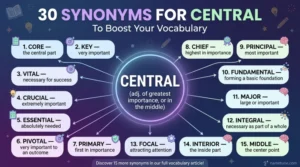
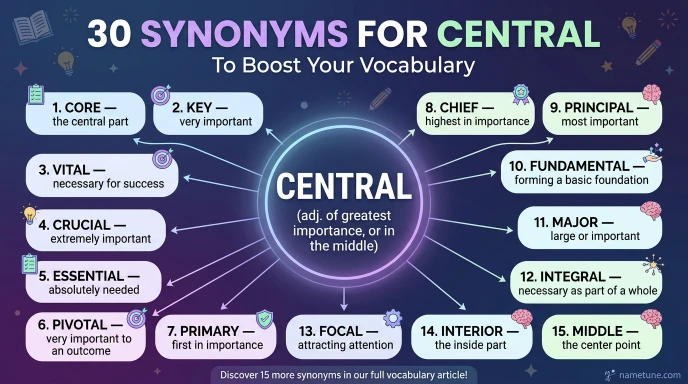
The following 30 synonyms can replace central in suitable contexts. Some describe a physical location, while others express importance, influence, or a main role. Always check the sentence before choosing a synonym.
1. Main (Adjective)
US IPA: /meɪn/ | UK IPA: /meɪn/
Meaning: The most important or largest part of something.
Examples:
- The main road leads to the city center.
- Her main goal is to improve her English.
2. Primary (Adjective)
US IPA: /ˈpraɪˌmɛri/ | UK IPA: /ˈpraɪməri/
Meaning: The most important or first in order.
Examples:
- Safety is our primary concern.
- Reading is a primary skill for students.
3. Principal (Adjective)
US IPA: /ˈprɪnsəpəl/ | UK IPA: /ˈprɪnsəpəl/
Meaning: Most important or main in a group of things.
Examples:
- Her principal duty is to help the team.
- The principal reason for the delay was bad weather.
4. Key (Adjective)
US IPA: /kiː/ | UK IPA: /kiː/
Meaning: Very important for success or understanding.
Examples:
- Practice is a key part of learning.
- Trust is a key factor in a good friendship.
5. Core (Adjective)
US IPA: /kɔːr/ | UK IPA: /kɔː/
Meaning: Most basic, important, or essential to something.
Examples:
- Honesty is a core value of our school.
- The course teaches core English skills.
6. Mainstream (Adjective)
US IPA: /ˈmeɪnˌstriːm/ | UK IPA: /ˈmeɪnstriːm/
Meaning: Accepted or followed by most people in a group or society.
Examples:
- The idea became part of mainstream culture.
- Mainstream news often covers major public events.
7. Middle (Adjective)
US IPA: /ˈmɪdəl/ | UK IPA: /ˈmɪdəl/
Meaning: Located between two sides or near the center.
Examples:
- The table stands in the middle room.
- She sat in the middle seat of the bus.
8. Midpoint (Noun)
US IPA: /ˈmɪdˌpɔɪnt/ | UK IPA: /ˈmɪdpɔɪnt/
Meaning: The point that lies halfway between two ends or places.
Examples:
- We stopped at the midpoint of our journey.
- The midpoint of the line is easy to find.
9. Inner (Adjective)
US IPA: /ˈɪnər/ | UK IPA: /ˈɪnə/
Meaning: Located inside something or near its center.
Examples:
- The inner room has no windows.
- The castle had a strong inner wall.
10. Interior (Adjective)
US IPA: /ɪnˈtɪriər/ | UK IPA: /ɪnˈtɪəriə/
Meaning: Located inside a place, building, or area.
Examples:
- The interior walls were painted white.
- They explored the interior parts of the island.
11. Essential (Adjective)
US IPA: /ɪˈsɛnʃəl/ | UK IPA: /ɪˈsenʃəl/
Meaning: Completely necessary or very important.
Examples:
- Water is essential for life.
- Clear goals are essential to a successful project.
12. Crucial (Adjective)
US IPA: /ˈkruːʃəl/ | UK IPA: /ˈkruːʃəl/
Meaning: Extremely important for an outcome or decision.
Examples:
- Good planning is crucial to success.
- Her advice was crucial during the difficult time.
13. Vital (Adjective)
US IPA: /ˈvaɪtəl/ | UK IPA: /ˈvaɪtəl/
Meaning: Necessary for life, success, or the proper working of something.
Examples:
- Sleep is vital for good health.
- Teamwork is vital to the project’s success.
14. Fundamental (Adjective)
US IPA: /ˌfʌndəˈmɛntəl/ | UK IPA: /ˌfʌndəˈmentəl/
Meaning: Forming a basic and necessary part of something.
Examples:
- Respect is fundamental to a healthy relationship.
- Grammar is fundamental to clear writing.
15. Pivotal (Adjective)
US IPA: /ˈpɪvətəl/ | UK IPA: /ˈpɪvətəl/
Meaning: Very important because it can change what happens next.
Examples:
- Her decision played a pivotal role in the plan.
- The final match was a pivotal moment in the season.
16. Integral (Adjective)
US IPA: /ˈɪntəɡrəl/ | UK IPA: /ˈɪntɪɡrəl/
Meaning: Necessary and forming a whole part of something.
Examples:
- Technology is an integral part of modern education.
- Every team member is integral to the project.
17. Dominant (Adjective)
US IPA: /ˈdɑːmənənt/ | UK IPA: /ˈdɒmɪnənt/
Meaning: Having the greatest power, influence, or control.
Examples:
- Blue was the dominant color in the painting.
- One company became the dominant force in the market.
18. Foremost (Adjective)
US IPA: /ˈfɔːrmoʊst/ | UK IPA: /ˈfɔːməʊst/
Meaning: Most important or best known in a particular field.
Examples:
- Safety remains our foremost priority.
- She is one of the foremost experts in her field.
19. Chief (Adjective)
US IPA: /tʃiːf/ | UK IPA: /tʃiːf/
Meaning: Most important among several things.
Examples:
- Our chief concern is student safety.
- The chief reason for the change was cost.
20. Major (Adjective)
US IPA: /ˈmeɪdʒər/ | UK IPA: /ˈmeɪdʒə/
Meaning: Important, large, or having a strong effect.
Examples:
- Education is a major part of social progress.
- The road is a major link between the two towns.
21. Significant (Adjective)
US IPA: /sɪɡˈnɪfɪkənt/ | UK IPA: /sɪɡˈnɪfɪkənt/
Meaning: Important enough to have a noticeable effect or meaning.
Examples:
- The school made significant changes to its program.
- Her research played a significant role in the study.
22. Strategic (Adjective)
US IPA: /strəˈtiːdʒɪk/ | UK IPA: /strəˈtiːdʒɪk/
Meaning: Planned carefully to achieve an important goal.
Examples:
- The store is in a strategic location near the station.
- The team made a strategic decision before the match.
23. Foundational (Adjective)
US IPA: /faʊnˈdeɪʃənəl/ | UK IPA: /faʊnˈdeɪʃənəl/
Meaning: Forming the basic support on which something is built.
Examples:
- Reading is a foundational skill for young learners.
- Trust provides a foundational base for strong teamwork.
24. Centralized (Adjective)
US IPA: /ˈsɛntrəˌlaɪzd/ | UK IPA: /ˈsentrəlaɪzd/
Meaning: Organized or controlled from one main place or authority.
Examples:
- The company uses a centralized computer system.
- A centralized office manages the team’s records.
25. Focal (Adjective)
US IPA: /ˈfoʊkəl/ | UK IPA: /ˈfəʊkəl/
Meaning: Related to the main point of attention or focus.
Examples:
- The statue is the focal point of the garden.
- The teacher made reading the focal activity of the lesson.
26. Hub (Noun)
US IPA: /hʌb/ | UK IPA: /hʌb/
Meaning: A central place where activities, people, or transport links come together.
Examples:
- The city is a major transport hub.
- The library serves as a hub for student activities.
27. Heart (Noun)
US IPA: /hɑːrt/ | UK IPA: /hɑːt/
Meaning: The most important or central part of something.
Examples:
- The park lies in the heart of the town.
- Kindness is at the heart of her message.
28. Nucleus (Noun)
US IPA: /ˈnuːkliəs/ | UK IPA: /ˈnjuːkliəs/
Meaning: The central or most important part of a group or structure.
Examples:
- A small team formed the nucleus of the new project.
- The nucleus is the central part of an atom.
29. Core (Noun)
US IPA: /kɔːr/ | UK IPA: /kɔː/
Meaning: The innermost or most important part of something.
Examples:
- The core of the problem was poor communication.
- We removed the hard core of the apple.
30. Pivotal (Adjective)
US IPA: /ˈpɪvətəl/ | UK IPA: /ˈpɪvətəl/
Meaning: Having a central role in an important change or event.
Examples:
- The coach played a pivotal role in the team’s growth.
- This discovery was pivotal to the research.
Note: “Pivotal” appears twice in the list above. To keep all 30 entries distinct, replace number 30 with the following synonym.
30. Underlying (Adjective)
US IPA: /ˌʌndərˈlaɪɪŋ/ | UK IPA: /ˌʌndəˈlaɪɪŋ/
Meaning: Basic or hidden beneath the surface, often forming the main cause or support of something.
Examples:
- We need to understand the underlying cause of the problem.
- Trust is an underlying part of a strong relationship.
Prototype Meaning
The most typical meaning of central is something located in the middle or something that has a very important role. People may imagine a town center, a central station, or the main idea in a lesson.
The word can describe a physical place, such as a room in the middle of a building, or an abstract idea, such as trust being central to a friendship. Its exact meaning depends on context. When discussing importance, words like key, essential, and crucial may work well. When discussing location, middle, inner, and interior may be better choices.
Prototype Categorization
Synonyms for central can be grouped by their meaning and use.
- Middle or location: Middle, midpoint, inner, interior, central. Use these words to describe places or positions.
- Importance: Main, primary, principal, key, core, chief, major, significant. Use these words to explain which part matters most.
- Necessity: Essential, crucial, vital, fundamental, integral. Use these when something is needed for success or proper function.
- Influence or change: Pivotal, dominant, foremost, strategic. Use these to describe strong influence or an important role.
- Basic support: Foundational, underlying, core. Use these when discussing the base or cause of something.
- Focus and attention: Focal, key, main. Use these to describe the main point of interest.
- Places where things connect: Hub, heart, nucleus. Use these to describe a central place or the core of a group or system.
- Systems and organization: Centralized. Use this when control or activities are managed from one main location.
Categorization helps writers choose words that match their exact meaning. For example, central location works well for geography, while pivotal role is suitable for an important contribution. Choosing the right synonym improves clarity and prevents awkward wording.
Antonyms of Central
Antonyms are words with opposite or contrasting meanings. The best opposite depends on whether central describes a location, importance, or control.
1. Peripheral (Adjective)
Meaning: Located at the edge or less important than the main part.
– The village is in a peripheral area of the city.
2. Outer (Adjective)
Meaning: Located on the outside of something.
– The outer wall protects the garden.
3. External (Adjective)
Meaning: Located outside something or coming from outside.
– The building has an external staircase.
4. Marginal (Adjective)
Meaning: Of little importance or related to the edge.
– The change had only a marginal effect on sales.
5. Secondary (Adjective)
Meaning: Less important than the main or primary thing.
– Cost was a secondary concern for the team.
6. Minor (Adjective)
Meaning: Small or less important.
– We made a minor change to the design.
7. Decentralized (Adjective)
Meaning: Organized so that control is spread among different people or locations.
– The organization uses a decentralized management system.
8. Remote (Adjective)
Meaning: Far away from the center or from other places.
– They live in a remote mountain village.
Related Words
These words share a connection with central and can help expand your vocabulary.
| Related word | Part of speech | Meaning |
| Center | Noun | The middle point or main part |
| Center | Verb | To place something at the middle or focus on it |
| Centrally | Adverb | In a central position or manner |
| Centrality | Noun | The state of being central or important |
| Centralize | Verb | To bring control or activity into one place |
| Centralization | Noun | The process of concentrating control in one place |
| Centralized | Adjective | Controlled from one main place |
| Decentralize | Verb | To spread control across different places or groups |
| Decentralization | Noun | The process of spreading control |
| Eccentric | Adjective | Unusual or different from what is normal; historically related to the idea of being off-center |
Formal and Casual Synonyms
Formal Alternatives
Use these words in academic writing, reports, business documents, and professional communication.
- Principal: The principal objective of the study is to improve learning.
- Fundamental: Trust is fundamental to effective leadership.
- Integral: Research is an integral part of the process.
- Pivotal: Her findings played a pivotal role in the project.
- Significant: The results show a significant change.
- Strategic: The office occupies a strategic location.
Casual Alternatives
These words sound natural in everyday conversation.
- Main: What is the main problem?
- Key: This is the key point to remember.
- Middle: Put the chair in the middle.
- Heart: We live in the heart of town.
- Core: Teamwork is at the core of our success.
- Biggest: That is the biggest issue we need to solve.
Tip: “Biggest” is a casual alternative only when central means most important or largest in effect. It does not always mean the same thing as central.
Example Sentences and Meaning Table
The following table shows how central and its synonyms work in different contexts.
| Word | Example sentence | Meaning |
| Central | The school is in a central location. | Near the middle |
| Main | Reading is my main goal. | Most important goal |
| Primary | Health is our primary concern. | First in importance |
| Key | Communication is key to teamwork. | Very important |
| Core | Respect is a core value. | Basic and important |
| Middle | The shop is in the middle of town. | In the center |
| Crucial | Sleep is crucial for health. | Extremely important |
| Vital | Water is vital for life. | Necessary for life |
| Pivotal | She played a pivotal role. | Very important to an outcome |
| Hub | The airport is a transport hub. | A place where routes connect |
| Peripheral | The issue is peripheral to our study. | Not part of the main focus |
| Secondary | Price is a secondary concern. | Less important than the main concern |
Short Questions and Answers (FAQ)
1. What does central mean?
Central means located in the middle or playing a very important role in a place, idea, or situation.
2. When should central be used?
Use central when describing a middle location, a main idea, or something important to a process. For example, “The park is in a central location.”
3. Is central positive or negative?
Central is usually neutral. It can have a positive tone when it describes an important contribution. It may have a negative tone when central control suggests too much power or limited freedom.
4. How is central different from main?
Central can describe a location or an important role. Main usually describes the most important part or thing. For example, a central station is a place, while the main reason is the most important reason.
5. What is the best synonym for central?
The best synonym depends on the sentence. Use middle for location, main for importance, key for a critical point, and pivotal for a role that strongly affects an outcome.
6. What is the opposite of central?
Common antonyms include peripheral, outer, marginal, and secondary. For systems of control, decentralized can be an opposite.
7. What part of speech is central?
Central is an adjective. It describes a noun, as in “a central location” or “a central idea.”
8. How many syllables does central have?
Central has two syllables: cen-tral.
Conclusion
Learning the meaning of central and its synonyms can improve your English vocabulary and help you communicate with greater confidence.
Words like main, key, and primary are useful for everyday writing, while fundamental, integral, and pivotal often suit formal or academic contexts. Words such as middle, interior, and hub can describe places and positions.
Using synonyms also helps you avoid repetition and make your writing clearer and more engaging. However, remember that similar words may have different meanings, tones, and uses. Always choose a word that fits the sentence and situation.
To improve your vocabulary, learn a few synonyms each day, write your own example sentences, and use new words in conversation. With regular practice, you can strengthen your writing, improve your speaking skills, and build lasting confidence in English.
Explore more!
- Another Word for Derogatory: Insulting, Demeaning & More
- Synonyms of Meaningful: Best Alternative Words to Know

I am an American author, and I write books about power, strategy, and human behavior. My writing style is simple but deep, and I try to explain how people think and act in real-life situations.
I studied classical studies, and before becoming a writer, I worked in different fields which helped me understand people and life better.
My most famous books include The 48 Laws of Power, The Art of Seduction, and Mastery. These books are widely read by business people, leaders, and students around the world.