The word park usually means a public green space where people relax, walk, play, or enjoy nature. Imagine a family spending a sunny afternoon under trees, children playing on swings, and friends enjoying a picnic.
This is a typical situation where the word park is used. It is a common word in everyday English because parks are important places for recreation, exercise, and community activities.
Learning synonyms for park helps English learners, students, writers, and content creators improve their vocabulary and avoid repeating the same word. Different synonyms can fit different situations and writing styles.
In this article, you will learn the meaning of park, its pronunciation, history, connotative meaning, grammar, and 30 useful synonyms with examples. You will also explore semantic categories, related words, antonyms, and practical usage tips.
Meaning of Park
Definition
Park (Noun):
A public area of land with grass, trees, and open spaces used for recreation, relaxation, or outdoor activities.
Park (Verb):
To leave a vehicle in a particular place for a period of time.
Examples
- We spent the afternoon in the park.
- She parked her car near the library.
Connotative Meaning
(Connotation: the emotional or cultural feeling associated with a word beyond its dictionary meaning.)
- Positive Tone: Nature, relaxation, recreation, beauty, peace, community.
- Negative Tone: Can suggest overcrowding, noise, or lack of maintenance in some contexts.
- Neutral Tone: Simply refers to a public green area or the act of leaving a vehicle.
Etymology
- Origin: Old French and Medieval Latin.
- Derived from Old French parc.
- Related to Medieval Latin parricus.
- Original meaning: An enclosed area of land reserved for animals, hunting, or recreation.
Short History of the Keyword
Old English (450–1100)
- The exact word park was not common.
- People used words related to fields, forests, and enclosed lands.
Middle English (1100–1500)
- The word entered English from Old French parc.
- It referred to enclosed hunting grounds and estates.
Modern English (1500–Present)
- The meaning expanded to public recreational spaces, gardens, and urban green areas.
- It also became a verb meaning to leave a vehicle in a designated place.
Pronunciation (US & UK – IPA)
US:
park (/pɑːrk/)
UK:
park (/pɑːk/)
Syllables
park (1 syllable)
Affixation Pattern of Park
Root
- park
Prefix
- None
Suffix
- None
Word Formation
- park (noun) – public green area
- park (verb) – leave a vehicle
- parked (verb) – left a vehicle
- parking (noun/verb) – act of leaving a vehicle
- parks (noun/verb) – plural or present tense
- parkland (noun) – large area of park-like land
- parkway (noun) – landscaped road
Related Words
- garden
- playground
- reserve
- recreation area
- green space
- woodland
- forest
- meadow
- picnic area
- parking lot
Formal and Casual Alternatives
| Formal | Casual |
|---|---|
| Recreation Area | Park |
| Nature Reserve | Green Space |
| Public Garden | Garden |
| Conservation Area | Open Space |
| Urban Park | Community Park |
Example Sentence and Meaning Table
| Word | Meaning | Example |
|---|---|---|
| Park | Public recreation area | We walked in the park. |
| Garden | Area with plants and flowers | She visited the garden. |
| Reserve | Protected natural area | The reserve attracts tourists. |
| Playground | Area for children’s play | Kids enjoyed the playground. |
| Green Space | Open natural area | The city created more green spaces. |
Synonyms of Park
1. Garden (Noun)
US: /ˈɡɑːrdən/ | UK: /ˈɡɑːdn/
Meaning: An area with plants, flowers, and landscaping.
Examples:
- She enjoyed walking through the garden.
- The garden was full of colorful flowers.
2. Playground (Noun)
US: /ˈpleɪɡraʊnd/ | UK: /ˈpleɪɡraʊnd/
Meaning: An outdoor area designed for children’s activities.
Examples:
- Children played happily in the playground.
- The school built a new playground.
3. Reserve (Noun)
US: /rɪˈzɜːrv/ | UK: /rɪˈzɜːv/
Meaning: A protected area for wildlife or nature.
Examples:
- The reserve protects rare animals.
- Visitors explored the nature reserve.
4. Green Space (Noun)
US: /ɡriːn speɪs/ | UK: /ɡriːn speɪs/
Meaning: Open land covered with grass, trees, or plants.
Examples:
- Cities need more green spaces.
- Families gathered in the green space.
5. Recreation Area (Noun)
US: /ˌrekriˈeɪʃən ˈeriə/ | UK: /ˌrekriˈeɪʃən ˈeəriə/
Meaning: A place for leisure and outdoor activities.
Examples:
- The recreation area includes hiking trails.
- People visited the recreation area on weekends.
6. Public Garden (Noun)
US: /ˈpʌblɪk ˈɡɑːrdən/ | UK: /ˈpʌblɪk ˈɡɑːdn/
Meaning: A garden open for everyone to visit.
Examples:
- The public garden attracts many tourists.
- We spent the morning in the public garden.
7. Nature Reserve (Noun)
US: /ˈneɪtʃər rɪˌzɜːrv/ | UK: /ˈneɪtʃə rɪˌzɜːv/
Meaning: A protected area for wildlife and nature.
Examples:
- The nature reserve is home to many birds.
- Scientists studied animals in the reserve.
8. Common (Noun)
US: /ˈkɑːmən/ | UK: /ˈkɒmən/
Meaning: Shared open land used by the public.
Examples:
- People gathered on the common.
- The village common hosted local events.
9. Meadow (Noun)
US: /ˈmedoʊ/ | UK: /ˈmedəʊ/
Meaning: A field covered with grass and wildflowers.
Examples:
- The meadow looked beautiful in spring.
- Cows grazed in the meadow.
10. Plaza (Noun)
US: /ˈplɑːzə/ | UK: /ˈplɑːzə/
Meaning: An open public square in a town or city.
Examples:
- Tourists gathered in the plaza.
- The plaza was busy during the festival.
11. Open Space (Noun)
US: /ˈoʊpən speɪs/ | UK: /ˈəʊpən speɪs/
Meaning: An outdoor area free from buildings and heavy development.
Examples:
- Families enjoyed the open space on weekends.
- The city preserved the open space for public use.
12. Woodland (Noun)
US: /ˈwʊdlænd/ | UK: /ˈwʊdlənd/
Meaning: Land covered with trees and natural vegetation.
Examples:
- The woodland was filled with birds.
- Visitors explored the woodland trail.
13. Forest (Noun)
US: /ˈfɔːrɪst/ | UK: /ˈfɒrɪst/
Meaning: A large area covered mainly with trees.
Examples:
- The forest attracts many hikers.
- Animals live safely in the forest.
14. Arboretum (Noun)
US: /ˌɑːrbəˈriːtəm/ | UK: /ˌɑːbəˈriːtəm/
Meaning: A place where different kinds of trees are grown for study and display.
Examples:
- Students visited the arboretum.
- The arboretum contains rare tree species.
15. Botanical Garden (Noun)
US: /bəˈtænɪkəl ˈɡɑːrdən/ | UK: /bəˈtænɪkəl ˈɡɑːdn/
Meaning: A garden dedicated to the collection and display of plants.
Examples:
- Tourists explored the botanical garden.
- Scientists study rare species in the botanical garden.
16. Courtyard (Noun)
US: /ˈkɔːrtiɑːrd/ | UK: /ˈkɔːtjɑːd/
Meaning: An open area surrounded by buildings.
Examples:
- Students relaxed in the courtyard.
- The courtyard was decorated with plants.
17. Promenade (Noun)
US: /ˌprɑːməˈneɪd/ | UK: /ˌprɒməˈneɪd/
Meaning: A public walkway for walking and leisure.
Examples:
- People walked along the promenade.
- The promenade offered beautiful views.
18. Grounds (Noun)
US: /ɡraʊndz/ | UK: /ɡraʊndz/
Meaning: Land surrounding a building or institution.
Examples:
- Visitors toured the castle grounds.
- The school grounds were well maintained.
19. Picnic Area (Noun)
US: /ˈpɪknɪk ˈeriə/ | UK: /ˈpɪknɪk ˈeəriə/
Meaning: A designated outdoor place for eating and relaxing.
Examples:
- Families gathered in the picnic area.
- The picnic area had many tables.
20. Community Park (Noun)
US: /kəˈmjuːnəti pɑːrk/ | UK: /kəˈmjuːnəti pɑːk/
Meaning: A local park designed for neighborhood activities.
Examples:
- Children play in the community park every day.
- The community park hosts events throughout the year.
21. Recreation Ground (Noun)
US: /ˌrekriˈeɪʃən ɡraʊnd/ | UK: /ˌrekriˈeɪʃən ɡraʊnd/
Meaning: An outdoor area used for sports and leisure activities.
Examples:
- Children played football on the recreation ground.
- The recreation ground is open every day.
22. Civic Park (Noun)
US: /ˈsɪvɪk pɑːrk/ | UK: /ˈsɪvɪk pɑːk/
Meaning: A public park managed by a city or local authority.
Examples:
- The civic park hosts community events.
- Visitors enjoy walking in the civic park.
23. Urban Park (Noun)
US: /ˈɜːrbən pɑːrk/ | UK: /ˈɜːbən pɑːk/
Meaning: A park located within a city.
Examples:
- The urban park provides green space for residents.
- Many people exercise in the urban park.
24. Memorial Park (Noun)
US: /məˈmɔːriəl pɑːrk/ | UK: /məˈmɔːriəl pɑːk/
Meaning: A park created to honor people or events.
Examples:
- Tourists visited the memorial park.
- The memorial park remembers local heroes.
25. National Park (Noun)
US: /ˈnæʃənəl pɑːrk/ | UK: /ˈnæʃənəl pɑːk/
Meaning: A protected area preserved for nature and recreation.
Examples:
- The national park attracts thousands of visitors.
- Wildlife thrives in the national park.
26. State Park (Noun)
US: /steɪt pɑːrk/ | UK: /steɪt pɑːk/
Meaning: A public park managed by a state government.
Examples:
- Families camped in the state park.
- The state park offers hiking trails.
27. Leisure Area (Noun)
US: /ˈliːʒər ˈeriə/ | UK: /ˈleʒə ˈeəriə/
Meaning: A place designed for relaxation and enjoyment.
Examples:
- The leisure area includes benches and gardens.
- Visitors spent time in the leisure area.
28. Greenbelt (Noun)
US: /ˈɡriːnbelt/ | UK: /ˈɡriːnbelt/
Meaning: Protected open land surrounding a city.
Examples:
- The greenbelt protects natural habitats.
- Many trails run through the greenbelt.
29. Scenic Area (Noun)
US: /ˈsiːnɪk ˈeriə/ | UK: /ˈsiːnɪk ˈeəriə/
Meaning: A place known for beautiful natural views.
Examples:
- Tourists photographed the scenic area.
- The scenic area overlooks the valley.
30. Public Space (Noun)
US: /ˈpʌblɪk speɪs/ | UK: /ˈpʌblɪk speɪs/
Meaning: An area open and accessible to everyone.
Examples:
- The city created a new public space.
- Residents gathered in the public space.
Prototype Meaning
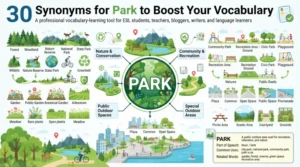
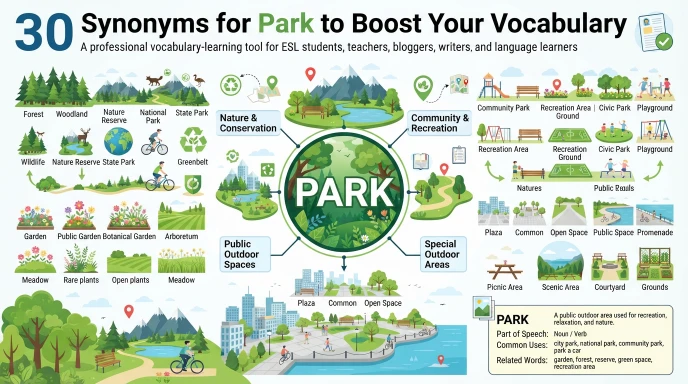
The most typical meaning of park is a public outdoor area with grass, trees, paths, and open spaces where people relax, exercise, play, or spend time with family and friends.
When people hear the word park, they often imagine nature, fresh air, playgrounds, walking trails, and community activities.
Prototype Categorization
- Nature & Conservation Areas
- Nature Reserve
- National Park
- State Park
- Woodland
- Forest
- Greenbelt
- Gardens & Plant Areas
- Garden
- Public Garden
- Botanical Garden
- Arboretum
- Community & Recreation Spaces
- Community Park
- Recreation Area
- Recreation Ground
- Civic Park
- Leisure Area
- Open Public Spaces
- Plaza
- Public Space
- Common
- Open Space
- Specialized Outdoor Areas
- Picnic Area
- Scenic Area
- Promenade
- Courtyard
Categorization helps writers choose the most accurate synonym based on context. For example, national park fits protected natural areas, while plaza is better for urban public spaces.
Antonyms of Park
- Building (Noun) – A constructed structure rather than open land.
- Factory (Noun) – A place used for manufacturing.
- Industrial Zone (Noun) – An area used for industry instead of recreation.
- Warehouse (Noun) – A building used for storage.
- Office Complex (Noun) – A group of business buildings.
- Shopping Mall (Noun) – A commercial retail center.
- Parking Garage (Noun) – A structure for storing vehicles.
- Construction Site (Noun) – Land used for building projects.
Short Questions and Answers
- What does park mean?
A park is a public outdoor area used for recreation, relaxation, and community activities. - When should park be used?
Use park when referring to green public spaces or outdoor recreation areas. - Is park positive or negative?
It is usually positive because it is associated with nature, leisure, and community life. - How is it different from similar words?
Park is a broad term. Garden focuses on plants, reserve emphasizes protection, and playground is designed mainly for children.
Conclusion
Learning the word park and its synonyms can greatly improve English vocabulary and communication skills. Different synonyms such as garden, reserve, woodland, plaza, and community park help writers describe outdoor spaces more accurately.
Using a variety of words avoids repetition and makes writing more engaging. Understanding pronunciation, connotation, history, and usage also strengthens speaking and reading skills.
if you are an English learner, student, teacher, or content writer, practicing these synonyms will help you express ideas more clearly and confidently. Make vocabulary learning a daily habit and try using new synonyms in conversations and writing exercises to build lasting language skills.
Discover more about!
- Synonyms for Unity: Powerful Words to Use Instead
- Synonyms for Vulnerable: Alternative Words & Meanings
- Synonyms for Advocate: Alternative Words & Meanings

I am a British-American author, speaker, and motivational thinker. I focus on leadership and inspiration.
My main idea is that great leaders and successful organizations start with “why”.
I studied cultural anthropology and communication. My well-known books include Start With Why, Leaders Eat Last, and The Infinite Game.