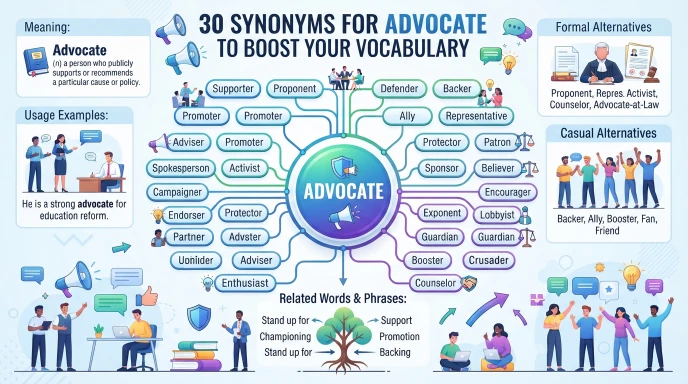
Advocate means to support, defend, or speak in favor of a person, idea, cause, or action. Imagine a student speaking up for cleaner classrooms at school. The student is acting as an advocate for a better environment. This word is common in daily conversations, education, law, business, and social causes.
Learning synonyms for advocate helps English learners, writers, students, teachers, and content creators express ideas more clearly.
Using different words prevents repetition and makes writing stronger and more engaging.
In this article, you will learn the meaning of advocate, its pronunciation, history, grammar, connotative meaning, and 30 useful synonyms. You will also discover examples, semantic categories, antonyms, and related vocabulary to improve your English skills.
Meaning of Advocate
Definition
Advocate (Verb / Noun):
A person who publicly supports a cause, or someone who speaks in favor of an idea, person, or action.
Examples
- She advocates equal opportunities for all students.
- He is a strong advocate for environmental protection.
Connotative Meaning
(Connotation: the emotional or cultural feeling connected to a word beyond its dictionary meaning.)
- Positive tone: Supporting good causes, helping others, defending rights.
- Negative tone: Can sometimes suggest pushing an opinion too strongly.
- Neutral tone: Simply means speaking in favor of something.
Etymology
- Origin: Latin
- From the Latin word advocatus
- Original meaning: “one called to help” or “one summoned for support”
Short History of the Keyword
Old English (450–1100)
- The exact word advocate was not commonly used.
- Similar ideas were expressed through native English words meaning helper or defender.
Middle English (1100–1500)
- The word entered English through French and Latin influence.
- It began to refer to legal defenders and supporters.
Modern English (1500–Present)
- The meaning expanded to include supporters of causes, policies, and social issues.
- Today it is widely used in law, education, business, and activism.
Pronunciation (US & UK – IPA)
US: /ˈæd.və.keɪt/
UK: /ˈæd.və.kət/
Syllables
ad-vo-cate
Affixation Pattern of Advocate
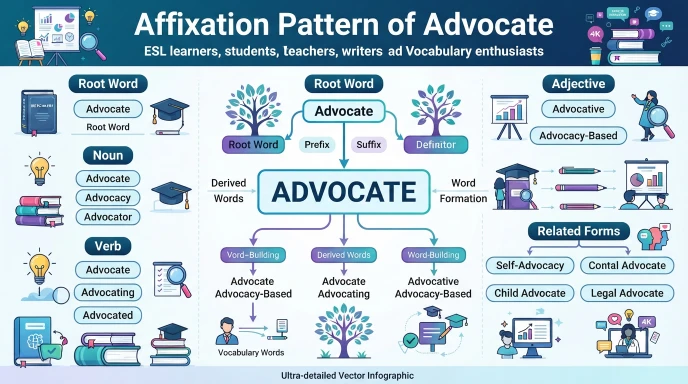
Root: voc (voice, call)
Prefix: ad- (toward)
Suffix: -ate
Word Formation of Advocate
- Advocate (Noun)
- Advocate (Verb)
- Advocacy (Noun)
- Advocative (Adjective)
- Advocated (Verb)
- Advocating (Verb)
- Advocates (Noun/Verb)
Synonyms of Advocate
1. Supporter (Noun)
US: /səˈpɔr.tər/ | UK: /səˈpɔː.tə/
Meaning: A person who supports someone or something.
Examples:
- She is a supporter of public education.
- Many supporters attended the event.
2. Defender (Noun)
US: /dɪˈfen.dər/ | UK: /dɪˈfen.də/
Meaning: A person who protects or supports others.
Examples:
- He became a defender of human rights.
- The defender spoke confidently.
3. Champion (Noun)
US: /ˈtʃæm.pi.ən/ | UK: /ˈtʃæm.pi.ən/
Meaning: Someone who strongly supports a cause.
Examples:
- She is a champion of equality.
- The mayor became a champion for change.
4. Backer (Noun)
US: /ˈbæk.ər/ | UK: /ˈbæk.ə/
Meaning: A person who provides support.
Examples:
- The project found a new backer.
- Every movement needs backers.
5. Promoter (Noun)
US: /prəˈmoʊ.t̬ɚ/ | UK: /prəˈməʊ.tə/
Meaning: Someone who encourages support.
Examples:
- He is a promoter of healthy living.
- The promoter advertised the campaign.
6. Spokesperson (Noun)
US: /ˈspoʊksˌpɝː.sən/ | UK: /ˈspəʊksˌpɜː.sən/
Meaning: A person who speaks for a group.
Examples:
- The spokesperson answered questions.
- She served as the organization’s spokesperson.
7. Representative (Noun)
US: /ˌrep.rɪˈzen.tə.tɪv/ | UK: /ˌrep.rɪˈzen.tə.tɪv/
Meaning: Someone who acts for others.
Examples:
- The representative spoke at the meeting.
- He was chosen as a representative.
8. Proponent (Noun)
US: /prəˈpoʊ.nənt/ | UK: /prəˈpəʊ.nənt/
Meaning: A person who argues for something.
Examples:
- She is a proponent of renewable energy.
- The proponent presented strong evidence.
9. Ally (Noun)
US: /ˈæl.aɪ/ | UK: /ˈæl.aɪ/
Meaning: A supporter or partner.
Examples:
- She became an ally of the workers.
- Good allies help each other.
10. Patron (Noun)
US: /ˈpeɪ.trən/ | UK: /ˈpeɪ.trən/
Meaning: A supporter who provides help or funding.
Examples:
- The museum thanked its patron.
- Patrons helped fund the project.
11. Activist (Noun)
US: /ˈæk.tɪ.vɪst/ | UK: /ˈæk.tɪ.vɪst/
Meaning: Someone who works for social or political change.
Examples:
- The activist organized a campaign.
- Many activists joined the rally.
12. Campaigner (Noun)
US: /kæmˈpeɪ.nɚ/ | UK: /kæmˈpeɪ.nə/
Meaning: A person who actively promotes a cause.
Examples:
- The campaigner raised awareness.
- She is a dedicated campaigner.
13. Endorser (Noun)
US: /ɪnˈdɔr.sɚ/ | UK: /ɪnˈdɔː.sə/
Meaning: Someone who publicly approves something.
Examples:
- The endorser praised the program.
- Several endorsers joined the effort.
14. Booster (Noun)
US: /ˈbuː.stɚ/ | UK: /ˈbuː.stə/
Meaning: A person who encourages support.
Examples:
- The booster promoted local businesses.
- She was a strong booster of the idea.
15. Protector (Noun)
US: /prəˈtek.tɚ/ | UK: /prəˈtek.tə/
Meaning: Someone who guards or supports.
Examples:
- He became a protector of wildlife.
- Protectors play an important role.
16. Counsel (Verb)
US: /ˈkaʊn.səl/ | UK: /ˈkaʊn.səl/
Meaning: To advise or support.
Examples:
- Experts counsel patients carefully.
- She counseled the team.
17. Recommend (Verb)
US: /ˌrek.əˈmend/ | UK: /ˌrek.əˈmend/
Meaning: To suggest support for something.
Examples:
- I recommend this policy.
- Teachers recommend good habits.
18. Promote (Verb)
US: /prəˈmoʊt/ | UK: /prəˈməʊt/
Meaning: To encourage or support.
Examples:
- They promote education.
- The group promotes awareness.
19. Encourage (Verb)
US: /ɪnˈkɝː.ɪdʒ/ | UK: /ɪnˈkʌr.ɪdʒ/
Meaning: To give support or confidence.
Examples:
- Parents encourage reading.
- She encouraged participation.
20. Urge (Verb)
US: /ɝːdʒ/ | UK: /ɜːdʒ/
Meaning: To strongly advise.
Examples:
- Leaders urge action.
- Doctors urge healthy habits.
21. Favor (Verb)
US: /ˈfeɪ.vɚ/ | UK: /ˈfeɪ.və/
Meaning: To support or prefer.
Examples:
- Many voters favor the plan.
- She favors fair treatment.
22. Defend (Verb)
US: /dɪˈfend/ | UK: /dɪˈfend/
Meaning: To protect or support.
Examples:
- He defended his position.
- Lawyers defend clients.
23. Uphold (Verb)
US: /ʌpˈhoʊld/ | UK: /ʌpˈhəʊld/
Meaning: To maintain or support.
Examples:
- Courts uphold laws.
- We must uphold standards.
24. Lobby (Verb)
US: /ˈlɑː.bi/ | UK: /ˈlɒb.i/
Meaning: To try to influence decisions.
Examples:
- Groups lobby for reforms.
- They lobbied government officials.
25. Plead For (Verb)
US: /pliːd fɔr/ | UK: /pliːd fɔː/
Meaning: To strongly ask for support.
Examples:
- She pleaded for change.
- Citizens pleaded for action.
26. Speak For (Verb)
US: /spiːk fɔr/ | UK: /spiːk fɔː/
Meaning: To represent or support.
Examples:
- He speaks for the community.
- She spoke for the team.
27. Stand Up For (Verb)
US: /stænd ʌp fɔr/ | UK: /stænd ʌp fɔː/
Meaning: To defend or support.
Examples:
- Always stand up for fairness.
- He stood up for his friend.
28. Advocate For (Verb)
US: /ˈæd.və.keɪt fɔr/ | UK: /ˈæd.və.kət fɔː/
Meaning: To publicly support.
Examples:
- She advocates for children.
- They advocate for change.
29. Exponent (Noun)
US: /ɪkˈspoʊ.nənt/ | UK: /ɪkˈspəʊ.nənt/
Meaning: A supporter of an idea.
Examples:
- He is an exponent of reform.
- The exponent shared evidence.
30. Voice (Noun)
US: /vɔɪs/ | UK: /vɔɪs/
Meaning: A person expressing support.
Examples:
- She became a voice for equality.
- The organization is a voice for change.
Formal and Casual Alternatives
Formal Synonyms
- Proponent
- Representative
- Spokesperson
- Endorser
- Exponent
- Champion
- Defender
- Uphold
Casual Synonyms
- Supporter
- Ally
- Backer
- Booster
- Speak For
- Stand Up For
- Favor
- Encourage
Related Words
- Advocacy (Noun)
- Advocate (Verb)
- Advocate (Noun)
- Advocacy Group (Noun)
- Activism (Noun)
- Activist (Noun)
- Representation (Noun)
- Support (Noun/Verb)
- Promotion (Noun)
- Defense (Noun)
Prototype Meaning
The most common meaning of advocate is a person who supports and speaks up for a cause, idea, group, or individual.
When people hear the word, they often imagine someone defending rights, promoting fairness, or encouraging positive change.
Prototype Categorization
Categorizing synonyms helps writers choose the most accurate word for a specific situation.
- Supporters: supporter, ally, backer, patron
- Defenders: defender, protector, champion
- Representatives: spokesperson, representative, voice
- Promoters: promoter, booster, endorser
- Activists: activist, campaigner, lobbyist-related terms
- Action Verbs: promote, defend, encourage, uphold, urge
Antonyms of Advocate
- Opponent (Noun): A person who disagrees or resists.
- Critic (Noun): A person who points out faults.
- Detractor (Noun): Someone who speaks against a person or idea.
- Adversary (Noun): An enemy or rival.
- Resister (Noun): A person who opposes change.
- Condemn (Verb): To strongly disapprove.
- Oppose (Verb): To disagree with or fight against.
- Reject (Verb): To refuse acceptance.
- Discourage (Verb): To reduce support or confidence.
- Attack (Verb): To criticize or oppose strongly.
Short Questions and Answers
- What does advocate mean?
Advocate means to support, defend, or speak in favor of a person, cause, or idea. - When should advocate be used?
Use it when describing support, representation, or public approval of something. - Is advocate positive or negative?
It is usually positive, but context may affect the tone. - How is it different from similar words?
Advocate often involves active public support, while a supporter may simply agree without taking action.
Conclusion
Learning the word advocate and its synonyms is a great way to improve your English vocabulary. These words help you express support, defense, encouragement, and representation more accurately.
Using different synonyms strengthens both writing and speaking while reducing repetition. It also helps students, ESL learners, teachers, and content writers communicate with greater confidence.
Understanding pronunciation, history, connotation, and related words gives deeper knowledge of how the word works in real-life situations.
Practice using these synonyms every day in conversations, essays, emails, and articles. Small daily vocabulary habits can lead to stronger communication skills and greater confidence in English.
Read more about!
- 30 Synonyms for ‘Connect’ to Boost Your Vocabulary
- Synonyms for Unity: Powerful Words to Use Instead
- Synonyms for Vulnerable: Alternative Words & Meanings

I am a linguist with 17 years of experience in English language teaching, including postgraduate-level instruction. My expertise includes English grammar, and I contribute as a content and blog writer, producing scholarly and educational language resources.