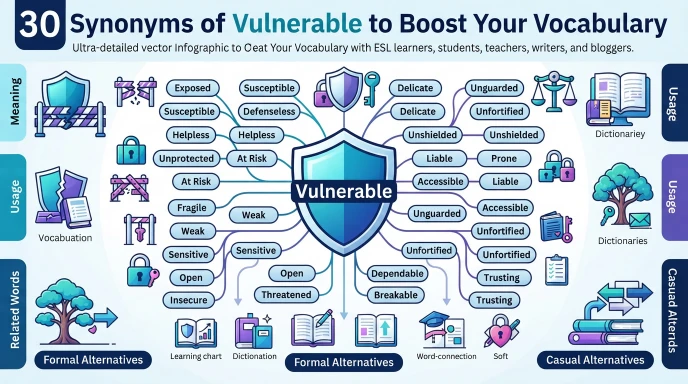
The word vulnerable means being open to harm, danger, attack, or emotional hurt. Imagine a child walking alone in a crowded place. The child may be vulnerable because they need protection and support.
People often use this word when talking about safety, health, emotions, technology, and relationships.
Learning synonyms of vulnerable is important for English learners, students, writers, and content creators. Different synonyms help express ideas more accurately and make writing more interesting.
They also help avoid repeating the same word.
In this article, you will learn the meaning of vulnerable, its pronunciation, history, grammar, connotation, and 30 useful synonyms. You will also discover examples, semantic categories, antonyms, related words, and practical tips to strengthen your English vocabulary and communication skills.
Meaning of Vulnerable
Definition
Vulnerable (Adjective):
Able to be harmed, hurt, attacked, influenced, or affected easily.
Examples
- Young children are vulnerable to illness.
- He felt vulnerable after sharing his personal story.
Connotative Meaning
What is connotation? (The emotional or cultural feeling connected to a word beyond its dictionary meaning.)
- Positive tone: Open, honest, emotionally sincere.
- Negative tone: Weak, exposed, defenseless, at risk.
- Neutral tone: Likely to be affected or harmed.
Etymology
- Comes from Latin vulnerabilis.
- Derived from vulnus, meaning “wound.”
- Originally meant “capable of being wounded.”
Short History of the Keyword
Old English (450–1100)
- The word vulnerable was not used in Old English.
- Similar ideas were expressed through words meaning weak or exposed.
Middle English (1100–1500)
- Latin and French vocabulary influenced English.
- Related concepts of injury and weakness became common.
Modern English (1500–Present)
- Vulnerable entered English from Latin.
- It became widely used in medicine, psychology, technology, and everyday speech.
Pronunciation (US & UK – IPA)
US: /ˈvʌl.nɚ.ə.bəl/
UK: /ˈvʌl.nər.ə.bəl/
Syllables
vul-ner-a-ble
Affixation Pattern of Vulnerable
Root: vulner (wound)
Prefix: None
Suffix: -able
Word Formation of Vulnerable
- Vulnerable (Adjective)
- Vulnerably (Adverb)
- Vulnerability (Noun)
- Invulnerable (Adjective)
- Invulnerability (Noun)
- Vulnerableness (Noun)
Synonyms of Vulnerable
1. Defenseless (Adjective)
US: /dɪˈfen.sləs/ | UK: /dɪˈfen.sləs/
Meaning: Unable to protect oneself.
Examples:
- The animal was defenseless against predators.
- The child felt defenseless in the situation.
2. Exposed (Adjective)
US: /ɪkˈspoʊzd/ | UK: /ɪkˈspəʊzd/
Meaning: Open to danger or harm.
Examples:
- The village was exposed to flooding.
- His mistake left him exposed to criticism.
3. Susceptible (Adjective)
US: /səˈsep.tə.bəl/ | UK: /səˈsep.tɪ.bəl/
Meaning: Easily affected by something.
Examples:
- Children are susceptible to infections.
- She is susceptible to stress.
4. Helpless (Adjective)
US: /ˈhelp.ləs/ | UK: /ˈhelp.ləs/
Meaning: Unable to help or defend oneself.
Examples:
- He felt helpless during the storm.
- The injured bird looked helpless.
5. Weak (Adjective)
US: /wiːk/ | UK: /wiːk/
Meaning: Lacking strength or power.
Examples:
- She felt weak after being sick.
- The weak wall collapsed.
6. Fragile (Adjective)
US: /ˈfrædʒ.aɪl/ | UK: /ˈfrædʒ.aɪl/
Meaning: Easily damaged or broken.
Examples:
- The vase is fragile.
- His confidence was fragile.
7. Sensitive (Adjective)
US: /ˈsen.sə.tɪv/ | UK: /ˈsen.sɪ.tɪv/
Meaning: Easily affected emotionally or physically.
Examples:
- She has sensitive skin.
- He is sensitive to criticism.
8. At Risk (Adjective Phrase)
US: /æt rɪsk/ | UK: /æt rɪsk/
Meaning: In danger of harm.
Examples:
- The species is at risk of extinction.
- Many homes were at risk.
9. Unprotected (Adjective)
US: /ˌʌn.prəˈtek.tɪd/ | UK: /ˌʌn.prəˈtek.tɪd/
Meaning: Without protection.
Examples:
- The crops were unprotected.
- Sensitive data remained unprotected.
10. Unsafe (Adjective)
US: /ʌnˈseɪf/ | UK: /ʌnˈseɪf/
Meaning: Not secure from danger.
Examples:
- The building was unsafe.
- The road became unsafe after rain.
11. Insecure (Adjective)
US: /ˌɪn.sɪˈkjʊr/ | UK: /ˌɪn.sɪˈkjʊə/
Meaning: Lacking confidence or safety.
Examples:
- He felt insecure about his skills.
- The border remained insecure.
12. Delicate (Adjective)
US: /ˈdel.ə.kət/ | UK: /ˈdel.ɪ.kət/
Meaning: Easily damaged or affected.
Examples:
- The flower is delicate.
- It was a delicate matter.
13. Powerless (Adjective)
US: /ˈpaʊ.ɚ.ləs/ | UK: /ˈpaʊə.ləs/
Meaning: Without power or control.
Examples:
- They felt powerless to stop it.
- She felt powerless in the debate.
14. Threatened (Adjective)
US: /ˈθret.ənd/ | UK: /ˈθret.ənd/
Meaning: Facing danger or harm.
Examples:
- The animals are threatened.
- He felt threatened by the situation.
15. Endangered (Adjective)
US: /ɪnˈdeɪn.dʒɚd/ | UK: /ɪnˈdeɪn.dʒəd/
Meaning: In danger of extinction or harm.
Examples:
- The tiger is endangered.
- Several plants are endangered.
16. Open (Adjective)
US: /ˈoʊ.pən/ | UK: /ˈəʊ.pən/
Meaning: Not protected or hidden.
Examples:
- The area remained open to attack.
- The network was open to intrusion.
17. Perilous (Adjective)
US: /ˈper.ə.ləs/ | UK: /ˈper.ɪ.ləs/
Meaning: Full of danger.
Examples:
- They faced a perilous journey.
- The climb was perilous.
18. Precarious (Adjective)
US: /prɪˈker.i.əs/ | UK: /prɪˈkeə.ri.əs/
Meaning: Not secure and likely to fail.
Examples:
- His job was precarious.
- The structure looked precarious.
19. Frail (Adjective)
US: /freɪl/ | UK: /freɪl/
Meaning: Weak and delicate.
Examples:
- After the illness, she felt frail and tired.
- The branch was frail.
20. Breakable (Adjective)
US: /ˈbreɪ.kə.bəl/ | UK: /ˈbreɪ.kə.bəl/
Meaning: Able to be broken easily.
Examples:
- The toy is breakable.
- These materials are breakable.
21. Impressionable (Adjective)
US: /ɪmˈpreʃ.ən.ə.bəl/ | UK: /ɪmˈpreʃ.ən.ə.bəl/
Meaning: Easily influenced.
Examples:
- Young children are impressionable.
- Teens can be impressionable.
22. Defective (Adjective)
US: /dɪˈfek.tɪv/ | UK: /dɪˈfek.tɪv/
Meaning: Having weaknesses or faults.
Examples:
- The device was defective.
- A defective system is vulnerable.
23. Unshielded (Adjective)
US: /ʌnˈʃiːldɪd/ | UK: /ʌnˈʃiːldɪd/
Meaning: Not protected from danger.
Examples:
- The equipment was unshielded.
- The cable remained unshielded.
24. Tender (Adjective)
US: /ˈten.dɚ/ | UK: /ˈten.də/
Meaning: Easily hurt physically or emotionally.
Examples:
- The skin was tender.
- She had a tender heart.
25. Shaky (Adjective)
US: /ˈʃeɪ.ki/ | UK: /ˈʃeɪ.ki/
Meaning: Weak or unstable.
Examples:
- The bridge looked shaky.
- His confidence was shaky.
26. Unstable (Adjective)
US: /ʌnˈsteɪ.bəl/ | UK: /ʌnˈsteɪ.bəl/
Meaning: Not secure or steady.
Examples:
- The ladder was unstable.
- The situation remained unstable.
27. Wounded (Adjective)
US: /ˈwuːn.dɪd/ | UK: /ˈwuːn.dɪd/
Meaning: Physically or emotionally hurt.
Examples:
- The soldier was wounded.
- She felt emotionally wounded.
28. Unsecured (Adjective)
US: /ˌʌn.sɪˈkjʊrd/ | UK: /ˌʌn.sɪˈkjʊəd/
Meaning: Not safely protected.
Examples:
- The door was unsecured.
- The files were unsecured.
29. Soft (Adjective)
US: /sɔːft/ | UK: /sɒft/
Meaning: Easily affected or damaged.
Examples:
- Soft materials tear easily.
- He has a soft nature.
30. Unresistant (Adjective)
US: /ˌʌn.rɪˈzɪs.tənt/ | UK: /ˌʌn.rɪˈzɪs.tənt/
Meaning: Unable to resist harm or influence.
Examples:
- The plants were unresistant to disease.
- The material was unresistant to heat.
Prototype Meaning
The most common meaning of vulnerable is being open to harm, danger, or emotional hurt.
When people hear this word, they often imagine someone who needs protection, support, or care because they can be affected easily by difficult situations.
Prototype Categorization
- Physical Weakness: weak, frail, fragile, delicate, breakable.
- Lack of Protection: defenseless, unprotected, exposed, unshielded, unsecured.
- Emotional Vulnerability: sensitive, insecure, tender, wounded.
- Danger and Risk: threatened, endangered, perilous, at risk.
- Instability: shaky, precarious, unstable.
- Influence and Susceptibility: impressionable, susceptible.
Categorization helps writers choose the most accurate synonym based on context, tone, and meaning.
Antonyms of Vulnerable
- Protected (Adjective) – Kept safe from harm.
- Secure (Adjective) – Safe and protected.
- Strong (Adjective) – Having power or strength.
- Resistant (Adjective) – Able to withstand harm.
- Invulnerable (Adjective) – Unable to be harmed.
- Safe (Adjective) – Free from danger.
- Shielded (Adjective) – Protected from risk.
- Stable (Adjective) – Firm and secure.
Formal and Casual Alternatives
Formal Alternatives
- Susceptible
- Precarious
- Perilous
- Defenseless
- Endangered
- Exposed
Casual Alternatives
- Weak
- Unsafe
- Open
- Shaky
- Soft
- At risk
Related Words
- Vulnerability (Noun)
- Vulnerably (Adverb)
- Protection (Noun)
- Exposure (Noun)
- Risk (Noun)
- Weakness (Noun)
- Security (Noun)
- Sensitivity (Noun)
Short Questions and Answers
- What does vulnerable mean?
Vulnerable means able to be hurt, harmed, or affected easily. - When should vulnerable be used?
Use it when describing someone or something that is open to danger, damage, or emotional pain. - Is vulnerable positive or negative?
It can be positive when describing honesty and openness, but negative when describing risk or weakness. - How is it different from similar words?
Vulnerable is a broad term, while words like fragile focus on weakness and susceptible focuses on being easily affected.
Conclusion
Learning the word vulnerable and its synonyms can greatly improve your English vocabulary. These words help you describe risk, weakness, emotions, and protection more accurately. Understanding different synonyms allows you to write with greater precision and avoid repeating the same word.
Knowing the pronunciation, history, connotation, and categories of these words also strengthens your language skills.
if you are a student, ESL learner, teacher, writer, or content creator, mastering these vocabulary terms can improve both speaking and writing.
Make vocabulary practice a daily habit by learning and using new synonyms in real-life conversations and written work. Over time, your confidence and communication skills will continue to grow.
Discover more about!
- Synonyms for Represent 30 Powerful Words to Improve
- Synonyms for Diverse and How to Use Them Correctly
- Synonyms for Talk : 30 Words to Boost Vocabulary

I am an American author, and I write books about power, strategy, and human behavior. My writing style is simple but deep, and I try to explain how people think and act in real-life situations.
I studied classical studies, and before becoming a writer, I worked in different fields which helped me understand people and life better.
My most famous books include The 48 Laws of Power, The Art of Seduction, and Mastery. These books are widely read by business people, leaders, and students around the world.