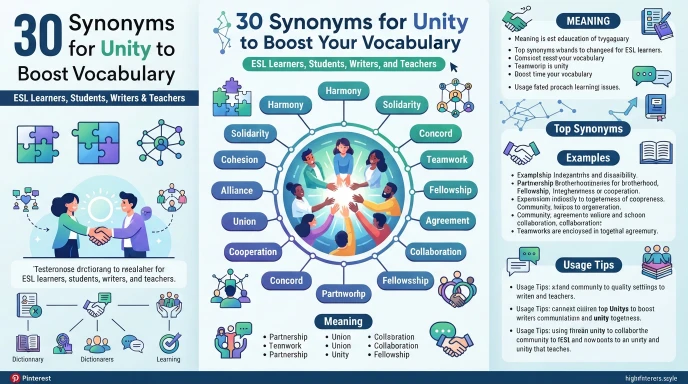
Unity means the state of being joined together, connected, or working as one. Imagine a sports team preparing for an important match. Every player supports the others, follows the same goal, and works together.
This is a perfect example of unity. The word is commonly used in schools, workplaces, communities, governments, and organizations because cooperation is important in many parts of life.
Learning synonyms for unity helps English learners, students, teachers, writers, and content creators express ideas more clearly. Different situations may require different words, and knowing alternatives helps improve writing and speaking skills.
In this article, you will learn the meaning of unity, its pronunciation, grammar, history, connotation, and 30 useful synonyms. You will also discover examples, semantic categories, antonyms, related words, and practical vocabulary tips.
Meaning of Unity
Definition
Unity (Noun):
The state of being together, connected, or working as one group.
Examples
- Unity helped the team win the competition.
- The community showed unity during the difficult time.
Connotative Meaning
(Connotation: the emotional or cultural feeling connected to a word beyond its dictionary meaning.)
- Positive tone: Cooperation, harmony, teamwork, and togetherness.
- Negative tone: Sometimes may suggest pressure to conform.
- Neutral tone: The condition of being joined together.
Etymology
- Origin: Latin
- Derived from the Latin word unitas
- Original meaning: “oneness” or “state of being one”
Short History of the Keyword
Old English (450–1100)
- The exact word unity was not common.
- Similar ideas were expressed through words meaning oneness and agreement.
Middle English (1100–1500)
- Entered English through Old French and Latin influence.
- Used in religious and social contexts.
Modern English (1500–Present)
- Expanded to politics, society, education, and teamwork.
- Today it commonly refers to cooperation and solidarity.
Pronunciation (US & UK – IPA)
US: /ˈjuː.nə.ti/
UK: /ˈjuː.nɪ.ti/
Syllables
u-ni-ty
Affixation Pattern of Unity
Root: unit
Prefix: None
Suffix: -y
Word Formation of the Keyword
- Unity (Noun)
- Unite (Verb)
- United (Adjective/Verb)
- Uniting (Verb)
- Unification (Noun)
- Unified (Adjective)
- Unifier (Noun)
Synonyms of Unity
1. Harmony (Noun)
US: /ˈhɑːr.mə.ni/ | UK: /ˈhɑː.mə.ni/
Meaning: Peaceful agreement among people.
Examples:
- The family lived in harmony.
- Harmony improved workplace relations.
2. Togetherness (Noun)
US: /təˈɡeð.ɚ.nəs/ | UK: /təˈɡeð.ə.nəs/
Meaning: A feeling of closeness and unity.
Examples:
- The event promoted togetherness.
- Togetherness strengthened friendships.
3. Solidarity (Noun)
US: /ˌsɑː.ləˈder.ə.t̬i/ | UK: /ˌsɒl.ɪˈdær.ə.ti/
Meaning: Mutual support within a group.
Examples:
- Workers showed solidarity.
- Solidarity helped the movement succeed.
4. Cooperation (Noun)
US: /koʊˌɑː.pəˈreɪ.ʃən/ | UK: /kəʊˌɒp.əˈreɪ.ʃən/
Meaning: Working together toward a goal.
Examples:
- Cooperation improved results.
- The project required cooperation.
5. Collaboration (Noun)
US: /kəˌlæb.əˈreɪ.ʃən/ | UK: /kəˌlæb.əˈreɪ.ʃən/
Meaning: Working jointly with others.
Examples:
- The collaboration was successful.
- Schools encourage collaboration.
6. Concord (Noun)
US: /ˈkɑːn.kɔːrd/ | UK: /ˈkɒŋ.kɔːd/
Meaning: Agreement and peace.
Examples:
- The nations lived in concord.
- Concord benefited everyone.
7. Agreement (Noun)
US: /əˈɡriː.mənt/ | UK: /əˈɡriː.mənt/
Meaning: Shared understanding or acceptance.
Examples:
- They reached an agreement.
- Agreement ended the conflict.
8. Union (Noun)
US: /ˈjuː.njən/ | UK: /ˈjuː.njən/
Meaning: The act of joining together.
Examples:
- The union created strength.
- Their union lasted many years.
9. Cohesion (Noun)
US: /koʊˈhiː.ʒən/ | UK: /kəʊˈhiː.ʒən/
Meaning: The quality of sticking together.
Examples:
- Team cohesion increased success.
- Cohesion builds trust.
10. Oneness (Noun)
US: /ˈwʌn.nəs/ | UK: /ˈwʌn.nəs/
Meaning: The state of being one.
Examples:
- The group felt oneness.
- Oneness inspired cooperation.
11. Accord (Noun)
US: /əˈkɔːrd/ | UK: /əˈkɔːd/
Meaning: Agreement and harmony.
Examples:
- Leaders signed an accord.
- The accord brought peace.
12. Fellowship (Noun)
US: /ˈfel.oʊ.ʃɪp/ | UK: /ˈfel.əʊ.ʃɪp/
Meaning: Friendly unity among people.
Examples:
- Fellowship united the members.
- They enjoyed fellowship together.
13. Brotherhood (Noun)
US: /ˈbrʌð.ɚ.hʊd/ | UK: /ˈbrʌð.ə.hʊd/
Meaning: A feeling of friendship and support.
Examples:
- Brotherhood encouraged trust.
- The organization valued brotherhood.
14. Sisterhood (Noun)
US: /ˈsɪs.tɚ.hʊd/ | UK: /ˈsɪs.tə.hʊd/
Meaning: Unity among women.
Examples:
- Sisterhood inspired confidence.
- The club promoted sisterhood.
15. Friendship (Noun)
US: /ˈfrend.ʃɪp/ | UK: /ˈfrend.ʃɪp/
Meaning: A close relationship of support.
Examples:
- Their friendship grew stronger.
- Friendship encourages unity.
16. Alliance (Noun)
US: /əˈlaɪ.əns/ | UK: /əˈlaɪ.əns/
Meaning: A partnership for mutual benefit.
Examples:
- The alliance improved security.
- Nations formed an alliance.
17. Partnership (Noun)
US: /ˈpɑːrt.nɚ.ʃɪp/ | UK: /ˈpɑːt.nə.ʃɪp/
Meaning: Working together as partners.
Examples:
- The partnership succeeded.
- Partnership creates strength.
18. Teamwork (Noun)
US: /ˈtiːm.wɝːk/ | UK: /ˈtiːm.wɜːk/
Meaning: Cooperative effort by a group.
Examples:
- Teamwork improved performance.
- Good teamwork leads to success.
19. Integration (Noun)
US: /ˌɪn.təˈɡreɪ.ʃən/ | UK: /ˌɪn.tɪˈɡreɪ.ʃən/
Meaning: Combining parts into a whole.
Examples:
- Integration strengthened the community.
- The integration process worked well.
20. Unification (Noun)
US: /ˌjuː.nə.fəˈkeɪ.ʃən/ | UK: /ˌjuː.nɪ.fɪˈkeɪ.ʃən/
Meaning: The act of making one.
Examples:
- Unification brought stability.
- Leaders supported unification.
21. Compatibility (Noun)
US: /kəmˌpæt.əˈbɪl.ə.t̬i/ | UK: /kəmˌpæt.əˈbɪl.ɪ.ti/
Meaning: Ability to work well together.
Examples:
- Compatibility improved teamwork.
- Their compatibility was clear.
22. Community (Noun)
US: /kəˈmjuː.nə.t̬i/ | UK: /kəˈmjuː.nɪ.ti/
Meaning: A group connected by common interests.
Examples:
- The community worked together.
- Community creates belonging.
23. Consensus (Noun)
US: /kənˈsen.səs/ | UK: /kənˈsen.səs/
Meaning: General agreement.
Examples:
- The committee reached consensus.
- Consensus ended the debate.
24. Rapport (Noun)
US: /ræˈpɔːr/ | UK: /ræˈpɔː/
Meaning: A close and positive relationship.
Examples:
- The team developed rapport.
- Rapport improved communication.
25. Connection (Noun)
US: /kəˈnek.ʃən/ | UK: /kəˈnek.ʃən/
Meaning: A bond between people.
Examples:
- The connection felt strong.
- Connection builds unity.
26. Bond (Noun)
US: /bɑːnd/ | UK: /bɒnd/
Meaning: A strong relationship.
Examples:
- They shared a close bond.
- The bond united the group.
27. Coordination (Noun)
US: /koʊˌɔːr.dəˈneɪ.ʃən/ | UK: /kəʊˌɔː.dɪˈneɪ.ʃən/
Meaning: Organized cooperation.
Examples:
- Coordination improved efficiency.
- Good coordination prevented mistakes.
28. Mutuality (Noun)
US: /ˌmjuː.tʃuˈæl.ə.t̬i/ | UK: /ˌmjuː.tʃuˈæl.ɪ.ti/
Meaning: Shared feelings or interests.
Examples:
- Mutuality strengthened trust.
- Their relationship showed mutuality.
29. Kinship (Noun)
US: /ˈkɪn.ʃɪp/ | UK: /ˈkɪn.ʃɪp/
Meaning: A feeling of connection.
Examples:
- They felt a sense of kinship.
- Kinship encouraged cooperation.
30. Collectiveness (Noun)
US: /kəˈlek.tɪv.nəs/ | UK: /kəˈlek.tɪv.nəs/
Meaning: The quality of acting as a group.
Examples:
- Collectiveness improved results.
- The project benefited from collectiveness.
Formal and Casual Sections
Formal Synonyms
- Cohesion
- Concord
- Accord
- Consensus
- Integration
- Unification
- Solidarity
- Collaboration
Casual Synonyms
- Togetherness
- Friendship
- Bond
- Teamwork
- Connection
- Community
- Fellowship
- Partnership
Related Words
- Unite (Verb)
- United (Adjective)
- Unification (Noun)
- Unified (Adjective)
- Cooperation (Noun)
- Harmony (Noun)
- Collaboration (Noun)
- Teamwork (Noun)
- Alliance (Noun)
- Solidarity (Noun)
Prototype Meaning
The most typical meaning of unity is people coming together and working as one group.
When people hear this word, they often imagine teamwork, harmony, cooperation, and individuals joining efforts to achieve a common goal.
Prototype Categorization
Categorizing synonyms helps writers select the most suitable word for a specific context.
- Agreement and Peace: harmony, concord, accord, consensus
- Team Effort: cooperation, collaboration, teamwork, coordination
- Social Connection: friendship, fellowship, brotherhood, sisterhood
- Group Strength: solidarity, alliance, partnership, community
- Oneness and Integration: union, cohesion, oneness, unification
Using categories helps writers choose the most precise synonym instead of repeating the word unity.
Antonyms
- Division (Noun): Separation into parts.
- Conflict (Noun): A serious disagreement.
- Discord (Noun): Lack of harmony.
- Disunity (Noun): Absence of unity.
- Separation (Noun): The act of moving apart.
- Isolation (Noun): Being alone or disconnected.
- Opposition (Noun): Resistance or disagreement.
- Rivalry (Noun): Competition between groups.
- Hostility (Noun): Unfriendly behavior.
- Fragmentation (Noun): Breaking into smaller parts.
Short Questions and Answers
- What does unity mean?
Unity means the state of being joined together and working as one. - When should unity be used?
Use it when describing cooperation, agreement, teamwork, or togetherness. - Is unity positive or negative?
Unity is usually a positive word because it suggests harmony and cooperation. - How is it different from similar words?
Unity is a broad term, while words like teamwork, solidarity, and cohesion describe specific types of togetherness.
Conclusion
Learning the word unity and its synonyms can greatly improve your English vocabulary. These words help you describe cooperation, teamwork, agreement, and strong relationships more accurately.
Using a variety of synonyms strengthens writing and speaking, reduces repetition, and makes communication more engaging.
Understanding pronunciation, history, connotation, and related vocabulary also helps you use these words correctly in different situations.
if you are a student, teacher, writer, or English learner, practicing these synonyms daily can build confidence and improve communication skills. The more words you learn, the easier it becomes to express ideas clearly and effectively.
Explore more about!
- Powerful Alternatives to “Normal” You Should Know
- 30 Synonyms of Neurodivergent to Boost Your Vocabulary
- 30 Synonyms for ‘Connect’ to Boost Your Vocabulary

I am an American author, and I write books about power, strategy, and human behavior. My writing style is simple but deep, and I try to explain how people think and act in real-life situations.
I studied classical studies, and before becoming a writer, I worked in different fields which helped me understand people and life better.
My most famous books include The 48 Laws of Power, The Art of Seduction, and Mastery. These books are widely read by business people, leaders, and students around the world.