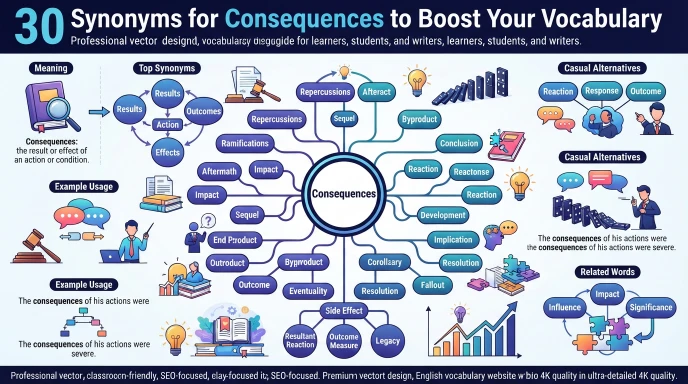
The word consequences means the results or effects that happen because of an action, decision, or event. Imagine a student who studies hard for an exam. The good grade is a consequence of that effort. In the same way, forgetting to prepare can lead to poor results. We use the word consequences every day when talking about choices and outcomes.
Learning synonyms for consequences is important for English learners, students, teachers, writers, and content creators. It helps improve vocabulary, makes writing more interesting, and prevents repetition. Different synonyms also help express different shades of meaning.
In this article, you will learn the meaning of consequences, its pronunciation, grammar, history, connotative meaning, prototype meaning, and 30 useful synonyms with examples. These words will help you communicate more clearly and confidently in English.
Meaning of Consequences
Definition
Consequences (Noun):
The results, effects, or outcomes that happen because of an action, event, or decision.
Examples
- Missing the deadline had serious consequences.
- Good habits often bring positive consequences.
Connotative Meaning
(Connotation: the emotional feeling or association connected to a word beyond its basic dictionary meaning.)
- Positive tone: Rewards, benefits, gains, achievements.
- Negative tone: Punishments, losses, problems, damage.
- Neutral tone: Results, outcomes, effects, developments.
Etymology
- Comes from Latin consequentia, meaning “following closely” or “result.”
- Entered English through Old French.
- Originally referred to something that naturally follows from another thing.
Short History of the Keyword
Old English (450–1100)
- The exact word consequence was not used.
- People expressed similar ideas using words meaning result or outcome.
Middle English (1100–1500)
- Influenced by French and Latin vocabulary.
- Early forms of the word entered English.
Modern English (1500–Present)
- Became common in writing and speech.
- Now refers to both positive and negative results of actions.
Pronunciation (US & UK – IPA)
US: /ˈkɑːn.səˌkwen.sɪz/
UK: /ˈkɒn.sɪˌkwen.sɪz/
Syllables
con-se-quen-ces
Affixation Pattern of Consequences
Root: sequ (follow)
Prefix: con- (together)
Suffix: -ence, -es
Word Formation of Consequences
- Consequence (Noun)
- Consequences (Plural Noun)
- Consequent (Adjective)
- Consequently (Adverb)
- Inconsequential (Adjective)
- Inconsequentially (Adverb)
Synonyms of Consequences
1. Result (Noun)
US: /rɪˈzʌlt/ | UK: /rɪˈzʌlt/
Meaning: Something that happens because of an action.
Examples:
- The result of hard work was success.
- Her decision produced a good result.
2. Outcome (Noun)
US: /ˈaʊtˌkʌm/ | UK: /ˈaʊtˌkʌm/
Meaning: The final effect of an event.
Examples:
- The outcome surprised everyone.
- We are waiting for the outcome.
3. Effect (Noun)
US: /ɪˈfekt/ | UK: /ɪˈfekt/
Meaning: A change caused by something else.
Examples:
- The medicine had a positive effect.
- Stress can have harmful effects.
4. Repercussion (Noun)
US: /ˌriːpərˈkʌʃən/ | UK: /ˌriːpəˈkʌʃən/
Meaning: An indirect or unexpected consequence.
Examples:
- The decision had serious repercussions.
- Economic changes caused many repercussions.
5. Aftermath (Noun)
US: /ˈæftərˌmæθ/ | UK: /ˈɑːftəmæθ/
Meaning: The period following an important event.
Examples:
- The town recovered from the aftermath.
- People struggled in the aftermath of the storm.
6. Impact (Noun)
US: /ˈɪmpækt/ | UK: /ˈɪmpækt/
Meaning: A strong effect on something.
Examples:
- Technology has a huge impact on life.
- The policy had little impact.
7. Ramification (Noun)
US: /ˌræməfəˈkeɪʃən/ | UK: /ˌræmɪfɪˈkeɪʃən/
Meaning: A complex result of an action.
Examples:
- We discussed the ramifications.
- The law had many ramifications.
8. Product (Noun)
US: /ˈprɑːdʌkt/ | UK: /ˈprɒdʌkt/
Meaning: Something produced by a cause.
Examples:
- Success is a product of effort.
- The idea was a product of teamwork.
9. End Result (Noun)
US: /end rɪˈzʌlt/ | UK: /end rɪˈzʌlt/
Meaning: The final outcome.
Examples:
- The end result was excellent.
- We focused on the end result.
10. By-product (Noun)
US: /ˈbaɪˌprɑːdʌkt/ | UK: /ˈbaɪˌprɒdʌkt/
Meaning: A secondary result.
Examples:
- Confidence was a by-product of practice.
- Waste can be a by-product of production.
11. Issue (Noun)
US: /ˈɪʃuː/ | UK: /ˈɪsjuː/
Meaning: A result or matter arising from something.
Examples:
- Several issues developed later.
- The issue came from poor planning.
12. Sequel (Noun)
US: /ˈsiːkwəl/ | UK: /ˈsiːkwəl/
Meaning: Something that follows another event.
Examples:
- The sequel to the event was unexpected.
- Many changes were its sequel.
13. Development (Noun)
US: /dɪˈveləpmənt/ | UK: /dɪˈveləpmənt/
Meaning: A result of growth or change.
Examples:
- This development pleased investors.
- New developments appeared quickly.
14. Yield (Noun)
US: /jiːld/ | UK: /jiːld/
Meaning: The amount produced by an action.
Examples:
- The farm had a high yield.
- Better methods increased the yield.
15. Fruit (Noun)
US: /fruːt/ | UK: /fruːt/
Meaning: A reward or result of effort.
Examples:
- Their work bore fruit.
- Patience brought fruit.
16. Payoff (Noun)
US: /ˈpeɪˌɔːf/ | UK: /ˈpeɪˌɒf/
Meaning: A beneficial result.
Examples:
- The payoff was worth the effort.
- Training produced a big payoff.
17. Return (Noun)
US: /rɪˈtɜːrn/ | UK: /rɪˈtɜːn/
Meaning: Something gained from an action.
Examples:
- The investment gave a good return.
- Hard work brings returns.
18. Outcome Effect (Noun)
US: /ˈaʊtkʌm ɪˈfekt/ | UK: /ˈaʊtkʌm ɪˈfekt/
Meaning: The effect produced by an action.
Examples:
- The outcome effect was measurable.
- We studied the outcome effect.
19. Reaction (Noun)
US: /riˈækʃən/ | UK: /riˈækʃən/
Meaning: A response caused by something.
Examples:
- His comment caused a reaction.
- The reaction was immediate.
20. Legacy (Noun)
US: /ˈleɡəsi/ | UK: /ˈleɡəsi/
Meaning: A lasting result left behind.
Examples:
- The project created a strong legacy.
- Her work remains a legacy.
21. Output (Noun)
US: /ˈaʊtpʊt/ | UK: /ˈaʊtpʊt/
Meaning: The amount produced.
Examples:
- Factory output increased.
- Output improved this year.
22. Follow-up (Noun)
US: /ˈfɑːloʊ ʌp/ | UK: /ˈfɒləʊ ʌp/
Meaning: Something that comes afterward.
Examples:
- The follow-up revealed problems.
- We arranged a follow-up.
23. Upshot (Noun)
US: /ˈʌpʃɑːt/ | UK: /ˈʌpʃɒt/
Meaning: The final conclusion or result.
Examples:
- The upshot was clear.
- The upshot favored the team.
24. Conclusion (Noun)
US: /kənˈkluːʒən/ | UK: /kənˈkluːʒən/
Meaning: The end result of reasoning or events.
Examples:
- The conclusion was positive.
- We reached a conclusion.
25. Corollary (Noun)
US: /ˈkɔːrəˌleri/ | UK: /kəˈrɒləri/
Meaning: A natural result that follows.
Examples:
- Higher costs were a corollary.
- This is a corollary of change.
26. Outcome Measure (Noun)
US: /ˈaʊtkʌm ˈmeʒər/ | UK: /ˈaʊtkʌm ˈmeʒə/
Meaning: A result used for evaluation.
Examples:
- Success was the main outcome measure.
- Researchers used outcome measures.
27. Eventuality (Noun)
US: /ɪˌven.tʃuˈæl.ə.ti/ | UK: /ɪˌven.tʃuˈæl.ə.ti/
Meaning: A possible future result.
Examples:
- They planned for every eventuality.
- The eventuality became real.
28. Harvest (Noun)
US: /ˈhɑːrvɪst/ | UK: /ˈhɑːvɪst/
Meaning: The result gained from effort.
Examples:
- The harvest rewarded farmers.
- Years of work brought a rich harvest.
29. Reward (Noun)
US: /rɪˈwɔːrd/ | UK: /rɪˈwɔːd/
Meaning: A positive consequence.
Examples:
- Success was the reward.
- Good behavior earned a reward.
30. Penalty (Noun)
US: /ˈpenəlti/ | UK: /ˈpenəlti/
Meaning: A negative consequence.
Examples:
- Speeding brought a penalty.
- The penalty was severe.
Formal and Casual Alternatives
Formal Synonyms
- Repercussion
- Ramification
- Corollary
- Outcome
- Consequence
- Development
- Eventuality
Casual Synonyms
- Result
- Effect
- Impact
- Payoff
- Reward
- Upshot
- Follow-up
Related Words Section
- Consequent (Adjective)
- Consequently (Adverb)
- Outcome (Noun)
- Effect (Noun)
- Result (Noun)
- Impact (Noun)
- Repercussion (Noun)
- Ramification (Noun)
Prototype Meaning
The most common meaning of consequences is the results that follow an action or decision.
When people hear this word, they usually think about what happens after someone makes a choice. These results can be positive, negative, or neutral depending on the situation.
Prototype Categorization
Categorizing synonyms helps writers choose the most accurate word for a situation.
- General Results: Result, Outcome, Effect, Conclusion
- Negative Results: Repercussion, Penalty, Ramification, Aftermath
- Positive Results: Reward, Payoff, Fruit, Return
- Long-Term Results: Legacy, Development, Corollary
- Business and Production Results: Output, Yield, Product, Harvest
Choosing categories helps writers match the tone and meaning of their message.
Antonyms of Consequences
- Cause (Noun): The reason something happens.
- Origin (Noun): The starting point of something.
- Source (Noun): The place from which something comes.
- Beginning (Noun): The start of an event.
- Initiation (Noun): The act of starting something.
- Trigger (Noun): Something that causes an event.
Short Questions and Answers
- What does consequences mean?
Consequences are the results or effects of an action, decision, or event. - When should consequences be used?
Use it when talking about what happens because of a choice or action. - Is consequences positive or negative?
It can be positive, negative, or neutral depending on the context. - How is it different from similar words?
Consequences often emphasize the connection between an action and its result, while words like effect or outcome may sound more neutral.
Conclusion
Learning the word consequences and its synonyms can greatly improve your English vocabulary. These words help you describe results, effects, rewards, and outcomes more accurately.
Using different synonyms strengthens both writing and speaking by making language more varied and expressive. It also helps avoid repeating the same word again and again. Understanding pronunciation, history, connotation, and usage gives learners deeper language skills.
if you are a student, teacher, ESL learner, writer, or content creator, mastering these synonyms can increase your confidence and communication ability. Practice using a new synonym every day in conversations and writing. Over time, your vocabulary will become richer, stronger, and more natural.
Read more about!
- Synonyms for Unity: Powerful Words to Use Instead
- Synonyms for Vulnerable: Alternative Words & Meanings

I am a linguist with 17 years of experience in English language teaching, including postgraduate-level instruction. My expertise includes English grammar, and I contribute as a content and blog writer, producing scholarly and educational language resources.