Secede means to formally leave a group, country, union, or organization. Imagine a region that decides it no longer wants to be part of a larger country. Its leaders may announce that the region will secede and become independent. The word is common in history, politics, government, and discussions about independence.
Learning synonyms of secede helps English learners understand different shades of meaning and avoid using the same word again and again. It also helps content writers choose precise words for different situations.
In this guide, we will explore the meaning, synonyms, examples, grammar, pronunciation, history, word formation, and emotional tone of secede. You will also learn related words, antonyms, formal and casual alternatives, and semantic categories so you can use this vocabulary naturally and confidently.
Meaning of Secede
Secede (Verb):
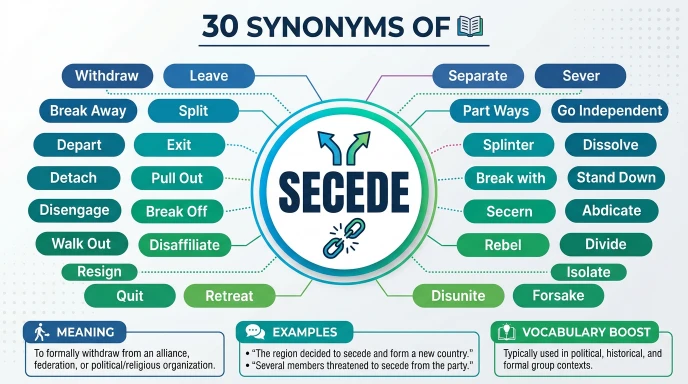
To formally leave a political union, country, organization, or larger group.
Examples
- The region voted to secede from the federation.
- Several states threatened to secede from the union.
Connotative Meaning
Connotation (the feeling or idea that a word suggests beyond its basic meaning):
- Positive tone: May suggest independence, freedom, or self-rule when separation is viewed favorably.
- Negative tone: May suggest division, conflict, rebellion, or instability.
- Neutral tone: Can simply describe the formal act of leaving a larger political or organized group.
Etymology
- Source: Latin sēcēdere
- Original meaning: “To go apart” or “to withdraw.”
- It comes from Latin se- meaning “apart” and cedere meaning “to go” or “to move.”
Short History of the Keyword
Old English (450–1100):
The exact word secede was not part of Old English vocabulary. English used native words related to leaving, departing, or withdrawing.
Middle English (1100–1500):
Latin-based vocabulary became more common through French and scholarly influence. Ideas connected with political separation could be expressed through words such as depart and withdraw.
Modern English (1500–Present):
Secede entered English in the 18th century from Latin. It became strongly associated with political and territorial separation, especially during major historical conflicts involving unions and states.
Pronunciation (US & UK – IPA)
US: /sɪˈsiːd/
UK: /sɪˈsiːd/
Syllables
se-cede
Affixation Pattern of Secede
- Root: ced — related to “go” or “move”
- Prefix: se- — meaning “apart”
- Suffix: No productive English suffix in the modern word
- Word formation: secede is primarily a verb.
- Secession — noun
- Secessionist — noun/adjective
- Seceder — noun
- Seceded — past-tense verb
- Seceding — present participle verb
Synonyms of Secede
1. Withdraw (Verb)
US IPA: /wɪðˈdrɔː/ | UK IPA: /wɪðˈdrɔː/
Meaning: To leave a group, activity, or organization.
Examples:
- The country decided to withdraw from the agreement.
- The member threatened to withdraw from the alliance.
2. Separate (Verb)
US IPA: /ˈsɛpəreɪt/ | UK IPA: /ˈsepəreɪt/
Meaning: To move or become apart from something.
Examples:
- The region wanted to separate from the federation.
- The two groups decided to separate peacefully.
3. Break Away (Verb)
US IPA: /breɪk əˈweɪ/ | UK IPA: /breɪk əˈweɪ/
Meaning: To leave a larger group and become independent.
Examples:
- The territory planned to break away from the union.
- The smaller group chose to break away.
4. Split Off (Verb)
US IPA: /splɪt ɔːf/ | UK IPA: /splɪt ɒf/
Meaning: To separate from a larger group.
Examples:
- The province decided to split off from the federation.
- A new organization split off from the parent group.
5. Depart (Verb)
US IPA: /dɪˈpɑːrt/ | UK IPA: /dɪˈpɑːt/
Meaning: To leave a place, group, or situation.
Examples:
- The delegates chose to depart from the alliance.
- The country formally departed from the agreement.
6. Leave (Verb)
US IPA: /liːv/ | UK IPA: /liːv/
Meaning: To stop being part of something.
Examples:
- The state decided to leave the federation.
- They voted to leave the organization.
7. Quit (Verb)
US IPA: /kwɪt/ | UK IPA: /kwɪt/
Meaning: To stop participating in or belonging to something.
Examples:
- The group threatened to quit the alliance.
- Several members decided to quit the organization.
8. Resign (Verb)
US IPA: /rɪˈzaɪn/ | UK IPA: /rɪˈzaɪn/
Meaning: To formally leave a position, office, or organization.
Examples:
- The leader chose to resign from the committee.
- Several officials resigned after the dispute.
9. Disassociate (Verb)
US IPA: /ˌdɪsəˈsoʊsieɪt/ | UK IPA: /ˌdɪsəˈsəʊsieɪt/
Meaning: To stop being connected with a person or group.
Examples:
- The organization decided to disassociate itself from the movement.
- The company disassociated itself from the controversial group.
10. Dissociate (Verb)
US IPA: /dɪˈsoʊʃieɪt/ | UK IPA: /dɪˈsəʊʃieɪt/
Meaning: To separate or remove a connection.
Examples:
- The leader tried to dissociate from the organization.
- The group dissociated itself from the decision.
11. Detach (Verb)
US IPA: /dɪˈtætʃ/ | UK IPA: /dɪˈtætʃ/
Meaning: To separate something from a larger unit.
Examples:
- The territory sought to detach itself from the state.
- The smaller unit was detached from the main organization.
12. Disengage (Verb)
US IPA: /ˌdɪsɪnˈɡeɪdʒ/ | UK IPA: /ˌdɪsɪnˈɡeɪdʒ/
Meaning: To stop being involved with something.
Examples:
- The government decided to disengage from the alliance.
- The group began to disengage from the political movement.
13. Abandon (Verb)
US IPA: /əˈbændən/ | UK IPA: /əˈbændən/
Meaning: To leave something completely.
Examples:
- The leaders decided to abandon the union.
- The group abandoned its former political alliance.
14. Forsake (Verb)
US IPA: /fɔːrˈseɪk/ | UK IPA: /fəˈseɪk/
Meaning: To leave or give up something completely.
Examples:
- The movement chose to forsake its former alliance.
- They refused to forsake their goal of independence.
15. Renounce (Verb)
US IPA: /rɪˈnaʊns/ | UK IPA: /rɪˈnaʊns/
Meaning: To formally reject or give up something.
Examples:
- The leader renounced membership in the organization.
- The government renounced its former agreement.
16. Repudiate (Verb)
US IPA: /rɪˈpjuːdieɪt/ | UK IPA: /rɪˈpjuːdieɪt/
Meaning: To reject something formally or strongly.
Examples:
- The government repudiated the old political agreement.
- The leaders repudiated their connection with the group.
17. Defect (Verb)
US IPA: /dɪˈfɛkt/ | UK IPA: /dɪˈfekt/
Meaning: To leave a group, organization, or country and join another.
Examples:
- Several officials defected from the political movement.
- The soldiers defected to the opposing side.
18. Secessionize (Verb)
US IPA: /sɪˈsɛʃənaɪz/ | UK IPA: /sɪˈsɛʃənaɪz/
Meaning: To organize or promote separation into an independent unit.
Examples:
- The movement sought to secessionize the territory.
- Political activists discussed plans to secessionize the region.
19. Revolt (Verb)
US IPA: /rɪˈvoʊlt/ | UK IPA: /rɪˈvəʊlt/
Meaning: To rebel against authority.
Examples:
- The population began to revolt against central rule.
- The region threatened to revolt if its demands were ignored.
20. Rebel (Verb)
US IPA: /ˈrɛbəl/ | UK IPA: /ˈrebəl/
Meaning: To resist or oppose an authority.
Examples:
- The region began to rebel against the central government.
- The citizens rebelled against the ruling authority.
21. Break From (Verb)
US IPA: /breɪk frəm/ | UK IPA: /breɪk frəm/
Meaning: To end a connection with a group or tradition.
Examples:
- The region wanted to break from the federation.
- The new movement broke from its former organization.
22. Go Independent (Verb Phrase)
US IPA: /ɡoʊ ˌɪndɪˈpɛndənt/ | UK IPA: /ɡəʊ ˌɪndɪˈpendənt/
Meaning: To become politically or organizationally independent.
Examples:
- The territory voted to go independent.
- The island wanted to go independent from the larger state.
23. Gain Independence (Verb Phrase)
US IPA: /ɡeɪn ˌɪndɪˈpɛndəns/ | UK IPA: /ɡeɪn ˌɪndɪˈpendəns/
Meaning: To achieve freedom from outside political control.
Examples:
- The territory hoped to gain independence.
- The movement worked for decades to gain independence.
24. Declare Independence (Verb Phrase)
US IPA: /dɪˈklɛr ˌɪndɪˈpɛndəns/ | UK IPA: /dɪˈkleə ˌɪndɪˈpendəns/
Meaning: To officially announce that a territory is independent.
Examples:
- The leaders decided to declare independence.
- The colony later declared independence from the empire.
25. Secession (Noun)
US IPA: /sɪˈsɛʃən/ | UK IPA: /sɪˈseʃən/
Meaning: The formal act of leaving a political union or organization.
Examples:
- The issue of secession caused serious debate.
- Secession became the main political demand.
26. Disunion (Noun)
US IPA: /ˌdɪsˈjuːnjən/ | UK IPA: /ˌdɪsˈjuːnjən/
Meaning: A state of separation or lack of unity.
Examples:
- The conflict created fears of disunion.
- Political disunion weakened the country.
27. Separation (Noun)
US IPA: /ˌsɛpəˈreɪʃən/ | UK IPA: /ˌsepəˈreɪʃən/
Meaning: The act of becoming separate from something.
Examples:
- The proposed separation caused political debate.
- The separation of the territory changed the region.
28. Independence (Noun)
US IPA: /ˌɪndɪˈpɛndəns/ | UK IPA: /ˌɪndɪˈpendəns/
Meaning: Freedom from control by another country or authority.
Examples:
- The people demanded independence.
- The region celebrated its new independence.
29. Autonomy (Noun)
US IPA: /ɔːˈtɑːnəmi/ | UK IPA: /ɔːˈtɒnəmi/
Meaning: The right or ability to govern yourself.
Examples:
- The region demanded greater autonomy.
- Local leaders wanted more autonomy from the central government.
30. Self-Determination (Noun)
US IPA: /ˌsɛlf dɪˌtɜːrməˈneɪʃən/ | UK IPA: /ˌself dɪˌtɜːmɪˈneɪʃən/
Meaning: The right of a people to choose their own political future.
Examples:
- The movement demanded self-determination.
- The people argued that self-determination was their right.
Prototype Meaning
The most typical meaning of secede is to formally leave a larger political union and become separate.
When people hear this word, they usually imagine a state, region, or territory separating from a country or federation. The word often appears in serious political or historical discussions.
Prototype Categorization
- Formal political separation: secede, withdraw, separate, declare independence.
- Becoming independent: go independent, gain independence, autonomy, self-determination.
- General separation: detach, disassociate, dissociate, disengage.
- Leaving a group: leave, quit, depart, break away.
- Conflict or resistance: rebel, revolt, defect.
- Formal rejection: renounce, repudiate, forsake.
- States or conditions of separation: secession, disunion, separation, independence.
Short Questions and Answers
- What does secede mean?
Secede means to formally leave a political union, country, organization, or larger group. - When should secede be used?
Use secede mainly when discussing formal political or organizational separation. - Is secede positive or negative?
It is usually neutral. Its emotional meaning depends on if separation is viewed as freedom or division. - How is secede different from leave?
Leave is very general. Secede specifically suggests formal separation from a larger political or organized group.
Conclusion
Learning secede and its synonyms gives English learners a stronger vocabulary for politics, history, government, and formal writing. Words such as withdraw, separate, break away, independence, autonomy, and self-determination express related ideas, but they are not always interchangeable.
Understanding their small differences helps you choose the most accurate word. This also makes your writing clearer and prevents repetition. For speakers, a wider vocabulary makes communication more natural and confident.
For writers, it adds precision and variety to articles, essays, and reports. Keep practicing these words in short sentences. Read them, say them aloud, and use a few in your daily writing. Regular practice will help you remember secede and use its related vocabulary with greater confidence.
Explore more about!
- Synonyms for A Lot: Alternative Words & Meanin
- Synonyms of Frequent: Best Alternative Words to Know
- Synonyms of Boring: Best Alternative Words to Know

I am a British-American author, speaker, and motivational thinker. I focus on leadership and inspiration.
My main idea is that great leaders and successful organizations start with “why”.
I studied cultural anthropology and communication. My well-known books include Start With Why, Leaders Eat Last, and The Infinite Game.