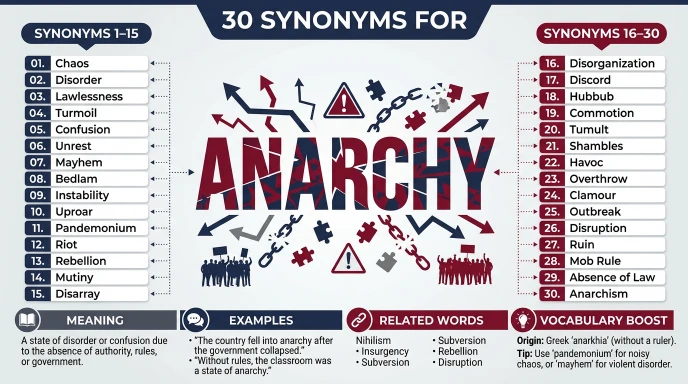
Anarchy means a state of disorder where there is little or no effective government, authority, or control. Imagine a town where the main authority suddenly disappears. Rules are not enforced, people act without control, and confusion spreads.
In such a situation, the word anarchy may be used to describe what is happening. The word is common in history, politics, news, social studies, and everyday discussions about serious disorder. Learning synonyms for anarchy helps English learners understand different shades of meaning and avoid repeating the same word.
It also helps content writers choose stronger words for different situations. This guide explains the meaning, synonyms, examples, grammar, pronunciation, etymology, history, connotation, semantic categories, formal and casual usage, related words, and antonyms of anarchy.
Meaning of Anarchy
Definition
Anarchy (Noun): a situation in which there is no effective government, authority, or system of control, often causing disorder and confusion.
Examples
- The country fell into anarchy after the government collapsed.
- Without clear rules, the meeting quickly turned into anarchy.
Connotative Meaning
Connotation (the feeling, idea, or emotional meaning associated with a word beyond its basic dictionary definition).
- Positive tone: Anarchy can have a positive meaning in some political or philosophical contexts when it refers to freedom from oppressive authority.
- Negative tone: In everyday English, anarchy usually suggests chaos, violence, lawlessness, confusion, or loss of control.
- Neutral tone: In academic or political writing, anarchy can neutrally describe the absence of a central governing authority.
Etymology
- Source: Anarchy comes from the Greek word anarkhia.
- Greek parts: an- means “without,” while arkhos means “ruler” or “leader.”
- Original meaning: The basic idea was “without a ruler” or “without government.”
- The word entered English through French and Latin influence and later became strongly associated with political disorder and lawlessness.
Short History of the Keyword
- Old English (450–1100): The modern word anarchy was not commonly used in Old English. English speakers used native words connected with lawlessness, disorder, rebellion, and lack of rule.
- Middle English (1100–1500): French and Latin influence brought many political and religious terms into English. Concepts related to disorder, rebellion, and the absence of rulers became easier to express with learned vocabulary.
- Modern English (1500–Present): Anarchy became established as a political and social term. It can describe the absence of central authority, serious public disorder, or the political philosophy of anarchism, depending on context.
Pronunciation (US & UK – IPA)
US: /ˈænərki/
UK: /ˈænəki/
Syllables
an-ar-chy
Affixation Pattern of Anarchy
- Root: arch / arkh, connected with the idea of ruling or governing.
- Prefix: an-, meaning “without” or “not.”
- Suffix: -y, forming a noun.
- Word formation: anarchy is a noun.
- Related forms: anarchic (adjective), anarchical (adjective), anarchist (noun/adjective), anarchism (noun), anarchically (adverb), anarchistic (adjective).
- These forms belong mainly to noun, adjective, and adverb grammatical categories.
Synonyms of Anarchy
1. Chaos (Noun)
US: /ˈkeɪɑːs/ | UK: /ˈkeɪɒs/
Meaning: A state of extreme confusion and disorder.
Examples:
- The sudden announcement caused chaos in the office.
- Traffic was in complete chaos after the accident.
2. Disorder (Noun)
US: /dɪsˈɔːrdər/ | UK: /dɪsˈɔːdə/
Meaning: A lack of order, organization, or control.
Examples:
- The city experienced serious disorder after the protest.
- The room was left in complete disorder.
3. Lawlessness (Noun)
US: /ˈlɔːləsnəs/ | UK: /ˈlɔːləsnəs/
Meaning: A situation where laws are ignored or not enforced.
Examples:
- The region suffered from widespread lawlessness.
- Officials tried to stop the growing lawlessness.
4. Turmoil (Noun)
US: /ˈtɝːmɔɪl/ | UK: /ˈtɜːmɔɪl/
Meaning: A state of great confusion, conflict, or unrest.
Examples:
- The country was facing political turmoil.
- The crisis created turmoil across the region.
5. Mayhem (Noun)
US: /ˈmeɪhɛm/ | UK: /ˈmeɪhem/
Meaning: Extreme disorder, confusion, or violent activity.
Examples:
- The sudden storm caused mayhem on the roads.
- The crowd created mayhem outside the stadium.
6. Pandemonium (Noun)
US: /ˌpændəˈmoʊniəm/ | UK: /ˌpændəˈməʊniəm/
Meaning: Complete and noisy confusion or disorder.
Examples:
- Pandemonium broke out when the alarm sounded.
- The announcement caused pandemonium among the fans.
7. Lawlessness (Noun)
US: /ˈlɔːləsnəs/ | UK: /ˈlɔːləsnəs/
Meaning: The absence of respect for laws and authority.
Examples:
- The authorities struggled to control the lawlessness.
- Years of lawlessness damaged the local economy.
8. Unrest (Noun)
US: /ʌnˈrɛst/ | UK: /ʌnˈrest/
Meaning: Public disagreement, disturbance, or social tension.
Examples:
- Political unrest spread across the country.
- The government responded to growing public unrest.
9. Confusion (Noun)
US: /kənˈfjuːʒən/ | UK: /kənˈfjuːʒən/
Meaning: A state in which people do not understand what is happening or what to do.
Examples:
- The lack of instructions caused confusion.
- The sudden change created confusion among workers.
10. Disarray (Noun)
US: /ˌdɪsəˈreɪ/ | UK: /ˌdɪsəˈreɪ/
Meaning: A condition of poor organization or disorder.
Examples:
- The organization was left in disarray.
- The documents were scattered in complete disarray.
11. Unruliness (Noun)
US: /ʌnˈruːlinəs/ | UK: /ʌnˈruːlinəs/
Meaning: Behavior that is difficult to control or manage.
Examples:
- The teacher struggled with the students’ unruliness.
- Officials were concerned about public unruliness.
12. Disorganization (Noun)
US: /dɪsˌɔːrɡənəˈzeɪʃən/ | UK: /dɪsˌɔːɡənaɪˈzeɪʃən/
Meaning: A lack of proper organization or structure.
Examples:
- Poor planning led to disorganization.
- The team’s disorganization caused many problems.
13. Breakdown (Noun)
US: /ˈbreɪkdaʊn/ | UK: /ˈbreɪkdaʊn/
Meaning: A failure of a system, relationship, or form of control.
Examples:
- The crisis caused a breakdown of public order.
- A breakdown in leadership made the situation worse.
14. Social Disorder (Noun Phrase)
US: /ˈsoʊʃəl dɪsˈɔːrdər/ | UK: /ˈsəʊʃəl dɪsˈɔːdə/
Meaning: A situation where normal social rules and structures are seriously disturbed.
Examples:
- The conflict resulted in social disorder.
- Leaders wanted to prevent further social disorder.
15. Political Disorder (Noun Phrase)
US: /pəˈlɪtɪkəl dɪsˈɔːrdər/ | UK: /pəˈlɪtɪkəl dɪsˈɔːdə/
Meaning: A serious lack of political stability or effective authority.
Examples:
- The nation experienced political disorder after the crisis.
- Years of political disorder weakened the government.
16. Statlessness (Noun)
US: /ˈsteɪtləsnəs/ | UK: /ˈsteɪtləsnəs/
Meaning: A condition in which there is no recognized state or central political authority.
Examples:
- The region experienced periods of statelessness.
- Historians studied the effects of statelessness on the population.
17. Absence of Authority (Noun Phrase)
US: /ˈæbsəns əv əˈθɔːrəti/ | UK: /ˈæbsəns əv əˈθɒrəti/
Meaning: A situation where no effective person or institution has control.
Examples:
- The conflict created an absence of authority.
- An absence of authority made law enforcement difficult.
18. Lack of Government (Noun Phrase)
US: /læk əv ˈɡʌvərnmənt/ | UK: /læk əv ˈɡʌvənmənt/
Meaning: A condition in which effective government is missing.
Examples:
- The lack of government created serious problems.
- Citizens suffered because of the lack of government.
19. Lack of Control (Noun Phrase)
US: /læk əv kənˈtroʊl/ | UK: /læk əv kənˈtrəʊl/
Meaning: A situation where people or events are not effectively managed.
Examples:
- The event became dangerous because of a lack of control.
- A lack of control can quickly create disorder.
20. Uncontrolled Disorder (Noun Phrase)
US: /ˌʌnkənˈtroʊld dɪsˈɔːrdər/ | UK: /ˌʌnkənˈtrəʊld dɪsˈɔːdə/
Meaning: Disorder that is not being effectively controlled.
Examples:
- The city faced uncontrolled disorder during the crisis.
- Authorities worked to prevent uncontrolled disorder.
21. Turbulence (Noun)
US: /ˈtɝːbjələns/ | UK: /ˈtɜːbjʊləns/
Meaning: A state of instability, disturbance, or conflict.
Examples:
- The country went through years of political turbulence.
- Economic turbulence affected many families.
22. Instability (Noun)
US: /ˌɪnstəˈbɪləti/ | UK: /ˌɪnstəˈbɪləti/
Meaning: A lack of stability or reliable control.
Examples:
- Political instability worried investors.
- The region has suffered from long-term instability.
23. Uncertainty (Noun)
US: /ʌnˈsɝːtənti/ | UK: /ʌnˈsɜːtənti/
Meaning: A state of not knowing what will happen or what rules will apply.
Examples:
- The crisis created great uncertainty.
- Political changes increased economic uncertainty.
24. Confusion and Disorder (Noun Phrase)
US: /kənˈfjuːʒən ænd dɪsˈɔːrdər/ | UK: /kənˈfjuːʒən ænd dɪsˈɔːdə/
Meaning: A combined state of confusion, poor order, and lack of control.
Examples:
- The sudden crisis caused confusion and disorder.
- Officials tried to restore order after the confusion and disorder.
25. Social Breakdown (Noun Phrase)
US: /ˈsoʊʃəl ˈbreɪkdaʊn/ | UK: /ˈsəʊʃəl ˈbreɪkdaʊn/
Meaning: A serious failure of normal social systems and relationships.
Examples:
- War can lead to social breakdown.
- The community feared complete social breakdown.
26. Civic Disorder (Noun Phrase)
US: /ˈsɪvɪk dɪsˈɔːrdər/ | UK: /ˈsɪvɪk dɪsˈɔːdə/
Meaning: Serious disorder within a community or public society.
Examples:
- The city experienced civic disorder after the political crisis.
- Leaders called for calm to prevent civic disorder.
27. Anarchic Disorder (Noun Phrase)
US: /əˈnɑːrkɪk dɪsˈɔːrdər/ | UK: /əˈnɑːkɪk dɪsˈɔːdə/
Meaning: Disorder that resembles a situation without effective authority.
Examples:
- The area descended into anarchic disorder.
- The novel describes a city suffering from anarchic disorder.
28. Breakdown of Order (Noun Phrase)
US: /ˈbreɪkdaʊn əv ˈɔːrdər/ | UK: /ˈbreɪkdaʊn əv ˈɔːdə/
Meaning: A failure of normal rules, authority, and organization.
Examples:
- The conflict led to a breakdown of order.
- Officials feared a complete breakdown of order.
29. Absence of Rule (Noun Phrase)
US: /ˈæbsəns əv ruːl/ | UK: /ˈæbsəns əv ruːl/
Meaning: A condition in which there is no effective system of government or control.
Examples:
- The historical period was marked by an absence of rule.
- An absence of rule can make communities vulnerable.
30. Absence of Governance (Noun Phrase)
US: /ˈæbsəns əv ˈɡʌvərnəns/ | UK: /ˈæbsəns əv ˈɡʌvənəns/
Meaning: A situation where effective systems for governing and managing society are missing.
Examples:
- The conflict resulted in an absence of governance.
- An absence of governance made public services difficult to maintain.
Prototype Meaning
The most typical meaning of anarchy is a serious lack of government, authority, or social control.
When people hear the word, they often imagine a place where laws are not enforced, leaders have lost control, and confusion or violence is spreading. In everyday English, anarchy usually has a strong negative meaning. However, in political theory, it can also refer more specifically to a society without a centralized ruling authority.
Prototype Categorization
- Extreme disorder: chaos, mayhem, pandemonium, disorder describe situations where normal order has broken down.
- Political problems: political disorder, political instability, turbulence work well for governments and political systems.
- Law and authority: lawlessness, absence of authority, lack of government, absence of governance focus on missing or ineffective control.
- Social problems: social disorder, social breakdown, civic disorder are useful for communities and society.
- Confusion and poor organization: confusion, disarray, disorganization, uncertainty describe less direct forms of disorder.
- Formal alternatives: absence of governance, political disorder, social breakdown, and statelessness are better suited to academic or formal writing.
- Strong everyday alternatives: chaos, mayhem, and pandemonium are useful when describing dramatic disorder.
Categorization helps writers select a word that matches the exact situation. Instead of using anarchy in every sentence, a writer can choose lawlessness for broken laws, political instability for government problems, or chaos for general confusion.
Short Questions and Answers
- What does anarchy mean?
Anarchy means a state where effective government, authority, or control is absent or has broken down. - When should anarchy be used?
Use anarchy when describing a serious lack of authority or government, especially in political, historical, or social contexts. - Is anarchy positive or negative?
In everyday English, anarchy is usually negative because it suggests chaos and lawlessness. In political theory, however, it can have a more neutral meaning. - How is anarchy different from similar words?
Anarchy focuses strongly on the absence of authority or government. Chaos focuses on confusion and disorder. Lawlessness focuses on the failure to follow or enforce laws. Turmoil focuses on conflict and instability.
Conclusion
Learning anarchy and its synonyms can make your English vocabulary stronger and more flexible. The word describes a lack of effective authority, government, or control, but different synonyms highlight different parts of the idea.
Chaos is useful for general confusion, while lawlessness focuses on broken laws. Political instability works well in formal writing about governments, and mayhem is useful for dramatic disorder. Knowing these differences helps you avoid repetition and choose words that fit your exact meaning.
It also improves both writing and speaking skills. English learners can build confidence by studying a few new synonyms each day and using them in original sentences. Regular vocabulary practice makes word choice easier, clearer, and more natural.
Explore more about!
- Synonyms of Frequent: Best Alternative Words to Know
- Synonyms of Boring: Best Alternative Words to Know
- Synonyms for A Lot: Alternative Words & Meanings

I am an American writer and speaker who focuses on habits, productivity, and self-improvement.
I study how small daily habits can create big changes in life. I try to write in a very simple and practical way so anyone can apply my ideas.
My most popular book is Atomic Habits, which is read around the world.