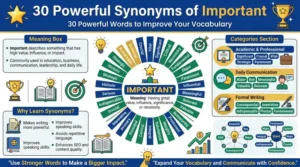
Important means having great value, significance, or influence. Imagine a student preparing for a final exam. The teacher reminds the class to review key chapters because they are important for success.
In daily life, people use the word important to describe things, people, events, decisions, and ideas that matter.
This word appears often in conversations, education, business, and writing. Learning synonyms of important helps English learners and content writers expand their vocabulary and avoid repeating the same word.
Using a variety of synonyms makes communication clearer and more engaging.
In this article, you will learn the meaning of important, its pronunciation, grammar, history, connotation, and 30 useful synonyms. You will also explore examples, semantic categories, antonyms, related words, and practical tips to improve your English skills.
Meaning of Important
Definition
Important (Adjective):
Having great value, significance, influence, or effect.
Examples
- Education is important for personal growth.
- It is important to arrive on time.
Connotative Meaning
(Connotation: the emotional feeling or association connected to a word beyond its dictionary meaning.)
- Positive tone: Valuable, meaningful, respected, necessary.
- Negative tone: Can sometimes suggest excessive self-importance.
- Neutral tone: Describes something that has significance or value.
Etymology
- Source language: Latin
- Derived from the Latin word importare, meaning “to bring in” or “carry significance.”
- Entered English through French influences.
- Original meaning: Something that carries weight or meaning.
Short History of the Keyword
- Old English (450–1100): The word important was not used in Old English.
- Middle English (1100–1500): Similar ideas were expressed through other words meaning valuable or significant.
- Modern English (1500–Present): Important became widely used to describe significance, value, and influence.
Pronunciation (US & UK – IPA)
US: /ɪmˈpɔːrtənt/
UK: /ɪmˈpɔːtənt/
Syllables
im-por-tant
Affixation Pattern of Important
Root: port
Prefix: im-
Suffix: -ant
Word Formation of the Keyword
- Important (Adjective)
- Importance (Noun)
- Importantly (Adverb)
- Unimportant (Adjective)
- Unimportance (Noun)
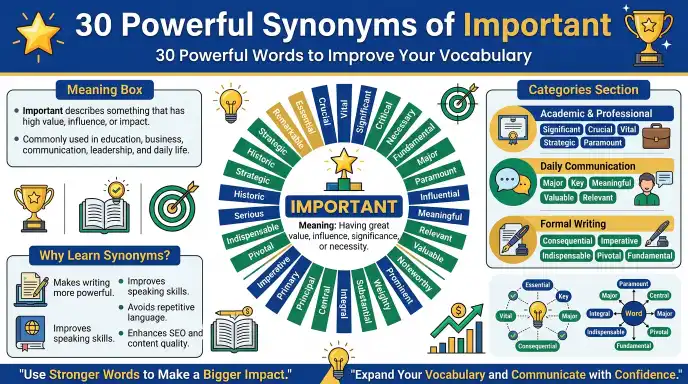
Synonyms of Important
1. Significant (Adjective)
US: /sɪɡˈnɪfɪkənt/ | UK: /sɪɡˈnɪfɪkənt/
Meaning: Having special meaning or value.
Examples:
- This is a significant discovery.
- She made a significant contribution.
2. Crucial (Adjective)
US: /ˈkruːʃəl/ | UK: /ˈkruːʃəl/
Meaning: Extremely necessary or critical.
Examples:
- Water is crucial for life.
- This is a crucial decision.
3. Essential (Adjective)
US: /ɪˈsenʃəl/ | UK: /ɪˈsenʃəl/
Meaning: Absolutely necessary.
Examples:
- Sleep is essential for health.
- Teamwork is essential for success.
4. Vital (Adjective)
US: /ˈvaɪtəl/ | UK: /ˈvaɪtəl/
Meaning: Necessary for survival or success.
Examples:
- Clean water is vital.
- Communication is vital in business.
5. Critical (Adjective)
US: /ˈkrɪtɪkəl/ | UK: /ˈkrɪtɪkəl/
Meaning: Extremely important at a particular time.
Examples:
- We reached a critical stage.
- This is a critical issue.
6. Meaningful (Adjective)
US: /ˈmiːnɪŋfəl/ | UK: /ˈmiːnɪŋfəl/
Meaning: Having deep value or purpose.
Examples:
- It was a meaningful conversation.
- She made a meaningful impact.
7. Valuable (Adjective)
US: /ˈvæljuəbəl/ | UK: /ˈvæljuəbəl/
Meaning: Worth a lot or highly useful.
Examples:
- Experience is valuable.
- The advice was valuable.
8. Influential (Adjective)
US: /ˌɪnfluˈenʃəl/ | UK: /ˌɪnfluˈenʃəl/
Meaning: Having power to affect others.
Examples:
- She is an influential leader.
- The book was influential.
9. Major (Adjective)
US: /ˈmeɪdʒər/ | UK: /ˈmeɪdʒə/
Meaning: Very large or important.
Examples:
- This is a major problem.
- They announced a major change.
10. Key (Adjective)
US: /kiː/ | UK: /kiː/
Meaning: Very important or central.
Examples:
- Trust is a key factor.
- He played a key role.
11. Central (Adjective)
US: /ˈsentrəl/ | UK: /ˈsentrəl/
Meaning: Most important part.
Examples:
- Education is central to growth.
- This issue is central to the discussion.
12. Fundamental (Adjective)
US: /ˌfʌndəˈmentəl/ | UK: /ˌfʌndəˈmentəl/
Meaning: Forming the basic foundation.
Examples:
- Reading is a fundamental skill.
- Respect is fundamental.
13. Necessary (Adjective)
US: /ˈnesəseri/ | UK: /ˈnesəsəri/
Meaning: Needed for a purpose.
Examples:
- Practice is necessary.
- Change is necessary.
14. Indispensable (Adjective)
US: /ˌɪndɪˈspensəbəl/ | UK: /ˌɪndɪˈspensəbəl/
Meaning: Impossible to do without.
Examples:
- Computers are indispensable today.
- Her support was indispensable.
15. Prominent (Adjective)
US: /ˈprɑːmɪnənt/ | UK: /ˈprɒmɪnənt/
Meaning: Well known and important.
Examples:
- He is a prominent scientist.
- The building stands in a prominent location.
16. Notable (Adjective)
US: /ˈnoʊtəbəl/ | UK: /ˈnəʊtəbəl/
Meaning: Worth noticing.
Examples:
- She achieved notable success.
- There was a notable improvement.
17. Consequential (Adjective)
US: /ˌkɑːnsɪˈkwenʃəl/ | UK: /ˌkɒnsɪˈkwenʃəl/
Meaning: Producing important results.
Examples:
- It was a consequential decision.
- The meeting was consequential.
18. Weighty (Adjective)
US: /ˈweɪti/ | UK: /ˈweɪti/
Meaning: Having serious importance.
Examples:
- They discussed weighty matters.
- It was a weighty responsibility.
19. Serious (Adjective)
US: /ˈsɪriəs/ | UK: /ˈsɪəriəs/
Meaning: Requiring careful attention.
Examples:
- This is a serious concern.
- They faced a serious challenge.
20. Substantial (Adjective)
US: /səbˈstænʃəl/ | UK: /səbˈstænʃəl/
Meaning: Large in amount or importance.
Examples:
- The project made substantial progress.
- She gave substantial support.
21. Powerful (Adjective)
US: /ˈpaʊərfəl/ | UK: /ˈpaʊəfəl/
Meaning: Having great influence.
Examples:
- It was a powerful message.
- She is a powerful speaker.
22. Eminent (Adjective)
US: /ˈemɪnənt/ | UK: /ˈemɪnənt/
Meaning: Famous and respected.
Examples:
- He is an eminent doctor.
- The eminent scholar gave a lecture.
23. Prestigious (Adjective)
US: /preˈstɪdʒəs/ | UK: /preˈstɪdʒəs/
Meaning: Highly respected.
Examples:
- She attended a prestigious university.
- The award is prestigious.
24. Outstanding (Adjective)
US: /aʊtˈstændɪŋ/ | UK: /aʊtˈstændɪŋ/
Meaning: Exceptionally good or important.
Examples:
- He did outstanding work.
- The performance was outstanding.
25. Remarkable (Adjective)
US: /rɪˈmɑːrkəbəl/ | UK: /rɪˈmɑːkəbəl/
Meaning: Worth attention or praise.
Examples:
- She made remarkable progress.
- It was a remarkable achievement.
26. Prime (Adjective)
US: /praɪm/ | UK: /praɪm/
Meaning: First in importance.
Examples:
- Safety is the prime concern.
- This is a prime example.
27. Leading (Adjective)
US: /ˈliːdɪŋ/ | UK: /ˈliːdɪŋ/
Meaning: Most important or successful.
Examples:
- She works for a leading company.
- He is a leading expert.
28. Strategic (Adjective)
US: /strəˈtiːdʒɪk/ | UK: /strəˈtiːdʒɪk/
Meaning: Important for achieving goals.
Examples:
- They made a strategic decision.
- The location is strategic.
29. Imperative (Adjective)
US: /ɪmˈperətɪv/ | UK: /ɪmˈperətɪv/
Meaning: Absolutely necessary.
Examples:
- Action is imperative.
- It is imperative to act quickly.
30. Significant-Minded (Adjective)
US: /sɪɡˈnɪfɪkənt ˈmaɪndɪd/ | UK: /sɪɡˈnɪfɪkənt ˈmaɪndɪd/
Meaning: Focused on meaningful matters.
Examples:
- She is significant-minded in her work.
- Significant-minded leaders inspire change.
Prototype Meaning
The most typical meaning of important is something that matters greatly and deserves attention.
When people hear this word, they usually think of valuable decisions, key responsibilities, meaningful events, or people who have influence and significance.
Prototype Categorization
- Necessity Synonyms: Essential, Vital, Necessary, Imperative, Indispensable
- Influence Synonyms: Influential, Powerful, Prominent, Leading
- Value Synonyms: Valuable, Meaningful, Significant, Notable
- Achievement Synonyms: Outstanding, Remarkable, Prestigious, Eminent
- Priority Synonyms: Key, Central, Prime, Strategic, Critical
Categorization helps writers choose the most suitable synonym. For example, essential emphasizes necessity, while prestigious highlights status and respect.
Antonyms of Important
- Unimportant (Adjective): Not significant or valuable.
- Trivial (Adjective): Having little importance.
- Minor (Adjective): Small in importance.
- Insignificant (Adjective): Not meaningful or influential.
- Meaningless (Adjective): Lacking value or purpose.
- Irrelevant (Adjective): Not related or important to the matter.
Formal and Casual Usage
Formal Synonyms
- Significant
- Crucial
- Essential
- Strategic
- Consequential
- Imperative
Casual Synonyms
- Important
- Key
- Major
- Valuable
- Serious
- Remarkable
Related Words Section
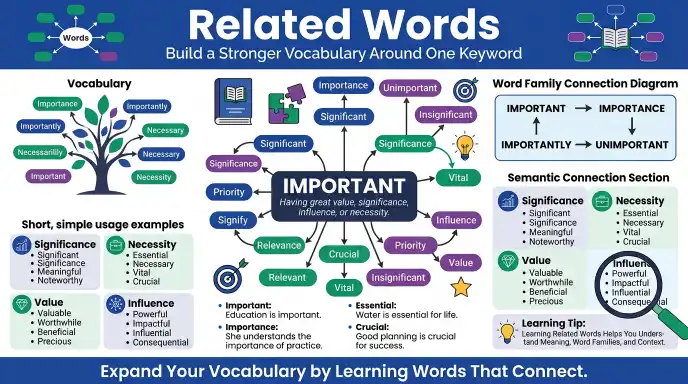
- Importance
- Significance
- Value
- Priority
- Influence
- Necessity
- Relevance
- Impact
- Meaning
- Contribution
Meaning and Example Sentence Table
| Word | Meaning | Example Sentence |
| Important | Having great value | Education is important. |
| Significant | Meaningful and valuable | The discovery was significant. |
| Essential | Absolutely necessary | Water is essential for life. |
| Vital | Necessary for success | Communication is vital. |
| Crucial | Extremely important | This is a crucial decision. |
Short Questions and Answers
- What does important mean?
Important means having great value, significance, or influence. - When should important be used?
Use it when describing something that matters or deserves attention. - Is important positive or negative?
It is usually positive or neutral, depending on context. - How is it different from similar words?
Important is a general term, while words like crucial, essential, and vital express stronger levels of importance.
Conclusion
Learning the word important and its synonyms can greatly improve your vocabulary and communication skills. These words help you describe value, significance, influence, and necessity with greater precision.
Using different synonyms makes writing and speaking more interesting while reducing repetition. Understanding pronunciation, history, connotation, and semantic categories also helps you select the best word for each situation.
if you are writing essays, creating content, or speaking in daily conversations, these synonyms can make your English stronger and more effective.
Practice them regularly to build confidence, improve fluency, and expand your vocabulary every day.
Read more about!
- Synonyms for Fancy: 30 Vocabulary-Boosting Words
- Synonyms for Common: 30 Words to Boost Vocabulary
- 30 Powerful Synonyms for Various You Should Know

I am a linguist with 17 years of experience in English language teaching, including postgraduate-level instruction. My expertise includes English grammar, and I contribute as a content and blog writer, producing scholarly and educational language resources.