Idiot is a noun that usually means a very foolish or unintelligent person.
Imagine someone ignoring a clear warning, making a careless choice, and then saying, “I did not think about it.”
A friend might jokingly call that person an idiot. The word is common in everyday English, but it can sound rude or insulting when used about a person. For English learners, knowing synonyms is useful because one word cannot fit every situation.
Content writers also need varied vocabulary to make their writing clear, natural, and interesting.
In this guide, we will explore the meaning of idiot, its synonyms, examples, grammar, pronunciation, history, word formation, connotations, semantic categories, and antonyms. You will also learn how different words express different levels of foolishness, from mild and playful terms to strong insults.
Meaning of Idiot
Definition
Idiot (noun): a person who behaves in a very foolish, silly, or unintelligent way.
Examples
He was an idiot for leaving his keys inside the locked car.
I felt like an idiot when I realized I had read the instructions backward.
Connotative Meaning
Connotation (the feelings or ideas that a word suggests beyond its basic meaning):
Positive tone: Usually none. However, idiot can sometimes be used playfully between close friends without serious anger.
Negative tone: Strongly negative when it attacks someone’s intelligence or judgment.
Neutral tone: The word can be neutral when discussing its historical meaning, linguistic history, or use as a quotation, but it is normally negative in modern everyday speech.
Etymology
Source: Greek idiōtēs, meaning a private person or someone without professional or public knowledge.
It passed through Latin idiōta and Old French before entering English.
Its early sense was connected with an ordinary or unskilled person rather than simply a foolish person.
Over time, its meaning shifted toward a person seen as lacking intelligence or good judgment.
Short History of Idiot
Old English (450–1100): The modern word idiot was not part of Old English vocabulary. English used other native words to describe foolish or unwise people.
Middle English (1100–1500): Idiot entered English through French and Latin influence. Its meaning was connected with an uneducated, uninformed, or inexperienced person.
Modern English (1500–Present): The word increasingly developed the sense of a very foolish or unintelligent person. It was also once used as a medical or legal classification, but those historical uses are now outdated and inappropriate in modern professional language.
Pronunciation (US & UK – IPA)
US: /ˈɪdiət/
UK: /ˈɪdiət/
Syllables
id-i-ot
Affixation Pattern of Idiot
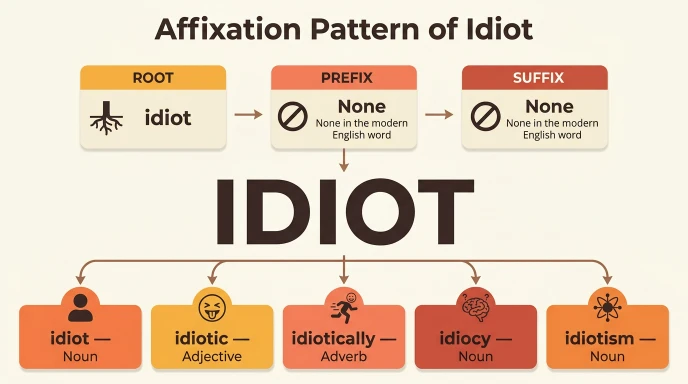
Root: idiot the complete borrowed base used in modern English.
Prefix: None in the modern English word.
Suffix: No productive English suffix is added to form the basic word idiot. The ending has a historical origin rather than functioning as a normal English suffix.
Word Formation of Idiot
Common English words formed from or closely based on idiot include:
idiot noun: a foolish person.
idiotic adjective: extremely foolish or unreasonable.
idiotically : adverb: in an idiotic or foolish manner.
idiocy :noun: extremely foolish behavior or thinking.
idiotism : noun: an outdated or uncommon term connected with foolishness or a characteristic expression.
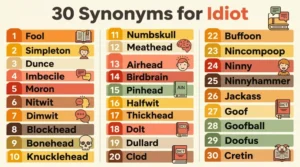
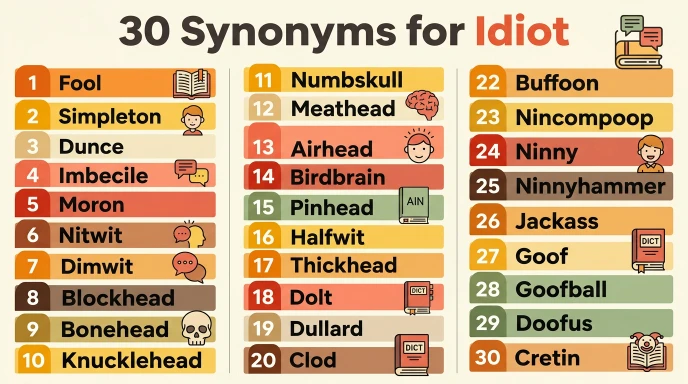
Synonyms of Idiot
The following words are related to idiot, but they are not all exact substitutes. Some are mild, humorous, old-fashioned, informal, or much stronger. Choose them according to context.
1. Fool (Noun)
US: /fuːl/ | UK: /fuːl/
Meaning: A person who acts without good sense or judgment.
Examples:
He was a fool to ignore the warning.
I felt like a fool after making such an obvious mistake.
2. Simpleton (Noun)
US: /ˈsɪmpəltən/ | UK: /ˈsɪmpəltən/
Meaning: A person who is easily fooled or lacks good judgment.
Examples:
The story presents him as a harmless simpleton.
Do not treat your younger brother like a simpleton.
3. Dunce (Noun)
US: /dʌns/ | UK: /dʌns/
Meaning: A person who is slow to learn or understand things.
Examples:
He called himself a dunce after failing the easy quiz.
The teacher never called her a dunce for making one mistake.
4.Imbecile (Noun)
US: /ˈɪmbəsəl/ | UK: /ˈɪmbəsiːl/
Meaning: An extremely foolish person; now mainly used as a strong insult.
Examples:
5. Moron (Noun)
US: /ˈmɔːrɑːn/ | UK: /ˈmɔːrɒn/
Meaning: A very foolish person, usually used as an insult.
Examples:
He behaved like a moron during the meeting.
Calling someone a moron can sound very offensive.
6. Nitwit (Noun)
US: /ˈnɪtwɪt/ | UK: /ˈnɪtwɪt/
Meaning: A silly or foolish person.
Examples:
You nitwit, you put the milk in the cupboard!
The comic character is a lovable nitwit.
7. Dimwit (Noun)
US: /ˈdɪmwɪt/ | UK: /ˈdɪmwɪt/
Meaning: A person who seems slow to understand things.
Examples:
He felt like a dimwit after forgetting the password again.
The movie’s dimwit hero often makes funny mistakes.
8. Blockhead (Noun)
US: /ˈblɑːkhed/ | UK: /ˈblɒkhed/
Examples:
You blockhead, the door opens the other way.
The old comedy is full of silly blockheads.
9. Bonehead (Noun)
US: /ˈboʊnhed/ | UK: /ˈbəʊnhed/
Meaning: A person who makes a very foolish mistake.
Examples:
I made a bonehead mistake and sent the wrong file.
Only a bonehead would forget to save the work.
10. Knucklehead (Noun)
US: /ˈnʌkəlhed/ | UK: /ˈnʌkəlhed/
Meaning: A foolish person, often used in a humorous or informal way.
Examples:
You knucklehead, you left the window open.
My brother can be a real knucklehead sometimes.
11. Numbskull (Noun)
US: /ˈnʌmskʌl/ | UK: /ˈnʌmskʌl/
Meaning: A person who seems very foolish or slow to understand.
Examples:
That numbskull forgot where he parked.
I felt like a numbskull when I made the same mistake twice.
12. Meathead (Noun)
US: /ˈmiːthed/ | UK: /ˈmiːthed/
Meaning: An informal term for a person seen as unintelligent, often with a strong or tough appearance.
Examples:
The movie portrays him as a friendly meathead.
He acted like a meathead and ignored everyone’s advice.
13. Airhead (Noun)
US: /ˈerhed/ | UK: /ˈeəhed/
Meaning: An informal term for a person who seems forgetful, careless, or unintelligent.
Examples:
I was an airhead and left my phone at home.
She laughed and called herself an airhead after forgetting the appointment.
14. Birdbrain (Noun)
US: /ˈbɜːrdbreɪn/ | UK: /ˈbɜːdbreɪn/
Meaning: An informal and humorous word for a person considered unintelligent.
Examples:
I had a birdbrain moment and forgot the meeting time.
He jokingly called himself a birdbrain.
15. Pinhead (Noun)
US: /ˈpɪnhed/ | UK: /ˈpɪnhed/
Meaning: An informal insult for a foolish or unintelligent person.
Examples:
That pinhead forgot to check the address.
I would feel like a pinhead if I made that mistake.
16. Halfwit (Noun)
US: /ˈhæfwɪt/ | UK: /ˈhɑːfwɪt/
Examples:
He called the thief a halfwit for leaving evidence behind.
The novel has a comic halfwit who causes trouble.
17. Thickhead (Noun)
US: /ˈθɪkhed/ | UK: /ˈθɪkhed/
Meaning: A person who is slow to understand something.
Examples:
I must be a thickhead because I still do not understand it.
The character is a lovable thickhead who learns slowly.
18. Dolt (Noun)
US: /doʊlt/ | UK: /dəʊlt/
Meaning: A foolish or slow-thinking person.
Examples:
The dolt forgot to bring the tickets.
He felt like a dolt after misunderstanding the simple question.
19. Dullard (Noun)
US: /ˈdʌlərd/ | UK: /ˈdʌləd/
Meaning: A person who is slow to learn or understand.
Examples:
The teacher never treated him as a dullard.
The character is described as a lazy dullard.
20. Clod (Noun)
US: /klɑːd/ | UK: /klɒd/
Meaning: An awkward or foolish person.
Examples:
That clod knocked over the lamp.
I felt like a clod when I forgot her name.
21. Oaf (Noun)
US: /oʊf/ | UK: /əʊf/
Meaning: A large, clumsy, or foolish person.
Examples:
The friendly oaf accidentally broke the chair.
He apologized for behaving like an oaf.
22. Buffoon (Noun)
US: /bəˈfuːn/ | UK: /bəˈfuːn/
Meaning: A foolish person who behaves in a ridiculous way.
Examples:
The politician was portrayed as a buffoon in the comedy.
He made a buffoon of himself at the party.
23. Nincompoop (Noun)
US: /ˈnɪŋkəmpuːp/ | UK: /ˈnɪŋkəmpuːp/
Meaning: A silly or foolish person, usually in a humorous way.
Examples:
You nincompoop, you forgot to turn on the computer.
The cartoon hero is a lovable nincompoop.
24. Ninny (Noun)
US: /ˈnɪni/ | UK: /ˈnɪni/
Meaning: A silly or foolish person.
Examples:
Do not be such a ninny; the dog is not dangerous.
He felt like a ninny after getting scared by a harmless noise.
25. Ninnyhammer (Noun)
US: /ˈnɪniˌhæmər/ | UK: /ˈnɪniˌhæmə/
Meaning: A humorous and old-fashioned word for a foolish person.
Examples:
You ninnyhammer, the answer is right in front of you.
The writer uses ninnyhammer to create a playful tone.
26. Jackass (Noun)
US: /ˈdʒækæs/ | UK: /ˈdʒækæs/
Meaning: An informal and often offensive word for a foolish or annoying person.
Examples:
He acted like a jackass during the argument.
Do not be a jackass to people who are trying to help.
27. Goof (Noun)
US: /ɡuːf/ | UK: /ɡuːf/
Meaning: An informal word for a silly or foolish person.
Examples:
He is a lovable goof who makes everyone laugh.
I felt like a goof after wearing my shirt backward.
28. Goofball (Noun)
US: /ˈɡuːfbɔːl/ | UK: /ˈɡuːfbɔːl/
Meaning: A silly or eccentric person, often used affectionately.
Examples:
My brother is a complete goofball.
That goofball made everyone laugh during lunch.
29. Doofus (Noun)
US: /ˈduːfəs/ | UK: /ˈduːfəs/
Meaning: An informal and usually humorous word for a foolish person.
Examples:
I was a doofus and left my wallet at home.
You doofus, you put the batteries in backward.
30. Cretin (Noun)
US: /ˈkriːtən/ | UK: /ˈkriːtɪn/
Meaning: A very offensive term for a foolish or unpleasant person.
Examples:
The angry driver called the other driver a cretin.
Calling someone a cretin can sound harsh and insulting.
Prototype Meaning
The prototype meaning of idiot is a person who does something that seems obviously foolish, careless, or lacking in common sense.
When people hear idiot, they usually imagine someone making a very poor decision, ignoring obvious information, or behaving in a silly way.
The word focuses more on foolish behavior or judgment than on a person’s actual intelligence.
Prototype Categorization
General foolishness: fool, idiot, simpleton, dolt
useful when someone shows poor judgment or common sense.
Slow understanding: dunce, dullard, thickhead, dimwit focus more on difficulty understanding or learning.
Humorous insults: nitwit, nincompoop, ninny, doofus, goofball often sound playful rather than seriously hostile.
Informal modern insults: bonehead, knucklehead, numbskull, airhead, birdbrain common in casual speech.
Clumsy foolishness: oaf, clod, buffoon describe people whose behavior is awkward, ridiculous, or foolish.
Old-fashioned vocabulary: ninnyhammer, dolt, dullard useful in literature, humor, or historical-style writing.
Categorization helps writers choose the right synonym for the situation. A humorous story may need doofus, while a serious description may need foolish person. A strong insult such as moron or cretin should be used carefully because it can offend people.
Antonyms of Idiot
Genius (Noun): a person with exceptional intelligence or ability.
Intellectual (Noun): a person who is highly interested in serious ideas and learning.
Thinker (Noun): a person who thinks carefully and deeply.
Sage (Noun): a very wise person.
Scholar (Noun): a person with deep knowledge of a subject.
Wise (Adjective): showing good judgment and understanding.
Intelligent (Adjective): able to learn, understand, and use information well.
Clever (Adjective): quick to understand or solve problems.
Sensible (Adjective): showing practical and reasonable judgment.
Wise (Adjective): having good judgment based on knowledge and experience.
Short Questions and Answers
What does idiot mean?
Idiot means a person who behaves in a very foolish or unintelligent way.
When should idiot be used?
Use it mainly in informal speech or writing when describing very foolish behavior. Avoid using it as a serious label for someone’s intelligence.
Is idiot positive or negative?
It is normally negative. Between close friends, it can sometimes be used jokingly, but the tone depends heavily on context.
How is it different from similar words?
Words such as fool, dunce, doofus, and moron have different levels of seriousness. Doofus often sounds playful, while moron and cretin can sound much harsher.
Conclusion
Learning idiot and its synonyms gives English learners more ways to describe foolish behavior accurately.
Instead of repeating the same word, you can choose fool, simpleton, dunce, doofus, knucklehead, or another suitable term based on the situation and tone.
Understanding pronunciation also improves speaking and listening skills, while learning word history makes vocabulary easier to remember.
Knowing connotations is especially important because some synonyms are playful and others are offensive.
This knowledge helps writers create clearer, stronger, and more natural sentences. It also helps speakers communicate with greater confidence. Practice these words in short sentences each day, but always consider the audience and situation before using an insulting term.
Read more about!
- Synonyms for Stop : 30 Words to Boost Vocabulary
- Synonyms for Motivation:30 Words to Boost Vocabulary

I am an American writer and speaker who focuses on habits, productivity, and self-improvement.
I study how small daily habits can create big changes in life. I try to write in a very simple and practical way so anyone can apply my ideas.
My most popular book is Atomic Habits, which is read around the world.