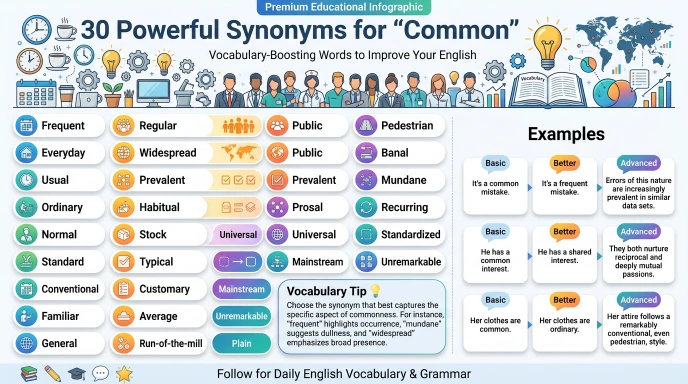
The word common means something that happens often, is found in many places, or is shared by many people.
For example, a student may say, “It is common to feel nervous before an exam.” This word is used in daily English because it helps people describe normal events, usual things, and shared experiences.
English learners and content writers need synonyms because using the same word again and again can make speech and writing boring. Learning similar words helps people express ideas with more accuracy and confidence.
This article explains the meaning of common, its synonyms, examples, grammar use, pronunciation, history, and different semantic categories to help learners choose the right word in every situation.
Meaning of Common
Definition
Common (Adjective):
Common means something that is usual, ordinary, frequent, or shared by many people.
Examples
- This is a common mistake among new English learners.
- Mobile phones are common in modern society.
Connotative Meaning
Connotation: (The emotional or cultural feeling connected with a word beyond its basic meaning.)
- Positive tone:
Common can show connection, equality, and something shared by everyone.
Example: “We have a common goal.” - Negative tone:
Common can sometimes mean ordinary or not special.
Example: “The design looks common.” - Neutral tone:
Common simply describes something that happens often or exists widely.
Example: “Cold weather is common in winter.”
Etymology
- The word common comes from the Latin word communis, meaning “shared by all” or “belonging together.”
- It entered English through Old French comun before becoming common in English.
Short History of Common
Old English (450–1100):
The exact modern form “common” was not widely used in Old English. Similar ideas were expressed through words related to sharing and belonging.
Middle English (1100–1500):
The word entered English from Old French after the Norman influence. It was used to describe things shared by people or belonging to the public.
Modern English (1500–Present):
Common developed many meanings, including “usual,” “frequent,” “ordinary,” and “general.” Today it is one of the most frequently used English adjectives.
Pronunciation (US & UK – IPA)
US: /ˈkɑː.mən/
UK: /ˈkɒm.ən/
Syllables
com-mon
Affixation Pattern of Common
Root:
- commun- (from Latin communis, meaning “shared”)
Prefix:
- No prefix
Suffix:
- -on (part of the historical word form, not a productive modern suffix)
Word Formation of Common
- common (adjective) usual or shared
- commonly (adverb) in a usual or frequent way
- commonness (noun) the state of being common
- commoner (noun) an ordinary person or someone without a special social rank
Synonyms of Common
1. Usual (Adjective)
US IPA: /ˈjuː.ʒu.əl/ | UK IPA: /ˈjuː.ʒu.əl/
Meaning:
Usual means something that normally happens or is expected.
Examples:
- It was a usual day at the office.
- She arrived at her usual time.
2. Normal (Adjective)
US IPA: /ˈnɔːr.məl/ | UK IPA: /ˈnɔː.məl/
Meaning:
Normal means something that is typical, regular, or not unusual.
Examples:
- Feeling tired after exercise is normal.
- This temperature is normal for winter.
3. Ordinary (Adjective)
US IPA: /ˈɔːr.də.ner.i/ | UK IPA: /ˈɔː.dɪ.nər.i/
Meaning:
Ordinary means not special, different, or unusual.
Examples:
- He lives an ordinary life.
- The meal looked ordinary but tasted great.
4. Regular (Adjective)
US IPA: /ˈreɡ.jə.lɚ/ | UK IPA: /ˈreɡ.jʊ.lər/
Meaning:
Regular means happening repeatedly or following a pattern.
Examples:
- She is a regular customer at the shop.
- Regular exercise improves health.
5. Frequent (Adjective)
US IPA: /ˈfriː.kwənt/ | UK IPA: /ˈfriː.kwənt/
Meaning:
Frequent means happening many times or often.
Examples:
- Frequent practice helps students learn faster.
- He makes frequent visits to his hometown.
6. Typical (Adjective)
US IPA: /ˈtɪp.ɪ.kəl/ | UK IPA: /ˈtɪp.ɪ.kəl/
Meaning:
Typical means showing the usual features of something.
Examples:
- This is a typical example of modern design.
- Rainy weather is typical in this region.
7. General (Adjective)
US IPA: /ˈdʒen.ər.əl/ | UK IPA: /ˈdʒen.ər.əl/
Meaning:
General means related to many people or things, not specific.
Examples:
- The general opinion was positive.
- I have a general idea about the topic.
8. Popular (Adjective)
US IPA: /ˈpɑː.pjə.lɚ/ | UK IPA: /ˈpɒp.jʊ.lər/
Meaning:
Popular means liked or accepted by many people.
Examples:
- Football is a popular sport worldwide.
- This restaurant is popular among students.
9. Widespread (Adjective)
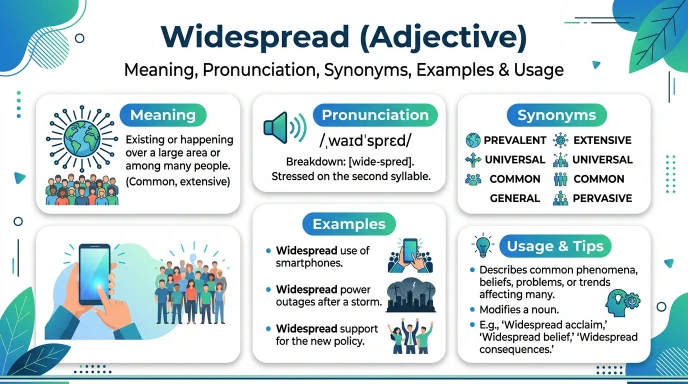
US IPA: /ˈwaɪd.spred/ | UK IPA: /ˈwaɪd.spred/
Meaning:
Widespread means existing or happening in many places.
Examples:
- Internet use is widespread today.
- The disease became widespread quickly.
10. Commonplace (Adjective)
US IPA: /ˈkɑː.mən.pleɪs/ | UK IPA: /ˈkɒm.ən.pleɪs/
Meaning:
Commonplace means very common and not unusual.
Examples:
- Smartphones are commonplace now.
- Online meetings are commonplace in business.
11. Everyday (Adjective)
US IPA: /ˈev.ri.deɪ/ | UK IPA: /ˈev.ri.deɪ/
Meaning:
Everyday means normal and happening as part of daily life.
Examples:
- These are everyday problems.
- She uses simple words in everyday conversations.
12. Familiar (Adjective)
US IPA: /fəˈmɪl.jɚ/ | UK IPA: /fəˈmɪl.i.ər/
Meaning:
Familiar means known or recognized because of past experience.
Examples:
- His face looks familiar to me.
- This song sounds familiar.
13. Frequented (Adjective)
US IPA: /ˈfriː.kwən.tɪd/ | UK IPA: /ˈfriː.kwən.tɪd/
Meaning:
Frequented means visited or used often.
Examples:
- The park is frequented by local families.
- This café is frequented by writers.
14. Conventional (Adjective)
US IPA: /kənˈven.ʃən.əl/ | UK IPA: /kənˈven.ʃən.əl/
Meaning:
Conventional means following common traditions or accepted ways.
Examples:
- They chose a conventional method.
- His ideas are conventional.
15. Ordinary-looking (Adjective)
US IPA: /ˈɔːr.də.ner.i ˈlʊk.ɪŋ/ | UK IPA: /ˈɔː.dɪ.nər.i ˈlʊk.ɪŋ/
Meaning:
Ordinary-looking means appearing normal or not special.
Examples:
- The building looks ordinary-looking from outside.
- He wore ordinary-looking clothes.
16. Average (Adjective)
US IPA: /ˈæv.ər.ɪdʒ/ | UK IPA: /ˈæv.ər.ɪdʒ/
Meaning:
Average means normal or around the usual level.
Examples:
- The student has average marks.
- The average person spends hours online.
17. Standard (Adjective)
US IPA: /ˈstæn.dɚd/ | UK IPA: /ˈstæn.dəd/
Meaning:
Standard means accepted as normal or common.
Examples:
- English is the standard language for communication.
- This is a standard procedure.
18. Routine (Adjective)
US IPA: /ruːˈtiːn/ | UK IPA: /ruːˈtiːn/
Meaning:
Routine means happening regularly as part of normal activities.
Examples:
- A health check is a routine process.
- She follows a routine schedule.
19. Abundant (Adjective)
US IPA: /əˈbʌn.dənt/ | UK IPA: /əˈbʌn.dənt/
Meaning:
Abundant means available in large amounts.
Examples:
- Fresh water is abundant in this area.
- The garden has abundant flowers.
20. Numerous (Adjective)
US IPA: /ˈnuː.mər.əs/ | UK IPA: /ˈnjuː.mər.əs/
Meaning:
Numerous means existing in large numbers.
Examples:
- Numerous people attended the event.
- She received numerous messages.
21. Many (Adjective/Determiner)
US IPA: /ˈmen.i/ | UK IPA: /ˈmen.i/
Meaning:
Many means a large number of people, things, or events.
Examples:
- Many students learn English online.
- Many people enjoy reading books.
22. Ordinary (Adjective)
US IPA: /ˈɔːr.də.ner.i/ | UK IPA: /ˈɔː.dɪ.nər.i/
Meaning:
Ordinary means normal and not different from others.
Examples:
- It was an ordinary day at school.
- She prefers ordinary clothes for daily use.
23. Public (Adjective)
US IPA: /ˈpʌb.lɪk/ | UK IPA: /ˈpʌb.lɪk/
Meaning:
Public means available or known by many people.
Examples:
- The library is a public place.
- Public transport is common in large cities.
24. Shared (Adjective)
US IPA: /ʃerd/ | UK IPA: /ʃeəd/
Meaning:
Shared means used, experienced, or owned by more than one person.
Examples:
- They have a shared interest in music.
- The team worked toward a shared goal.
25. Collective (Adjective)
US IPA: /kəˈlek.tɪv/ | UK IPA: /kəˈlek.tɪv/
Meaning:
Collective means belonging to a group or community.
Examples:
- They made a collective decision.
- Collective effort can solve problems.
26. Universal (Adjective)
US IPA: /ˌjuː.nəˈvɝː.səl/ | UK IPA: /ˌjuː.nɪˈvɜː.səl/
Meaning:
Universal means true, accepted, or found everywhere.
Examples:
- Love is a universal human feeling.
- The internet has become a universal tool.
27. Commonly Used (Adjective Phrase)
US IPA: /ˈkɑː.mən.li juːzd/ | UK IPA: /ˈkɒm.ən.li juːzd/
Meaning:
Commonly used means used by many people very often.
Examples:
- English has many commonly used words.
- This phrase is commonly used in conversation.
28. Ordinary-Level (Adjective)
US IPA: /ˈɔːr.də.ner.i ˈlev.əl/ | UK IPA: /ˈɔː.dɪ.nər.i ˈlev.əl/
Meaning:
Ordinary-level means normal or basic in quality or amount.
Examples:
- The product has ordinary-level features.
- He achieved an ordinary-level result.
29. Prevailing (Adjective)
US IPA: /prɪˈveɪ.lɪŋ/ | UK IPA: /prɪˈveɪ.lɪŋ/
Meaning:
Prevailing means existing or accepted at a particular time.
Examples:
- The prevailing opinion was positive.
- The prevailing culture affects behavior.
30. Frequent (Adjective)
US IPA: /ˈfriː.kwənt/ | UK IPA: /ˈfriː.kwənt/
Meaning:
Frequent means happening often or repeatedly.
Examples:
- Frequent communication builds strong relationships.
- Frequent errors can slow progress.
Prototype Meaning
The prototype meaning of common is something that is usual, normal, and seen by many people.
When people hear the word common, they usually imagine everyday things that are not rare or unusual, such as common problems, common habits, or common experiences.
The main idea is that something appears often or is shared by many people.
Prototype Categorization
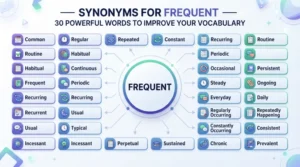
Synonyms of common can be grouped into different categories. These categories help writers choose the most suitable word based on meaning and situation.
- Frequency Category (things that happen often):
- Frequent
- Regular
- Usual
- Routine
- Commonly used
- Normality Category (things that are ordinary or expected):
- Normal
- Typical
- Ordinary
- Average
- Everyday
- Sharing Category (things connected with many people):
- Shared
- Collective
- Public
- Universal
- Large Number Category (things existing in high quantity):
- Many
- Numerous
- Abundant
- Widespread
Understanding these groups helps writers avoid repetition and select words with the correct meaning, tone, and strength.
Antonyms of Common
- Rare (Adjective):
Something that does not happen often or is difficult to find. - Unusual (Adjective):
Something different from what normally happens. - Unique (Adjective):
Something that is one of a kind. - Special (Adjective):
Something better or different from ordinary things. - Exceptional (Adjective):
Something much better or different from normal. - Scarce (Adjective):
Something that is difficult to find or available in small amounts. - Uncommon (Adjective):
Something that is not frequently seen or experienced.
Short Questions and Answers
- What does common mean?
Common means something usual, normal, frequent, or shared by many people. - When should common be used?
Common should be used when describing things that happen often or exist in many places. - Is common positive or negative?
Common can be positive, negative, or neutral depending on the context. It can show connection or describe something ordinary. - How is it different from similar words?
Common is a general word. Words like frequent focus on time, while widespread focuses on something existing in many places.
Conclusion
Learning the word common and its synonyms helps English learners build a stronger vocabulary.
These words allow speakers and writers to express ideas more clearly without repeating the same terms. Understanding small differences between synonyms improves writing quality, speaking skills, and communication confidence.
Words like usual, normal, widespread, and typical may have similar meanings, but each one works better in different situations. Regular vocabulary practice helps learners remember new words and use them naturally. By studying meanings, pronunciation, tone, history, and examples, learners can improve their English step by step and become more effective communicators.
Explore more about!
- Synonyms for Unfortunately: 30 Words to Boost Your Vocabulary
- Synonyms for Healthy:30 Powerful Words to Improve
- Synonyms for Challenging :Boost Your Vocabulary Instantly

I am an American writer and speaker who focuses on habits, productivity, and self-improvement.
I study how small daily habits can create big changes in life. I try to write in a very simple and practical way so anyone can apply my ideas.
My most popular book is Atomic Habits, which is read around the world.