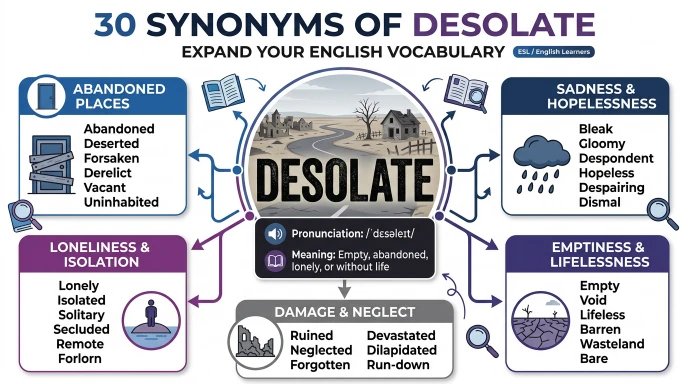
The word desolate means empty, lonely, abandoned, or without life and happiness. Imagine walking through an old town where no people live anymore. The streets are silent, the buildings are broken, and everything feels lonely.
This scene can be described as desolate. The word is commonly used in everyday English, literature, travel writing, news reports, and emotional descriptions.
Learning synonyms of desolate helps English learners, students, writers, and content creators express ideas more clearly and avoid repeating the same word. Different synonyms can show different shades of meaning, such as loneliness, abandonment, sadness, or emptiness.
In this article, you will learn the meaning of desolate, its pronunciation, history, grammar, connotation, and 30 useful synonyms with examples. You will also discover how these words fit into different semantic categories and writing situations.
Meaning of Desolate
Definition
Desolate (Adjective):
A place, person, or situation that is empty, abandoned, lonely, or filled with sadness.
Examples
- The travelers crossed a desolate desert with no signs of life.
- After the shop closed, the street looked desolate and quiet.
Connotative Meaning
(Connotation means the emotional feeling or association that a word carries beyond its dictionary meaning.)
- Positive tone: Can suggest peace, solitude, or untouched natural beauty in rare contexts.
- Negative tone: Usually suggests loneliness, abandonment, sadness, emptiness, or hopelessness.
- Neutral tone: May simply describe a place with very few people or activities.
Etymology
- Originates from the Latin word desolatus.
- Derived from desolare, meaning “to leave alone” or “abandon.”
- Entered English through Old French influences.
- Original meaning focused on abandonment and isolation.
Short History of the Keyword
Old English (450–1100)
The exact word desolate was not used in Old English. Similar ideas were expressed through words meaning lonely, empty, or abandoned.
Middle English (1100–1500)
The word entered English through French and Latin influences. Writers began using it to describe abandoned places and sorrowful conditions.
Modern English (1500–Present)
The word became common in literature, poetry, travel writing, and everyday English. Today it describes lonely places, emotional sadness, and abandoned environments.
Pronunciation (US & UK – IPA)
US: /ˈdɛsəleɪt/
UK: /ˈdesələt/
Syllables
des-o-late
Affixation Pattern of Desolate
Root: sol (related to being alone)
Prefix: de- (away, removal)
Suffix: -ate
Word Formation of Desolate
- Desolate (Adjective) – lonely, abandoned
- Desolately (Adverb) – in a lonely or miserable way
- Desolation (Noun) – state of emptiness or ruin
- Desolating (Adjective/Verb Form) – causing ruin or sadness
- Desolated (Adjective/Verb Form) – made empty or abandoned
Synonyms of Desolate
1. Abandoned (Adjective)
US: /əˈbændənd/ | UK: /əˈbændənd/
Meaning: Left behind and no longer cared for.
Examples:
- The abandoned house stood at the end of the road.
- We explored an abandoned factory.
2. Deserted (Adjective)
US: /dɪˈzɜːrtɪd/ | UK: /dɪˈzɜːtɪd/
Meaning: Empty because people have left.
Examples:
- The beach was deserted after sunset.
- They walked through a deserted village.
3. Lonely (Adjective)
US: /ˈloʊnli/ | UK: /ˈləʊnli/
Meaning: Feeling alone or isolated.
Examples:
- She felt lonely in the new city.
- The lonely cabin sat deep in the forest.
4. Barren (Adjective)
US: /ˈbærən/ | UK: /ˈbærən/
Meaning: Unable to produce plants or life.
Examples:
- The barren land stretched for miles.
- Farmers struggled to use the barren soil.
5. Bleak (Adjective)
US: /bliːk/ | UK: /bliːk/
Meaning: Cold, empty, or without hope.
Examples:
- The weather looked bleak and gray.
- His future seemed bleak after the loss.
6. Empty (Adjective)
US: /ˈɛmpti/ | UK: /ˈempti/
Meaning: Having nothing inside.
Examples:
- The room was completely empty.
- Empty streets surrounded the building.
7. Isolated (Adjective)
US: /ˈaɪsəleɪtɪd/ | UK: /ˈaɪsəleɪtɪd/
Meaning: Separated from others.
Examples:
- The isolated farm was far from town.
- He felt isolated from his friends.
8. Forsaken (Adjective)
US: /fɔːrˈseɪkən/ | UK: /fəˈseɪkən/
Meaning: Abandoned or forgotten.
Examples:
- A forsaken church stood on the hill.
- The dog looked forsaken and sad.
9. Vacant (Adjective)
US: /ˈveɪkənt/ | UK: /ˈveɪkənt/
Meaning: Not occupied or used.
Examples:
- The apartment remained vacant for months.
- Several vacant buildings lined the street.
10. Uninhabited (Adjective)
US: /ˌʌnɪnˈhæbɪtɪd/ | UK: /ˌʌnɪnˈhæbɪtɪd/
Meaning: Having no people living there.
Examples:
- They discovered an uninhabited island.
- The region remained largely uninhabited.
11. Despondent (Adjective)
US: /dɪˈspɑːndənt/ | UK: /dɪˈspɒndənt/
Meaning: Feeling very sad and without hope.
Examples:
- The team became despondent after the defeat.
- She looked despondent when she heard the news.
12. Gloomy (Adjective)
US: /ˈɡluːmi/ | UK: /ˈɡluːmi/
Meaning: Dark, sad, or depressing.
Examples:
- The gloomy sky suggested rain.
- The abandoned building looked gloomy.
13. Dreary (Adjective)
US: /ˈdrɪri/ | UK: /ˈdrɪəri/
Meaning: Dull, depressing, and lifeless.
Examples:
- It was a dreary winter afternoon.
- The town appeared dreary and silent.
14. Wretched (Adjective)
US: /ˈretʃɪd/ | UK: /ˈretʃɪd/
Meaning: Very unhappy or in poor condition.
Examples:
- They lived in wretched conditions.
- He felt wretched after the mistake.
15. Ruined (Adjective)
US: /ˈruːɪnd/ | UK: /ˈruːɪnd/
Meaning: Damaged or destroyed.
Examples:
- The ruined castle attracted tourists.
- Heavy storms left the village ruined.
16. Devastated (Adjective)
US: /ˈdevəsteɪtɪd/ | UK: /ˈdevəsteɪtɪd/
Meaning: Completely destroyed or emotionally shocked.
Examples:
- The city was devastated by flooding.
- She felt devastated after the loss.
17. Neglected (Adjective)
US: /nɪˈɡlektɪd/ | UK: /nɪˈɡlektɪd/
Meaning: Not given proper care or attention.
Examples:
- The neglected garden was full of weeds.
- Many neglected buildings needed repair.
18. Remote (Adjective)
US: /rɪˈmoʊt/ | UK: /rɪˈməʊt/
Meaning: Far away from people or cities.
Examples:
- They stayed in a remote mountain village.
- The remote area had few visitors.
19. Solitary (Adjective)
US: /ˈsɑːləteri/ | UK: /ˈsɒlɪtəri/
Meaning: Existing alone.
Examples:
- A solitary tree stood in the field.
- He preferred a solitary lifestyle.
20. Secluded (Adjective)
US: /sɪˈkluːdɪd/ | UK: /sɪˈkluːdɪd/
Meaning: Quiet and away from other people.
Examples:
- They rented a secluded cabin.
- The beach remained secluded and peaceful.
21. Desponding (Adjective)
US: /dɪˈspɑːndɪŋ/ | UK: /dɪˈspɒndɪŋ/
Meaning: Feeling discouraged and without hope.
Examples:
- The workers became desponding after the factory closed.
- He felt desponding about the future.
22. Derelict (Adjective)
US: /ˈderəlɪkt/ | UK: /ˈderəlɪkt/
Meaning: Abandoned and in poor condition.
Examples:
- A derelict warehouse stood beside the river.
- The derelict building needed repairs.
23. Wasteland (Noun)
US: /ˈweɪstlænd/ | UK: /ˈweɪstlænd/
Meaning: A barren and unproductive area.
Examples:
- The drought turned the farmland into a wasteland.
- Large parts of the region became wasteland.
24. Lifeless (Adjective)
US: /ˈlaɪfləs/ | UK: /ˈlaɪfləs/
Meaning: Without life, energy, or activity.
Examples:
- The garden looked lifeless during winter.
- His voice sounded lifeless and weak.
25. Depressed (Adjective)
US: /dɪˈprest/ | UK: /dɪˈprest/
Meaning: Feeling very sad and discouraged.
Examples:
- She felt depressed after moving away.
- He seemed depressed throughout the week.
26. Hopeless (Adjective)
US: /ˈhoʊpləs/ | UK: /ˈhəʊpləs/
Meaning: Having no expectation of success or improvement.
Examples:
- The situation appeared hopeless.
- They felt hopeless after many failures.
27. Void (Adjective/Noun)
US: /vɔɪd/ | UK: /vɔɪd/
Meaning: Empty or lacking content.
Examples:
- The hall felt void of activity.
- He experienced a void after retirement.
28. Stark (Adjective)
US: /stɑːrk/ | UK: /stɑːk/
Meaning: Harsh, plain, and empty.
Examples:
- The stark landscape stretched endlessly.
- The room was stark and undecorated.
29. Despairing (Adjective)
US: /dɪˈsperɪŋ/ | UK: /dɪˈspeərɪŋ/
Meaning: Feeling a complete loss of hope.
Examples:
- She gave a despairing look.
- The refugees felt despairing about their future.
30. Forgotten (Adjective)
US: /fərˈɡɑːtən/ | UK: /fəˈɡɒtən/
Meaning: No longer remembered or cared about.
Examples:
- A forgotten path led into the woods.
- The forgotten town slowly disappeared from maps.
Antonyms of Desolate
- Lively (Adjective) – full of life and activity
- Thriving (Adjective) – growing and succeeding
- Populated (Adjective) – filled with people
- Occupied (Adjective) – in use by people
- Prosperous (Adjective) – successful and flourishing
- Cheerful (Adjective) – happy and positive
- Vibrant (Adjective) – energetic and full of life
- Hopeful (Adjective) – expecting good outcomes
- Bustling (Adjective) – busy and active
- Productive (Adjective) – producing useful results
Short Questions and Answers
- What does desolate mean?
Desolate means empty, abandoned, lonely, or lacking life and activity. - When should desolate be used?
It is used to describe lonely places, abandoned areas, sad situations, or feelings of isolation. - Is desolate positive or negative?
It is usually negative because it suggests loneliness, sadness, or abandonment. In rare cases, it can describe peaceful solitude. - How is it different from similar words?
Desolate combines the ideas of emptiness, loneliness, and sadness. Words like empty focus on absence, while lonely focuses on emotion.
Meaning and Usage Table
| Word | Part of Speech | Meaning |
| Desolate | Adjective | Empty, lonely, abandoned |
| Barren | Adjective | Unable to support life |
| Deserted | Adjective | Empty of people |
| Forsaken | Adjective | Abandoned or forgotten |
| Bleak | Adjective | Hopeless and gloomy |
| Secluded | Adjective | Away from other people |
| Solitary | Adjective | Existing alone |
| Derelict | Adjective | Abandoned and neglected |
| Void | Noun/Adjective | Empty space or emptiness |
| Lifeless | Adjective | Without life or energy |
Prototype Meaning
The most typical meaning of desolate is a place that is empty, abandoned, and lacking life or activity. When people hear the word, they often imagine a lonely desert, an abandoned village, a ruined building, or a person feeling completely alone.
The word usually creates a strong image of emptiness, sadness, and isolation.
Prototype Categorization
Grouping synonyms into categories helps writers choose the most accurate word for a specific situation.
Abandoned Places
- Abandoned
- Deserted
- Forsaken
- Vacant
- Uninhabited
These words focus on places where people are absent.
Loneliness and Isolation
- Lonely
- Isolated
- Solitary
- Secluded
- Remote
These words emphasize separation from others.
Sadness and Emotional Pain
- Despondent
- Gloomy
- Wretched
- Devastated
- Bleak
These words highlight emotional suffering and hopelessness.
Lifeless or Unproductive Areas
- Barren
- Empty
- Dreary
- Neglected
- Ruined
These words describe places lacking activity, beauty, or growth.
How Categorization Helps Writers
Categorization helps writers select the best synonym based on context. For example, barren works better for land, lonely works better for emotions, deserted works better for empty places, and devastated works better for strong emotional loss. Choosing the right category makes writing clearer and more powerful.
Related Words
- Desolation (Noun) – a state of emptiness or ruin
- Isolate (Verb) – to separate from others
- Isolation (Noun) – the condition of being alone
- Solitude (Noun) – the state of being alone
- Seclusion (Noun) – privacy and isolation
- Loneliness (Noun) – sadness caused by being alone
- Desertion (Noun) – the act of abandoning
- Abandonment (Noun) – leaving someone or something behind
- Ruin (Noun) – destruction or decay
- Wilderness (Noun) – a wild, undeveloped area
Formal and Casual Usage
Formal Alternatives
These synonyms are common in academic, professional, literary, and formal writing:
- Desolate
- Forsaken
- Bleak
- Barren
- Uninhabited
- Devastated
- Solitary
- Secluded
- Wretched
- Ruined
Formal Example:
“The researchers documented several desolate and uninhabited regions.”
Casual Alternatives
These synonyms are common in everyday conversations:
- Empty
- Lonely
- Quiet
- Deserted
- Abandoned
- Remote
- Gloomy
- Neglected
Casual Example:
“The street looked empty and lonely at night.”
Example Sentence and Meaning Table
| Word | Simple Meaning |
| Desolate | Empty and lonely |
| Abandoned | Left behind |
| Deserted | Empty of people |
| Lonely | Feeling alone |
| Barren | Unable to support life |
| Bleak | Hopeless and gloomy |
| Vacant | Not occupied |
| Forsaken | Forgotten or abandoned |
| Solitary | Existing alone |
| Secluded | Hidden from people |
Conclusion:
Learning the word desolate and its synonyms can greatly improve your English vocabulary. These words help you describe empty places, lonely situations, abandoned locations, and feelings of sadness with greater accuracy.
Understanding different synonyms strengthens both writing and speaking because it allows you to choose the most suitable word for each context. It also helps you avoid repetition and makes your communication more engaging.
By studying pronunciation, history, connotation, related words, and semantic categories, you gain a deeper understanding of how the word is used in real-life English. Make vocabulary practice a daily habit, and try using new synonyms in sentences, conversations, and writing tasks to build confidence and fluency.
See more!
- Synonyms of Frequent: Best Alternative Words to Know
- Synonyms of Boring: Best Alternative Words to Know

I am an American author, and I write books about power, strategy, and human behavior. My writing style is simple but deep, and I try to explain how people think and act in real-life situations.
I studied classical studies, and before becoming a writer, I worked in different fields which helped me understand people and life better.
My most famous books include The 48 Laws of Power, The Art of Seduction, and Mastery. These books are widely read by business people, leaders, and students around the world.