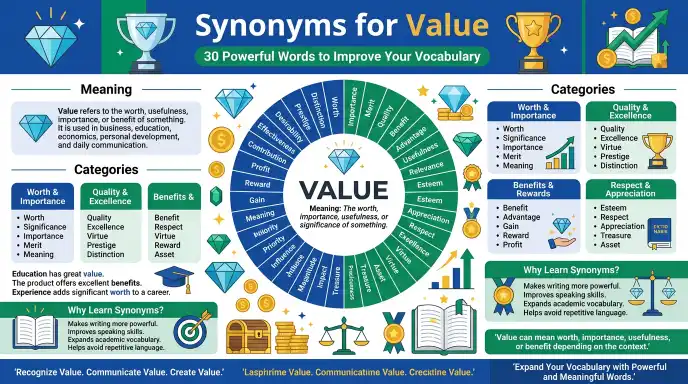
Value means the worth, importance, usefulness, or benefit of something. Imagine buying a good-quality book at a low price. You might say it offers great value because it is useful and worth the cost.
People use the word value in business, education, finance, relationships, and everyday conversations to describe importance or worth.
Learning synonyms for value helps English learners and content writers improve their vocabulary and express ideas more accurately. Different synonyms can describe monetary worth, personal importance, respect, or usefulness.
Using a variety of words also makes writing and speaking more engaging while reducing repetition.
In this article, you will learn the meaning of value, its pronunciation, history, grammar, emotional tone, and 30 useful synonyms. You will also explore examples, semantic categories, antonyms, related words, and practical language tips to strengthen your English skills.
Meaning of Value
Definition
Value (Noun, Verb):
The worth, importance, usefulness, or benefit of something; to consider something important.
Examples
- Education has great value in life.
- I value honesty and kindness.
Connotative Meaning
(Connotation: the emotional feeling or association connected to a word beyond its dictionary meaning.)
- Positive tone: Importance, worth, respect, benefit.
- Negative tone: May refer to low monetary value in some contexts.
- Neutral tone: The worth or significance of something.
Etymology
- Source language: Latin
- Derived from Latin valere, meaning “to be strong” or “to be worth.”
- Entered English through Old French.
- Original meaning: Worth or importance.
Short History of the Keyword
- Old English (450–1100): The exact word value was not commonly used.
- Middle English (1100–1500): Entered English through French influence.
- Modern English (1500–Present): Widely used in economics, education, and daily speech.
Pronunciation (US & UK – IPA)
US: /ˈvæljuː/
UK: /ˈvæljuː/
Syllables
val-ue
Affixation Pattern of Value
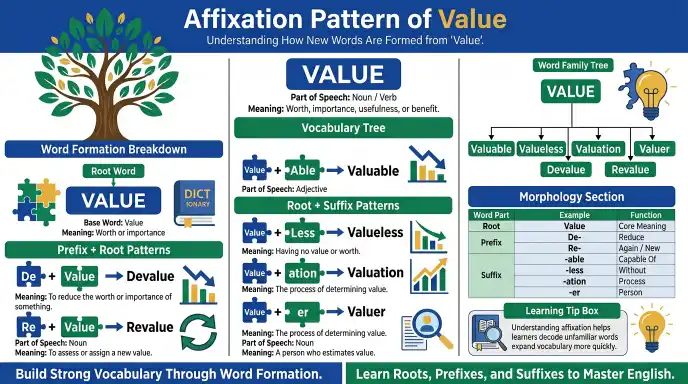
Root: value
Prefix: None
Suffix: None
Word Formation of the Keyword
- Value (Noun)
- Value (Verb)
- Valuable (Adjective)
- Valuation (Noun)
- Valued (Adjective)
- Valueless (Adjective)
- Value-added (Adjective)
Synonyms of Value
1. Worth (Noun)
US: /wɜːrθ/ | UK: /wɜːθ/
Meaning: The importance or usefulness of something.
Examples:
- The painting has great worth.
- Her advice is worth listening to.
2. Importance (Noun)
US: /ɪmˈpɔːrtəns/ | UK: /ɪmˈpɔːtəns/
Meaning: The quality of being significant.
Examples:
- Education has importance.
- We understand its importance.
3. Significance (Noun)
US: /sɪɡˈnɪfɪkəns/ | UK: /sɪɡˈnɪfɪkəns/
Meaning: Meaning or importance.
Examples:
- The discovery has significance.
- Its significance is clear.
4. Merit (Noun)
US: /ˈmerɪt/ | UK: /ˈmerɪt/
Meaning: Quality deserving praise.
Examples:
- The idea has merit.
- Her work shows merit.
5. Benefit (Noun)
US: /ˈbenəfɪt/ | UK: /ˈbenɪfɪt/
Meaning: Something helpful or useful.
Examples:
- Exercise offers benefits.
- The plan has many benefits.
6. Usefulness (Noun)
US: /ˈjuːsfəlnəs/ | UK: /ˈjuːsfəlnəs/
Meaning: Being helpful or practical.
Examples:
- The tool has usefulness.
- We appreciate its usefulness.
7. Quality (Noun)
US: /ˈkwɑːləti/ | UK: /ˈkwɒləti/
Meaning: A high standard of excellence.
Examples:
- The product has quality.
- Customers value quality.
8. Excellence (Noun)
US: /ˈeksələns/ | UK: /ˈeksələns/
Meaning: Outstanding quality.
Examples:
- The school promotes excellence.
- Excellence requires effort.
9. Virtue (Noun)
US: /ˈvɜːrtʃuː/ | UK: /ˈvɜːtʃuː/
Meaning: A good moral quality.
Examples:
- Patience is a virtue.
- Honesty is a valued virtue.
10. Esteem (Noun)
US: /ɪˈstiːm/ | UK: /ɪˈstiːm/
Meaning: Respect and admiration.
Examples:
- She earned esteem.
- He is held in esteem.
11. Respect (Noun)
US: /rɪˈspekt/ | UK: /rɪˈspekt/
Meaning: Admiration and regard.
Examples:
- Respect is important.
- They showed respect.
12. Appreciation (Noun)
US: /əˌpriːʃiˈeɪʃən/ | UK: /əˌpriːʃiˈeɪʃən/
Meaning: Recognition of value.
Examples:
- She expressed appreciation.
- Appreciation encourages people.
13. Price (Noun)
US: /praɪs/ | UK: /praɪs/
Meaning: Amount of money something costs.
Examples:
- The price increased.
- Check the price first.
14. Cost (Noun)
US: /kɔːst/ | UK: /kɒst/
Meaning: Amount paid for something.
Examples:
- The cost is reasonable.
- We reduced the cost.
15. Valuation (Noun)
US: /ˌvæljuˈeɪʃən/ | UK: /ˌvæljuˈeɪʃən/
Meaning: Assessment of worth.
Examples:
- Experts completed the valuation.
- The valuation was accurate.
16. Asset (Noun)
US: /ˈæset/ | UK: /ˈæset/
Meaning: Something valuable.
Examples:
- She is an asset to the team.
- Knowledge is an asset.
17. Treasure (Noun)
US: /ˈtreʒər/ | UK: /ˈtreʒə/
Meaning: Something highly valued.
Examples:
- Family is a treasure.
- The letter became a treasure.
18. Prize (Noun)
US: /praɪz/ | UK: /praɪz/
Meaning: Something highly valued.
Examples:
- Friendship is a prize.
- He considers health a prize.
19. Advantage (Noun)
US: /ədˈvæntɪdʒ/ | UK: /ədˈvɑːntɪdʒ/
Meaning: A helpful benefit.
Examples:
- Experience gives an advantage.
- The plan offers advantages.
20. Gain (Noun)
US: /ɡeɪn/ | UK: /ɡeɪn/
Meaning: A benefit or profit.
Examples:
- There was financial gain.
- The gain was significant.
21. Profit (Noun)
US: /ˈprɑːfɪt/ | UK: /ˈprɒfɪt/
Meaning: Financial benefit.
Examples:
- The business made profit.
- Profit increased this year.
22. Relevance (Noun)
US: /ˈreləvəns/ | UK: /ˈreləvəns/
Meaning: Importance to a situation.
Examples:
- The topic has relevance.
- Its relevance remains clear.
23. Weight (Noun)
US: /weɪt/ | UK: /weɪt/
Meaning: Importance or influence.
Examples:
- His words carry weight.
- The decision has weight.
24. Standing (Noun)
US: /ˈstændɪŋ/ | UK: /ˈstændɪŋ/
Meaning: Status or reputation.
Examples:
- She has high standing.
- The company improved its standing.
25. Credibility (Noun)
US: /ˌkredəˈbɪləti/ | UK: /ˌkredəˈbɪləti/
Meaning: Quality of being trusted.
Examples:
- Credibility matters.
- The report gained credibility.
26. Worthiness (Noun)
US: /ˈwɜːrðinəs/ | UK: /ˈwɜːðinəs/
Meaning: Deserving value or respect.
Examples:
- Her worthiness is evident.
- The cause showed worthiness.
27. Dignity (Noun)
US: /ˈdɪɡnəti/ | UK: /ˈdɪɡnəti/
Meaning: Worth and honor.
Examples:
- Everyone deserves dignity.
- He acted with dignity.
28. Prestige (Noun)
US: /preˈstiːʒ/ | UK: /preˈstiːʒ/
Meaning: High respect or status.
Examples:
- The award brought prestige.
- The university has prestige.
29. Significance Level (Noun Phrase)
US: /sɪɡˈnɪfɪkəns ˈlevəl/ | UK: /sɪɡˈnɪfɪkəns ˈlevəl/
Meaning: Degree of importance.
Examples:
- The issue has a high significance level.
- Researchers measured significance levels.
30. Worthwhileness (Noun)
US: /ˌwɜːrθˈwaɪlnəs/ | UK: /ˌwɜːθˈwaɪlnəs/
Meaning: Quality of being valuable.
Examples:
- The project’s worthwhileness is clear.
- We discussed its worthwhileness.
Prototype Meaning
The most typical meaning of value is the worth, importance, or usefulness of something.
When people hear this word, they often think about quality, benefits, respect, money, or things that are important in life.
Prototype Categorization
- Monetary Value: Price, Cost, Profit, Gain, Valuation
- Personal Importance: Worth, Significance, Importance, Relevance
- Respect and Honor: Esteem, Respect, Prestige, Dignity
- Quality and Excellence: Merit, Quality, Excellence, Virtue
- Benefits and Usefulness: Benefit, Advantage, Usefulness, Asset
Categorization helps writers choose the best synonym. For example, price relates to money, while respect relates to personal regard.
Antonyms of Value
- Worthlessness (Noun): Lack of value.
- Uselessness (Noun): Lack of usefulness.
- Insignificance (Noun): Lack of importance.
- Inferiority (Noun): Lower quality or status.
- Disregard (Noun): Lack of respect.
- Neglect (Noun): Failure to value something.
Formal and Casual Sections
Formal Synonyms
- Significance
- Merit
- Esteem
- Prestige
- Credibility
- Valuation
Casual Synonyms
- Worth
- Benefit
- Asset
- Treasure
- Prize
- Gain
Related Words Section
- Valuable
- Valuation
- Worth
- Importance
- Benefit
- Respect
- Appreciation
- Merit
- Quality
- Significance
Meaning and Example Sentence Table
| Word | Meaning | Example Sentence |
| Value | Worth or importance | Education has great value. |
| Worth | Importance or usefulness | The painting has worth. |
| Merit | Deserving praise | The idea has merit. |
| Benefit | Helpful advantage | Exercise offers benefits. |
| Respect | Admiration and regard | They showed respect. |
Short Questions and Answers
FAQ
- What does value mean?
Value means the worth, importance, usefulness, or benefit of something. - When should value be used?
Use it when discussing worth, quality, importance, or respect. - Is value positive or negative?
It is usually positive because it suggests importance or usefulness. - How is it different from similar words?
Value is a broad term, while words like price focus on money and respect focuses on admiration.
Conclusion
Learning the word value and its synonyms can greatly improve your vocabulary and communication skills. These words help you describe worth, importance, usefulness, quality, and respect more accurately.
Using a variety of synonyms makes writing and speaking more engaging and helps avoid repetition. Understanding pronunciation, history, connotation, and semantic categories also makes it easier to choose the best word for different situations.
if you are discussing business, education, relationships, or personal goals, these synonyms can strengthen your English. Practice them regularly in conversations and writing exercises to build confidence and expand your vocabulary every day.
Read more about!
- Synonyms for Fancy: 30 Vocabulary-Boosting Words
- Synonyms for Common: 30 Words to Boost Vocabulary
- 30 Powerful Synonyms for Various You Should Know

I am a British-American author, speaker, and motivational thinker. I focus on leadership and inspiration.
My main idea is that great leaders and successful organizations start with “why”.
I studied cultural anthropology and communication. My well-known books include Start With Why, Leaders Eat Last, and The Infinite Game.