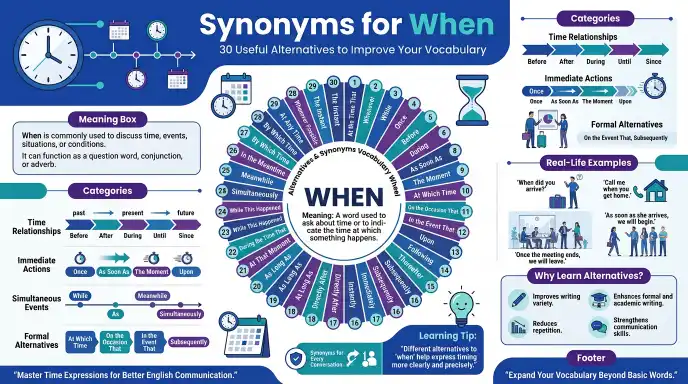
When is a common English word used to ask about time or to connect events that happen at a certain moment. Imagine a friend says, “When will you arrive?” The word helps identify the time of an action or event.
Because time is part of daily conversations, when is one of the most frequently used words in English.
Learning synonyms and related expressions for when can help English learners and content writers improve vocabulary, write more naturally, and avoid repeating the same word.
Different alternatives work better in formal, informal, academic, and creative writing.
In this article, you will learn the meaning of when, its pronunciation, history, grammar, connotation, and useful alternatives. You will also explore examples, semantic categories, antonyms, related words, and practical language tips to strengthen your English communication skills.
Meaning of When
Definition
When (Adverb, Conjunction, Pronoun):
A word used to ask about time or to refer to the time at which something happens.
Examples
- When will the meeting start?
- Call me when you arrive home.
Connotative Meaning
(Connotation: the emotional feeling or association connected to a word beyond its dictionary meaning.)
- Positive tone: Can show interest, curiosity, or planning.
- Negative tone: Usually none.
- Neutral tone: Refers to time or timing.
Etymology
- Source language: Old English
- Derived from hwænne, meaning “at what time.”
- Related to other Germanic languages.
- Original meaning: Asking or referring to a specific time.
Short History of the Keyword
- Old English (450–1100): Used as hwænne to ask about time.
- Middle English (1100–1500): Spelling gradually changed to when.
- Modern English (1500–Present): Became one of the most common time-related words.
Pronunciation (US & UK – IPA)
US: /wen/
UK: /wen/
Syllables
when
Affixation Pattern of When
Root: when
Prefix: None
Suffix: None
Word Formation of the Keyword
- When (Adverb)
- Whenever (Conjunction/Adverb)
- Whensoever (Adverb)
- Whenabouts (Adverb)
- When’s (Contraction)
Synonyms of When
Note: “When” has very few true synonyms. The following are common alternatives, related expressions, and time-reference words used in similar contexts.
1. Whenever (Conjunction)
US: /wenˈevər/ | UK: /wenˈevə/
Meaning: At any time that.
Examples:
- Call whenever you need help.
- Visit whenever you like.
2. While (Conjunction)
US: /waɪl/ | UK: /waɪl/
Meaning: During the time that.
Examples:
- Read while waiting.
- She smiled while talking.
3. As (Conjunction)
US: /æz/ | UK: /æz/
Meaning: At the same time that.
Examples:
- As I entered, everyone stood.
- He waved as he left.
4. Once (Conjunction)
US: /wʌns/ | UK: /wʌns/
Meaning: As soon as.
Examples:
- Call once you arrive.
- Start once everyone is ready.
5. After (Conjunction)
US: /ˈæftər/ | UK: /ˈɑːftə/
Meaning: Later than a time.
Examples:
- Leave after dinner.
- We met after school.
6. Before (Conjunction)
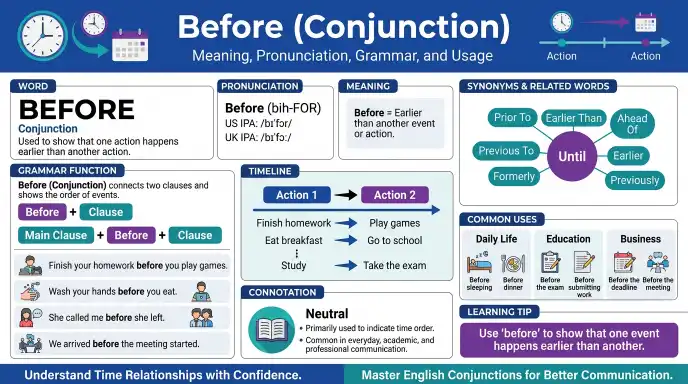
US: /bɪˈfɔːr/ | UK: /bɪˈfɔː/
Meaning: Earlier than a time.
Examples:
- Finish before noon.
- Call before leaving.
7. Since (Conjunction)
US: /sɪns/ | UK: /sɪns/
Meaning: From a past time until now.
Examples:
- Since he arrived, things improved.
- I have lived here since 2020.
8. Until (Conjunction)
US: /ənˈtɪl/ | UK: /ənˈtɪl/
Meaning: Up to a particular time.
Examples:
- Wait until tomorrow.
- Stay until sunset.
9. As Soon As (Phrase)
US: /æz suːn æz/ | UK: /æz suːn æz/
Meaning: Immediately after.
Examples:
- Call as soon as possible.
- Leave as soon as ready.
10. The Moment (Phrase)
US: /ðə ˈmoʊmənt/ | UK: /ðə ˈməʊmənt/
Meaning: Exactly at the time.
Examples:
- The moment I arrived, it rained.
- She smiled the moment she saw him.
11. At the Time (Phrase)
US: /æt ðə taɪm/ | UK: /æt ðə taɪm/
Meaning: During a particular period.
Examples:
- I was busy at the time.
- Nobody knew at the time.
12. During (Preposition)
US: /ˈdʊrɪŋ/ | UK: /ˈdjʊərɪŋ/
Meaning: Throughout a period.
Examples:
- During class, remain quiet.
- It rained during the trip.
13. Upon (Conjunction)
US: /əˈpɑːn/ | UK: /əˈpɒn/
Meaning: Immediately after.
Examples:
- Upon arrival, register.
- Upon hearing the news, she smiled.
14. Instantly (Adverb)
US: /ˈɪnstəntli/ | UK: /ˈɪnstəntli/
Meaning: Immediately.
Examples:
- He responded instantly.
- The machine stopped instantly.
15. Directly (Conjunction)
US: /dəˈrektli/ | UK: /daɪˈrektli/
Meaning: As soon as.
Examples:
- Call directly you arrive.
- Start directly the bell rings.
16. Immediately (Adverb)
US: /ɪˈmiːdiətli/ | UK: /ɪˈmiːdiətli/
Meaning: Without delay.
Examples:
- Reply immediately.
- He acted immediately.
17. Then (Adverb)
US: /ðen/ | UK: /ðen/
Meaning: At that time.
Examples:
- I was young then.
- Then we went home.
18. At What Time (Phrase)
US: /æt wʌt taɪm/ | UK: /æt wɒt taɪm/
Meaning: Asking about time.
Examples:
- At what time does it begin?
- At what time will you arrive?
19. On Arrival (Phrase)
US: /ɑːn əˈraɪvəl/ | UK: /ɒn əˈraɪvəl/
Meaning: When arriving.
Examples:
- Pay on arrival.
- Check in on arrival.
20. Following (Preposition)
US: /ˈfɑːloʊɪŋ/ | UK: /ˈfɒləʊɪŋ/
Meaning: After.
Examples:
- Following lunch, we met.
- Following the event, everyone left.
21. Subsequently (Adverb)
US: /ˈsʌbsɪkwəntli/ | UK: /ˈsʌbsɪkwəntli/
Meaning: Afterward.
Examples:
- He resigned and subsequently moved.
- The plan changed subsequently.
22. Thereafter (Adverb)
US: /ˌðerˈæftər/ | UK: /ˌðeərˈɑːftə/
Meaning: After that time.
Examples:
- Thereafter, sales increased.
- She lived there thereafter.
23. Meanwhile (Adverb)
US: /ˈmiːnwaɪl/ | UK: /ˈmiːnwaɪl/
Meaning: During the same time.
Examples:
- Meanwhile, we waited.
- He worked; meanwhile, she studied.
24. Simultaneously (Adverb)
US: /ˌsaɪməlˈteɪniəsli/ | UK: /ˌsɪməlˈteɪniəsli/
Meaning: At the same time.
Examples:
- Both events occurred simultaneously.
- They spoke simultaneously.
25. Concurrently (Adverb)
US: /kənˈkɜːrəntli/ | UK: /kənˈkʌrəntli/
Meaning: Happening together.
Examples:
- The projects ran concurrently.
- Both courses were taken concurrently.
26. Eventually (Adverb)
US: /ɪˈventʃuəli/ | UK: /ɪˈventʃuəli/
Meaning: At a later time.
Examples:
- He eventually agreed.
- They eventually arrived.
27. Subsequently To (Phrase)
US: /ˈsʌbsɪkwəntli tuː/ | UK: /ˈsʌbsɪkwəntli tə/
Meaning: After a particular time.
Examples:
- Subsequently to graduation, she worked abroad.
- Subsequently to the meeting, changes occurred.
28. At the Point When (Phrase)
US: /æt ðə pɔɪnt wen/ | UK: /æt ðə pɔɪnt wen/
Meaning: At the exact moment.
Examples:
- At the point when it happened, nobody noticed.
- He called at the point when I left.
29. Whenever Possible (Phrase)
US: /wenˈevər ˈpɑːsəbəl/ | UK: /wenˈevə ˈpɒsɪbəl/
Meaning: At any available time.
Examples:
- Exercise whenever possible.
- Help whenever possible.
30. In the Meantime (Phrase)
US: /ɪn ðə ˈmiːntaɪm/ | UK: /ɪn ðə ˈmiːntaɪm/
Meaning: During the period before something happens.
Examples:
- In the meantime, wait here.
- We worked in the meantime.
Prototype Meaning
The most typical meaning of when is asking about or referring to time.
When people hear this word, they usually think of questions about schedules, dates, events, or the moment something happens.
Prototype Categorization
- Time Questions: At What Time, When, Whenever
- Same-Time Actions: While, As, Meanwhile, Simultaneously
- Before and After Time: Before, After, Following, Thereafter
- Immediate Time: Once, Immediately, Directly, The Moment
- Ongoing Time: During, Until, Since, In the Meantime
Categorization helps writers choose the most accurate time-related expression for formal writing, storytelling, and everyday conversation.
Antonyms of When
- Never (Adverb): At no time.
- Nowhere (Adverb): In no place.
- Timelessly (Adverb): Without reference to time.
- N/A (Expression): Time not applicable.
- No Time (Phrase): Absence of a specific time reference.
Formal and Casual Sections
Formal Alternatives
- Subsequently
- Thereafter
- Concurrently
- Simultaneously
- Following
- Upon
Casual Alternatives
- Once
- Then
- While
- As Soon As
- Meanwhile
- Whenever
Related Words Section
- Whenever
- Where
- Why
- Which
- Time
- Timing
- Moment
- Occasion
- Period
- Schedule
Meaning and Example Sentence Table
| Word | Meaning | Example Sentence |
| When | At what time | When will you arrive? |
| While | During the time that | Read while waiting. |
| Once | As soon as | Call once you arrive. |
| After | Later than a time | We met after school. |
| Meanwhile | During the same time | Meanwhile, we waited. |
Short Questions and Answers
FAQ
- What does when mean?
It refers to or asks about a specific time. - When should when be used?
Use it when asking about time or connecting events by time. - Is when positive or negative?
It is neutral because it simply refers to time. - How is it different from similar words?
“When” asks about time directly, while words like “while” and “after” describe relationships between events.
Conclusion
Learning the word when and its related alternatives can improve your English vocabulary and communication skills. These expressions help you discuss time, schedules, events, and sequences more clearly and naturally.
Using different time-related words makes writing and speaking more varied and reduces repetition.
Understanding pronunciation, history, grammar, and semantic categories also helps you choose the best expression for each situation.
if you are writing essays, telling stories, or having everyday conversations, mastering these alternatives will strengthen your English. Practice them daily in speaking and writing to build confidence and improve fluency.
Explore more about!
- Synonyms for Penis Educational and Medical Vocabulary Guide
- Anger Synonyms Boost Your Vocabulary
- Synonyms of This 30 Powerful Words to Improve

I am a linguist with 17 years of experience in English language teaching, including postgraduate-level instruction. My expertise includes English grammar, and I contribute as a content and blog writer, producing scholarly and educational language resources.