The word “used” is one of the most common words in English, describing something done before or done as a regular habit. For instance, “I used this phone for two years” or “I used to play football when I was young.”
This simple word shows up everywhere , in daily conversations, writing, instructions, and storytelling. It helps us talk about past actions, habits, and conditions with ease.
While English learners rely on “used” constantly, mastering its synonyms allows them to express ideas more precisely and naturally. It also builds confidence in both speaking and writing.
For content writers, variety is key. Using different words instead of repeating “used” keeps writing fresh, engaging, and professional.
In this article, we’ll explore the meaning, grammar, history, pronunciation, and word formation of “used,” along with 30 powerful synonyms and examples , so you’ll always know the perfect word to use in any situation.
Meaning of Used
Definition
Used (Verb/Adjective):
Having been utilized before, or having done something regularly in the past.
Examples
- I used my old laptop for five years.
- She used to visit her grandmother every weekend.
Connotative Meaning
(Connotation means the feeling or idea connected with a word beyond its basic dictionary meaning.)
- Positive Tone: Can suggest experience, familiarity, and proper utilization.
- Negative Tone: Can suggest something old, worn, or no longer new.
- Neutral Tone: Simply describes something that has been utilized before or a past habit.
Etymology
- Source Language: Old French and Latin.
- Original Word: Old French user from Latin uti.
- Original Meaning: To use, employ, or make use of something.
Short History
- Old English (450–1100): The exact modern form used was not common in Old English, but similar ideas were expressed through words meaning “employ” or “make use of.”
- Middle English (1100–1500): The word entered English through Old French influence as usen and became related to the idea of applying something for a purpose.
- Modern English (1500–Present): Used developed many meanings, including past habits, previous ownership, and the action of utilizing something.
Pronunciation (US & UK – IPA)
US: /juːzd/
UK: /juːzd/
Syllables
used (1 syllable)
Affixation Pattern of Used
Root: use
Prefix: None
Suffix: -ed (forms the past tense and past participle)
Word Formation of the Keyword
- Use (Verb/Noun) – to employ something or the purpose of something.
- Used (Verb/Adjective) – utilized before or familiar through experience.
- Useful (Adjective) – having practical value.
- Useless (Adjective) – having no value or purpose.
- User (Noun) – a person who uses something.
- Usage (Noun) – the way something is used.
- Reusable (Adjective) – able to be used again.
- Misuse (Verb/Noun) – wrong or improper use.
- Overuse (Verb/Noun) – use something too much.
Synonyms of Used
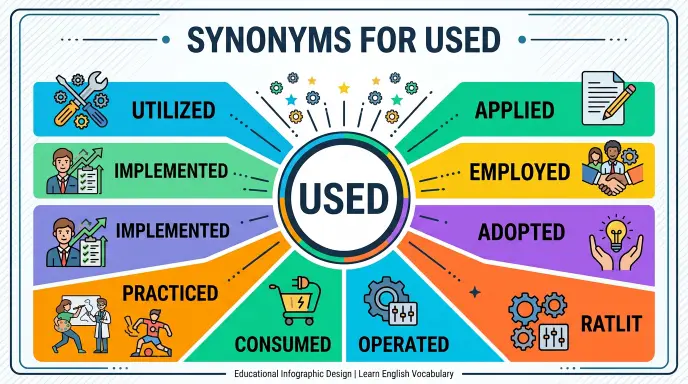
1. Utilized (Verb)
US: /ˈjuːtəˌlaɪzd/ | UK: /ˈjuːtɪlaɪzd/
Meaning: Used something for a specific purpose.
Examples:
- The teacher utilized technology in the classroom.
- They utilized available resources effectively.
2. Employed (Verb)
US: /ɪmˈplɔɪd/ | UK: /ɪmˈplɔɪd/
Meaning: Used something for a particular purpose.
Examples:
- The company employed new strategies.
- Scientists employed advanced methods in their research.
3. Applied (Verb)
US: /əˈplaɪd/ | UK: /əˈplaɪd/
Meaning: Used an idea, method, or skill in a situation.
Examples:
- She applied her knowledge to solve the problem.
- The rules were applied fairly.
4. Adopted (Verb)
US: /əˈdɑːptɪd/ | UK: /əˈdɒptɪd/
Meaning: Accepted and started using something new.
Examples:
- The company adopted a new system.
- Many schools adopted online learning.
5. Operated (Verb)
US: /ˈɑːpəˌreɪtɪd/ | UK: /ˈɒpəreɪtɪd/
Meaning: Used or controlled a machine, system, or device.
Examples:
- He operated the computer carefully.
- The machine was operated by trained workers.
6. Handled (Verb)
US: /ˈhændəld/ | UK: /ˈhændəld/
Meaning: Used, managed, or dealt with something.
Examples:
- She handled the equipment safely.
- He handled the situation professionally.
7. Managed (Verb)
US: /ˈmænɪdʒd/ | UK: /ˈmænɪdʒd/
Meaning: Used or controlled something successfully.
Examples:
- He managed the resources wisely.
- She managed her time effectively.
8. Practiced (Verb)
US: /ˈpræktɪst/ | UK: /ˈpræktɪst/
Meaning: Used a skill repeatedly to improve it.
Examples:
- She practiced English every day.
- He practiced new techniques at work.
9. Experienced (Verb/Adjective)
US: /ɪkˈspɪriənst/ | UK: /ɪkˈspɪəriənst/
Meaning: Having gone through or used something before.
Examples:
- He experienced many challenges in his career.
- She is experienced in computer programming.
10. Familiar (Adjective)
US: /fəˈmɪljər/ | UK: /fəˈmɪliə/
Meaning: Known or recognized because of previous use or experience.
Examples:
- I am familiar with this software.
- She is familiar with the process.
11. Consumed (Verb)
US: /kənˈsuːmd/ | UK: /kənˈsjuːmd/
Meaning: Used up or completely taken by something.
Examples:
- The car consumed a lot of fuel.
- She consumed all the available resources.
12. Spent (Verb)
US: /spent/ | UK: /spent/
Meaning: Used time, money, or energy for a purpose.
Examples:
- He spent two hours studying.
- They spent money on new equipment.
13. Expended (Verb)
US: /ɪkˈspendɪd/ | UK: /ɪkˈspendɪd/
Meaning: Used up resources, energy, or effort.
Examples:
- The workers expended great effort.
- She expended her energy on the project.
14. Devoted (Verb)
US: /dɪˈvoʊtɪd/ | UK: /dɪˈvəʊtɪd/
Meaning: Used time, attention, or effort for something important.
Examples:
- He devoted his time to learning English.
- She devoted her energy to the charity.
15. Invested (Verb)
US: /ɪnˈvestɪd/ | UK: /ɪnˈvestɪd/
Meaning: Used money, time, or effort to gain a benefit.
Examples:
- They invested money in new technology.
- She invested time in improving her skills.
16. Consumed (Adjective)
US: /kənˈsuːmd/ | UK: /kənˈsjuːmd/
Meaning: Completely used or taken.
Examples:
- The consumed materials were replaced.
- All consumed energy was measured carefully.
17. Worn (Adjective)
US: /wɔːrn/ | UK: /wɔːn/
Meaning: Damaged or changed because of repeated use.
Examples:
- He bought a pair of worn shoes.
- The old carpet looked worn.
18. Secondhand (Adjective)
US: /ˈsekəndˌhænd/ | UK: /ˌsekəndˈhænd/
Meaning: Previously owned or used by another person.
Examples:
- She bought a secondhand car.
- He sells secondhand books online.
19. Preowned (Adjective)
US: /ˌpriːˈoʊnd/ | UK: /ˌpriːˈəʊnd/
Meaning: Owned and used by someone before.
Examples:
- They purchased a preowned laptop.
- The shop sells preowned furniture.
20. Familiarized (Verb)
US: /fəˈmɪljəˌraɪzd/ | UK: /fəˈmɪliəraɪzd/
Meaning: Became comfortable with something through use or experience.
Examples:
- She familiarized herself with the new software.
- Students familiarized themselves with the rules.
21. Experienced (Adjective)
US: /ɪkˈspɪriənst/ | UK: /ɪkˈspɪəriənst/
Meaning: Having knowledge or skill gained through previous use or practice.
Examples:
- She is an experienced teacher.
- Experienced workers can solve problems quickly.
22. Accustomed (Adjective)
US: /əˈkʌstəmd/ | UK: /əˈkʌstəmd/
Meaning: Familiar with something because of regular use or practice.
Examples:
- He is accustomed to working late.
- She became accustomed to the new environment.
23. Habitual (Adjective)
US: /həˈbɪtʃuəl/ | UK: /həˈbɪtʃuəl/
Meaning: Done regularly as a habit.
Examples:
- His habitual use of a planner helps him stay organized.
- Drinking water in the morning is her habitual routine.
24. Regular (Adjective)
US: /ˈreɡjələr/ | UK: /ˈreɡjʊlə/
Meaning: Happening or done often and repeatedly.
Examples:
- Regular exercise improves health.
- He is a regular user of this service.
25. Repeated (Adjective)
US: /rɪˈpiːtɪd/ | UK: /rɪˈpiːtɪd/
Meaning: Done or happening many times.
Examples:
- Repeated use can damage the machine.
- She made repeated attempts to improve.
26. Frequent (Adjective)
US: /ˈfriːkwənt/ | UK: /ˈfriːkwənt/
Meaning: Happening often or many times.
Examples:
- Frequent practice improves language skills.
- He is a frequent visitor to the library.
27. Common (Adjective)
US: /ˈkɑːmən/ | UK: /ˈkɒmən/
Meaning: Used or found often.
Examples:
- This is a common expression in English.
- Mobile phones are common today.
28. Familiarized (Verb)
US: /fəˈmɪljəˌraɪzd/ | UK: /fəˈmɪliəraɪzd/
Meaning: Became comfortable with something through practice or use.
Examples:
- He familiarized himself with the new system.
- Students familiarized themselves with the instructions.
29. Utilitarian (Adjective)
US: /ˌjuːtəˈlɪteriən/ | UK: /ˌjuːtɪˈlɪteəriən/
Meaning: Designed or used for practical purposes.
Examples:
- The building has a simple utilitarian design.
- They chose a utilitarian tool for the job.
30. Exhausted (Adjective)
US: /ɪɡˈzɔːstɪd/ | UK: /ɪɡˈzɔːstɪd/
Meaning: Completely used up or finished.
Examples:
- The exhausted resources had to be replaced.
- All available supplies were exhausted.
Note: The word used has different meanings in English: “used before,” “used regularly,” and “used up.” Therefore, its synonyms come from different meaning groups. In a final vocabulary article, it is better to organize synonyms by these categories to make word choice clearer.
Prototype Meaning
What Is the Prototype Meaning of Used?
The prototype meaning of used is something that has been utilized before or something that a person does regularly. When people hear the word used, they often imagine an object that is not new, such as a used car, used book, or used phone. They may also think about a repeated action, such as “I used to play football.” The word is flexible because it can describe previous ownership, regular habits, or the act of using something for a purpose.
Prototype Categorization
The synonyms of used can be grouped into different categories based on their meanings:
- Previous Use or Ownership: secondhand, preowned, worn, consumed
- These words describe things that were used before or are no longer new.
- Using Something for a Purpose: utilized, employed, applied, operated
- These words focus on the action of using something effectively.
- Regular Habits and Experience: accustomed, habitual, regular, frequent
- These words describe repeated actions or familiarity.
- Using Time, Money, or Energy: spent, invested, devoted, expended
- These words describe resources used for a specific goal.
- Knowledge Through Experience: experienced, familiar, practiced
- These words show learning or ability gained through use.
Categorizing synonyms helps writers choose the correct word for each situation. For example, secondhand is suitable for a previously owned item, while utilized is better for formal writing about using resources. Choosing the right synonym makes writing clearer and more professional.
Antonyms of Used
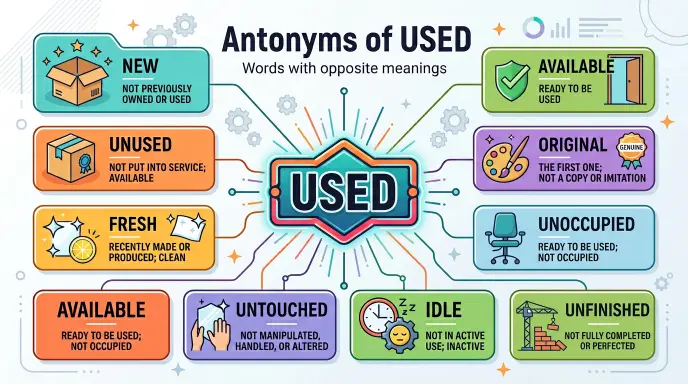
- New (Adjective): Not used before; fresh and original.
- Unused (Adjective): Not used or not previously utilized.
- Fresh (Adjective): Recently made, obtained, or created.
- Original (Adjective): Existing from the beginning and not previously used.
- Newly-made (Adjective): Recently produced or created.
- Available (Adjective): Ready to be used but not yet used.
- Preserved (Adjective): Kept in good condition without being used.
- Untouched (Adjective): Not changed, handled, or used.
- Clean (Adjective): Free from previous use or marks.
- Modern (Adjective): New in style, design, or technology.
Short Questions and Answers
• What does used mean?
Answer: Used means something that has been utilized before, or it can describe an action that happened regularly in the past.
• When should used be used?
Answer: Use used when talking about something that was previously used, or when describing past habits with “used to.”
• Is used positive or negative?
Answer: Used is neutral. It can be positive when describing experience or careful use, but it may sound negative when describing something old or damaged.
• How is used different from similar words?
Answer: Used is a general word. Utilized sounds more formal and focuses on purpose, while secondhand describes something previously owned, and accustomed describes being familiar with something.
Conclusion
Learning the word used and its synonyms helps English learners improve their vocabulary and communication skills. Although used is a simple and common word, it has several meanings that require different synonyms. Understanding these alternatives helps learners avoid repetition and choose more accurate words in speaking and writing.
Content writers can create stronger sentences by selecting the right synonym for each context. Learning pronunciation, meanings, history, and usage also builds confidence in English. Regular vocabulary practice helps learners remember new words and use them naturally. By mastering used and its synonyms, students and writers can express ideas more clearly and effectively.
Read more about!
Synonyms for Environment: 30 Powerful Words
Synonyms for Desire : 30 Powerful Words

I am an American writer and speaker who focuses on habits, productivity, and self-improvement.
I study how small daily habits can create big changes in life. I try to write in a very simple and practical way so anyone can apply my ideas.
My most popular book is Atomic Habits, which is read around the world.