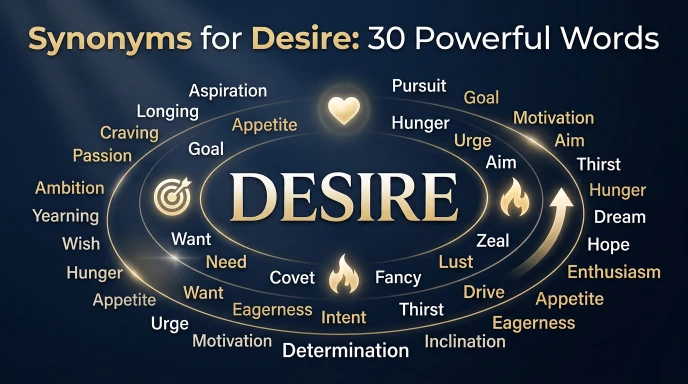
The word desire means a strong wish or longing for something. Imagine a student who studies hard because they desire success. Or think about someone who dreams of traveling the world.
In both situations, desire describes a deep feeling that motivates people to achieve their goals. This word is common in everyday conversations, books, business writing, and academic English because it expresses hopes, wants, and ambitions clearly.
Learning synonyms for desire helps English learners, students, and content writers expand their vocabulary and avoid repeating the same word. It also improves speaking, writing, and reading skills. In this article, you will learn the meaning of desire, its pronunciation, grammar, history, examples, and semantic categories.
You will also discover 30 useful synonyms with simple meanings and example sentences to help you communicate with greater confidence.
Meaning of Desire
Definition
Desire (Noun, Verb):
A strong wish, hope, or feeling of wanting someone or something.
Examples
- She has a strong desire to become a doctor.
- Many people desire a happy and peaceful life.
Connotative Meaning
(Connotation is the emotional feeling or idea that a word suggests in addition to its dictionary meaning.)
- Positive tone: A healthy goal, dream, ambition, hope, or strong motivation.
- Negative tone: An unhealthy craving, greed, obsession, or selfish want.
- Neutral tone: A simple wish or want without a strong positive or negative feeling.
Etymology
- Source language: Old French and Latin.
- Old French word: desirer.
- Latin word: desiderare.
- Original meaning: To long for, wish for, or feel the absence of something.
Short History of the Keyword
- Old English (450–1100): The word desire was not used in Old English. People expressed similar ideas with native words such as wish and will.
- Middle English (1100–1500): After the Norman Conquest, desire entered English from Old French and became common in literature and formal writing.
- Modern English (1500–Present): The word expanded in meaning and is now widely used in everyday speech, literature, psychology, education, business, and religion to express strong wants or longings.
Pronunciation (US & UK – IPA)
US: /dɪˈzaɪɚ/
UK: /dɪˈzaɪə/
Syllables
de-sire
Affixation Pattern of Desire
Root: desire
Prefix: None
Suffix: None
Word Formation of “Desire”
- Desire (noun) – a strong wish or longing.
- Desire (verb) – to strongly want something.
- Desired (adjective) – wanted or hoped for.
- Desired (verb, past tense/past participle) – wanted in the past.
- Desiring (verb, present participle) – wanting something strongly.
- Desirable (adjective) – attractive or worth having.
- Desirably (adverb) – in a desirable way.
- Desirability (noun) – the quality of being desirable.
- Undesirable (adjective) – not wanted or not suitable.
- Undesirably (adverb) – in an undesirable manner.
- Undesirability (noun) – the quality of being unwanted.
Synonyms of Desire
1. Wish (Noun, Verb)
US: /wɪʃ/ | UK: /wɪʃ/
Meaning: A hope or want for something to happen.
Examples:
- She made a wish on her birthday.
- I wish to learn English fluently.
2. Want (Verb, Noun)
US: /wɑːnt/ | UK: /wɒnt/
Meaning: To feel the need or wish to have something.
Examples:
- I want a new bicycle.
- They want to travel next summer.
3. Longing (Noun)
US: /ˈlɔːŋ.ɪŋ/ | UK: /ˈlɒŋ.ɪŋ/
Meaning: A strong feeling of wanting someone or something.
Examples:
- She felt a longing to see her family.
- His longing for success kept him motivated.
4. Craving (Noun)
US: /ˈkreɪ.vɪŋ/ | UK: /ˈkreɪ.vɪŋ/
Meaning: A very strong desire for something.
Examples:
- She had a craving for chocolate.
- He felt a craving for adventure.
5. Yearning (Noun)
US: /ˈjɝː.nɪŋ/ | UK: /ˈjɜː.nɪŋ/
Meaning: A deep and emotional desire for something.
Examples:
- Her yearning for knowledge inspired her studies.
- He had a yearning to explore the world.
6. Aspiration (Noun)
US: /ˌæs.pəˈreɪ.ʃən/ | UK: /ˌæs.pɪˈreɪ.ʃən/
Meaning: A strong hope or ambition to achieve something.
Examples:
- Becoming a teacher is her aspiration.
- His aspiration is to start a business.
7. Ambition (Noun)
US: /æmˈbɪʃ.ən/ | UK: /æmˈbɪʃ.ən/
Meaning: A strong desire to succeed or achieve a goal.
Examples:
- Her ambition is to become a scientist.
- Hard work helped him reach his ambition.
8. Hope (Noun, Verb)
US: /hoʊp/ | UK: /həʊp/
Meaning: A feeling of expecting or wishing for something good.
Examples:
- We hope for better days.
- There is hope for success.
9. Dream (Noun, Verb)
US: /driːm/ | UK: /driːm/
Meaning: A strong wish or goal that someone wants to achieve.
Examples:
- Her dream is to become a pilot.
- They dream of owning a house.
10. Urge (Noun, Verb)
US: /ɝːdʒ/ | UK: /ɜːdʒ/
Meaning: A strong feeling that makes someone want to do something.
Examples:
- He felt the urge to help others.
- She had an urge to call her friend.
11. Passion (Noun)
US: /ˈpæʃ.ən/ | UK: /ˈpæʃ.ən/
Meaning: A very strong feeling of love, interest, or desire for something.
Examples:
- She has a passion for music.
- His passion for learning never fades.
12. Hunger (Noun)
US: /ˈhʌŋ.ɡɚ/ | UK: /ˈhʌŋ.ɡə/
Meaning: A strong desire to achieve or experience something.
Examples:
- He has a hunger for success.
- Her hunger for knowledge is inspiring.
13. Thirst (Noun)
US: /θɝːst/ | UK: /θɜːst/
Meaning: A strong desire or eagerness for something.
Examples:
- She has a thirst for adventure.
- His thirst for learning keeps him motivated.
14. Inclination (Noun)
US: /ˌɪn.kləˈneɪ.ʃən/ | UK: /ˌɪn.klɪˈneɪ.ʃən/
Meaning: A natural wish or tendency to do something.
Examples:
- She has an inclination to help others.
- He showed an inclination toward science.
15. Preference (Noun)
US: /ˈpref.ər.əns/ | UK: /ˈpref.ər.əns/
Meaning: A greater liking or desire for one thing over another.
Examples:
- My preference is tea instead of coffee.
- She has a preference for quiet places.
16. Fancy (Noun, Verb)
US: /ˈfæn.si/ | UK: /ˈfæn.si/
Meaning: A sudden feeling of liking or wanting something.
Examples:
- I fancy a cup of coffee.
- She took a fancy to the little puppy.
17. Interest (Noun)
US: /ˈɪn.trəst/ | UK: /ˈɪn.trəst/
Meaning: A feeling of wanting to know, learn, or have something.
Examples:
- He has an interest in photography.
- The course increased my interest in history.
18. Zeal (Noun)
US: /ziːl/ | UK: /ziːl/
Meaning: Great energy and enthusiasm for achieving something.
Examples:
- She worked with great zeal.
- His zeal for learning impressed his teachers.
19. Eagerness (Noun)
US: /ˈiː.ɡɚ.nəs/ | UK: /ˈiː.ɡə.nəs/
Meaning: A strong desire and excitement to do or get something.
Examples:
- The children showed eagerness to learn.
- She accepted the job with eagerness.
20. Coveting (Noun)
US: /ˈkʌv.ɪ.tɪŋ/ | UK: /ˈkʌv.ɪ.tɪŋ/
Meaning: A strong desire to possess something that belongs to someone else.
Examples:
- Coveting another person’s success can lead to unhappiness.
- He admitted his coveting of the expensive car.
21. Yearn (Verb)
US: /jɝːn/ | UK: /jɜːn/
Meaning: To have a deep and strong desire for something.
Examples:
- She yearns for a peaceful life.
- Many people yearn to achieve their dreams.
22. Crave (Verb)
US: /kreɪv/ | UK: /kreɪv/
Meaning: To strongly want or need something.
Examples:
- He craves success and recognition.
- I sometimes crave a quiet weekend.
23. Seek (Verb)
US: /siːk/ | UK: /siːk/
Meaning: To try to find, get, or achieve something desired.
Examples:
- She seeks knowledge through reading.
- Many people seek happiness in life.
24. Pursue (Verb)
US: /pɚˈsuː/ | UK: /pəˈsjuː/
Meaning: To actively try to achieve or obtain something.
Examples:
- He wants to pursue his dream career.
- She pursued her goal with determination.
25. Aspire (Verb)
US: /əˈspaɪr/ | UK: /əˈspaɪə/
Meaning: To strongly hope or aim to achieve something.
Examples:
- She aspires to become a writer.
- Many students aspire to improve their skills.
26. Desire (Verb)
US: /dɪˈzaɪɚ/ | UK: /dɪˈzaɪə/
Meaning: To strongly want something.
Examples:
- They desire a better future.
- He desires to learn new languages.
27. Wanting (Noun, Adjective)
US: /ˈwɑːn.tɪŋ/ | UK: /ˈwɒn.tɪŋ/
Meaning: The feeling of needing or wishing for something.
Examples:
- Her wanting for change motivated her actions.
- His wanting to improve was clear.
28. Will (Noun)
US: /wɪl/ | UK: /wɪl/
Meaning: A strong intention or determination to do something.
Examples:
- His will to succeed helped him overcome problems.
- She has the will to continue learning.
29. Drive (Noun)
US: /draɪv/ | UK: /draɪv/
Meaning: Strong motivation or energy to achieve something.
Examples:
- Her drive to succeed is impressive.
- His drive helped him reach his goals.
30. Motivation (Noun)
US: /ˌmoʊ.təˈveɪ.ʃən/ | UK: /ˌməʊ.tɪˈveɪ.ʃən/
Meaning: The reason or desire that encourages someone to act.
Examples:
- Her motivation comes from her family.
- Good teachers increase students’ motivation.
Prototype Meaning
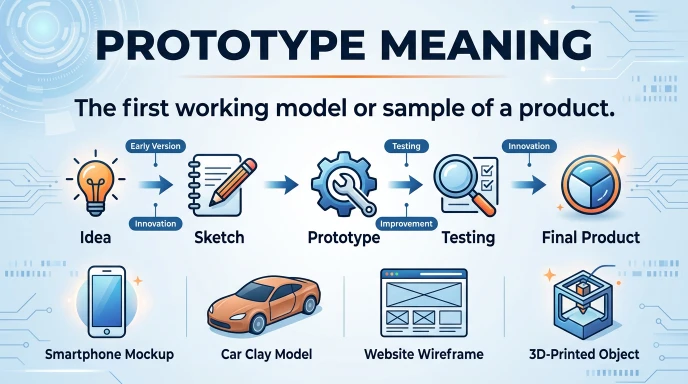
The most common meaning of desire is a strong feeling of wanting or wishing for something. When people hear the word desire, they usually imagine a personal goal, dream, need, or hope that someone wants to achieve. It can be a desire for success, happiness, love, knowledge, or a better future. The word often suggests a strong inner feeling that encourages people to take action and move toward their goals.
Prototype Categorization
Grouping synonyms into categories helps writers select the most accurate word for each situation. Different synonyms express different levels of emotion, strength, and purpose.
- General Wants and Wishes: wish, want, hope, fancy, preference
These words describe common needs, choices, or simple desires. - Strong Emotional Desires: longing, yearning, craving, passion, thirst
These words show deep feelings and powerful wants. - Goals and Achievements: aspiration, ambition, dream, drive, motivation
These words are often used for success, careers, and personal growth. - Action-Based Desires: seek, pursue, aspire, yearn, crave
These words show active efforts to reach something. - Natural Feelings and Tendencies: inclination, interest, eagerness, will, zeal
These words describe personal attitudes, energy, or willingness.
Using categories helps writers avoid repetition and choose words that match the exact meaning, emotion, and situation.
Antonyms of Desire
- Indifference (Noun) – A lack of interest, care, or desire.
- Dislike (Noun/Verb) – A feeling of not wanting or enjoying something.
- Aversion (Noun) – A strong feeling of dislike or avoidance.
- Reluctance (Noun) – A lack of willingness or desire to do something.
- Apathy (Noun) – A lack of interest, enthusiasm, or emotion.
- Disinterest (Noun) – A state of having no desire or concern.
- Rejection (Noun) – The act of refusing or not accepting something.
- Avoidance (Noun) – The act of staying away from something.
- Unwillingness (Noun) – A lack of desire or readiness to do something.
- Neglect (Noun/Verb) – Failure to give attention or care.
Short Questions and Answers
- What does desire mean?
Desire means a strong feeling of wanting, wishing for, or hoping to have something. - When should desire be used?
Use desire when you want to describe a strong wish, goal, or deep feeling of wanting something. - Is desire positive or negative?
Desire is usually positive when it refers to goals, dreams, and motivation. It can become negative when it describes greed, obsession, or unhealthy wants. - How is it different from similar words?
Desire is a general word for a strong want. Wish is often weaker, craving is usually stronger and more urgent, and ambition focuses on achieving goals.
Conclusion
Learning the word desire and its synonyms helps English learners build a stronger vocabulary and communicate more effectively. Understanding different words for similar ideas allows writers and speakers to express feelings with greater accuracy.
Synonyms help avoid repetition and make writing more interesting and professional. By learning pronunciation, meanings, history, and emotional tones, learners can use words confidently in different situations. Whether writing an essay, creating content, or having a conversation, a rich vocabulary improves communication skills. Practicing one new word and its synonyms every day is a simple way to develop better English skills and increase confidence over time.
READ MORE ABOUT!
Synonyms for Struggle: 30 Powerful Words
Synonyms for Environment: 30 Powerful Words

I am an American writer and speaker who focuses on habits, productivity, and self-improvement.
I study how small daily habits can create big changes in life. I try to write in a very simple and practical way so anyone can apply my ideas.
My most popular book is Atomic Habits, which is read around the world.