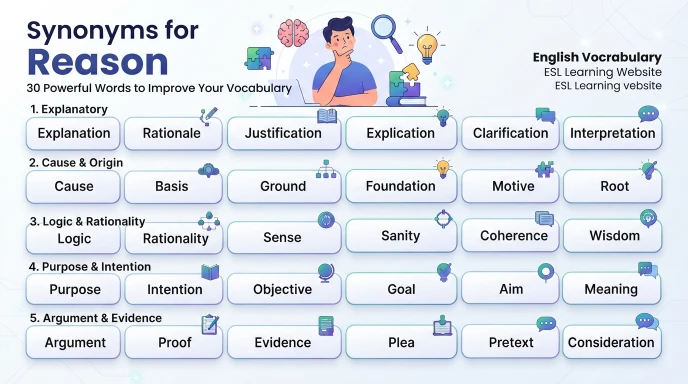
Reason means a cause, explanation, or basis for something. Imagine a student arriving late to school. The teacher asks for the reason. The student explains that a bus delay caused the problem. In daily life, people often use the word reason when they explain why something happened or why they made a choice.
This word is very common in speaking, writing, education, and business communication. Learning synonyms for reason helps English learners, students, writers, and content creators avoid repeating the same word. It also makes communication more precise and engaging.
In this article, you will learn the meaning of reason, its pronunciation, grammar, history, connotation, and semantic categories. You will also discover 30 useful synonyms with meanings and examples to improve your English vocabulary.
Meaning of Reason
Definition
Reason (Noun):
A cause, explanation, fact, or purpose that explains why something happens or why someone does something.
Examples
- The reason for his success is hard work.
- She gave a good reason for leaving early.
Connotative Meaning
(Connotation: the emotional or cultural feeling connected to a word beyond its basic meaning.)
- Positive tone: wisdom, logic, understanding, good judgment.
- Negative tone: excuse, justification, blame in some contexts.
- Neutral tone: a simple explanation or cause.
Etymology
- Origin: From Old French raison.
- Derived from Latin ratio meaning “calculation, judgment, explanation, method.”
- Entered English during the Middle Ages.
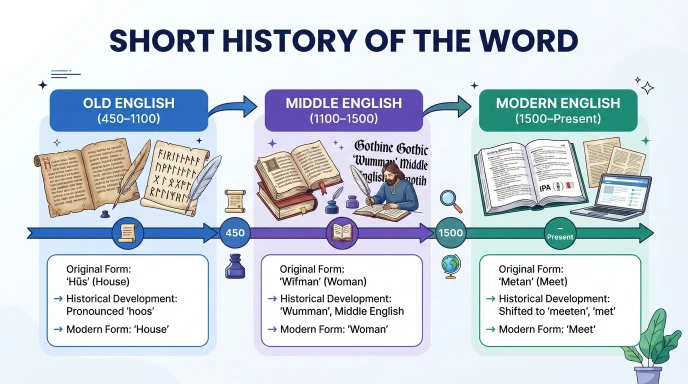
Short History of the Word
Old English (450–1100)
- Native English speakers used words related to judgment and understanding rather than the modern form reason.
Middle English (1100–1500)
- The word entered English through Old French after the Norman influence.
Modern English (1500–Present)
- Reason became widely used to mean logic, cause, explanation, and justification.
Pronunciation (US & UK – IPA)
US: /ˈriː.zən/
UK: /ˈriː.zən/
Syllables
rea-son
Affixation Pattern of Reason
Root: reason
Prefix: None
Suffix: None
Word Formation
- Reason (Noun)
- Reason (Verb)
- Reasonable (Adjective)
- Reasonably (Adverb)
- Reasoning (Noun)
- Unreasonable (Adjective)
- Unreasonably (Adverb)
- Reasoned (Adjective/Verb)
Synonyms of Reason
1. Cause (Noun)
US: /kɔːz/ | UK: /kɔːz/
Meaning: Something that makes an event happen.
Examples:
- The storm was the cause of the damage.
- Nobody knew the exact cause of the accident.
2. Explanation (Noun)
US: /ˌek.spləˈneɪ.ʃən/ | UK: /ˌek.spləˈneɪ.ʃən/
Meaning: A statement that makes something clear.
Examples:
- Her explanation was easy to understand.
- The teacher gave an explanation of the rule.
3. Motive (Noun)
US: /ˈmoʊ.tɪv/ | UK: /ˈməʊ.tɪv/
Meaning: A reason behind an action.
Examples:
- Police searched for a motive.
- His motive remained unknown.
4. Purpose (Noun)
US: /ˈpɝː.pəs/ | UK: /ˈpɜː.pəs/
Meaning: The goal or aim of something.
Examples:
- The purpose of the meeting was planning.
- She explained her purpose clearly.
5. Basis (Noun)
US: /ˈbeɪ.sɪs/ | UK: /ˈbeɪ.sɪs/
Meaning: The foundation of an idea.
Examples:
- Trust is the basis of friendship.
- Facts form the basis of the report.
6. Ground (Noun)
US: /ɡraʊnd/ | UK: /ɡraʊnd/
Meaning: A valid reason for an action.
Examples:
- He had good grounds for concern.
- There was no ground for complaint.
7. Justification (Noun)
US: /ˌdʒʌs.tə.fəˈkeɪ.ʃən/ | UK: /ˌdʒʌs.tɪ.fɪˈkeɪ.ʃən/
Meaning: A reason that shows something is right.
Examples:
- She offered a justification for her decision.
- There was little justification for the delay.
8. Excuse (Noun)
US: /ɪkˈskjuːs/ | UK: /ɪkˈskjuːs/
Meaning: A reason given to avoid blame.
Examples:
- He made an excuse for being late.
- That excuse sounded weak.
9. Rationale (Noun)
US: /ˌræʃ.əˈnæl/ | UK: /ˌræʃ.əˈnɑːl/
Meaning: The logical basis for a decision.
Examples:
- She explained the rationale behind the plan.
- The rationale was accepted.
10. Logic (Noun)
US: /ˈlɑː.dʒɪk/ | UK: /ˈlɒdʒ.ɪk/
Meaning: Clear and sensible thinking.
Examples:
- I understand the logic.
- His logic was strong.
11. Argument (Noun)
US: /ˈɑːr.ɡjə.mənt/ | UK: /ˈɑː.ɡjə.mənt/
Meaning: A set of reasons supporting an idea.
Examples:
- She presented a strong argument.
- His argument convinced the group.
12. Evidence (Noun)
US: /ˈev.ə.dəns/ | UK: /ˈev.ɪ.dəns/
Meaning: Information supporting a claim.
Examples:
- The evidence was clear.
- We need more evidence.
13. Factor (Noun)
US: /ˈfæk.tɚ/ | UK: /ˈfæk.tər/
Meaning: Something that influences a result.
Examples:
- Cost was an important factor.
- Weather is a major factor.
14. Influence (Noun)
US: /ˈɪn.flu.əns/ | UK: /ˈɪn.flu.əns/
Meaning: A force that affects decisions.
Examples:
- Friends had a strong influence.
- Her influence was positive.
15. Consideration (Noun)
US: /kənˌsɪd.əˈreɪ.ʃən/ | UK: /kənˌsɪd.əˈreɪ.ʃən/
Meaning: Something carefully thought about.
Examples:
- Safety was a key consideration.
- Cost deserves consideration.
16. Occasion (Noun)
US: /əˈkeɪ.ʒən/ | UK: /əˈkeɪ.ʒən/
Meaning: A particular reason or event.
Examples:
- The occasion brought people together.
- It was a special occasion.
17. Foundation (Noun)
US: /faʊnˈdeɪ.ʃən/ | UK: /faʊnˈdeɪ.ʃən/
Meaning: The underlying support for something.
Examples:
- Honesty is the foundation of trust.
- Facts are the foundation of science.
18. Principle (Noun)
US: /ˈprɪn.sə.pəl/ | UK: /ˈprɪn.sɪ.pəl/
Meaning: A basic truth or rule.
Examples:
- Fairness is an important principle.
- The principle guided her actions.
19. Premise (Noun)
US: /ˈprem.ɪs/ | UK: /ˈprem.ɪs/
Meaning: An idea forming the basis of reasoning.
Examples:
- The argument rests on a premise.
- The premise seemed logical.
20. Incentive (Noun)
US: /ɪnˈsen.tɪv/ | UK: /ɪnˈsen.tɪv/
Meaning: Something that encourages action.
Examples:
- Money was an incentive.
- Rewards create incentives.
21. Stimulus (Noun)
US: /ˈstɪm.jə.ləs/ | UK: /ˈstɪm.jʊ.ləs/
Meaning: Something that causes activity.
Examples:
- The news acted as a stimulus.
- Change provided a stimulus.
22. Catalyst (Noun)
US: /ˈkæt.əl.ɪst/ | UK: /ˈkæt.əl.ɪst/
Meaning: Something that causes change.
Examples:
- The event was a catalyst for growth.
- Innovation became a catalyst.
23. Aim (Noun)
US: /eɪm/ | UK: /eɪm/
Meaning: An intended goal.
Examples:
- Education was her aim.
- His aim was success.
24. Objective (Noun)
US: /əbˈdʒek.tɪv/ | UK: /əbˈdʒek.tɪv/
Meaning: A planned goal.
Examples:
- Our objective is improvement.
- The objective was achieved.
25. Intent (Noun)
US: /ɪnˈtent/ | UK: /ɪnˈtent/
Meaning: A person’s purpose or plan.
Examples:
- His intent was clear.
- She acted with good intent.
26. End (Noun)
US: /end/ | UK: /end/
Meaning: A purpose or goal.
Examples:
- The action served a useful end.
- Every effort had an end.
27. Account (Noun)
US: /əˈkaʊnt/ | UK: /əˈkaʊnt/
Meaning: An explanation of events.
Examples:
- She gave an account of the incident.
- His account was detailed.
28. Causeway (Noun)
US: /ˈkɔːz.weɪ/ | UK: /ˈkɔːz.weɪ/
Meaning: Used rarely as a figurative basis or pathway.
Examples:
- The discussion became a causeway to agreement.
- Learning served as a causeway to success.
29. Determinant (Noun)
US: /dɪˈtɝː.mə.nənt/ | UK: /dɪˈtɜː.mɪ.nənt/
Meaning: A factor that decides an outcome.
Examples:
- Skill was a determinant of success.
- Health is a key determinant.
30. Provocation (Noun)
US: /ˌprɑː.vəˈkeɪ.ʃən/ | UK: /ˌprɒv.əˈkeɪ.ʃən/
Meaning: Something that causes a reaction.
Examples:
- The comment was a provocation.
- His actions were a provocation.
Formal and Casual Alternatives
Formal Synonyms
- Rationale
- Justification
- Premise
- Principle
- Determinant
- Consideration
Casual Synonyms
- Cause
- Excuse
- Purpose
- Aim
- Ground
- Factor
Related Words
- Reasoning (Noun)
- Rational (Adjective)
- Rationality (Noun)
- Reasonable (Adjective)
- Explain (Verb)
- Explanation (Noun)
- Logic (Noun)
- Motive (Noun)
Prototype Meaning
The most common meaning of reason is an explanation for why something happens or why a person does something.
When people hear the word, they usually think of a cause, motive, or logical explanation behind an action, decision, or event.
Prototype Categorization
Categorizing synonyms helps writers select the most accurate word for each context.
- Cause and Effect: Cause, Factor, Catalyst, Stimulus, Determinant
- Purpose and Goals: Purpose, Aim, Objective, Intent, End
- Logic and Thinking: Logic, Rationale, Principle, Premise
- Explanation and Support: Explanation, Account, Evidence, Argument
- Defense and Justification: Justification, Excuse, Ground
Antonyms of Reason
- Irrationality (Noun): Lack of logical thinking.
- Nonsense (Noun): Words or ideas without meaning.
- Absurdity (Noun): Something completely unreasonable.
- Illogic (Noun): Lack of sound reasoning.
- Foolishness (Noun): Poor judgment or wisdom.
- Confusion (Noun): Lack of clear understanding.
- Chance (Noun): An event happening without a known cause.
- Randomness (Noun): Lack of purpose or order.
Short Questions and Answers
- What does reason mean?
- Reason means a cause, explanation, or purpose for something.
- When should reason be used?
- Use reason when explaining why something happened or why a decision was made.
- Is reason positive or negative?
- It is usually neutral, but it can be positive when linked to wisdom or negative when used as an excuse.
- How is it different from similar words?
- Reason is broad and general. Words like motive focus on intention, while cause focuses on what creates an event.
Conclusion
Learning the word reason and its synonyms is a great way to improve your English vocabulary. These words help you explain ideas, causes, motives, and decisions more clearly.
Using different synonyms strengthens both writing and speaking by making language more interesting and precise. It also helps avoid repeating the same word again and again.
Understanding pronunciation, history, meaning, and connotation gives you a deeper knowledge of English vocabulary. if you are a student, teacher, ESL learner, writer, or content creator, practicing these synonyms can increase your confidence.
Try using a new synonym each day in conversations and writing. Small vocabulary improvements can lead to stronger communication skills over time.
Explore more about!
- “Value” Synonyms: 30 Words to Elevate Your Vocabulary
- Fascinating” Synonyms List with Meaning & Examples

I am a linguist with 17 years of experience in English language teaching, including postgraduate-level instruction. My expertise includes English grammar, and I contribute as a content and blog writer, producing scholarly and educational language resources.