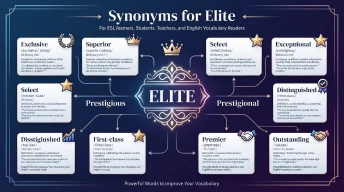
Elite means a group of people, things, or organizations that are considered the best, most skilled, or most successful. Imagine a young athlete training every day to join an elite sports team.
Only the top performers earn a place on that team. This is a common example of how the word elite is used in daily life.
People often use the word elite when talking about top students, professional athletes, successful businesses, and highly skilled experts. Learning synonyms for elite helps English learners, students, writers, and content creators express ideas more clearly and avoid repeating the same word.
This article explains the meaning of elite, its pronunciation, grammar, history, connotation, and word formation. You will also learn 30 powerful synonyms with meanings, pronunciations, examples, and semantic categories to improve your vocabulary and communication skills.
Meaning of Elite
Definition
Elite (Noun / Adjective):
A person, group, or thing that is considered the best, most skilled, or most successful in a particular area.
Examples
- She was selected for an elite training program.
- The university attracts elite students from around the world.
Connotative Meaning
(Connotation: the emotional or cultural feeling associated with a word beyond its dictionary meaning.)
- Positive tone: Excellent, highly skilled, outstanding, respected.
- Negative tone: Sometimes suggests exclusivity, privilege, or social separation.
- Neutral tone: Refers to a top-ranking group based on performance or status.
Etymology
- Origin: French élite, meaning “chosen” or “selected.”
- Derived from Old French eslite, meaning “the best choice.”
- Entered English in the 18th century.
- Original meaning: A selected group of superior quality.
Short History of the Keyword
- Old English (450–1100): The word elite did not exist, but ideas of noble or chosen groups were common.
- Middle English (1100–1500): Similar concepts appeared through French-influenced words relating to rank and status.
- Modern English (1500–Present): Elite became widely used for top-performing groups, experts, leaders, athletes, and institutions.
Pronunciation (US & UK – IPA)
US: /eɪˈliːt/
UK: /eɪˈliːt/
Syllables
e-lite
Affixation Pattern of Elite
Root: elite
Prefix: None
Suffix: None
Word Formation of Elite
- Elite (Noun) – a superior group
- Elite (Adjective) – belonging to the best group
- Elitism (Noun) – belief that some groups are superior
- Elitist (Noun) – a person who supports elitism
- Elitist (Adjective) – relating to elitism
- Non-elite (Adjective) – not belonging to the top group
Synonyms of Elite
1. Superior (Adjective)
US: /suˈpɪriər/ | UK: /suːˈpɪəriə/
Meaning: Better than others in quality or ability.
Examples:
- The company offers superior service.
- She showed superior skills.
2. Excellent (Adjective)
US: /ˈeksələnt/ | UK: /ˈeksələnt/
Meaning: Extremely good.
Examples:
- He did an excellent job.
- The results were excellent.
3. Outstanding (Adjective)
US: /aʊtˈstændɪŋ/ | UK: /aʊtˈstændɪŋ/
Meaning: Exceptionally good.
Examples:
- She gave an outstanding performance.
- The school has outstanding teachers.
4. Exceptional (Adjective)
US: /ɪkˈsepʃənəl/ | UK: /ɪkˈsepʃənəl/
Meaning: Better than normal.
Examples:
- He has exceptional talent.
- The service was exceptional.
5. Premier (Adjective)
US: /prɪˈmɪr/ | UK: /ˈpremiə/
Meaning: First in importance or quality.
Examples:
- It is a premier institution.
- She joined a premier company.
6. Top-tier (Adjective)
US: /tɑp tɪr/ | UK: /tɒp tɪə/
Meaning: Belonging to the highest level.
Examples:
- He works at a top-tier firm.
- The athlete joined a top-tier team.
7. Distinguished (Adjective)
US: /dɪˈstɪŋɡwɪʃt/ | UK: /dɪˈstɪŋɡwɪʃt/
Meaning: Highly respected and successful.
Examples:
- She is a distinguished professor.
- The guest was distinguished.
8. Prestigious (Adjective)
US: /preˈstɪdʒəs/ | UK: /preˈstɪdʒəs/
Meaning: Having high status and respect.
Examples:
- He received a prestigious award.
- The school is prestigious.
9. Exclusive (Adjective)
US: /ɪkˈskluːsɪv/ | UK: /ɪkˈskluːsɪv/
Meaning: Limited to a select group.
Examples:
- They attended an exclusive event.
- The club is exclusive.
10. Select (Adjective)
US: /sɪˈlekt/ | UK: /sɪˈlekt/
Meaning: Carefully chosen from the best.
Examples:
- Only select members attended.
- The program accepts a select group.
11. Prime (Adjective)
US: /praɪm/ | UK: /praɪm/
Meaning: Of highest quality.
Examples:
- The store sells prime products.
- He is in his prime years.
12. First-rate (Adjective)
US: /ˈfɜrst reɪt/ | UK: /ˈfɜːst reɪt/
Meaning: Excellent in quality.
Examples:
- The hotel is first-rate.
- She received first-rate training.
13. High-class (Adjective)
US: /ˈhaɪ klæs/ | UK: /ˈhaɪ klɑːs/
Meaning: Very high in quality or status.
Examples:
- They stayed in a high-class hotel.
- The restaurant is high-class.
14. Noble (Adjective)
US: /ˈnoʊbəl/ | UK: /ˈnəʊbəl/
Meaning: Belonging to a high social rank.
Examples:
- The noble family was respected.
- He had noble origins.
15. Eminent (Adjective)
US: /ˈemɪnənt/ | UK: /ˈemɪnənt/
Meaning: Famous and respected.
Examples:
- She is an eminent scientist.
- The conference welcomed eminent speakers.
16. Renowned (Adjective)
US: /rɪˈnaʊnd/ | UK: /rɪˈnaʊnd/
Meaning: Widely known and respected.
Examples:
- He is a renowned author.
- The university is renowned.
17. Accomplished (Adjective)
US: /əˈkɑmplɪʃt/ | UK: /əˈkʌmplɪʃt/
Meaning: Highly skilled and successful.
Examples:
- She is an accomplished musician.
- He is an accomplished leader.
18. Skilled (Adjective)
US: /skɪld/ | UK: /skɪld/
Meaning: Having great ability.
Examples:
- The skilled worker solved the problem.
- She is a skilled artist.
19. Expert (Adjective)
US: /ˈekspɜrt/ | UK: /ˈekspɜːt/
Meaning: Having advanced knowledge.
Examples:
- He is an expert engineer.
- The expert team succeeded.
20. Masterful (Adjective)
US: /ˈmæstərfəl/ | UK: /ˈmɑːstəfəl/
Meaning: Showing great skill.
Examples:
- She delivered a masterful speech.
- The painting was masterful.
21. Champion (Noun)
US: /ˈtʃæmpiən/ | UK: /ˈtʃæmpiən/
Meaning: A winner at the highest level.
Examples:
- The champion defended the title.
- She became a national champion.
22. Leading (Adjective)
US: /ˈliːdɪŋ/ | UK: /ˈliːdɪŋ/
Meaning: Most important or successful.
Examples:
- It is a leading company.
- She is a leading researcher.
23. Prominent (Adjective)
US: /ˈprɑmɪnənt/ | UK: /ˈprɒmɪnənt/
Meaning: Important and well known.
Examples:
- He is a prominent figure.
- The city has prominent landmarks.
24. High-ranking (Adjective)
US: /haɪ ˈræŋkɪŋ/ | UK: /haɪ ˈræŋkɪŋ/
Meaning: Holding a top position.
Examples:
- A high-ranking officer attended.
- She met high-ranking officials.
25. Choice (Adjective)
US: /tʃɔɪs/ | UK: /tʃɔɪs/
Meaning: Of the best quality.
Examples:
- The shop sells choice products.
- Choice materials were used.
26. Selective (Adjective)
US: /səˈlektɪv/ | UK: /sɪˈlektɪv/
Meaning: Choosing only the best.
Examples:
- The college is highly selective.
- The team is selective.
27. Aristocratic (Adjective)
US: /əˌrɪstəˈkrætɪk/ | UK: /əˌrɪstəˈkrætɪk/
Meaning: Related to the highest social class.
Examples:
- The family had aristocratic roots.
- The building has an aristocratic style.
28. Blue-blooded (Adjective)
US: /ˈbluː ˌblʌdɪd/ | UK: /ˈbluː ˌblʌdɪd/
Meaning: Belonging to a noble family.
Examples:
- The character was blue-blooded.
- They came from a blue-blooded family.
29. Supreme (Adjective)
US: /suˈprim/ | UK: /suːˈpriːm/
Meaning: Highest in rank or authority.
Examples:
- She achieved supreme success.
- The supreme leader spoke.
30. Finest (Adjective)
US: /ˈfaɪnɪst/ | UK: /ˈfaɪnɪst/
Meaning: The very best quality.
Examples:
- The city offers the finest cuisine.
- They use the finest materials.
Formal and Casual Alternatives
Formal Synonyms
- Prestigious
- Eminent
- Distinguished
- Premier
- Exceptional
- Renowned
- Supreme
- Aristocratic
Casual Synonyms
- Top-tier
- Skilled
- Excellent
- Outstanding
- Prime
- Finest
- Leading
- Expert
Related Words
- Excellence
- Prestige
- Status
- Leadership
- Authority
- Success
- Achievement
- Distinction
- Quality
- Superiority
Prototype Meaning
The prototype meaning of elite is a person, group, or organization that stands above others because of exceptional skill, success, quality, or status.
When people hear the word elite, they usually imagine top athletes, leading universities, successful professionals, or highly respected institutions.
Prototype Categorization
- High Status: Prestigious, Eminent, Distinguished, Renowned
- Top Quality: Superior, Excellent, Outstanding, Finest
- Exclusive Groups: Exclusive, Select, Aristocratic, Blue-blooded
- Professional Excellence: Expert, Skilled, Accomplished, Masterful
- Leadership and Rank: Leading, Supreme, High-ranking, Premier
- Competition and Achievement: Champion, Exceptional, First-rate, Prime
Categorization helps writers choose the most accurate synonym. For example, prestigious fits reputation, while skilled focuses on ability and exclusive emphasizes limited access.
Antonyms of Elite
- Ordinary (Adjective) – common and not special
- Average (Adjective) – typical or normal
- Common (Adjective) – widely found and not exclusive
- Inferior (Adjective) – lower in quality
- Mediocre (Adjective) – only average in quality
- Unremarkable (Adjective) – not outstanding
- Standard (Adjective) – usual or typical
- Low-ranking (Adjective) – having a lower position or status
Short Questions and Answers
- What does elite mean?
Elite means the best, most skilled, or most successful people or things in a group. - When should elite be used?
Use it when describing top performers, highly respected groups, or superior-quality organizations. - Is elite positive or negative?
It is usually positive, but it can sometimes suggest exclusivity or privilege depending on context. - How is it different from similar words?
Elite often refers to a select top group, while words like excellent describe quality and prestigious describes reputation.
Conclusion
Learning the word elite and its synonyms can greatly strengthen your English vocabulary. These words help you describe excellence, status, achievement, quality, and expertise with greater precision. Using a variety of synonyms makes writing and speaking more engaging while avoiding repetition.
Understanding pronunciation, history, connotation, and categories also helps you choose the right word for different situations. if you are writing essays, creating content, preparing presentations, or improving everyday communication, these synonyms will help you express ideas more effectively.
Make vocabulary practice a daily habit, and you will gradually build stronger language skills, better confidence, and more powerful communication.
Discover more!
- 30 Synonyms for ‘Vulnerable’ to Boost Your Vocabulary
- Synonyms for Disappointed: Powerful Words to Use Instead

I am a British-American author, speaker, and motivational thinker. I focus on leadership and inspiration.
My main idea is that great leaders and successful organizations start with “why”.
I studied cultural anthropology and communication. My well-known books include Start With Why, Leaders Eat Last, and The Infinite Game.