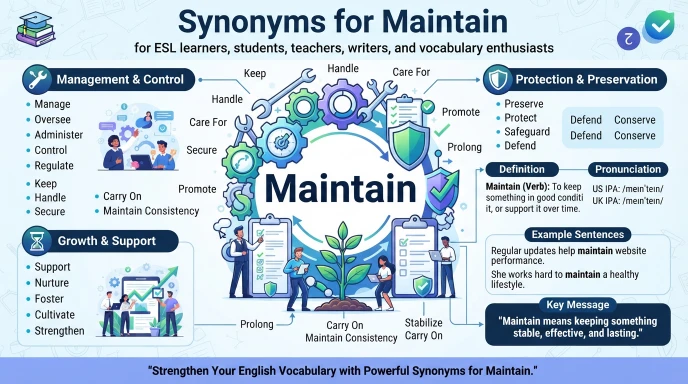
The word maintain means to keep something in good condition, continue it, support it, or preserve it over time. Imagine a student who studies every day to maintain good grades. Or think of a homeowner who regularly repairs and cleans a house to maintain its value.
In everyday life, people maintain relationships, health, equipment, habits, and beliefs.
Because it applies to so many situations, maintain is a very common word in English.
Learning synonyms for maintain helps English learners, students, writers, teachers, and content creators improve their vocabulary and communication skills.
Different situations often require different words. Using a variety of synonyms makes writing more natural and professional while avoiding repetition.
In this article, you will learn the meaning of maintain, its pronunciation, grammar, history, connotation, and 30 useful synonyms with examples, categories, antonyms, related words, and FAQs.
Meaning of Maintain
Definition
Maintain (Verb):
To keep something in a particular condition, continue it, support it, or preserve it over time.
Examples
- She works hard to maintain her fitness.
- The company maintains high quality standards.
Connotative Meaning
(Connotation means the emotional feeling or idea connected to a word beyond its basic definition.)
- Positive Tone: Preserve, support, protect, sustain, improve.
- Negative Tone: Sometimes suggests stubbornly holding an opinion.
- Neutral Tone: Keeping something in its current state.
Etymology
- Origin: From Old French maintenir.
- Source Language: Old French and Latin.
- Original Meaning: To hold in the hand, support, or keep.
Short History of the Keyword
- Old English (450–1100): Native English words such as keep and hold were commonly used.
- Middle English (1100–1500): Maintain entered English through Old French influence.
- Modern English (1500–Present): The word expanded to include preserving, supporting, continuing, and defending.
Pronunciation (US & UK – IPA)
US: /meɪnˈteɪn/
UK: /meɪnˈteɪn/
Syllables
main-tain
Affixation Pattern of Maintain
Root: tain (from Latin tenere, meaning “to hold”)
Prefix: main-
Suffix: None
Word Formation of the Keyword
- Maintain (Verb) – keep or preserve.
- Maintains (Verb) – keeps or preserves.
- Maintained (Verb/Adjective) – preserved or supported.
- Maintaining (Verb) – continuing or preserving.
- Maintenance (Noun) – the act of maintaining.
- Maintainer (Noun) – a person who maintains something.
Synonyms of Maintain
1. Keep (Verb)
US: /kiːp/ | UK: /kiːp/
Meaning: To continue having or preserving something.
Examples:
- Keep the room clean.
- She keeps her promises.
2. Preserve (Verb)
US: /prɪˈzɜːrv/ | UK: /prɪˈzɜːv/
Meaning: To protect and keep something unchanged.
Examples:
- We must preserve nature.
- The museum preserves history.
3. Sustain (Verb)
US: /səˈsteɪn/ | UK: /səˈsteɪn/
Meaning: To continue supporting something.
Examples:
- Healthy habits sustain energy.
- The project was sustained by funding.
4. Support (Verb)
US: /səˈpɔːrt/ | UK: /səˈpɔːt/
Meaning: To hold up or help continue.
Examples:
- Parents support their children.
- The policy supports growth.
5. Uphold (Verb)
US: /ʌpˈhoʊld/ | UK: /ʌpˈhəʊld/
Meaning: To maintain or defend.
Examples:
- Judges uphold the law.
- We should uphold our values.
6. Continue (Verb)
US: /kənˈtɪnjuː/ | UK: /kənˈtɪnjuː/
Meaning: To keep going without stopping.
Examples:
- Continue your studies.
- The rain continued all day.
7. Retain (Verb)
US: /rɪˈteɪn/ | UK: /rɪˈteɪn/
Meaning: To keep possession of something.
Examples:
- She retained her position.
- The company retained customers.
8. Conserve (Verb)
US: /kənˈsɜːrv/ | UK: /kənˈsɜːv/
Meaning: To protect and save.
Examples:
- We should conserve water.
- They conserve energy daily.
9. Protect (Verb)
US: /prəˈtekt/ | UK: /prəˈtekt/
Meaning: To keep safe from harm.
Examples:
- Sunscreen protects the skin.
- Laws protect citizens.
10. Defend (Verb)
US: /dɪˈfend/ | UK: /dɪˈfend/
Meaning: To support or guard.
Examples:
- She defended her opinion.
- The soldiers defended the city.
11. Carry On (Verb Phrase)
US: /ˈkæri ɑːn/ | UK: /ˈkæri ɒn/
Meaning: To continue doing something.
Examples:
- Carry on with your work.
- They carried on despite challenges.
12. Prolong (Verb)
US: /prəˈlɔːŋ/ | UK: /prəˈlɒŋ/
Meaning: To make something last longer.
Examples:
- Exercise can prolong life.
- They prolonged the discussion.
13. Extend (Verb)
US: /ɪkˈstend/ | UK: /ɪkˈstend/
Meaning: To lengthen or continue.
Examples:
- We extended the deadline.
- The agreement was extended.
14. Foster (Verb)
US: /ˈfɔːstər/ | UK: /ˈfɒstə/
Meaning: To encourage growth.
Examples:
- Schools foster learning.
- The program fosters creativity.
15. Cultivate (Verb)
US: /ˈkʌltəveɪt/ | UK: /ˈkʌltɪveɪt/
Meaning: To develop and maintain.
Examples:
- She cultivates friendships.
- Farmers cultivate crops.
16. Nurture (Verb)
US: /ˈnɜːrtʃər/ | UK: /ˈnɜːtʃə/
Meaning: To care for and support growth.
Examples:
- Parents nurture children.
- Teachers nurture talent.
17. Manage (Verb)
US: /ˈmænɪdʒ/ | UK: /ˈmænɪdʒ/
Meaning: To keep under control.
Examples:
- He manages the business.
- She manages her time well.
18. Operate (Verb)
US: /ˈɑːpəreɪt/ | UK: /ˈɒpəreɪt/
Meaning: To keep functioning.
Examples:
- The company operates worldwide.
- The machine operates smoothly.
19. Run (Verb)
US: /rʌn/ | UK: /rʌn/
Meaning: To keep something working.
Examples:
- She runs a small business.
- They run the program efficiently.
20. Keep Up (Verb Phrase)
US: /kiːp ʌp/ | UK: /kiːp ʌp/
Meaning: To continue at the same level.
Examples:
- Keep up the good work.
- He keeps up his exercise routine.
21. Hold (Verb)
US: /hoʊld/ | UK: /həʊld/
Meaning: To keep in a particular state.
Examples:
- Hold your position.
- The company held its market share.
22. Stabilize (Verb)
US: /ˈsteɪbəlaɪz/ | UK: /ˈsteɪbəlaɪz/
Meaning: To keep steady.
Examples:
- The medicine stabilized her condition.
- The policy stabilized prices.
23. Perpetuate (Verb)
US: /pərˈpetʃueɪt/ | UK: /pəˈpetʃueɪt/
Meaning: To keep something going.
Examples:
- Stories perpetuate traditions.
- The practice was perpetuated for years.
24. Safeguard (Verb)
US: /ˈseɪfɡɑːrd/ | UK: /ˈseɪfɡɑːd/
Meaning: To protect and maintain.
Examples:
- Laws safeguard rights.
- We safeguard important records.
25. Reserve (Verb)
US: /rɪˈzɜːrv/ | UK: /rɪˈzɜːv/
Meaning: To keep for future use.
Examples:
- They reserved extra funds.
- We reserve resources for emergencies.
26. Keep Alive (Verb Phrase)
US: /kiːp əˈlaɪv/ | UK: /kiːp əˈlaɪv/
Meaning: To continue supporting something.
Examples:
- Volunteers keep traditions alive.
- Stories keep memories alive.
27. Maintain Order (Verb Phrase)
US: /meɪnˈteɪn ˈɔːrdər/ | UK: /meɪnˈteɪn ˈɔːdə/
Meaning: To keep things organized.
Examples:
- Police maintain order.
- Teachers maintain order in class.
28. Maintain Balance (Verb Phrase)
US: /meɪnˈteɪn ˈbæləns/ | UK: /meɪnˈteɪn ˈbæləns/
Meaning: To keep things stable.
Examples:
- Exercise helps maintain balance.
- We maintain balance in life.
29. Service (Verb)
US: /ˈsɜːrvɪs/ | UK: /ˈsɜːvɪs/
Meaning: To maintain equipment.
Examples:
- Mechanics service vehicles.
- The machine is serviced yearly.
30. Care For (Verb Phrase)
US: /ker fɔːr/ | UK: /keə fɔː/
Meaning: To maintain through attention.
Examples:
- She cares for the garden.
- Nurses care for patients in the hospital.
Prototype Meaning
The prototype meaning of maintain is to keep something in a good, stable, or existing condition over time.
When people hear this word, they often think about preserving health, maintaining equipment, supporting relationships, or continuing standards and routines.
Prototype Categorization
- Keeping Something Stable: keep, hold, stabilize, retain.
- Protecting and Preserving: preserve, conserve, protect, safeguard.
- Supporting and Defending: support, uphold, defend, nurture.
- Continuing Activities: continue, carry on, keep up, prolong.
- Managing Systems: manage, operate, run, service.
Categorization helps writers choose the best synonym. For example, preserve is often used for history and nature, while manage is more suitable for businesses and projects.
Antonyms of Maintain
- Neglect (Verb) – fail to care for something.
- Abandon (Verb) – leave completely.
- Discard (Verb) – throw away.
- Ignore (Verb) – pay no attention to.
- Damage (Verb) – cause harm.
- Destroy (Verb) – ruin completely.
- Deteriorate (Verb) – become worse.
- End (Verb) – stop completely.
- Cease (Verb) – bring to an end.
- Forget (Verb) – fail to keep or remember.
Related Words
- Maintain (Verb)
- Maintenance (Noun)
- Maintained (Verb/Adjective)
- Maintaining (Verb)
- Maintainer (Noun)
- Preservation (Noun)
- Protection (Noun)
- Conservation (Noun)
- Support (Noun/Verb)
- Sustainability (Noun)
Formal and Casual Alternatives
Formal Alternatives
- Preserve
- Sustain
- Uphold
- Retain
- Safeguard
- Perpetuate
Casual Alternatives
- Keep
- Carry On
- Keep Up
- Hold
- Run
- Care For
Short Questions and Answers
- What does maintain mean?
Maintain means to keep, preserve, support, or continue something over time. - When should maintain be used?
Use maintain when talking about keeping something in good condition or continuing it. - Is maintain positive or negative?
It is usually positive or neutral because it often involves preservation or support. - How is it different from similar words?
Maintain is a general term, while words like preserve, sustain, and uphold have more specific meanings.
Conclusion
Learning the word maintain and its synonyms can improve your vocabulary and communication skills. Different synonyms help you describe preservation, support, continuation, and protection more accurately.
Words such as preserve, sustain, uphold, and retain add variety and precision to writing and speaking. Understanding pronunciation, connotation, history, and related words also strengthens language knowledge.
Using these alternatives helps avoid repetition and makes communication more effective. Practice them in conversations, essays, emails, reports, and daily writing. The more vocabulary you learn, the more confident and fluent you will become in English.
Discover more!

I am a linguist with 17 years of experience in English language teaching, including postgraduate-level instruction. My expertise includes English grammar, and I contribute as a content and blog writer, producing scholarly and educational language resources.