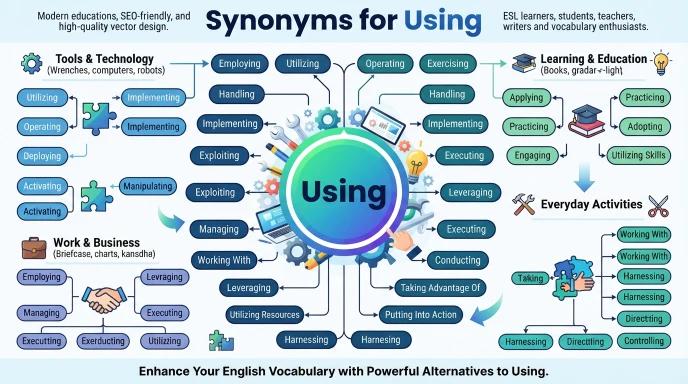
There are several effective synonyms for “using” that can make your writing more varied and precise, such as utilizing, employing, applying, and operating.
Repeating the word “using” too often in your writing can make it sound dull and repetitive. Choosing the right synonym can add variety and improve clarity.
Words like utilizing, employing, and applying carry a similar meaning but fit differently depending on the context. Understanding these subtle differences helps in selecting the most appropriate word.
if you’re writing an academic paper, a business report, or casual content, having strong alternatives to “using” enhances the overall quality of your writing. It also helps avoid monotony in sentence structure.
In this guide, we will explore the best synonyms for “using”, along with their meanings and examples, so you can confidently choose the right word for any situation.
In daily life, people use tools, skills, ideas, and resources to complete tasks. That is why the word using is very common in spoken and written English.
Quick Answer:
The best synonyms for using include utilizing, employing, applying, operating, implementing, and exercising: all of which can replace “using” depending on the context of your sentence.
Meaning of Using
Using (Verb Present Participle of Use):
To employ, apply, operate, or make use of something for a particular purpose.
Examples:
- She is using a laptop to complete her homework.
- We are using new methods to improve our results.
Connotative Meaning
(Connotation means the emotional feeling or idea connected to a word beyond its basic definition.)
- Positive Tone: Making good use of resources, skills, or opportunities.
- Negative Tone: Exploiting or taking advantage of someone unfairly.
- Neutral Tone: Simply employing or operating something for a purpose.
Etymology
- Origin: From Old French user meaning “to employ or practice.”
- Source Language: Old French and Latin.
- Latin Root: uti, meaning “to use, enjoy, or employ.”
Short History of the Keyword
- Old English (450–1100): Similar concepts were expressed through native verbs meaning employ or enjoy.
- Middle English (1100–1500): The word entered English from Old French after the Norman influence.
- Modern English (1500–Present): The word became common in daily speech, writing, business, education, and technology.
Pronunciation (US & UK – IPA)
US: /ˈjuːzɪŋ/
UK: /ˈjuːzɪŋ/
Syllables
us-ing
Affixation Pattern of Using
Root: use
Prefix: None
Suffix: -ing
Word Formation of the Keyword
- Use (Verb) – to employ something.
- Use (Noun) – purpose or function.
- Uses (Verb/Noun) – employs or purposes.
- Used (Verb/Adjective) – employed before.
- Using (Verb) – employing.
- Useful (Adjective) – helpful.
- Usefully (Adverb) – in a helpful way.
- Usefulness (Noun) – quality of being useful.
- Useless (Adjective) – not useful.
- Uselessly (Adverb) – in a useless way.
- Uselessness (Noun) – lack of usefulness.
- User (Noun) – person who uses something.
Synonyms of Using
1. Employing (Verb)
US: /ɪmˈplɔɪɪŋ/ | UK: /ɪmˈplɔɪɪŋ/
Meaning: Making use of something for a purpose.
Examples:
- We are employing new strategies at work.
- The company is employing advanced software.
2. Applying (Verb)
US: /əˈplaɪɪŋ/ | UK: /əˈplaɪɪŋ/
Meaning: Putting something into action.
Examples:
- She is applying her knowledge effectively.
- They are applying modern techniques.
3. Utilizing (Verb)
US: /ˈjuːtəlaɪzɪŋ/ | UK: /ˈjuːtɪlaɪzɪŋ/
Meaning: Making practical use of something.
Examples:
- The team is utilizing available resources.
- We are utilizing solar energy.
4. Operating (Verb)
US: /ˈɑːpəreɪtɪŋ/ | UK: /ˈɒpəreɪtɪŋ/
Meaning: Running or controlling a machine.
Examples:
- He is operating the equipment carefully.
- She is operating the computer system.
5. Handling (Verb)
US: /ˈhændlɪŋ/ | UK: /ˈhændlɪŋ/
Meaning: Managing or dealing with something.
Examples:
- She is handling the project well.
- They are handling customer requests.
6. Exercising (Verb)
US: /ˈeksərsaɪzɪŋ/ | UK: /ˈeksəsaɪzɪŋ/
Meaning: Putting a skill or power into action.
Examples:
- He is exercising his authority.
- She is exercising her talents.
7. Exploiting (Verb)
US: /ɪkˈsplɔɪtɪŋ/ | UK: /ɪkˈsplɔɪtɪŋ/
Meaning: Making use of something fully.
Examples:
- The company is exploiting natural resources.
- They are exploiting market opportunities.
8. Adopting (Verb)
US: /əˈdɑːptɪŋ/ | UK: /əˈdɒptɪŋ/
Meaning: Choosing and using something.
Examples:
- Schools are adopting new policies.
- We are adopting better habits.
9. Practicing (Verb)
US: /ˈpræktɪsɪŋ/ | UK: /ˈpræktɪsɪŋ/
Meaning: Doing something regularly.
Examples:
- She is practicing English daily.
- They are practicing new skills.
10. Exercising (Verb)
US: /ˈeksərsaɪzɪŋ/ | UK: /ˈeksəsaɪzɪŋ/
Meaning: Making active use of something.
Examples:
- He is exercising his rights.
- She is exercising good judgment.
11. Employing (Verb)
US: /ɪmˈplɔɪɪŋ/ | UK: /ɪmˈplɔɪɪŋ/
Meaning: Using for a specific purpose.
Examples:
- Scientists are employing new methods.
- Teachers are employing creative activities.
12. Leveraging (Verb)
US: /ˈlevərɪdʒɪŋ/ | UK: /ˈliːvərɪdʒɪŋ/
Meaning: Using something to gain an advantage.
Examples:
- She is leveraging her experience.
- Businesses are leveraging technology.
13. Executing (Verb)
US: /ˈeksɪkjuːtɪŋ/ | UK: /ˈeksɪkjuːtɪŋ/
Meaning: Carrying out a plan.
Examples:
- The team is executing the strategy.
- He is executing the instructions.
14. Administering (Verb)
US: /ədˈmɪnəstərɪŋ/ | UK: /ədˈmɪnɪstərɪŋ/
Meaning: Managing or applying something.
Examples:
- Nurses are administering medicine.
- She is administering the program.
15. Implementing (Verb)
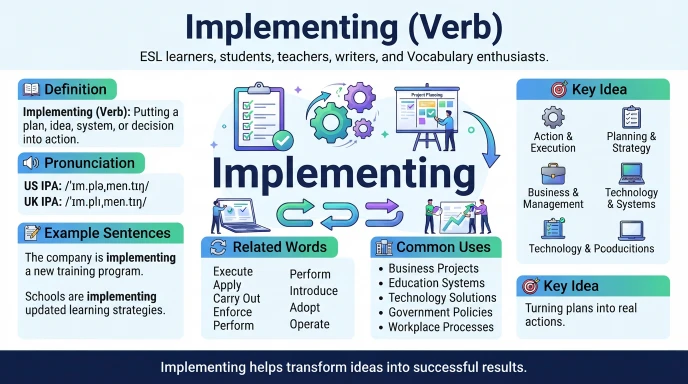
US: /ˈɪmpləmentɪŋ/ | UK: /ˈɪmplɪmentɪŋ/
Meaning: Putting a plan into action.
Examples:
- The company is implementing changes.
- Schools are implementing new rules.
16. Deploying (Verb)
US: /dɪˈplɔɪɪŋ/ | UK: /dɪˈplɔɪɪŋ/
Meaning: Positioning something for use.
Examples:
- Engineers are deploying software.
- The army is deploying equipment.
17. Exercising Control (Verb Phrase)
US: /ˈeksərsaɪzɪŋ/ | UK: /ˈeksəsaɪzɪŋ/
Meaning: Using authority or power.
Examples:
- She is exercising control wisely.
- The manager is exercising authority.
18. Utilizing Resources (Verb Phrase)
US: /ˈjuːtəlaɪzɪŋ/ | UK: /ˈjuːtɪlaɪzɪŋ/
Meaning: Making effective use of resources.
Examples:
- We are utilizing resources carefully.
- The team is utilizing every opportunity.
19. Working With (Verb Phrase)
US: /ˈwɜːrkɪŋ wɪð/ | UK: /ˈwɜːkɪŋ wɪð/
Meaning: Using or cooperating with something.
Examples:
- She is working with new software.
- They are working with experts.
20. Engaging (Verb)
US: /ɪnˈɡeɪdʒɪŋ/ | UK: /ɪnˈɡeɪdʒɪŋ/
Meaning: Actively using or involving.
Examples:
- Students are engaging digital tools.
- Workers are engaging new systems.
21. Manipulating (Verb)
US: /məˈnɪpjəleɪtɪŋ/ | UK: /məˈnɪpjʊleɪtɪŋ/
Meaning: Handling skillfully.
Examples:
- She is manipulating the controls.
- Scientists are manipulating data.
22. Exercising Authority (Verb Phrase)
US: /ˈeksərsaɪzɪŋ/ | UK: /ˈeksəsaɪzɪŋ/
Meaning: Using official power.
Examples:
- The officer is exercising authority.
- Leaders are exercising responsibility.
23. Taking Advantage Of (Verb Phrase)
US: /teɪkɪŋ ədˈvæntɪdʒ/ | UK: /teɪkɪŋ ədˈvɑːntɪdʒ/
Meaning: Making use of an opportunity.
Examples:
- She is taking advantage of free courses.
- We are taking advantage of good weather.
24. Employing Techniques (Verb Phrase)
US: /ɪmˈplɔɪɪŋ/ | UK: /ɪmˈplɔɪɪŋ/
Meaning: Using methods or skills.
Examples:
- Artists are employing new techniques.
- Teachers are employing active learning.
25. Putting Into Practice (Verb Phrase)
US: /ˈpʊtɪŋ/ | UK: /ˈpʊtɪŋ/
Meaning: Using ideas in real situations.
Examples:
- He is putting lessons into practice.
- They are putting plans into practice.
26. Drawing On (Verb Phrase)
US: /ˈdrɔːɪŋ ɑːn/ | UK: /ˈdrɔːɪŋ ɒn/
Meaning: Using knowledge or experience.
Examples:
- She is drawing on past experience.
- We are drawing on expert advice.
27. Resorting To (Verb Phrase)
US: /rɪˈzɔːrtɪŋ/ | UK: /rɪˈzɔːtɪŋ/
Meaning: Turning to something for use.
Examples:
- He is resorting to simple methods.
- They are resorting to online tools.
28. Accessing (Verb)
US: /ˈæksesɪŋ/ | UK: /ˈæksesɪŋ/
Meaning: Obtaining and using.
Examples:
- She is accessing information online.
- Students are accessing resources.
29. Employing Resources (Verb Phrase)
US: /ɪmˈplɔɪɪŋ/ | UK: /ɪmˈplɔɪɪŋ/
Meaning: Making use of available materials.
Examples:
- The team is employing resources efficiently.
- Schools are employing digital tools.
30. Capitalizing On (Verb Phrase)
US: /ˈkæpɪtəlaɪzɪŋ/ | UK: /ˈkæpɪtəlaɪzɪŋ/
Meaning: Using an opportunity for benefit.
Examples:
- Businesses are capitalizing on trends.
- She is capitalizing on her skills.
Prototype Meaning
The most common meaning of using is employing or making use of something to achieve a goal.
When people hear the word, they usually imagine someone using a tool, device, skill, resource, or method to complete a task more effectively.
Prototype Categorization
- General Use: employing, utilizing, applying, adopting.
- Practical Action: implementing, executing, deploying.
- Managing and Operating: operating, handling, administering.
- Using Skills and Knowledge: practicing, drawing on, leveraging.
- Using Opportunities: capitalizing on, taking advantage of.
- Using Authority: exercising authority, exercising control.
Categorization helps writers choose the most accurate synonym for different situations. A business report may use leveraging, while everyday conversation may use using or applying.
Antonyms of Using
- Ignoring (Verb) – not paying attention to something.
- Neglecting (Verb) – failing to use or care for something.
- Abandoning (Verb) – leaving something behind.
- Discarding (Verb) – throwing something away.
- Rejecting (Verb) – refusing to accept or use.
- Avoiding (Verb) – staying away from something.
- Forgetting (Verb) – failing to remember or use.
- Withholding (Verb) – keeping something from being used.
Related Words
- Use (Noun/Verb)
- User (Noun)
- Useful (Adjective)
- Usefulness (Noun)
- Utilization (Noun)
- Application (Noun)
- Implementation (Noun)
- Operation (Noun)
- Resource (Noun)
- Function (Noun)
Formal and Casual Alternatives
Formal Alternatives
- Utilize
- Implement
- Employ
- Leverage
- Administer
- Deploy
Casual Alternatives
- Use
- Work with
- Apply
- Try
- Put to use
- Make use of
Frequently Asked Questions:
- Q1: What words can I use instead of “using”?
- You can use words like utilizing, employing, applying, operating, implementing, and exercising instead of “using,” depending on the context of your sentence.
- Q2: What is another word for “using”?
- A common alternative for “using” is utilizing, though other options like employing, applying, and adopting also work well in different contexts.
- Q3: What to say instead of “using”?
- Instead of “using,” you can say utilizing, employing, applying, handling, or operating to add variety to your writing.
- Q4: What words can I use instead?
- Depending on the sentence, you can replace common words with more precise alternatives : for example, “using” can become utilizing, employing, or applying to sound more professional and varied.
Conclusion
Learning the word using and its synonyms can greatly improve your English vocabulary. Instead of repeating the same word, you can choose alternatives such as applying, utilizing, leveraging, or implementing to express ideas more precisely.
This helps make writing and speaking clearer, more professional, and more engaging. Understanding pronunciation, history, connotation, and related meanings also deepens language knowledge.
As you practice these synonyms in daily conversations, essays, emails, and content writing, you will become more confident in English communication. Make vocabulary learning a daily habit, and you will continue building stronger language skills over time.
Explore more about!

I am an American writer and speaker who focuses on habits, productivity, and self-improvement.
I study how small daily habits can create big changes in life. I try to write in a very simple and practical way so anyone can apply my ideas.
My most popular book is Atomic Habits, which is read around the world.