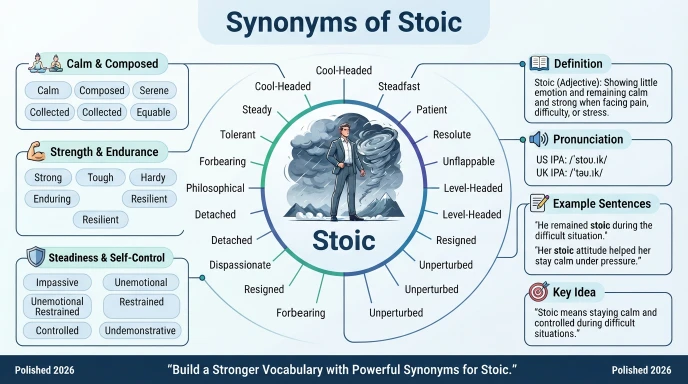
Stoic means calm, emotionally strong, and able to endure pain, difficulty, or stress without complaining. Imagine a student who receives disappointing exam results but remains calm and focuses on improving for the next test. Many people would describe that student as stoic.
The word stoic is commonly used when talking about emotional strength, patience, self-control, and resilience. It appears in books, articles, speeches, and daily conversations. Learning synonyms of stoic helps English learners, students, writers, and content creators expand their vocabulary and express ideas with greater precision.
This article explores the meaning of stoic, its pronunciation, grammar, history, connotations, and 30 useful synonyms. You will also learn antonyms, related words, prototype meaning, and semantic categories that can help you choose the best synonym in different situations.
Meaning of Stoic
Definition
Stoic (Adjective/Noun): A person or attitude that remains calm and does not show strong emotions, especially during difficult situations.
Examples
- She stayed stoic during the challenging interview.
- Despite the bad news, he remained stoic and focused.
Connotative Meaning
(Connotation: the emotional or cultural feeling associated with a word beyond its basic dictionary meaning.)
- Positive tone: Strong, calm, resilient, disciplined, patient.
- Negative tone: Can suggest emotional distance or lack of expression.
- Neutral tone: Simply showing self-control and emotional restraint.
Etymology
- Origin: Greek
- Source word: Stoikos
- Original meaning: “Of the Stoa,” referring to followers of the Stoic philosophy.
- Entered English through Latin and French influences.
Short History of Stoic
Old English (450–1100)
- The word stoic was not used in Old English.
- Similar ideas were expressed through words meaning patient or enduring.
Middle English (1100–1500)
- Classical Greek philosophy became more influential in Europe.
- References to Stoic ideas gradually appeared in scholarly works.
Modern English (1500–Present)
- The term stoic became common in English.
- Today it describes calmness, endurance, and emotional control.
Pronunciation (US & UK – IPA)
US: /ˈstoʊɪk/
UK: /ˈstəʊɪk/
Syllables
sto-ic
Affixation Pattern of Stoic
Root: stoic
Prefix: None
Suffix: None
Word Formation
- Stoicism (Noun)
- Stoically (Adverb)
- Stoical (Adjective)
- Stoicalness (Noun)
- Non-stoic (Adjective/Noun)
- Neo-Stoicism (Noun)
- Stoic philosophy (Noun Phrase)
- Stoic mindset (Noun Phrase)
Synonyms of Stoic
1. Calm (Adjective)
US: /kɑːm/ | UK: /kɑːm/
Meaning: Peaceful and not upset.
Examples:
- She remained calm during the storm.
- Try to stay calm under pressure.
2. Composed (Adjective)
US: /kəmˈpoʊzd/ | UK: /kəmˈpəʊzd/
Meaning: In control of emotions.
Examples:
- He looked composed during the debate.
- She stayed composed after the mistake.
3. Unemotional (Adjective)
US: /ˌʌnɪˈmoʊʃənəl/ | UK: /ˌʌnɪˈməʊʃənəl/
Meaning: Not showing strong feelings.
Examples:
- His response was unemotional.
- She remained unemotional throughout the meeting.
4. Reserved (Adjective)
US: /rɪˈzɜːrvd/ | UK: /rɪˈzɜːvd/
Meaning: Quiet and restrained.
Examples:
- He has a reserved personality.
- She was reserved around strangers.
5. Controlled (Adjective)
US: /kənˈtroʊld/ | UK: /kənˈtrəʊld/
Meaning: Showing self-discipline.
Examples:
- His reaction was controlled.
- She gave a controlled response.
6. Patient (Adjective)
US: /ˈpeɪʃənt/ | UK: /ˈpeɪʃənt/
Meaning: Able to wait calmly.
Examples:
- Be patient with others.
- He remained patient during delays.
7. Enduring (Adjective)
US: /ɪnˈdʊrɪŋ/ | UK: /ɪnˈdjʊərɪŋ/
Meaning: Lasting through hardship.
Examples:
- She showed enduring strength.
- Their support was enduring.
8. Resilient (Adjective)
US: /rɪˈzɪliənt/ | UK: /rɪˈzɪliənt/
Meaning: Able to recover from difficulties.
Examples:
- Children are often resilient.
- She remained resilient after failure.
9. Tough (Adjective)
US: /tʌf/ | UK: /tʌf/
Meaning: Strong and difficult to break.
Examples:
- He is mentally tough.
- Tough people keep going.
10. Strong (Adjective)
US: /strɔːŋ/ | UK: /strɒŋ/
Meaning: Having great inner power.
Examples:
- She stayed strong through challenges.
- Strong people face problems bravely.
11. Steady (Adjective)
US: /ˈstedi/ | UK: /ˈstedi/
Meaning: Consistent and calm.
Examples:
- His voice stayed steady.
- She maintained a steady attitude.
12. Stable (Adjective)
US: /ˈsteɪbəl/ | UK: /ˈsteɪbəl/
Meaning: Emotionally balanced.
Examples:
- He remained stable during stress.
- A stable mindset helps success.
13. Level-Headed (Adjective)
US: /ˌlevəl ˈhedɪd/ | UK: /ˌlevəl ˈhedɪd/
Meaning: Sensible and calm.
Examples:
- She is level-headed in crises.
- We need a level-headed leader.
14. Self-Controlled (Adjective)
US: /ˌself kənˈtroʊld/ | UK: /ˌself kənˈtrəʊld/
Meaning: Able to manage emotions.
Examples:
- He remained self-controlled.
- Her self-controlled behavior impressed everyone.
15. Disciplined (Adjective)
US: /ˈdɪsəplɪnd/ | UK: /ˈdɪsəplɪnd/
Meaning: Showing strong self-control.
Examples:
- She is highly disciplined.
- Disciplined people achieve goals.
16. Impassive (Adjective)
US: /ɪmˈpæsɪv/ | UK: /ɪmˈpæsɪv/
Meaning: Showing little emotion.
Examples:
- His face remained impassive.
- She gave an impassive look.
17. Unflappable (Adjective)
US: /ʌnˈflæpəbəl/ | UK: /ʌnˈflæpəbəl/
Meaning: Not easily upset.
Examples:
- He is unflappable under pressure.
- She remained unflappable during the emergency.
18. Detached (Adjective)
US: /dɪˈtætʃt/ | UK: /dɪˈtætʃt/
Meaning: Emotionally distant.
Examples:
- He sounded detached.
- She remained detached from the argument.
19. Cool (Adjective)
US: /kuːl/ | UK: /kuːl/
Meaning: Calm and relaxed.
Examples:
- Keep a cool head.
- She stayed cool in the crisis.
20. Collected (Adjective)
US: /kəˈlektɪd/ | UK: /kəˈlektɪd/
Meaning: Calm and organized.
Examples:
- He seemed collected.
- She remained collected during the interview.
21. Balanced (Adjective)
US: /ˈbælənst/ | UK: /ˈbælənst/
Meaning: Emotionally steady.
Examples:
- He has a balanced outlook.
- Balanced people handle stress well.
22. Restrained (Adjective)
US: /rɪˈstreɪnd/ | UK: /rɪˈstreɪnd/
Meaning: Controlled and moderate.
Examples:
- Her reaction was restrained.
- He gave a restrained response.
23. Philosophical (Adjective)
US: /ˌfɪləˈsɑːfɪkəl/ | UK: /ˌfɪləˈsɒfɪkəl/
Meaning: Calmly accepting life’s events.
Examples:
- She was philosophical about the loss.
- He took a philosophical view.
24. Courageous (Adjective)
US: /kəˈreɪdʒəs/ | UK: /kəˈreɪdʒəs/
Meaning: Brave in difficulty.
Examples:
- The firefighter was courageous.
- She made a courageous decision.
25. Fearless (Adjective)
US: /ˈfɪrləs/ | UK: /ˈfɪələs/
Meaning: Not afraid.
Examples:
- He was fearless in danger.
- Fearless leaders inspire others.
26. Resolute (Adjective)
US: /ˈrezəluːt/ | UK: /ˈrezəluːt/
Meaning: Firm and determined.
Examples:
- She remained resolute.
- His resolute attitude helped him succeed.
27. Firm (Adjective)
US: /fɜːrm/ | UK: /fɜːm/
Meaning: Strong and unwavering.
Examples:
- He gave a firm answer.
- Her beliefs remained firm.
28. Hardy (Adjective)
US: /ˈhɑːrdi/ | UK: /ˈhɑːdi/
Meaning: Strong and able to endure hardship.
Examples:
- Hardy people adapt well.
- The explorers were hardy.
29. Unsentimental (Adjective)
US: /ˌʌnsentɪˈmentəl/ | UK: /ˌʌnsentɪˈmentəl/
Meaning: Not guided by emotions.
Examples:
- He made an unsentimental decision.
- Her analysis was unsentimental.
30. Emotionless (Adjective)
US: /ɪˈmoʊʃənləs/ | UK: /ɪˈməʊʃənləs/
Meaning: Showing no visible emotion.
Examples:
- His face appeared emotionless.
- She gave an emotionless reply.
Formal and Casual Alternatives
Formal Synonyms
- Impassive
- Resolute
- Philosophical
- Restrained
- Composed
- Disciplined
- Self-Controlled
- Unsentimental
Casual Synonyms
- Calm
- Cool
- Tough
- Strong
- Steady
- Patient
- Collected
- Fearless
Related Words
- Stoicism (Noun)
- Stoically (Adverb)
- Stoical (Adjective)
- Endurance (Noun)
- Resilience (Noun)
- Patience (Noun)
- Self-Control (Noun)
- Discipline (Noun)
Prototype Meaning
The prototype meaning of stoic is a person who stays calm and emotionally controlled during difficult situations.
When people hear the word, they often imagine someone facing hardship, pain, loss, or stress without complaining, panicking, or showing strong emotions.
Prototype Categorization
Categorizing synonyms helps writers choose the most suitable word for a specific context.
- Emotional Control: composed, self-controlled, restrained, impassive
- Mental Strength: resilient, tough, strong, hardy
- Calmness: calm, cool, collected, steady
- Patience and Endurance: patient, enduring, resolute, disciplined
- Emotional Distance: detached, unemotional, emotionless, unsentimental
- Wisdom and Acceptance: philosophical, balanced, level-headed
Antonyms of Stoic
- Emotional (Adjective): Easily affected by feelings.
- Sensitive (Adjective): Strongly responsive to emotions.
- Expressive (Adjective): Openly showing feelings.
- Impulsive (Adjective): Acting without self-control.
- Excitable (Adjective): Easily stirred emotionally.
- Reactive (Adjective): Responding strongly to events.
- Dramatic (Adjective): Showing emotions openly.
Short Questions and Answers
- What does stoic mean?
- It means calm, emotionally controlled, and able to endure difficulties without complaining.
- When should stoic be used?
- Use it to describe people who remain calm and strong during challenging situations.
- Is stoic positive or negative?
- It is usually positive, but sometimes it may suggest emotional distance.
- How is it different from similar words?
- Stoic emphasizes emotional control, while words like resilient focus on recovery and calm focuses on peacefulness.
Conclusion
Learning the word stoic and its synonyms can greatly improve your vocabulary and communication skills. These words help you describe emotional strength, patience, resilience, and self-control with greater accuracy.
Understanding different synonyms allows you to avoid repetition and choose the most effective word for each situation.
Knowledge of pronunciation, connotations, history, and semantic categories also helps you use these words correctly in speaking and writing. Whether you are an English learner, student, teacher, or content writer, mastering stoic-related vocabulary can make your language richer and more expressive.
Practice these words regularly to build confidence and develop stronger English communication skills.
Read more abou!
- 30 Synonyms for Curious to Improve
- 30 Synonyms for “Pride” to Level Up Your Writing
- Energy Synonyms: 30 Words to Elevate Your Vocabulary

I am an American author, and I write books about power, strategy, and human behavior. My writing style is simple but deep, and I try to explain how people think and act in real-life situations.
I studied classical studies, and before becoming a writer, I worked in different fields which helped me understand people and life better.
My most famous books include The 48 Laws of Power, The Art of Seduction, and Mastery. These books are widely read by business people, leaders, and students around the world.