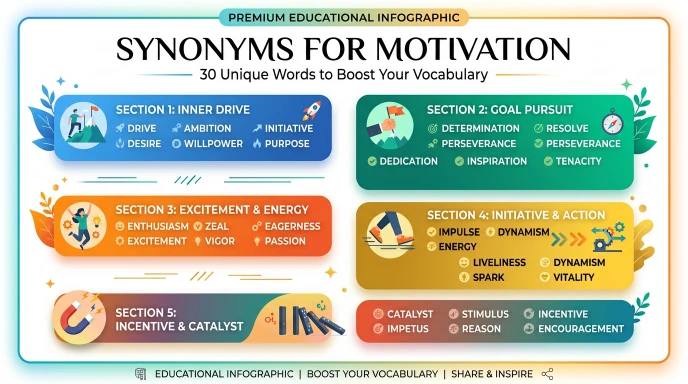
Motivation means the inner reason, feeling, or force that encourages a person to take action and achieve a goal. Learning synonyms for motivation helps you express this driving energy in different ways if you’re writing, speaking, or trying to inspire others with more powerful and varied vocabulary.
For example, a student who studies every day because they want to pass an exam shows motivation. A young athlete who practices hard to become better is also guided by motivation.
This word is commonly used because people often talk about goals, success, personal growth, and achievement. Learning synonyms for motivation is important for English learners and content writers because it helps them express ideas clearly and avoid repeating the same word.
This article explains the meaning of motivation, its synonyms, examples, grammar use, history, pronunciation, and semantic categories to help learners choose the right words for different situations.
Meaning of Motivation
Definition
Motivation (Noun):
Motivation means the reason, desire, or energy that makes someone want to do something.
Examples
- Her motivation helped her complete the difficult project.
- Success was his main motivation for working hard.
Connotative Meaning
Connotation: (The emotional or cultural feeling connected with a word beyond its direct meaning.)
- Positive tone:
Motivation often creates a feeling of ambition, hope, energy, and success.
Example: “Her motivation inspired the whole team.” - Negative tone:
Motivation can sometimes suggest pressure or unhealthy ambition.
Example: “Fear was his motivation for making quick decisions.” - Neutral tone:
Motivation can simply describe a reason behind an action.
Example: “Money was one motivation for changing jobs.”
Etymology
- The word motivation comes from the Latin word movere, meaning “to move.”
- It entered English through the French word motivation, meaning a reason or force that causes action.
Short History of Motivation
Old English (450–1100):
The modern word motivation was not used in Old English. Ideas related to motivation were expressed through words connected with desire, will, and purpose.
Middle English (1100–1500):
English developed more words from French and Latin influences. Ideas about reasons and intentions became more common in language.
Modern English (1500–Present):
The word motivation became widely used in psychology, education, business, and personal development. Today, it describes the mental force that encourages people to act.
Pronunciation (US & UK – IPA)
US: /ˌmoʊ.təˈveɪ.ʃən/
UK: /ˌməʊ.tɪˈveɪ.ʃən/
Syllables
mo-ti-va-tion
Affixation Pattern of Motivation
Root:
- mot (from Latin movere, meaning “to move”)
Prefix:
- No prefix
Suffix:
- -ation (used to form nouns showing an action or process)
Word Formation of Motivation
- Motivate (verb) : to encourage someone to act
- Motivation (noun) : the reason or force behind action
- Motivated (adjective) :having a strong desire to achieve something
- Motivating (adjective) : causing interest or enthusiasm
- Motivational (adjective) : related to encouragement or inspiration
Synonyms of Motivation
1. Inspiration (Noun)
US IPA: /ˌɪn.spəˈreɪ.ʃən/ | UK IPA: /ˌɪn.spɪˈreɪ.ʃən/
Meaning:
Inspiration means a feeling or idea that encourages someone to do something creative or valuable.
Examples:
- Her teacher was an inspiration for her success.
- The beautiful view gave him inspiration for his painting.
2. Drive (Noun)
US IPA: /draɪv/ | UK IPA: /draɪv/
Meaning:
Drive means a strong desire and determination to achieve something.
Examples:
- His drive helped him become a successful entrepreneur.
- She has the drive to reach her goals.
3. Ambition (Noun)
US IPA: /æmˈbɪʃ.ən/ | UK IPA: /æmˈbɪʃ.ən/
Meaning:
Ambition means a strong desire to achieve success or a specific goal.
Examples:
- Her ambition is to become a doctor.
- He worked hard because of his ambition.
4. Encouragement (Noun)
US IPA: /ɪnˈkɝː.ɪdʒ.mənt/ | UK IPA: /ɪnˈkʌr.ɪdʒ.mənt/
Meaning:
Encouragement means support that gives someone confidence to continue.
Examples:
- Her parents gave her encouragement during exams.
- A few words of encouragement can change a person’s attitude.
5. Determination (Noun)
US IPA: /dɪˌtɝː.məˈneɪ.ʃən/ | UK IPA: /dɪˌtɜː.mɪˈneɪ.ʃən/
Meaning:
Determination means a strong decision to achieve something despite difficulties.
Examples:
- His determination helped him overcome challenges.
- Success requires patience and determination.
6. Purpose (Noun)
US IPA: /ˈpɝː.pəs/ | UK IPA: /ˈpɜː.pəs/
Meaning:
Purpose means a reason or goal that gives direction to an action.
Examples:
- She found her purpose in helping others.
- The purpose of this meeting is to solve problems.
7. Desire (Noun)
US IPA: /dɪˈzaɪr/ | UK IPA: /dɪˈzaɪə/
Meaning:
Desire means a strong feeling of wanting something.
Examples:
- He has a strong desire to learn English.
- Her desire for success pushed her forward.
8. Willpower (Noun)
US IPA: /ˈwɪl.paʊ.ɚ/ | UK IPA: /ˈwɪl.paʊə/
Meaning:
Willpower means the ability to control yourself and continue working toward a goal.
Examples:
- Losing weight requires willpower and discipline.
- Her willpower helped her finish the difficult task.
9. Incentive (Noun)
US IPA: /ɪnˈsen.tɪv/ | UK IPA: /ɪnˈsen.tɪv/
Meaning:
Incentive means something that encourages a person to take action.
Examples:
- The company offered bonuses as an incentive.
- A reward can be a strong incentive for students.
10. Stimulus (Noun)
US IPA: /ˈstɪm.jə.ləs/ | UK IPA: /ˈstɪm.jʊ.ləs/
Meaning:
Stimulus means something that causes interest, action, or growth.
Examples:
- The new project was a stimulus for creativity.
- The teacher provided a stimulus for discussion.
11. Encouragement (Noun)
US IPA: /ɪnˈkɝː.ɪdʒ.mənt/ | UK IPA: /ɪnˈkʌr.ɪdʒ.mənt/
Meaning:
Encouragement means words or actions that give confidence and hope.
Examples:
- His friend’s encouragement helped him continue.
- Students need encouragement to improve.
12. Enthusiasm (Noun)
US IPA: /ɪnˈθuː.zi.æz.əm/ | UK IPA: /ɪnˈθjuː.zi.æz.əm/
Meaning:
Enthusiasm means strong excitement and interest in something.
Examples:
- She showed enthusiasm for the new project.
- His enthusiasm motivated the entire group.
13. Passion (Noun)
US IPA: /ˈpæʃ.ən/ | UK IPA: /ˈpæʃ.ən/
Meaning:
Passion means a strong love or interest in something.
Examples:
- Teaching is her passion.
- His passion for music made him practice daily.
14. Commitment (Noun)
US IPA: /kəˈmɪt.mənt/ | UK IPA: /kəˈmɪt.mənt/
Meaning:
Commitment means a strong promise or dedication to a goal.
Examples:
- Her commitment to learning improved her skills.
- Success needs commitment and hard work.
15. Goal (Noun)
US IPA: /ɡoʊl/ | UK IPA: /ɡəʊl/
Meaning:
Goal means something a person wants to achieve.
Examples:
- My goal is to improve my English.
- He reached his goal after years of e
16. Aspiration (Noun)
US IPA: /ˌæs.pəˈreɪ.ʃən/ | UK IPA: /ˌæs.pɪˈreɪ.ʃən/
Meaning:
Aspiration means a strong hope or desire to achieve something important.
Examples:
- Her aspiration is to become a successful writer.
- He followed his aspirations with hard work.
17. Zeal (Noun)
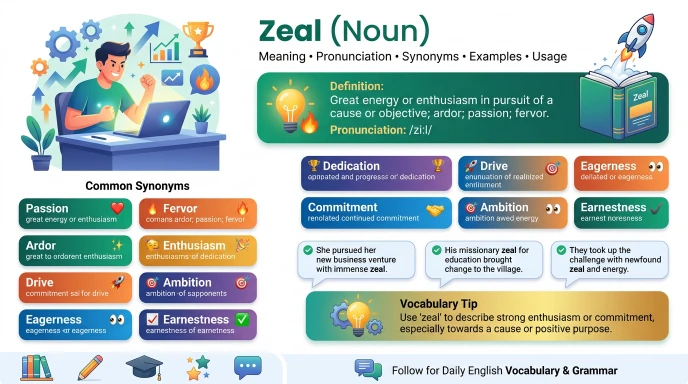
US IPA: /ziːl/ | UK IPA: /ziːl/
Meaning:
Zeal means great energy and enthusiasm for a purpose.
Examples:
- She worked with great zeal on the project.
- His zeal for learning impressed his teachers.
18. Energy (Noun)
US IPA: /ˈen.ɚ.dʒi/ | UK IPA: /ˈen.ə.dʒi/
Meaning:
Energy means the power and enthusiasm needed to do something.
Examples:
- The team started the work with positive energy.
- He has enough energy to complete the task.
19. Commitment (Noun)
US IPA: /kəˈmɪt.mənt/ | UK IPA: /kəˈmɪt.mənt/
Meaning:
Commitment means dedication and loyalty toward a goal or activity.
Examples:
- Her commitment helped her achieve success.
- Learning a language requires commitment.
20. Discipline (Noun)
US IPA: /ˈdɪs.ə.plɪn/ | UK IPA: /ˈdɪs.ɪ.plɪn/
Meaning:
Discipline means the ability to control actions and continue working toward a goal.
Examples:
- Discipline is important for long-term success.
- His discipline helped him maintain a healthy lifestyle.
21. Initiative (Noun)
US IPA: /ɪˈnɪʃ.ə.tɪv/ | UK IPA: /ɪˈnɪʃ.ə.tɪv/
Meaning:
Initiative means the ability and willingness to start something without being told.
Examples:
- She showed initiative by solving the problem herself.
- Taking initiative can create new opportunities.
22. Reason (Noun)
US IPA: /ˈriː.zən/ | UK IPA: /ˈriː.zən/
Meaning:
Reason means a cause or explanation for doing something.
Examples:
- His reason for studying was personal growth.
- Everyone has a reason for their choices.
23. Aim (Noun)
US IPA: /eɪm/ | UK IPA: /eɪm/
Meaning:
Aim means a goal or purpose that someone wants to achieve.
Examples:
- Her aim is to improve her speaking skills.
- The main aim of the program is education.
24. Objective (Noun)
US IPA: /əbˈdʒek.tɪv/ | UK IPA: /əbˈdʒek.tɪv/
Meaning:
Objective means a specific result that someone plans to achieve.
Examples:
- The objective of the project is clear.
- He completed his objective on time.
25. Reward (Noun)
US IPA: /rɪˈwɔːrd/ | UK IPA: /rɪˈwɔːd/
Meaning:
Reward means something given for achievement or effort.
Examples:
- The prize was a reward for her hard work.
- A reward can motivate people to improve.
26. Desire (Noun)
US IPA: /dɪˈzaɪr/ | UK IPA: /dɪˈzaɪə/
Meaning:
Desire means a strong wish to have or do something.
Examples:
- His desire to succeed was very strong.
- She has a desire to help others.
27. Interest (Noun)
US IPA: /ˈɪn.trəst/ | UK IPA: /ˈɪn.trəst/
Meaning:
Interest means curiosity or attention toward something.
Examples:
- His interest in science motivated him to study more.
- She developed an interest in writing.
28. Faith (Noun)
US IPA: /feɪθ/ | UK IPA: /feɪθ/
Meaning:
Faith means strong belief or confidence that encourages action.
Examples:
- Her faith in herself helped her succeed.
- Faith can give people strength during challenges.
29. Commitment (Noun)
US IPA: /kəˈmɪt.mənt/ | UK IPA: /kəˈmɪt.mənt/
Meaning:
Commitment means a strong dedication to completing something.
Examples:
- His commitment to education is inspiring.
- The project needs teamwork and commitment.
30. Empowerment (Noun)
US IPA: /ɪmˈpaʊ.ɚ.mənt/ | UK IPA: /ɪmˈpaʊə.mənt/
Meaning:
Empowerment means giving someone confidence and ability to take action.
Examples:
- Education provides empowerment for young people.
- The training program created empowerment among workers.
Prototype Meaning
The prototype meaning of motivation is the inner force that pushes a person to act, improve, and achieve a goal.
When people hear the word motivation, they often imagine determination, energy, ambition, and the desire to succeed.
It is usually connected with personal growth, hard work, and positive change.
Prototype Categorization
Synonyms of motivation can be divided into meaningful groups. These groups help writers choose the best word based on the exact situation.
- Goal and Achievement Category (words connected with success):
- Ambition
- Goal
- Aim
- Objective
- Aspiration
- Inner Strength Category (words showing personal power):
- Determination
- Willpower
- Discipline
- Drive
- Commitment
- Positive Emotion Category (words showing excitement and passion):
- Inspiration
- Enthusiasm
- Passion
- Zeal
- Energy
- External Support Category (words coming from outside influences):
- Encouragement
- Incentive
- Reward
- Stimulus
- Empowerment
Understanding these categories helps writers select stronger and more accurate vocabulary instead of using “motivation” repeatedly.
Antonyms of Motivation
- Laziness (Noun):
A lack of willingness to work or make effort. - Disinterest (Noun):
A lack of curiosity or concern about something. - Apathy (Noun):
A lack of interest, emotion, or enthusiasm. - Discouragement (Noun):
A feeling that reduces confidence or hope. - Indifference (Noun):
A lack of care or interest. - Inactivity (Noun):
A state of not taking action. - Reluctance (Noun):
A feeling of unwillingness to do something.
Short Questions and Answers
- What does motivation mean?
Motivation means the reason, desire, or energy that encourages someone to take action. - When should motivation be used?
Motivation should be used when talking about the reason or force that helps someone achieve a goal. - Is motivation positive or negative?
Motivation is usually positive because it encourages action and improvement, but the source of motivation can sometimes be negative, such as fear or pressure. - How is it different from similar words?
Motivation is a general term. Inspiration focuses on ideas, ambition focuses on success, and determination focuses on continuing despite difficulties.
Conclusion
Learning the word motivation and its synonyms helps English learners improve their vocabulary and express ideas more clearly.
Different synonyms show different meanings, such as ambition for success, determination for effort, and inspiration for creativity.
Using a variety of words makes writing and speaking more interesting and professional. It also helps avoid repetition and builds confidence in English communication.
Writers, students, and professionals can improve their language skills by practicing new vocabulary every day. Understanding pronunciation, meanings, tone, and word categories makes it easier to choose the right word for every situation.
Explore more about!
- Synonyms of Marginalized: Meaning, Examples & Alternatives
- Synonyms for You: Formal, Casual & Creative Alternatives
- Synonyms for Cause: 30 Words With Meanings & Examples

I am an American writer and speaker who focuses on habits, productivity, and self-improvement.
I study how small daily habits can create big changes in life. I try to write in a very simple and practical way so anyone can apply my ideas.
My most popular book is Atomic Habits, which is read around the world.