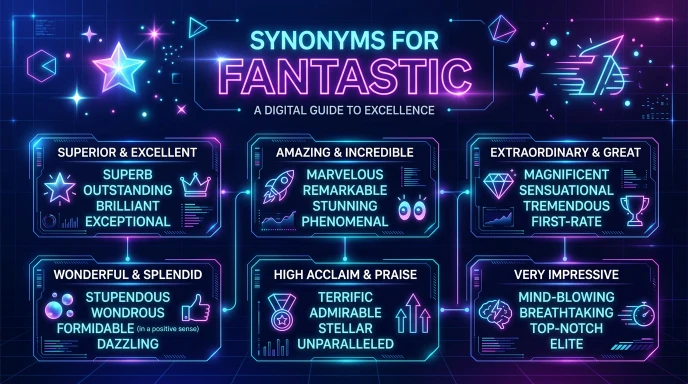
The word fantastic means extremely good, impressive, or wonderful. Imagine a student giving a perfect speech in class, an athlete winning an important match, or a writer creating an amazing story.
People often say, “That was a fantastic performance,” because the word quickly shows strong approval and excitement.Fantastic is commonly used in daily English because it is simple, positive, and works in many situations.
Learning synonyms for fantastic helps English learners and content writers express ideas with more variety and accuracy. Using different words can make speaking and writing more interesting and powerful.
This article explains the meaning of fantastic and explores its synonyms with examples, grammar details, pronunciation, history, word formation, and semantic categories to help learners build a stronger vocabulary.
Meaning of Fantastic
Definition
Fantastic (adjective):
Fantastic means extremely good, excellent, amazing, or beyond ordinary expectations.
Examples
- The movie was fantastic and everyone enjoyed it.
- She did a fantastic job on her science project.
Connotative Meaning
(Connotation means the feeling or idea connected with a word beyond its basic meaning.)
- Positive tone: Shows admiration, happiness, excitement, or strong approval.
- Negative tone: Sometimes suggests something unrealistic or imaginary when describing ideas.
- Neutral tone: Can describe something unusual or related to fantasy.
Etymology
- Source language: Latin and Greek roots through French.
- Original meaning: “Existing in imagination” or “created by fantasy.”
Short History
- Old English (450–1100): The word was not commonly used; English used simpler words for imagination and wonder.
- Middle English (1100–1500): French and Latin influences introduced many words connected with imagination and thought.
- Modern English (1500–Present): Fantastic developed meanings such as “wonderful,” “excellent,” and “very impressive.”
Pronunciation (US & UK – IPA)
- US: /fænˈtæs.tɪk/
- UK: /fænˈtæs.tɪk/
Syllables
fan-tas-tic
Affixation Pattern of Fantastic
- Root: fant- (from Latin phantasticus, imagination)
- Prefix: None
- Suffix: -ic (forming an adjective)
Word Formation
- Fantastic (adjective): extremely good or imaginative
- Fantastically (adverb): in an excellent way
- Fantasy (noun): an imagined idea or story
- Fantastical (adjective): related to fantasy or imagination
Synonyms of Fantastic
1. Amazing (Adjective)
US IPA: /əˈmeɪ.zɪŋ/ | UK IPA: /əˈmeɪ.zɪŋ/
Meaning: Causing great surprise or admiration.
Examples:
- The view from the mountain was amazing.
- She made amazing progress in English.
2. Excellent (Adjective)
US IPA: /ˈek.səl.ənt/ | UK IPA: /ˈek.səl.ənt/
Meaning: Extremely good in quality.
Examples:
- He gave an excellent presentation.
- This restaurant provides excellent service.
3. Wonderful (Adjective)
US IPA: /ˈwʌn.dɚ.fəl/ | UK IPA: /ˈwʌn.də.fəl/
Meaning: Very enjoyable or impressive.
Examples:
- We had a wonderful holiday.
- She is a wonderful teacher.
4. Outstanding (Adjective)
US IPA: /aʊtˈstæn.dɪŋ/ | UK IPA: /aʊtˈstæn.dɪŋ/
Meaning: Much better than usual.
Examples:
- His performance was outstanding.
- She received an award for outstanding work.
5. Brilliant (Adjective)
US IPA: /ˈbrɪl.jənt/ | UK IPA: /ˈbrɪl.jənt/
Meaning: Extremely clever or impressive.
Examples:
- That was a brilliant idea.
- The scientist made a brilliant discovery.
6. Awesome (Adjective)
US IPA: /ˈɑː.səm/ | UK IPA: /ˈɔː.səm/
Meaning: Extremely impressive or exciting.
Examples:
- The concert was awesome.
- You did an awesome job.
7. Incredible (Adjective)
US IPA: /ɪnˈkred.ə.bəl/ | UK IPA: /ɪnˈkred.ə.bəl/
Meaning: Impossible to believe because it is so good.
Examples:
- The athlete showed incredible skill.
- The story was incredible.
8. Remarkable (Adjective)
US IPA: /rɪˈmɑːr.kə.bəl/ | UK IPA: /rɪˈmɑː.kə.bəl/
Meaning: Worth noticing because it is unusual or excellent.
Examples:
- She achieved remarkable results.
- His memory is remarkable.
9. Fabulous (Adjective)
US IPA: /ˈfæb.jə.ləs/ | UK IPA: /ˈfæb.jə.ləs/
Meaning: Extremely attractive or excellent.
Examples:
- She looked fabulous at the event.
- The meal was fabulous.
10. Superb (Adjective)
US IPA: /suːˈpɝːb/ | UK IPA: /suːˈpɜːb/
Meaning: Of very high quality.
Examples:
- The team gave a superb performance.
- The hotel offers superb facilities.
11. Magnificent (Adjective)
US IPA: /mæɡˈnɪf.ə.sənt/ | UK IPA: /mæɡˈnɪf.ɪ.sənt/
Meaning: Very beautiful or impressive.
Examples:
- The palace looked magnificent.
- They saw a magnificent sunset.
12. Spectacular (Adjective)
US IPA: /spekˈtæk.jə.lɚ/ | UK IPA: /spekˈtæk.jə.lə/
Meaning: Very impressive and exciting.
Examples:
- The fireworks were spectacular.
- The show was spectacular.
13. Phenomenal (Adjective)
US IPA: /fəˈnɑː.mə.nəl/ | UK IPA: /fəˈnɒm.ɪ.nəl/
Meaning: Extremely impressive or successful.
Examples:
- Her success was phenomenal.
- He has phenomenal talent.
14. Terrific (Adjective)
US IPA: /təˈrɪf.ɪk/ | UK IPA: /təˈrɪf.ɪk/
Meaning: Very good or excellent.
Examples:
- You did a terrific job.
- The team had a terrific season.
15. Marvelous (Adjective)
US IPA: /ˈmɑːr.və.ləs/ | UK IPA: /ˈmɑː.və.ləs/
Meaning: Causing wonder or pleasure.
Examples:
- The painting is marvelous.
- We enjoyed a marvelous evening.
16. Exceptional (Adjective)
US IPA: /ɪkˈsep.ʃə.nəl/ | UK IPA: /ɪkˈsep.ʃən.əl/
Meaning: Much better than normal.
Examples:
- She is an exceptional student.
- His work quality is exceptional.
17. Extraordinary (Adjective)
US IPA: /ɪkˈstrɔːr.də.ner.i/ | UK IPA: /ɪkˈstrɔː.dɪ.nər.i/
Meaning: Very unusual and impressive.
Examples:
- He has extraordinary abilities.
- It was an extraordinary experience.
18. Fantastic (Adjective)
US IPA: /fænˈtæs.tɪk/ | UK IPA: /fænˈtæs.tɪk/
Meaning: Extremely good.
Examples:
- The idea is fantastic.
- She has fantastic skills.
19. Glorious (Adjective)
US IPA: /ˈɡlɔːr.i.əs/ | UK IPA: /ˈɡlɔː.ri.əs/
Meaning: Beautiful, successful, or wonderful.
Examples:
- It was a glorious morning.
- They celebrated a glorious victory.
20. Stunning (Adjective)
US IPA: /ˈstʌn.ɪŋ/ | UK IPA: /ˈstʌn.ɪŋ/
Meaning: Extremely impressive or attractive.
Examples:
- She wore a stunning dress.
- The building has stunning design.
21. Impressive (Adjective)
US IPA: /ɪmˈpres.ɪv/ | UK IPA: /ɪmˈpres.ɪv/
Meaning: Making people admire something.
Examples:
- His knowledge is impressive.
- The results are impressive.
22. Brilliantly (Adverb)
US IPA: /ˈbrɪl.jənt.li/ | UK IPA: /ˈbrɪl.jənt.li/
Meaning: In an excellent way.
Examples:
- She performed brilliantly.
- The plan worked brilliantly.
23. Wonderful (Adjective)
US IPA: /ˈwʌn.dɚ.fəl/ | UK IPA: /ˈwʌn.də.fəl/
Meaning: Very good and enjoyable.
Examples:
- The book was wonderful.
- They had a wonderful time.
24. Amazing (Adjective)
US IPA: /əˈmeɪ.zɪŋ/ | UK IPA: /əˈmeɪ.zɪŋ/
Meaning: Causing surprise or admiration.
Examples:
- The invention is amazing.
- Her voice is amazing.
25. Ideal (Adjective)
US IPA: /aɪˈdiː.əl/ | UK IPA: /aɪˈdɪəl/
Meaning: Perfect or most suitable.
Examples:
- This is an ideal solution.
- The location is ideal.
26. Perfect (Adjective)
US IPA: /ˈpɝː.fekt/ | UK IPA: /ˈpɜː.fekt/
Meaning: Without faults or problems.
Examples:
- The timing was perfect.
- She gave a perfect answer.
27. Delightful (Adjective)
US IPA: /dɪˈlaɪt.fəl/ | UK IPA: /dɪˈlaɪt.fəl/
Meaning: Very pleasant or enjoyable.
Examples:
- The garden is delightful.
- We had a delightful conversation.
28. Fantastic-looking (Adjective)
US IPA: /fænˈtæs.tɪk ˌlʊk.ɪŋ/ | UK IPA: /fænˈtæs.tɪk ˌlʊk.ɪŋ/
Meaning: Looking extremely attractive.
Examples:
- The design is fantastic-looking.
- She wore a fantastic-looking outfit.
29. Inspiring (Adjective)
US IPA: /ɪnˈspaɪr.ɪŋ/ | UK IPA: /ɪnˈspaɪə.rɪŋ/
Meaning: Giving motivation or encouragement.
Examples:
- Her story is inspiring.
- The speech was inspiring.
30. Wonderful-hearted (Adjective)
US IPA: /ˈwʌn.dɚ ˌhɑːr.tɪd/ | UK IPA: /ˈwʌn.də ˌhɑː.tɪd/
Meaning: Kind and excellent in character.
Examples:
- He is a wonderful-hearted person.
- She helped others with a wonderful-hearted attitude.
Prototype Meaning
The prototype meaning of fantastic is something that is extremely good, exciting, or impressive.
When people hear this word, they usually imagine a positive experience, such as a great achievement, beautiful object, or enjoyable event.
Prototype Categorization
Synonyms can be grouped by meaning:
- General praise: excellent, wonderful, amazing, fantastic, superb.
- Beauty and appearance: stunning, magnificent, glorious.
- Success and achievement: outstanding, exceptional, phenomenal.
- Excitement and surprise: incredible, awesome, spectacular.
- Personal qualities: inspiring, delightful.
Categorizing synonyms helps writers select the right word for different situations and avoid using the same expression repeatedly.
Antonyms of Fantastic
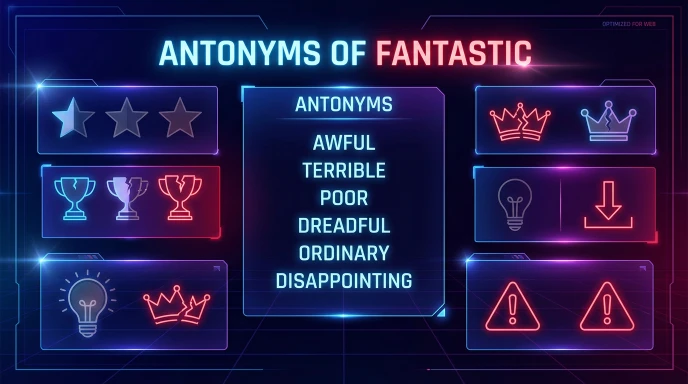
- Terrible (adjective): very bad or unpleasant.
- Awful (adjective): extremely poor or unpleasant.
- Poor (adjective): low in quality.
- Ordinary (adjective): normal and not special.
- Disappointing (adjective): failing to meet expectations.
Short Questions and Answers
- What does fantastic mean?
Fantastic means extremely good, impressive, or wonderful. - When should fantastic be used?
Use fantastic when describing something you strongly like or admire. - Is fantastic positive or negative?
Fantastic is usually positive, but it can describe imaginary things in a neutral way. - How is fantastic different from similar words?
Fantastic is a general positive word, while words like magnificent focus on beauty and outstanding focuses on achievement.
Conclusion
Learning the word fantastic and its synonyms improves vocabulary by giving English learners more ways to express ideas.
These words make writing stronger, speaking more natural, and communication more interesting. Using different synonyms helps avoid repetition and allows writers to choose words with the correct emotional tone.
Understanding pronunciation, history, and meaning also builds confidence in English. Daily vocabulary practice, reading, and using new words in sentences can help learners remember them better. A rich vocabulary allows people to share thoughts clearly and creatively.
Explore more about!
- 30 Best Synonyms for Thrive to Elevate Your Vocabulary
- Synonyms for Challenging :Boost Your Vocabulary Instantly
- Synonyms for You: Formal, Casual & Creative Alternatives

I am an American writer and speaker who focuses on habits, productivity, and self-improvement.
I study how small daily habits can create big changes in life. I try to write in a very simple and practical way so anyone can apply my ideas.
My most popular book is Atomic Habits, which is read around the world.