Utilize means to use something in a practical or effective way. Imagine a student who has an old laptop at home.Instead of leaving it unused, she utilizes it to learn new skills, attend online classes, and complete homework.
The word utilize is commonly used in formal English, business writing, academic texts, and professional communication because it suggests using something with a clear purpose.
Learning synonyms of utilize is important for English learners and content writers because repeating the same word can make writing less interesting. A strong vocabulary helps people express ideas more clearly and naturally.
This article explains the meaning of utilize, its synonyms, examples, pronunciation, grammar, history, and semantic categories. Understanding these related words helps writers choose the right word for different situations and improves both speaking and writing skills.
Meaning of Utilize
Definition
Utilize (verb):
To use something effectively for a specific purpose or to make practical use of something available.
Examples
- She utilized her free time to learn English grammar.
- The company utilized modern technology to improve its services.
Connotative Meaning
Connotation (the feeling, emotion, or idea connected with a word beyond its basic meaning):
- Positive tone:
- Suggests smart, efficient, and productive use of resources.
- Example: The team utilized its skills to solve the problem.
- Negative tone:
- Can sometimes suggest using something in a cold, overly technical, or manipulative way.
- Example: The organization utilized people only for profit.
- Neutral tone:
- Simply means using something without showing approval or criticism.
- Example: The teacher utilized a book during the lesson.
Etymology
- Origin:
- The word utilize comes from the Latin word utilis, meaning “useful” or “profitable.”
- It entered English through French utiliser, meaning “to make useful.”
Short History of Utilize
- Old English (450–1100):
- The exact word utilize was not used in Old English. People used simpler words such as “use” and “help” to express similar ideas.
- Middle English (1100–1500):
- French and Latin influence increased in English vocabulary after the Norman Conquest. Words related to usefulness and practical action began entering English.
- Modern English (1500–Present):
- Utilize became common in formal English, especially in academic, scientific, business, and technical writing. Today, it is often used when emphasizing effective or purposeful use.
Pronunciation (US & UK – IPA)
US: /ˈjuːtəlaɪz/
UK: /ˈjuːtɪlaɪz/
Syllables
u-til-ize
Affixation Pattern of Utilize
Root:
- util
- Meaning: useful, beneficial
Prefix:
- No prefix
Suffix:
- -ize
- Meaning: to make, become, or cause an action
Word Formation of Utilize
- Utilize (verb): to make practical use of something.
- Utilization (noun): the act or process of using something.
- Utilized (past participle/adjective): something that has been used.
- Utilizing (present participle/gerund): the action of using something.
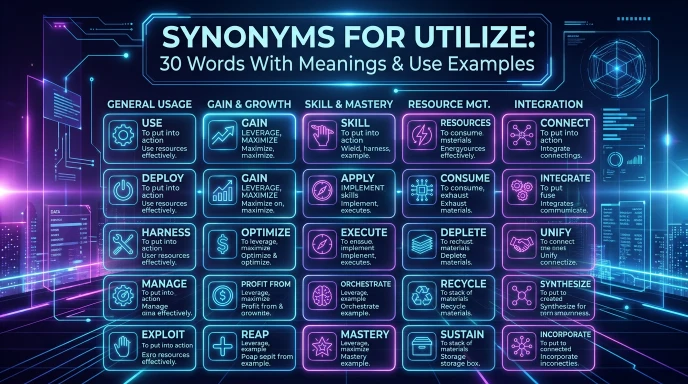
Synonyms of Utilize
1. Use (Verb)
US IPA: /juːz/
UK IPA: /juːz/
Meaning: To do something with an object, method, or resource for a purpose.
Examples:
- I use my phone to study English vocabulary.
- She uses fresh ingredients to prepare dinner.
2. Employ (Verb)
US IPA: /ɪmˈplɔɪ/
UK IPA: /ɪmˈplɔɪ/
Meaning: To use something or someone for a specific purpose.
Examples:
- The teacher employed a new method to teach grammar.
- The company employs advanced software to manage data.
3. Apply (Verb)
US IPA: /əˈplaɪ/
UK IPA: /əˈplaɪ/
Meaning: To use knowledge, skills, or methods in a situation.
Examples:
- She applied her English skills during the interview.
- Students should apply new vocabulary in daily conversations.
4. Implement (Verb)
US IPA: /ˈɪmpləment/
UK IPA: /ˈɪmplɪment/
Meaning: To put a plan, idea, or system into action.
Examples:
- The school implemented a new learning program.
- The company implemented safety rules for workers.
5. Apply (Verb)
US IPA: /əˈplaɪ/
UK IPA: /əˈplaɪ/
Meaning: To put something into practice or make practical use of it.
Examples:
- He applied his experience to solve the problem.
- Writers apply grammar rules to improve their sentences.
6. Exploit (Verb)
US IPA: /ɪkˈsplɔɪt/
UK IPA: /ɪkˈsplɔɪt/
Meaning: To use something fully, often to gain a benefit.
Examples:
- The farmer exploited modern technology to increase production.
- She exploited every opportunity to improve her skills.
7. Take Advantage of (Phrase/Verb)
US IPA: /teɪk ədˈvæntɪdʒ əv/
UK IPA: /teɪk ədˈvɑːntɪdʒ əv/
Meaning: To use a good opportunity or situation for benefit.
Examples:
- He took advantage of free online courses to learn coding.
- Students should take advantage of library resources.
8. Harness (Verb)
US IPA: /ˈhɑːrnɪs/
UK IPA: /ˈhɑːnɪs/
Meaning: To control and use something effectively, especially energy, skills, or ideas.
Examples:
- The company harnessed solar energy to reduce costs.
- She harnessed her creativity to write a great story.
9. Operate (Verb)
US IPA: /ˈɑːpəreɪt/
UK IPA: /ˈɒpəreɪt/
Meaning: To use or control a machine, system, or process.
Examples:
- He learned how to operate the new computer system.
- Workers operate machines carefully in the factory.
10. Manipulate (Verb)
US IPA: /məˈnɪpjəleɪt/
UK IPA: /məˈnɪpjʊleɪt/
Meaning: To handle, control, or use something skillfully.
Examples:
- Scientists manipulate data to study results.
- The artist manipulated colors to create a special effect.
11. Manage (Verb)
US IPA: /ˈmænɪdʒ/
UK IPA: /ˈmænɪdʒ/
Meaning: To control or use resources successfully.
Examples:
- She managed her time well during exams.
- The company managed its resources carefully.
12. Handle (Verb)
US IPA: /ˈhændəl/
UK IPA: /ˈhændəl/
Meaning: To use, control, or deal with something.
Examples:
- He handled the equipment with care.
- She handled the situation professionally.
13. Consume (Verb)
US IPA: /kənˈsuːm/
UK IPA: /kənˈsjuːm/
Meaning: To use up a resource such as food, energy, or time.
Examples:
- Cars consume large amounts of fuel.
- The project consumed many hours of work.
14. Spend (Verb)
US IPA: /spend/
UK IPA: /spend/
Meaning: To use time, money, or energy for something.
Examples:
- He spends his free time reading books.
- The company spent money on new equipment.
15. Devote (Verb)
US IPA: /dɪˈvoʊt/
UK IPA: /dɪˈvəʊt/
Meaning: To use time, effort, or attention for a purpose.
Examples:
- She devoted her time to learning English.
- He devoted his energy to the project.
16. Allocate (Verb)
US IPA: /ˈæləkeɪt/
UK IPA: /ˈæləkeɪt/
Meaning: To assign or use resources for a specific purpose.
Examples:
- The manager allocated funds for training.
- The school allocated more space for students.
US IPA: /əˈsaɪn/
UK IPA: /əˈsaɪn/
Meaning: To give something a specific purpose or use.
Examples:
- The teacher assigned tasks to each student.
- The company assigned resources to the new project.
18. Apply (Verb)
US IPA: /əˈplaɪ/
UK IPA: /əˈplaɪ/
Meaning: To use knowledge, rules, or methods in practice.
Examples:
- She applied her experience to solve the issue.
- Writers apply different techniques to improve content.
19. Practice (Verb)
US IPA: /ˈpræktɪs/
UK IPA: /ˈpræktɪs/
Meaning: To use a skill repeatedly to improve ability.
Examples:
- He practices English speaking every day.
- She practices new vocabulary in conversations.
20. Exercise (Verb)
US IPA: /ˈeksərsaɪz/
UK IPA: /ˈeksəsaɪz/
Meaning: To use a skill, right, or ability.
Examples:
- Citizens exercise their right to vote.
- She exercised creativity in her writing.
21. Adopt (Verb)
US IPA: /əˈdɑːpt/
UK IPA: /əˈdɒpt/
Meaning: To accept and use an idea, method, or system.
Examples:
- The company adopted new technology.
- Many schools adopted online learning methods.
22. Utilize (Verb)
US IPA: /ˈjuːtəlaɪz/
UK IPA: /ˈjuːtɪlaɪz/
Meaning: To make practical or effective use of something.
Examples:
- They utilized available resources wisely.
- She utilized her skills to complete the task.
23. Benefit From (Phrase/Verb)
US IPA: /ˈbenɪfɪt frəm/
UK IPA: /ˈbenɪfɪt frəm/
Meaning: To gain value or advantage from something.
Examples:
- Students benefit from regular practice.
- The business benefited from new technology.
24. Access (Verb)
US IPA: /ˈækses/
UK IPA: /ˈækses/
Meaning: To obtain or use something available.
Examples:
- Users can access online learning materials.
- She accessed information from the database.
25. Exploit (Verb)
US IPA: /ɪkˈsplɔɪt/
UK IPA: /ɪkˈsplɔɪt/
Meaning: To make use of something, sometimes unfairly.
Examples:
- The company exploited natural resources.
- He exploited a weakness in the system.
26. Convert (Verb)
US IPA: /kənˈvɝːt/
UK IPA: /kənˈvɜːt/
Meaning: To change something into a useful form.
Examples:
- The machine converts sunlight into energy.
- They converted the old room into an office.
27. Transform (Verb)
US IPA: /trænsˈfɔːrm/
UK IPA: /trænsˈfɔːm/
Meaning: To change something so it becomes more useful or effective.
Examples:
- Technology transformed the way people communicate.
- She transformed her ideas into a successful business.
28. Process (Verb)
US IPA: /ˈprɑːses/
UK IPA: /ˈprəʊses/
Meaning: To handle or use information or materials.
Examples:
- Computers process information quickly.
- The brain processes new experiences.
29. Utilize Effectively (Phrase/Verb)
US IPA: /ˈjuːtəlaɪz ɪˈfektɪvli/
UK IPA: /ˈjuːtɪlaɪz ɪˈfektɪvli/
Meaning: To use something in the best possible way.
Examples:
- Good leaders utilize resources effectively.
- Students should utilize their study time effectively.
30. Maximize (Verb)
US IPA: /ˈmæksəmaɪz/
UK IPA: /ˈmæksɪmaɪz/
Meaning: To use something to its highest possible level.
Examples:
- The company maximized its available resources.
- She maximized her learning opportunities.
Prototype Meaning of Utilize
The most typical meaning of utilize is to use something in a smart, practical, and purposeful way.
When people hear this word, they usually imagine making good use of available resources such as time, money, tools, skills, or technology.
The word often suggests efficiency and careful planning rather than simple use.
Prototype Categorization
Synonyms of utilize can be grouped into different categories based on meaning and usage:
- General use category:
- use, employ, apply, access
- These words describe normal actions of using something.
- Efficient resource use category:
- utilize, harness, maximize, allocate
- These words suggest careful and productive use.
- Skill and knowledge category:
- practice, exercise, apply, manage
- These words focus on using abilities or experience.
- Business and technical category:
- implement, operate, process, convert
- These words are common in professional and technical writing.
- Opportunity category:
- take advantage of, benefit from, adopt
- These words describe gaining value from situations.
Understanding these categories helps writers choose the best synonym. For example, harness sounds powerful when discussing energy or creativity, while allocate is better for money or resources.
Antonyms of Utilize
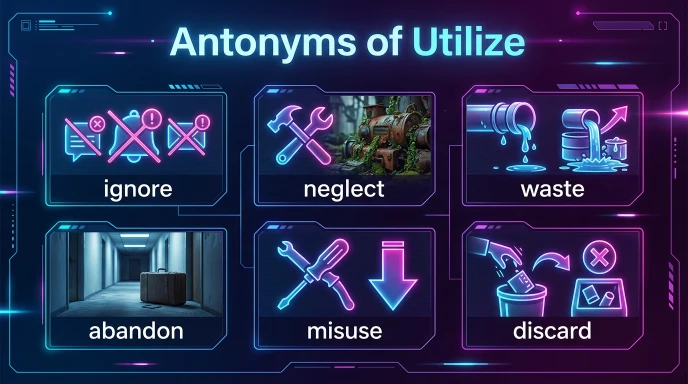
1. Waste (Verb)
Meaning: To use something carelessly or without gaining any benefit.
- He wasted his time instead of studying.
- The company wasted valuable resources.
2. Misuse (Verb)
Meaning: To use something in a wrong, harmful, or unsuitable way.
- People should not misuse technology.
- He misused company funds for personal needs.
3. Ignore (Verb)
Meaning: To fail to use or pay attention to something available.
- She ignored the opportunity to improve her skills.
- Many people ignore useful advice.
4. Neglect (Verb)
Meaning: To fail to give proper care, attention, or use to something.
- He neglected his talents for many years.
- The organization neglected available resources.
5. Abandon (Verb)
Meaning: To stop using or supporting something.
- They abandoned the old system.
- The project was abandoned after several problems.
6. Discard (Verb)
Meaning: To throw away or stop using something.
- Do not discard useful materials.
- The company discarded outdated equipment.
Short Questions and Answers
What does Utilize mean?
- Utilize means to use something effectively for a specific purpose. It often suggests making practical and useful use of available resources.
When should Utilize be used?
- Utilize should be used when you want to emphasize effective or purposeful use. It is common in formal writing, academic texts, business communication, and technical contexts.
- In everyday conversation, the simpler word use is often more natural.
Is Utilize positive or negative?
- Utilize is usually a neutral word.
- It can have a positive meaning when it shows efficiency, creativity, or smart use of resources.
- It may sound negative when it suggests using people or things only for personal benefit.
How is Utilize different from similar words?
- Use: A general word for using something.
- Example: I use a computer every day.
- Utilize: A more formal word that highlights effective or practical use.
- Example: The company utilized new technology to improve production.
- Employ: Often refers to using a method, tool, or person for a purpose.
- Example: The teacher employed a new teaching method.
- Exploit: Can mean using something fully, but it may also suggest unfair use.
- Example: The company exploited natural resources.
- Apply: Usually refers to using knowledge, skills, or rules in practice.
- Example: She applied her experience to solve the problem.
Conclusion
Learning the meaning of utilize and its synonyms helps English learners build a stronger vocabulary and communicate with greater accuracy.
Different synonyms express different ideas, such as simple use, efficient use, careful management, or practical application.
Choosing the right word makes writing clearer and more professional. For content writers, using varied vocabulary reduces repetition and improves the quality of articles, blogs, and reports.
For speakers, these words increase confidence and make conversations more effective. Regular vocabulary practice, reading, and using new words in daily sentences can help learners remember them naturally.
Understanding words like utilize is a useful step toward better English skills.
Explore more about!
- 30 Best Synonyms for Thrive to Elevate Your Vocabulary
- Synonyms for You: Formal, Casual & Creative Alternatives
- Synonyms for Challenging :Boost Your Vocabulary Instantly

I am a linguist with 17 years of experience in English language teaching, including postgraduate-level instruction. My expertise includes English grammar, and I contribute as a content and blog writer, producing scholarly and educational language resources.