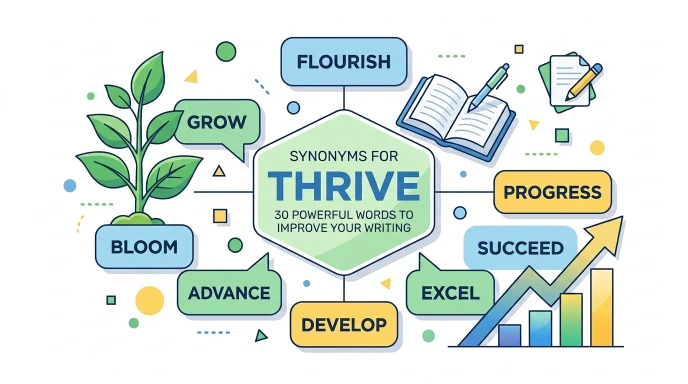
“Thrive” means to grow, succeed, or flourish successfully in a particular situation. Using the same word repeatedly in your writing can make it feel dull, which is why exploring synonyms adds variety and depth.
There are 30 powerful synonyms for “thrive” that writers, students, and professionals can use. Words like flourish, prosper, and blossom carry similar meanings but bring unique tone and emotion to your sentences.
Choosing the right synonym depends on context , formal, casual, or motivational writing all require different word choices. For example, “prosper” fits business content, while “blossom” suits personal growth topics.
This guide covers 30 handpicked alternatives to “thrive,” complete with meanings and usage examples. If you’re writing an essay, blog post, or resume, these words will help you sound more confident and expressive.
By the end of this article, you’ll have a rich vocabulary list ready to use anywhere.
Meaning of Thrive
Definition
Thrive (Verb):
To grow strongly, stay healthy, or become successful in a good environment.
Examples
- Children thrive when they receive love and support.
- Small businesses can thrive with good planning and hard work.
Connotative Meaning
(Connotation: the emotional or cultural feeling that a word suggests beyond its dictionary meaning.)
- Positive tone: Shows success, health, growth, prosperity, and progress.
- Negative tone: Rarely negative, but it may describe something harmful becoming stronger, such as “The disease thrived in warm weather.”
- Neutral tone: Simply means to grow or develop well without expressing strong emotion.
Etymology
- Source language: Old Norse
- Original word: þrífast
- Original meaning: To grasp firmly, prosper, flourish, or grow strong.
Short History of the Keyword
- Old English (450–1100):
The exact word thrive was not common in Old English. Similar ideas of growing and prospering were expressed using native English verbs. - Middle English (1100–1500):
The word entered English from Old Norse as thriven or thryve, meaning to prosper or grow successfully. - Modern English (1500–Present):
Thrive became a common verb used for people, animals, plants, businesses, and communities that grow, succeed, or remain healthy.
Pronunciation (US & UK – IPA)
US: /θraɪv/
UK: /θraɪv/
Syllables
thrive
(One syllable)
Affixation Pattern of Thrive
Root: thrive
Prefix: None
Suffix: None
Word Formation of Thrive
Words formed from thrive include:
- thrives (Verb – third person singular)
- thrived (Verb – past tense)
- thriven (Verb – past participle, less common)
- thriving (Adjective / Present Participle)
- thrivingly (Adverb – rare)
- thriver (Noun – a person or thing that thrives)
- well-thriving (Adjective)
- fast-thriving (Adjective)
These related forms help express different grammatical functions while keeping the central meaning of growth, success, and good health.
Synonyms of Thrive
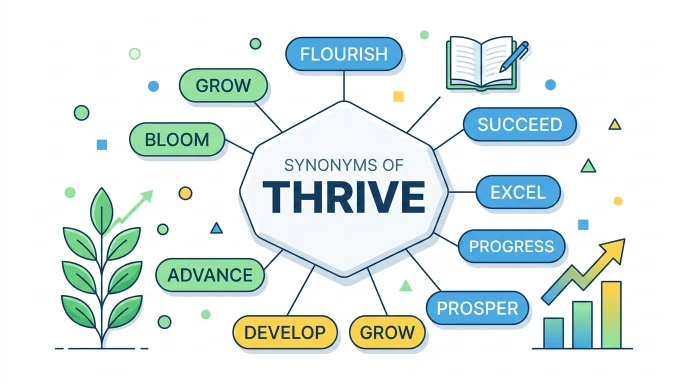
1. Flourish (Verb)
US: /ˈflɝːɪʃ/ | UK: /ˈflʌrɪʃ/
Meaning: To grow well, become successful, and develop strongly.
Examples:
- The flowers flourish in warm weather.
- Her business continues to flourish every year.
2. Prosper (Verb)
US: /ˈprɑːspər/ | UK: /ˈprɒspə/
Meaning: To become successful, especially in money or business.
Examples:
- The company prospered after launching a new product.
- Farmers prosper when the harvest is good.
3. Bloom (Verb)
US: /bluːm/ | UK: /bluːm/
Meaning: To grow well or become healthy and successful.
Examples:
- The garden blooms every spring.
- She bloomed after moving to a new school.
4. Blossom (Verb)
US: /ˈblɑːsəm/ | UK: /ˈblɒsəm/
Meaning: To develop into something successful or beautiful.
Examples:
- Their friendship blossomed over time.
- Young artists blossom with encouragement.
5. Grow (Verb)
US: /ɡroʊ/ | UK: /ɡrəʊ/
Meaning: To become larger, stronger, or more developed.
Examples:
- Plants grow quickly in rich soil.
- The business grew faster than expected.
6. Develop (Verb)
US: /dɪˈveləp/ | UK: /dɪˈveləp/
Meaning: To improve, expand, or become more advanced.
Examples:
- Children develop new skills every day.
- The town developed into a busy city.
7. Progress (Verb)
US: /prəˈɡres/ | UK: /prəˈɡres/
Meaning: To move forward or improve over time.
Examples:
- She progressed quickly in her English class.
- The project progressed smoothly.
8. Advance (Verb)
US: /ədˈvæns/ | UK: /ədˈvɑːns/
Meaning: To move forward or improve in position or quality.
Examples:
- Technology advances every year.
- He advanced in his career through hard work.
9. Succeed (Verb)
US: /səkˈsiːd/ | UK: /səkˈsiːd/
Meaning: To achieve a desired goal or result.
Examples:
- She succeeded because she never gave up.
- Hard-working students usually succeed.
10. Excel (Verb)
US: /ɪkˈsel/ | UK: /ɪkˈsel/
Meaning: To perform extremely well or be better than others.
Examples:
- He excels in mathematics.
- The team excelled in the championship.
11. Succeed (Verb)
US: /səkˈsiːd/ | UK: /səkˈsiːd/
Meaning: To achieve a goal or get a good result.
Examples:
- She succeeded in becoming a skilled writer.
- Students succeed when they practice regularly.
12. Achieve (Verb)
US: /əˈtʃiːv/ | UK: /əˈtʃiːv/
Meaning: To successfully reach a goal through effort.
Examples:
- He achieved his dream of starting a business.
- You can achieve great results with dedication.
13. Improve (Verb)
US: /ɪmˈpruːv/ | UK: /ɪmˈpruːv/
Meaning: To become better in quality, skill, or condition.
Examples:
- Her English improved after daily practice.
- Exercise can improve your health.
14. Strengthen (Verb)
US: /ˈstreŋθən/ | UK: /ˈstreŋθən/
Meaning: To make something stronger or more powerful.
Examples:
- Good habits strengthen the mind and body.
- The team strengthened its position in the competition.
15. Expand (Verb)
US: /ɪkˈspænd/ | UK: /ɪkˈspænd/
Meaning: To become larger or increase in size.
Examples:
- The company expanded into new markets.
- Her knowledge expanded through reading.
16. Increase (Verb)
US: /ɪnˈkriːs/ | UK: /ɪnˈkriːs/
Meaning: To become greater in amount, size, or value.
Examples:
- The population increased over the years.
- Regular training increased his confidence.
17. Multiply (Verb)
US: /ˈmʌltəˌplaɪ/ | UK: /ˈmʌltɪplaɪ/
Meaning: To grow in number or become much greater.
Examples:
- The plants multiplied quickly in the garden.
- Good ideas multiply when people share them.
18. Evolve (Verb)
US: /ɪˈvɑːlv/ | UK: /ɪˈvɒlv/
Meaning: To develop gradually into a better or different form.
Examples:
- Languages evolve over time.
- The company evolved into a global brand.
19. Mature (Verb)
US: /məˈtʃʊr/ | UK: /məˈtʃʊə/
Meaning: To grow and become more developed or responsible.
Examples:
- Children mature as they gain experience.
- His leadership skills matured with time.
20. Strengthen (Verb)
US: /ˈstreŋθən/ | UK: /ˈstreŋθən/
Meaning: To become stronger, healthier, or more effective.
Examples:
- Regular exercise strengthens the body.
- The relationship strengthened after their teamwork.
21. Survive (Verb)
US: /sərˈvaɪv/ | UK: /səˈvaɪv/
Meaning: To continue living or existing despite difficulties.
Examples:
- Some plants survive in dry climates.
- The small business survived a difficult year.
22. Live (Verb)
US: /lɪv/ | UK: /lɪv/
Meaning: To remain alive and experience life.
Examples:
- People live better with healthy habits.
- Animals live well in safe environments.
23. Maintain (Verb)
US: /meɪnˈteɪn/ | UK: /meɪnˈteɪn/
Meaning: To keep something in a good condition.
Examples:
- She maintains a healthy lifestyle.
- Regular care helps plants maintain their growth.
24. Strengthen (Verb)
US: /ˈstreŋθən/ | UK: /ˈstreŋθən/
Meaning: To make something stronger or more successful.
Examples:
- Reading strengthens your language skills.
- Good teamwork strengthens an organization.
25. Renew (Verb)
US: /rɪˈnuː/ | UK: /rɪˈnjuː/
Meaning: To make something fresh, active, or strong again.
Examples:
- A holiday helped renew her energy.
- The project was renewed with new ideas.
26. Revive (Verb)
US: /rɪˈvaɪv/ | UK: /rɪˈvaɪv/
Meaning: To bring something back to life, activity, or strength.
Examples:
- Rain revived the dry plants.
- The team revived its chances of winning.
27. Rejuvenate (Verb)
US: /rɪˈdʒuːvəˌneɪt/ | UK: /rɪˈdʒuːvəneɪt/
Meaning: To make someone or something feel young, fresh, or energetic again.
Examples:
- Exercise can rejuvenate your body.
- The garden was rejuvenated after careful work.
28. Boom (Verb)
US: /buːm/ | UK: /buːm/
Meaning: To grow quickly and become very successful.
Examples:
- The technology industry is booming.
- Tourism boomed after the new airport opened.
29. Prosperous (Adjective)
US: /ˈprɑːspərəs/ | UK: /ˈprɒspərəs/
Meaning: Successful, wealthy, or growing well.
Examples:
- They built a prosperous company.
- The town became prosperous through trade.
30. Healthy (Adjective)
US: /ˈhelθi/ | UK: /ˈhelθi/
Meaning: Being in good physical, mental, or successful condition.
Examples:
- A healthy plant can grow quickly.
- A healthy business continues to improve.
Prototype Meaning
The prototype meaning of thrive is to grow strongly and become successful in a suitable environment.
When people hear the word thrive, they often imagine a healthy plant growing, a person achieving goals, or a business becoming successful
. The central idea is positive growth, improvement, and progress.
Prototype Categorization
Synonyms of thrive can be grouped into different categories. These groups help writers select the most accurate word for different situations.
- Growth and Development Words:
Grow, develop, evolve, mature, expand
These words describe gradual improvement and change. - Success and Achievement Words:
Succeed, achieve, excel, prosper, boom
These words focus on reaching goals and gaining success. - Health and Strength Words:
Flourish, bloom, revive, rejuvenate, strengthen, maintain
These words describe physical or emotional well-being. - Survival Words:
Survive, live
These words focus on continuing despite challenges. - Business and Economy Words:
Prosper, prosperous, boom, expand
These words are often used for companies, industries, and communities.
Understanding these categories helps writers avoid repetition and choose words that match the exact meaning, emotion, and situation.
Antonyms of Thrive
- Fail (Verb): To be unsuccessful or not achieve a goal.
- Decline (Verb): To become weaker, smaller, or less successful.
- Deteriorate (Verb): To become worse in condition or quality.
- Struggle (Verb): To face difficulty in making progress.
- Shrink (Verb): To become smaller in size or amount.
- Wither (Verb): To become weak, dry, or unhealthy.
- Suffer (Verb): To experience pain, damage, or difficulty.
- Collapse (Verb): To fall down or stop working successfully.
Short Questions and Answers
- What does “thrive” mean?
Answer: Thrive means to grow, develop, and become successful or healthy. - When should “thrive” be used?
Answer: Use thrive when describing strong growth, success, or good development in people, plants, businesses, or communities. - Is “thrive” positive or negative?
Answer: Thrive is usually positive because it suggests success, improvement, and good health. - How is it different from similar words?
Answer: Thrive is a broad word for successful growth, while words like excel focus on outstanding performance and survive focuses only on continuing to exist.
Conclusion
Learning the word thrive and its synonyms can greatly improve English vocabulary and communication skills. These words help learners describe growth, success, health, and progress with more accuracy.
Using different synonyms makes writing stronger, avoids repetition, and helps speakers express ideas clearly
. Understanding the meaning, pronunciation, history, and emotional tone of these words allows English learners to choose the right word for each situation
.if writing an article, speaking in a conversation, or preparing professional content, a rich vocabulary creates confidence and clarity. Regular vocabulary practice with words like thrive helps learners become better readers, writers, and speakers.
Read more about!
- Synonyms for Struggle: 30 Powerful Words
- Synonyms for Vibe:30 Powerful Words to Improve Your Vocabulary

I am an American author, and I write books about power, strategy, and human behavior. My writing style is simple but deep, and I try to explain how people think and act in real-life situations.
I studied classical studies, and before becoming a writer, I worked in different fields which helped me understand people and life better.
My most famous books include The 48 Laws of Power, The Art of Seduction, and Mastery. These books are widely read by business people, leaders, and students around the world.