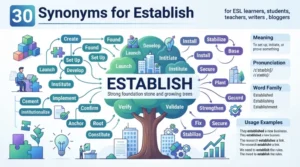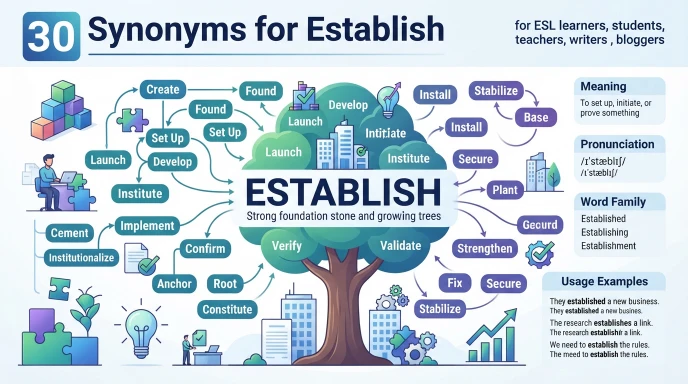
Establish means to create, build, set up, or make something firm and successful. Imagine that Sara starts a small bakery in her town. She works hard every day, gains customers, and turns her idea into a trusted business. In this situation, she has successfully established her bakery.
The word establish is common in daily English, business writing, education, law, and professional communication. Learning its synonyms helps English learners and content writers express ideas more clearly and avoid repeating the same word.
In this article, you will learn the meaning of establish, its pronunciation, history, etymology, connotative meanings, word formation patterns, and powerful synonyms with examples. You will also explore semantic categories and practical usage to improve your English vocabulary.
Meaning of Establish
Definition
Establish (Verb):
To create, start, prove, or make something strong, accepted, or permanent.
Examples
- The company plans to establish a new office in London.
- Scientists worked hard to establish the cause of the disease.
Connotative Meaning
(Connotation: the emotional or cultural feeling that a word carries beyond its dictionary meaning.)
- Positive tone: Building success, creating stability, gaining trust, achieving growth.
- Negative tone: Can sometimes suggest control, authority, or dominance.
- Neutral tone: Simply starting, creating, proving, or organizing something.
Etymology
- Origin: Old French establir
- Source Language: Latin stabilire
- Original Meaning: “to make firm, stable, or secure”
- Related Latin Root: stabilis meaning “stable” or “steady”
Short History of the Keyword
Old English (450–1100)
- The exact word establish was not commonly used.
- Similar ideas were expressed through native words meaning “set” or “make firm.”
Middle English (1100–1500)
- The word entered English through Old French.
- It was used to describe making laws, institutions, and agreements permanent.
Modern English (1500–Present)
- The meaning expanded to include creating businesses, organizations, systems, facts, and relationships.
- Today it is widely used in everyday and professional English.
Pronunciation (US & UK – IPA)
US: /ɪˈstæblɪʃ/
UK: /ɪˈstæblɪʃ/
Syllables
es-tab-lish
Affixation Pattern of Establish
Root:
- stabl (stable, firm)
Prefix:
- e- / ex- (historical Latin form)
Suffix:
- -ish
Word Formation of Establish
- Establish (Verb) – to create or set up
- Established (Adjective) – recognized and successful
- Established (Verb, Past Tense)
- Establishing (Verb, Present Participle)
- Establishment (Noun) – an institution or organization
- Reestablish (Verb) – to establish again
- Reestablishment (Noun) – the act of establishing again
- Disestablish (Verb) – to remove official status
- Disestablishment (Noun) – removal of official status
Synonyms of Establish
1. Create (Verb)
US: /kriˈeɪt/ | UK: /kriˈeɪt/
Meaning: To bring something new into existence.
Examples:
- She wants to create a new website.
- The artist created a beautiful painting.
2. Found (Verb)
US: /faʊnd/ | UK: /faʊnd/
Meaning: To start an organization, company, or institution.
Examples:
- They founded the school in 1990.
- She hopes to found a charity one day.
3. Form (Verb)
US: /fɔːrm/ | UK: /fɔːm/
Meaning: To make or organize something.
Examples:
- Students formed a study group.
- Clouds formed in the sky.
4. Build (Verb)
US: /bɪld/ | UK: /bɪld/
Meaning: To construct or develop something gradually.
Examples:
- They built a strong business.
- We need to build trust with customers.
5. Set Up (Verb)
US: /set ʌp/ | UK: /set ʌp/
Meaning: To arrange or start something.
Examples:
- She set up a new account.
- The company set up an office overseas.
6. Organize (Verb)
US: /ˈɔːrɡənaɪz/ | UK: /ˈɔːɡənaɪz/
Meaning: To arrange things into a proper structure.
Examples:
- They organized a fundraising event.
- Please organize the documents.
7. Institute (Verb)
US: /ˈɪnstɪtuːt/ | UK: /ˈɪnstɪtjuːt/
Meaning: To officially introduce a system or rule.
Examples:
- The school instituted new policies.
- The government instituted reforms.
8. Launch (Verb)
US: /lɔːntʃ/ | UK: /lɔːntʃ/
Meaning: To begin or introduce something publicly.
Examples:
- The company launched a new product.
- They launched a marketing campaign.
9. Develop (Verb)
US: /dɪˈveləp/ | UK: /dɪˈveləp/
Meaning: To grow or improve something over time.
Examples:
- She developed a useful app.
- The city developed rapidly.
10. Initiate (Verb)
US: /ɪˈnɪʃieɪt/ | UK: /ɪˈnɪʃieɪt/
Meaning: To begin a process or activity.
Examples:
- The manager initiated the project.
- They initiated discussions with investors.
11. Start (Verb)
US: /stɑːrt/ | UK: /stɑːt/
Meaning: To begin something.
Examples:
- They started a new business last year.
- She started learning French.
12. Begin (Verb)
US: /bɪˈɡɪn/ | UK: /bɪˈɡɪn/
Meaning: To make something happen from the first stage.
Examples:
- The meeting will begin at noon.
- He began a new career.
13. Construct (Verb)
US: /kənˈstrʌkt/ | UK: /kənˈstrʌkt/
Meaning: To build or create something carefully.
Examples:
- Workers constructed a bridge.
- The team constructed a detailed plan.
14. Produce (Verb)
US: /prəˈduːs/ | UK: /prəˈdjuːs/
Meaning: To make or create something.
Examples:
- The factory produces cars.
- The writer produced many articles.
15. Generate (Verb)
US: /ˈdʒenəreɪt/ | UK: /ˈdʒenəreɪt/
Meaning: To create or cause something to exist.
Examples:
- Solar panels generate electricity.
- The campaign generated interest.
16. Install (Verb)
US: /ɪnˈstɔːl/ | UK: /ɪnˈstɔːl/
Meaning: To place or set something into operation.
Examples:
- They installed new software.
- The company installed security systems.
17. Introduce (Verb)
US: /ˌɪntrəˈduːs/ | UK: /ˌɪntrəˈdjuːs/
Meaning: To bring something into use for the first time.
Examples:
- The company introduced a new service.
- The teacher introduced a new topic.
18. Implement (Verb)
US: /ˈɪmpləment/ | UK: /ˈɪmplɪment/
Meaning: To put a plan or system into action.
Examples:
- The school implemented new rules.
- They implemented the strategy successfully.
19. Constitute (Verb)
US: /ˈkɑːnstɪtuːt/ | UK: /ˈkɒnstɪtjuːt/
Meaning: To form or make up something.
Examples:
- Twelve members constitute the committee.
- These factors constitute the main problem.
20. Secure (Verb)
US: /sɪˈkjʊr/ | UK: /sɪˈkjʊə/
Meaning: To make something safe, stable, or certain.
Examples:
- The agreement secured future cooperation.
- She secured funding for the project.
21. Confirm (Verb)
US: /kənˈfɜːrm/ | UK: /kənˈfɜːm/
Meaning: To prove that something is true or correct.
Examples:
- The test confirmed the results.
- Scientists confirmed the theory.
22. Verify (Verb)
US: /ˈverɪfaɪ/ | UK: /ˈverɪfaɪ/
Meaning: To check and prove accuracy.
Examples:
- Please verify your email address.
- The accountant verified the records.
23. Validate (Verb)
US: /ˈvælədeɪt/ | UK: /ˈvælɪdeɪt/
Meaning: To prove that something is acceptable or correct.
Examples:
- The research validated the claim.
- Experts validated the new method.
24. Cement (Verb)
US: /sɪˈment/ | UK: /sɪˈment/
Meaning: To make a relationship or position stronger.
Examples:
- The agreement cemented their partnership.
- Success cemented her reputation.
25. Strengthen (Verb)
US: /ˈstreŋθən/ | UK: /ˈstreŋθən/
Meaning: To make something stronger.
Examples:
- Exercise strengthens muscles.
- The policy strengthened security.
26. Fix (Verb)
US: /fɪks/ | UK: /fɪks/
Meaning: To set firmly in place.
Examples:
- They fixed the sign to the wall.
- The date was fixed for next week.
27. Anchor (Verb)
US: /ˈæŋkər/ | UK: /ˈæŋkə/
Meaning: To secure something firmly.
Examples:
- The boat was anchored near the shore.
- Strong values anchor a community.
28. Root (Verb)
US: /ruːt/ | UK: /ruːt/
Meaning: To place something firmly in a foundation.
Examples:
- The tradition is rooted in history.
- Their success is rooted in hard work.
29. Entrench (Verb)
US: /ɪnˈtrentʃ/ | UK: /ɪnˈtrentʃ/
Meaning: To establish something very firmly.
Examples:
- The practice became deeply entrenched.
- The law entrenched certain rights.
30. Institutionalize (Verb)
US: /ˌɪnstɪˈtuːʃənəlaɪz/ | UK: /ˌɪnstɪˈtjuːʃənəlaɪz/
Meaning: To make something an official part of a system.
Examples:
- The organization institutionalized the process.
- The policy was institutionalized nationwide.
Prototype Meaning
The most typical meaning of establish is to create or set up something so that it becomes stable, recognized, and lasting.
When people hear the word establish, they often imagine starting a business, organization, rule, relationship, or fact and making it secure over time.
Prototype Categorization
Categorizing synonyms helps writers choose the most accurate word for different situations.
- Starting Something: create, start, begin, launch, initiate, found
- Building and Developing: build, construct, develop, form
- Organizing and Setting Up: organize, institute, install, implement, set up
- Proving Something: establish, confirm, verify, validate
- Making Strong and Permanent: cement, strengthen, secure, anchor, entrench
- Official or Formal Creation: institutionalize, constitute, introduce
Choosing the correct category improves clarity, precision, and writing quality.
Antonyms of Establish
- Destroy (Verb) : to ruin or completely damage something.
- Dismantle (Verb) : to take apart a structure or system.
- Abolish (Verb) : to officially end a law or practice.
- Remove (Verb) : to take away from a place or position.
- Eliminate (Verb) : to get rid of completely.
- Disorganize (Verb) : to make something confused or unstructured.
- Disprove (Verb) : to show that something is false.
- Weaken (Verb) : to make something less strong.
- Terminate (Verb) : to bring something to an end.
- Disestablish (Verb) : to remove official status or support.
Short Questions and Answers
- What does establish mean?
Establish means to create, prove, organize, or make something stable and permanent. - When should establish be used?
Use establish when talking about starting organizations, creating systems, proving facts, or building strong foundations. - Is establish positive or negative?
It is usually positive or neutral. The tone depends on the context in which it is used. - How is it different from similar words?
Establish often implies creating something that lasts, while words like start or begin simply mean to initiate something.
Conclusion
Learning the word establish and its synonyms can greatly improve your English vocabulary. This word is useful in academic writing, business communication, everyday conversations, and professional settings.
Understanding related words such as create, found, implement, verify, and strengthen helps you express ideas more accurately and avoid repetition.
Knowing different synonyms also improves both writing and speaking skills because you can choose the best word for each situation.
In addition, understanding pronunciation, history, connotation, and word formation gives you a deeper understanding of English vocabulary. Make vocabulary practice a daily habit, and you will gradually become a more confident and effective English communicator.
Discover more!
- Synonyms for Vulnerable: Alternative Words & Meanings
- Synonyms for Nervous: Powerful Words to Use Instead
- Synonyms for Consequences: Alternative Words & Meanings

I am a linguist with 17 years of experience in English language teaching, including postgraduate-level instruction. My expertise includes English grammar, and I contribute as a content and blog writer, producing scholarly and educational language resources.