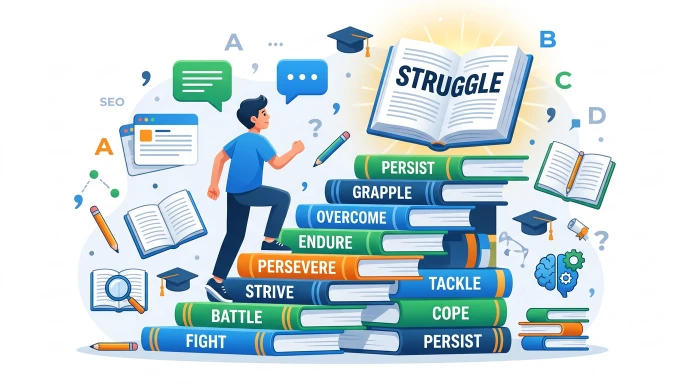
Learning new words helps you speak and write better. One common English word is struggle. People use this word every day to talk about difficult situations, hard work, or personal challenges. Imagine a student studying all night before an important exam. The lessons are difficult, but the student keeps trying. This is a perfect example of a struggle. Everyone faces struggles in life, if at school, work, or home.
The word struggle is common in conversations, books, news articles, and online writing. However, using the same word again and again can make your writing sound repetitive. Learning synonyms helps English learners express ideas more clearly and naturally. It also helps content writers improve writing quality, and vocabulary.
In this article, you will learn the meaning of struggle, its pronunciation, grammar, history, connotation, and 30 useful synonyms with simple meanings and examples.
Meaning of Struggle
Definition
Struggle (Verb, Noun):
To try very hard to do something difficult or to deal with a problem. It also means a difficult effort or fight against challenges.
Examples
- She struggles to wake up early every morning.
- Their family faced many struggles during difficult times.
Connotative Meaning
(Connotation means the emotional feeling or idea that a word suggests beyond its dictionary meaning.)
- Positive tone: Showing determination, courage, hard work, and persistence.
- Negative tone: Showing difficulty, pain, failure, stress, or suffering.
- Neutral tone: Simply describing effort or a difficult situation without emotion.
Etymology
- Source language: Latin
- Original word: strugulare
- Original meaning: To choke or struggle violently.
- The word later entered Italian and French before becoming part of English.
Short History of the Word
- Old English (450–1100): The modern word struggle did not exist. Similar ideas were expressed with words meaning fight or battle.
- Middle English (1100–1500): The word developed through Old French influences and began to describe physical fighting.
- Modern English (1500–Present): The meaning expanded to include emotional, mental, financial, academic, and personal difficulties.
Pronunciation (US & UK – IPA)
US: /ˈstrʌɡəl/
UK: /ˈstrʌɡəl/
Syllables
strug-gle
Affixation Pattern of Struggle
Root: struggle
Prefix: None
Suffix: None
Word Formation of Struggle
- struggle — noun
- struggle — verb
- struggling — adjective
- struggling — present participle
- struggled — past tense verb
- struggles — plural noun
- struggles — third-person singular verb
Synonyms of Struggle
1. Fight (Verb, Noun)
US: /faɪt/
UK: /faɪt/
Meaning: To try hard against someone or something.
Examples
- She fought for her dreams.
- We must fight against poverty.
2. Battle (Verb, Noun)
US: /ˈbætl/
UK: /ˈbætl/
Meaning: To face a difficult problem or challenge.
Examples
- He battled illness for many years.
- They battled strong winds during the trip.
3. Strive (Verb)
US: /straɪv/
UK: /straɪv/
Meaning: To work very hard to achieve something.
Examples
- Students should strive for success.
- She strives to become a better teacher.
4. Labor (Verb)
US: /ˈleɪbər/
UK: /ˈleɪbə/
Meaning: To work very hard, often for a long time.
Examples
- They labored all day in the field.
- She labored to finish the report.
5. Wrestle (Verb)
US: /ˈresəl/
UK: /ˈresəl/
Meaning: To deal with a difficult idea or problem.
Examples
- He wrestled with a hard decision.
- She wrestled with fear before speaking.
6. Endeavor (Verb, Noun)
US: /ɪnˈdevər/
UK: /ɪnˈdevə/
Meaning: To make a serious effort to achieve something.
Examples
- We endeavor to provide good service.
- Her endeavor inspired many people.
7. Toil (Verb, Noun)
US: /tɔɪl/
UK: /tɔɪl/
Meaning: To work very hard for a long time.
Examples
- Farmers toil every day.
- Years of toil brought success.
8. Persevere (Verb)
US: /ˌpɝːsəˈvɪr/
UK: /ˌpɜːsɪˈvɪə/
Meaning: To continue despite difficulties.
Examples
- She persevered through many challenges.
- Never stop; always persevere.
9. Persist (Verb)
US: /pərˈsɪst/
UK: /pəˈsɪst/
Meaning: To continue doing something despite problems.
Examples
- He persisted until he succeeded.
- The rain persisted all day.
10. Grapple (Verb)
US: /ˈɡræpəl/
UK: /ˈɡræpəl/
Meaning: To try hard to understand or solve a difficult problem.
Examples
- Scientists grapple with climate issues.
- She grappled with a difficult question.
11. Cope (Verb)
US: /koʊp/
UK: /kəʊp/
Meaning: To deal successfully with a difficult situation.
Examples
- She learned to cope with stress.
- Many families cope with rising costs.
12. Endure (Verb)
US: /ɪnˈdʊr/
UK: /ɪnˈdjʊə/
Meaning: To suffer or experience something difficult with patience.
Examples
- They endured a long winter.
- She endured many hardships before finding success.
13. Overcome (Verb)
US: /ˌoʊvərˈkʌm/
UK: /ˌəʊvəˈkʌm/
Meaning: To successfully defeat or solve a problem.
Examples
- He overcame his fear of public speaking.
- We can overcome every challenge with effort.
14. Confront (Verb)
US: /kənˈfrʌnt/
UK: /kənˈfrʌnt/
Meaning: To face a difficult situation or problem directly.
Examples
- She confronted her fears.
- The company must confront financial problems.
15. Tackle (Verb)
US: /ˈtækəl/
UK: /ˈtækəl/
Meaning: To begin dealing with a difficult task or problem.
Examples
- We need to tackle pollution.
- He tackled the project with confidence.
16. Challenge (Verb, Noun)
US: /ˈtʃælɪndʒ/
UK: /ˈtʃælɪndʒ/
Meaning: To test someone’s ability or present a difficult task.
Examples
- The new job challenged her skills.
- Learning a language is an exciting challenge.
17. Compete (Verb)
US: /kəmˈpiːt/
UK: /kəmˈpiːt/
Meaning: To try to win against others.
Examples
- Athletes compete in the championship.
- Many companies compete for customers.
18. Resist (Verb)
US: /rɪˈzɪst/
UK: /rɪˈzɪst/
Meaning: To refuse to accept or give in to something.
Examples
- She resisted the temptation.
- Plants can resist harsh weather.
19. Survive (Verb)
US: /sərˈvaɪv/
UK: /səˈvaɪv/
Meaning: To stay alive or continue despite great difficulty.
Examples
- The hikers survived the storm.
- Small businesses struggled to survive.
20. Press On (Phrasal Verb)
US: /pres ɑːn/
UK: /pres ɒn/
Meaning: To continue moving forward despite difficulties.
Examples
- They pressed on after the heavy rain.
- She pressed on even when she felt tired.
21. Suffer (Verb)
US: /ˈsʌfər/
UK: /ˈsʌfə/
Meaning: To experience pain, hardship, or difficulty.
Examples
- She suffered from a serious illness.
- Many people suffered during the storm.
22. Stress (Verb)
US: /stres/
UK: /stres/
Meaning: To experience mental or emotional pressure.
Examples
- Students often stress before exams.
- Try not to stress over small problems.
23. Agonize (Verb)
US: /ˈæɡənaɪz/
UK: /ˈæɡənaɪz/
Meaning: To worry deeply or suffer greatly over something.
Examples
- She agonized over her decision.
- He agonized about the interview result.
24. Fret (Verb)
US: /fret/
UK: /fret/
Meaning: To worry continuously about something.
Examples
- Don’t fret about small mistakes.
- Parents often fret about their children.
25. Hustle (Verb)
US: /ˈhʌsəl/
UK: /ˈhʌsəl/
Meaning: To work very hard and energetically.
Examples
- Young entrepreneurs hustle every day.
- She hustled to meet the deadline.
26. Push (Verb)
US: /pʊʃ/
UK: /pʊʃ/
Meaning: To force yourself to continue despite difficulty.
Examples
- Push yourself to improve.
- They pushed through the hard times.
27. Work Hard (Verb Phrase)
US: /wɝːk hɑːrd/
UK: /wɜːk hɑːd/
Meaning: To put in great effort to achieve something.
Examples
- She works hard every day.
- Success comes to those who work hard.
28. Make an Effort (Verb Phrase)
US: /meɪk ən ˈefərt/
UK: /meɪk ən ˈefət/
Meaning: To try seriously to do something.
Examples
- Please make an effort to improve.
- He made an effort to arrive early.
29. Strain (Verb, Noun)
US: /streɪn/
UK: /streɪn/
Meaning: To use great effort or energy.
Examples
- Don’t strain your eyes.
- They strained to lift the heavy box.
30. Sweat (Verb)
US: /swet/
UK: /swet/
Meaning: To work very hard, especially with physical or mental effort.
Examples
- She sweated over the final project.
- We sweated to finish the work on time.
Prototype Meaning
The most common meaning of struggle is trying very hard to overcome a difficult problem, obstacle, or challenge. When people hear the word, they usually imagine someone working hard, facing setbacks, and refusing to give up. A struggle may be physical, emotional, financial, academic, or professional. Although struggles are difficult, they often lead to learning, growth, and success.
Prototype Categorization
Grouping synonyms into categories helps writers choose the most accurate word for different situations.
- Fighting against problems: fight, battle, wrestle, grapple, confront, resist.
- Working hard: toil, labor, hustle, work hard, make an effort.
- Continuing despite difficulty: persevere, persist, endure, press on, push.
- Solving or defeating challenges: overcome, tackle, cope.
- Experiencing hardship: suffer, agonize, fret, strain, stress.
- Achieving goals: strive, endeavor, compete.
Choosing synonyms by category makes writing clearer, more natural, and more precise.
Antonyms of Struggle
- Succeed (Verb): To achieve a desired goal.
- Win (Verb): To gain victory or success.
- Triumph (Verb/Noun): To achieve great success after difficulty.
- Prosper (Verb): To grow successfully or do well.
- Thrive (Verb): To grow strongly and successfully.
- Excel (Verb): To perform extremely well.
- Accomplish (Verb): To complete something successfully.
- Achieve (Verb): To reach a goal through effort.
- Flourish (Verb): To develop successfully.
- Master (Verb): To become highly skilled at something.
Short Questions and Answers
- What does struggle mean?
It means to try very hard to deal with a difficult problem or achieve a goal. - When should struggle be used?
Use it when talking about challenges, hard work, or difficult situations in life, school, work, or relationships. - Is struggle positive or negative?
It can be positive because it shows determination, or negative because it describes hardship. The meaning depends on the context. - How is it different from similar words?
Struggle is a general word for facing difficulties. Words like strive focus on effort, battle suggests conflict, endure emphasizes patience, and overcome highlights successful victory over a problem.
Conclusion
Learning the word struggle and its synonyms is an excellent way to improve your English vocabulary. Instead of repeating the same word, you can choose the synonym that best matches your meaning and context. This makes your writing more interesting, natural, and professional. Understanding pronunciation, history, grammar, connotation, and different categories of synonyms also helps you communicate more accurately. If you are an English learner, student, teacher, blogger, or content writer, expanding your vocabulary strengthens both speaking and writing skills. Practice using one or two new synonyms every day in conversations and sentences. Over time, your confidence, fluency, and word choice will improve, making your English clearer and more expressive.
Read more about!
Synonyms for Get: 30 Powerful Words to Improve Your Vocabulary
Synonyms for Environment: 30 Powerful Words

I am an American writer and speaker who focuses on habits, productivity, and self-improvement.
I study how small daily habits can create big changes in life. I try to write in a very simple and practical way so anyone can apply my ideas.
My most popular book is Atomic Habits, which is read around the world.