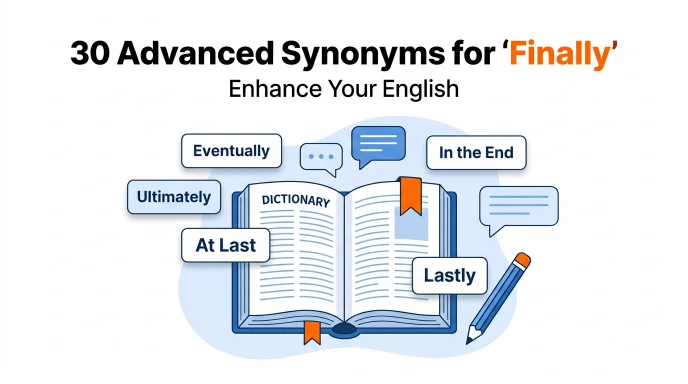
Discover 30 advanced synonyms for “finally” to enhance your English vocabulary and make your writing and speaking more natural, fluent, and impactful.
The word finally is one of the most common words in English. It means at the end, after a long time, or after many delays. People use this word every day in conversations, writing, stories, speeches, and academic work.
Imagine you are waiting for a job interview result for several weeks. Every day you check your email, hoping for good news. One morning, you open your inbox and see the message you have been waiting for.
You smile and say, “I finally got the job!” This simple sentence expresses relief, happiness, and the end of a long wait.
The word finally is useful because it clearly tells readers and listeners that something has reached its ending. However, using the same word repeatedly can make writing sound repetitive.
Learning synonyms helps English learners speak more naturally, improve their writing skills, and express different shades of meaning. It also helps bloggers, students, teachers, and content writers create more engaging content.
In this article, you will learn the meaning of finally, its pronunciation, grammar, history, connotative meaning, word formation, and semantic use. You will also discover 30 powerful synonyms with meanings, pronunciations, and examples.
Finally, you will explore prototype meaning, synonym categories, antonyms, frequently asked questions, and practical tips to improve your English vocabulary.
Meaning of Finally
Definition
Finally (Adverb):
Finally means at the end of a process, after a long time, or after all other events have happened. It can also introduce the last point in a list or discussion.
Examples
- We finally reached the airport after a long drive.
- She finally finished reading the novel before the deadline.
Connotative Meaning
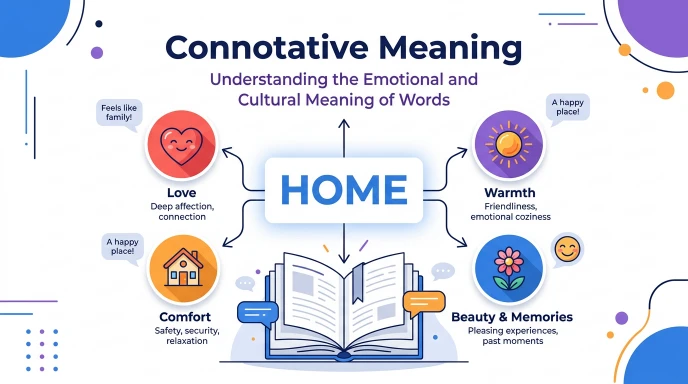
(Connotation is the emotional feeling or idea that a word suggests beyond its dictionary meaning.)
- Positive tone: Shows success, achievement, relief, happiness, or satisfaction after waiting.
- Negative tone: May express frustration, exhaustion, or annoyance because something took too long.
- Neutral tone: Simply indicates the last event or final step without showing strong emotion.
Etymology
- Source language: Latin
- Latin word: finalis
- Original meaning: “Relating to the end” or “last.”
- The word passed into English through Old French, where it developed into final, and later the adverb finally was formed by adding the suffix -ly.
Short History of the Keyword
Old English (450–1100)
The exact word finally was not used during Old English. People used phrases such as at the end or lastly to express similar meanings.
Middle English (1100–1500)
After the Norman Conquest, many French and Latin words entered English. During this period, the adjective final became common, laying the foundation for the later adverb finally.
Modern English (1500–Present)
By the Early Modern English period, finally became a standard English adverb. Today, it is widely used in everyday conversation, academic writing, journalism, literature, business communication, and digital content.
Pronunciation (US & UK – IPA)
US: /ˈfaɪ.nə.li/
UK: /ˈfaɪ.nəl.i/
Syllables
fi-nal-ly
(3 syllables)
Affixation Pattern of Finally
Root:
- final
Prefix:
- None
Suffix:
- -ly (forms an adverb from an adjective)
Word Formation of Finally
Words formed from the same root include:
- Final (Adjective) – coming at the end.
- Finally (Adverb) – at the end or after a long time.
- Finalize (Verb) – to complete or finish something.
- Finalized (Verb – Past Tense/Past Participle) – completed.
- Finalizing (Verb – Present Participle/Gerund) – completing.
- Finalization (Noun) – the process of completing something.
- Finality (Noun) – the condition of being final or permanent.
- Finale (Noun) – the last part of a performance, event, or series
30 synonyms for finally
1. ### At Last (Adverb)
US: /ət ˈlæst/ | UK: /ət ˈlɑːst/
Meaning: After a long wait or delay.
Examples:
- The train arrived at last after two hours.
- She smiled at last when she heard the good news.
2. ### Eventually (Adverb)
US: /ɪˈven.tʃu.ə.li/ | UK: /ɪˈven.tʃu.ə.li/
Meaning: In the end, after some time or effort.
Examples:
- He eventually found his lost wallet.
- The company eventually solved the problem.
3. ### In the End (Adverbial Phrase)
US: /ɪn ði ˈend/ | UK: /ɪn ði ˈend/
Meaning: After everything has happened.
Examples:
- In the end, we chose the blue car.
- They won the match in the end.
4. ### Ultimately (Adverb)
US: /ˈʌl.tə.mət.li/ | UK: /ˈʌl.tɪ.mət.li/
Meaning: After considering everything; as the final result.
Examples:
- Ultimately, the manager approved the plan.
- Your success ultimately depends on hard work.
5. ### Lastly (Adverb)
US: /ˈlæst.li/ | UK: /ˈlɑːst.li/
Meaning: As the final point in a list or discussion.
Examples:
- Lastly, remember to save your work.
- Lastly, thank everyone for their support.
6. ### At the End (Adverbial Phrase)
US: /ət ði ˈend/ | UK: /ət ði ˈend/
Meaning: At the final part or stage of something.
Examples:
- We met our teacher at the end of the class.
- There was a surprise at the end of the movie.
7. ### In Conclusion (Adverbial Phrase)
US: /ɪn kənˈkluːʒən/ | UK: /ɪn kənˈkluːʒən/
Meaning: Used to introduce the final statement or summary.
Examples:
- In conclusion, exercise improves your health.
- In conclusion, the project was successful.
8. ### At Length (Adverbial Phrase)
US: /ət ˈleŋθ/ | UK: /ət ˈleŋθ/
Meaning: After a long period of time.
Examples:
- They reached an agreement at length.
- At length, the rain stopped.
9. ### Afterward (Adverb)
US: /ˈæf.tɚ.wɚd/ | UK: /ˈɑːf.tə.wəd/
Meaning: After a particular event or time.
Examples:
- We had dinner and afterward watched a movie.
- She called me afterward to say thanks.
10. ### Thereafter (Adverb)
US: /ˌðerˈæf.tɚ/ | UK: /ˌðeərˈɑːf.tə/
Meaning: After that time or event.
Examples:
- He graduated in 2024 and worked abroad thereafter.
- The rule changed, and thereafter everyone followed it.
11. ### In Time (Adverbial Phrase)
US: /ɪn ˈtaɪm/ | UK: /ɪn ˈtaɪm/
Meaning: Before it is too late or after waiting long enough.
Examples:
- We arrived in time for the meeting.
- She completed the report in time for submission.
12. ### Sooner or Later (Adverbial Phrase)
US: /ˌsuː.nɚ ɔːr ˈleɪ.t̬ɚ/ | UK: /ˌsuː.nə ɔː ˈleɪ.tə/
Meaning: At some time in the future, even if it takes a while.
Examples:
- Sooner or later, everyone learns from mistakes.
- He knew the truth would come out sooner or later.
13. ### In Due Course (Adverbial Phrase)
US: /ɪn ˌduː ˈkɔːrs/ | UK: /ɪn ˌdjuː ˈkɔːs/
Meaning: At the proper or expected time.
Examples:
- Your application will be reviewed in due course.
- The results will be announced in due course.
14. ### One Day (Adverbial Phrase)
US: /wʌn ˈdeɪ/ | UK: /wʌn ˈdeɪ/
Meaning: At some time in the future.
Examples:
- One day, she hopes to become a doctor.
- We will visit Japan one day.
15. ### By and By (Adverbial Phrase)
US: /ˌbaɪ ən ˈbaɪ/ | UK: /ˌbaɪ ən ˈbaɪ/
Meaning: Before long or after some time. (Old-fashioned)
Examples:
- By and by, the sky became clear.
- Everything will improve by and by.
16. ### At Long Last (Adverbial Phrase)
US: /ət ˌlɔːŋ ˈlæst/ | UK: /ət ˌlɒŋ ˈlɑːst/
Meaning: After a very long wait.
Examples:
- At long last, the bridge was completed.
- She arrived at long last after the heavy traffic.
17. ### As a Final Point (Adverbial Phrase)
US: /æz ə ˈfaɪ.nəl pɔɪnt/ | UK: /æz ə ˈfaɪ.nəl pɔɪnt/
Meaning: Used to introduce the last idea in a discussion.
Examples:
- As a final point, always check your work.
- As a final point, thank your audience.
18. ### In Closing (Adverbial Phrase)
US: /ɪn ˈkloʊ.zɪŋ/ | UK: /ɪn ˈkləʊ.zɪŋ/
Meaning: Used when ending a speech, article, or presentation.
Examples:
- In closing, I appreciate your support.
- In closing, let us remember our goals.
19. ### To Conclude (Verb Phrase)
US: /tə kənˈkluːd/ | UK: /tə kənˈkluːd/
Meaning: Used to introduce the final statement or summary.
Examples:
- To conclude, teamwork leads to better results.
- To conclude, education changes lives.
20. ### At the Close (Adverbial Phrase)
US: /ət ðə ˈkloʊz/ | UK: /ət ðə ˈkləʊz/
Meaning: At the end of an event, meeting, or period.
Examples:
- At the close of the ceremony, everyone applauded.
- The winners were announced at the close of the event.
21. ### At the Last Moment (Adverbial Phrase)
US: /ət ðə ˈlæst ˈmoʊ.mənt/ | UK: /ət ðə lɑːst ˈməʊ.mənt/
Meaning: Just before the end or before it is too late.
Examples:
- We booked the tickets at the last moment.
- She changed her decision at the last moment.
22. ### As the Final Step (Adverbial Phrase)
US: /æz ðə ˈfaɪ.nəl step/ | UK: /æz ðə ˈfaɪ.nəl step/
Meaning: Used to describe the last action in a process.
Examples:
- As the final step, click the submit button.
- Add fresh herbs as the final step.
23. ### To Finish (Verb Phrase)
US: /tə ˈfɪn.ɪʃ/ | UK: /tə ˈfɪn.ɪʃ/
Meaning: Used to introduce the last idea or action.
Examples:
- To finish, I would like to thank everyone.
- To finish, review your answers carefully.
24. ### At the Conclusion (Adverbial Phrase)
US: /ət ðə ˌkɑːn.kluːˈʒən/ | UK: /ət ðə ˌkɒn.kluːˈʒən/
Meaning: At the ending of an event, report, or process.
Examples:
- At the conclusion of the meeting, everyone agreed.
- The awards were presented at the conclusion of the ceremony.
25. ### Endingly (Adverb)
US: /ˈen.dɪŋ.li/ | UK: /ˈen.dɪŋ.li/
Meaning: In a manner that brings something to an end. (Rarely used)
Examples:
- The story ended endingly with hope.
- The speaker concluded endingly with a short message.
Note: Endingly is extremely uncommon in modern English. It is included mainly for vocabulary study rather than everyday use.
26. ### In the Final Analysis (Adverbial Phrase)
US: /ɪn ðə ˈfaɪ.nəl əˈnæl.ə.sɪs/ | UK: /ɪn ðə ˈfaɪ.nəl əˈnæl.ə.sɪs/
Meaning: After considering every fact; ultimately.
Examples:
- In the final analysis, honesty is the best policy.
- In the final analysis, hard work brings success.
27. ### After All (Adverbial Phrase)
US: /ˌæf.tɚ ˈɔːl/ | UK: /ˌɑːf.tər ˈɔːl/
Meaning: When everything has been considered or when the outcome becomes clear.
Examples:
- After all, everyone makes mistakes.
- He decided to join us after all.
Note: After all is not always a direct synonym of finally. Its meaning often depends on the context.
28. ### At the End of the Day (Idiomatic Phrase)
US: /ət ði ˌend əv ðə ˈdeɪ/ | UK: /ət ði ˌend əv ðə ˈdeɪ/
Meaning: When everything is considered; ultimately.
Examples:
- At the end of the day, family comes first.
- At the end of the day, the choice is yours.
29. ### Conclusively (Adverb)
US: /kənˈkluː.sɪv.li/ | UK: /kənˈkluː.sɪv.li/
Meaning: In a way that settles something completely or reaches a final decision.
Examples:
- The evidence conclusively proved his innocence.
- Scientists have not conclusively answered the question.
30. ### Terminally (Adverb)
US: /ˈtɝː.mə.nəl.i/ | UK: /ˈtɜː.mɪ.nəl.i/
Meaning: In a way that relates to the final stage or end.
Examples:
- The project was terminally delayed.
- The system became terminally damaged.
Note: Terminally is not a common synonym for finally in everyday English. It usually refers to the final stage of a process, condition, or illness rather than simply meaning “at last.”
Important Note for and Accuracy
Not every word listed above is a perfect one-word synonym of finally. Some are adverbial phrases, transitional expressions, or contextual alternatives. English writers choose different alternatives depending on if they are:
- describing the end of a process,
- expressing relief after waiting,
- concluding an essay or speech,
- or emphasizing the final result.
This variety helps you avoid repetition while keeping your writing natural and accurate.
Prototype Meaning
The most typical meaning of finally is “after a long time or at the end of a process.” When people hear the word finally, they usually imagine waiting for something important to happen and then reaching the desired result
. It often expresses relief, success, completion, or the end of a journey, task, or difficult situation. For example, when someone says, “I finally finished my project,” listeners understand that the project took time and effort before it was completed.
Prototype Categorization
Grouping synonyms into categories helps writers choose the most suitable word for different situations. Instead of using finally every time, you can select a synonym that better matches the context and tone.
- Showing the end after waiting: At last, Eventually, At long last, In the end
- Showing the final result: Ultimately, In the final analysis, At the end of the day
- Ending speeches or writing: Lastly, In conclusion, In closing, To conclude, To finish
- Ending a process or event: At the end, At the close, At the conclusion, As the final step
- Showing future completion: One day, Sooner or later, In due course, By and by
- Showing what happens next: Afterward, Thereafter
Choosing the right category makes your writing more precise, natural, and engaging. It also helps avoid repeating the same word and improves the overall quality of your English.
Antonyms of Finally
- Initially (Adverb): At the beginning of something.
- Firstly (Adverb): Used to introduce the first point in a list.
- Originally (Adverb): At the earliest stage or in the beginning.
- At first (Adverbial Phrase): During the initial stage.
- Early (Adverb/Adjective): Before the expected or usual time.
- Prematurely (Adverb): Before the proper or expected time.
- Immediately (Adverb): Without delay.
- Instantly (Adverb): At once; without waiting.
Short Questions and Answers
- What does “finally” mean?
Answer: Finally means at the end, after a long time, or after many delays. - When should “finally” be used?
Answer: Use finally when something happens after waiting, effort, or when you want to introduce the last step, event, or point. - Is “finally” positive or negative?
Answer: It depends on the context. It is often positive because it shows success or relief. It can also be negative if it expresses frustration after a long delay. In many cases, it is neutral, simply indicating the end of something. - How is “finally” different from similar words?
Answer: Finally often emphasizes the end after waiting or delay. Ultimately focuses on the final result or conclusion. Lastly is mainly used to introduce the last point in a list or speech, while eventually emphasizes that something happened after some time.
Conclusion
Learning the word finally and its synonyms is an excellent way to improve your English vocabulary. Instead of repeating the same word, you can choose alternatives such as eventually, ultimately, at last, or in the end to match different situations and writing styles. This makes your speaking sound more natural and your writing more interesting and professional.
Understanding the meaning, pronunciation, history, connotation, grammar, and usage of finally also helps you communicate with greater confidence. If you are a student, teacher, blogger, or content writer, expanding your vocabulary strengthens your language skills and improves writing. Make it a habit to learn and practice new words every day. Small improvements in vocabulary can lead to big improvements in communication and overall English fluency.
Read more about!
Synonyms for Vibe:30 Powerful Words to Improve Your Vocabulary
Synonyms for Desire : 30 Powerful Words

I am an American author, and I write books about power, strategy, and human behavior. My writing style is simple but deep, and I try to explain how people think and act in real-life situations.
I studied classical studies, and before becoming a writer, I worked in different fields which helped me understand people and life better.
My most famous books include The 48 Laws of Power, The Art of Seduction, and Mastery. These books are widely read by business people, leaders, and students around the world.