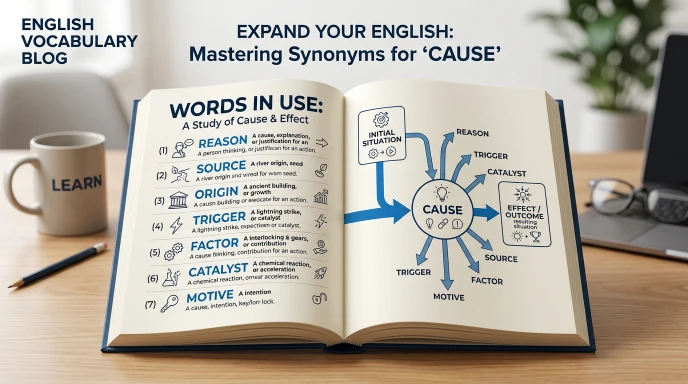
Looking for the best synonyms for cause? Words like reason, source, origin, motive, and trigger are some of the most powerful alternatives, depending on your tone and context.If you’re writing formally, casually, or academically, choosing the right word instead of “cause” can make your writing more precise and impactful.
The English language offers many ways to express the idea of “cause” from formal terms like catalyst and origin, to everyday words like reason and factor, and even action-driven alternatives like trigger and spark.
Understanding these synonyms for cause is especially useful for writers, students, researchers, and professionals who want to avoid repetition and express ideas with greater clarity and variety.
In this guide, we’ll explore formal, casual, academic, and cause-effect based alternatives complete with real examples so you can confidently pick the perfect word for any situation or context.
Meaning of Cause
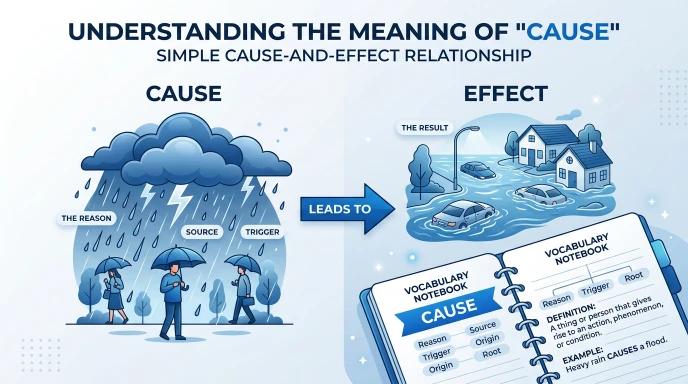
Definition
Cause (Noun, Verb):
- Noun: A person, thing, or event that makes something happen.
- Verb: To make something happen.
Examples
- Heavy rain was the cause of the flood.
- Smoking can cause serious health problems.
Connotative Meaning
(Connotation: the emotional or cultural feeling that a word suggests beyond its basic dictionary meaning.)
- Positive tone: Can describe something that produces a good result, such as a cause of happiness or success.
- Negative tone: Often refers to something that creates problems, illness, or damage.
- Neutral tone: Commonly used to explain the reason for an event without showing emotion.
Etymology
- Source language: Latin
- Original word: causa
- Original meaning: Reason, legal case, or motive.
- The word entered English through Old French cause.
Short History of the Keyword
- Old English (450–1100): Native English mostly used words meaning “reason” rather than cause.
- Middle English (1100–1500): Cause entered English from Old French after the Norman Conquest.
- Modern English (1500–Present): The word became widely used to mean both “reason” and “make something happen.”
Pronunciation (US & UK – IPA)
US: /kɔːz/
UK: /kɔːz/
Syllables
cause
(One syllable)
Affixation Pattern of Cause
Root: cause
Prefix: None
Suffix: None
Word Formation of the Keyword
- cause (noun)
- cause (verb)
- caused (verb)
- causing (verb)
- causal (adjective)
- causally (adverb)
- causation (noun)
- causative (adjective)
- causality (noun)
Synonyms of Cause
1. Reason (Noun)
US: /ˈriːzən/
UK: /ˈriːzən/
Meaning: The explanation for why something happens.
Examples
- The reason for the delay was heavy traffic.
- Nobody knows the reason for the mistake.
2. Source (Noun)
US: /sɔːrs/
UK: /sɔːs/
Meaning: The place or thing from which something begins.
Examples
- Scientists found the source of the infection.
- The river is the main source of fresh water.
3. Origin (Noun)
US: /ˈɔːrɪdʒɪn/
UK: /ˈɒrɪdʒɪn/
Meaning: The starting point or beginning of something.
Examples
- The origin of the fire is still unknown.
- Researchers studied the origin of the disease.
4. Root (Noun)
US: /ruːt/
UK: /ruːt/
Meaning: The basic or main cause of a problem or situation.
Examples
- Stress is the root of many health problems.
- We must find the root of the issue.
5. Basis (Noun)
US: /ˈbeɪsɪs/
UK: /ˈbeɪsɪs/
Meaning: The main idea or reason on which something depends.
Examples
- Trust is the basis of friendship.
- Facts should be the basis of every decision.
6. Motive (Noun)
US: /ˈmoʊtɪv/
UK: /ˈməʊtɪv/
Meaning: The reason why a person does something.
Examples
- Police searched for the motive behind the crime.
- His motive was to help others.
7. Trigger (Noun)
US: /ˈtrɪɡər/
UK: /ˈtrɪɡə/
Meaning: Something that starts or causes an event.
Examples
- Dust can be a trigger for allergies.
- One comment became the trigger for the argument.
8. Catalyst (Noun)
US: /ˈkætəlɪst/
UK: /ˈkætəlɪst/
Meaning: Something that causes change or speeds it up.
Examples
- The meeting became a catalyst for new ideas.
- Education is a catalyst for social change.
9. Factor (Noun)
US: /ˈfæktər/
UK: /ˈfæktə/
Meaning: One of several things that influence a result.
Examples
- Weather was an important factor in the game.
- Cost is a major factor when buying a house.
10. Influence (Noun)
US: /ˈɪnfluəns/
UK: /ˈɪnfluəns/
Meaning: The power to affect or change something.
Examples
- Parents have a strong influence on children.
- Social media has a big influence on modern life.
11. Agent (Noun)
US: /ˈeɪdʒənt/
UK: /ˈeɪdʒənt/
Meaning: A person, force, or thing that causes a change or produces an effect.
Examples
- Water is an agent of erosion.
- The virus is the agent that caused the disease.
12. Determinant (Noun)
US: /dɪˈtɜːrmɪnənt/
UK: /dɪˈtɜːmɪnənt/
Meaning: A factor that decides or strongly influences an outcome.
Examples
- Education is a key determinant of success.
- Age is an important determinant of health risks.
13. Impetus (Noun)
US: /ˈɪmpətəs/
UK: /ˈɪmpɪtəs/
Meaning: Something that gives force or encourages an action.
Examples
- The award gave her the impetus to work harder.
- The new law provided the impetus for change.
14. Stimulus (Noun)
US: /ˈstɪmjələs/
UK: /ˈstɪmjələs/
Meaning: Something that causes a reaction or encourages activity.
Examples
- Warm sunlight is a stimulus for plant growth.
- The teacher’s praise was a stimulus for learning.
15. Incentive (Noun)
US: /ɪnˈsentɪv/
UK: /ɪnˈsentɪv/
Meaning: Something that motivates a person to act.
Examples
- The bonus was an incentive to work harder.
- Free training is a good incentive for employees.
16. Occasion (Noun)
US: /əˈkeɪʒən/
UK: /əˈkeɪʒən/
Meaning: An event or situation that gives a reason for something to happen.
Examples
- The festival was the occasion for celebration.
- His visit became the occasion for a family reunion.
17. Ground (Noun)
US: /ɡraʊnd/
UK: /ɡraʊnd/
Meaning: A reason or basis for an action or belief.
Examples
- She had good grounds for her complaint.
- There is no ground for your fear.
18. Explanation (Noun)
US: /ˌekspləˈneɪʃən/
UK: /ˌekspləˈneɪʃən/
Meaning: A statement that tells why something happened.
Examples
- The manager gave an explanation for the delay.
- We need an explanation before making a decision.
19. Provocation (Noun)
US: /ˌprɑːvəˈkeɪʃən/
UK: /ˌprɒvəˈkeɪʃən/
Meaning: An action or event that causes a strong reaction, especially anger.
Examples
- His rude words were a provocation.
- The attack happened without provocation.
20. Occasioning (Verb)
US: /əˈkeɪʒənɪŋ/
UK: /əˈkeɪʒənɪŋ/
Meaning: Causing or bringing about something.
Examples
- The heavy rain was occasioning flooding in the area.
- Poor planning is occasioning unnecessary delays.
21. Producer (Noun)
US: /prəˈduːsər/
UK: /prəˈdjuːsə/
Meaning: A person or thing that creates or brings about something.
Examples
- The factory is a major producer of steel.
- The bacteria are the producer of the harmful toxin.
22. Generator (Noun)
US: /ˈdʒenəreɪtər/
UK: /ˈdʒenəreɪtə/
Meaning: Something that produces or causes energy, power, or another result.
Examples
- The machine is a generator of electricity.
- Exercise is a generator of positive energy.
23. Creator (Noun)
US: /kriˈeɪtər/
UK: /kriˈeɪtə/
Meaning: A person or thing that makes something exist.
Examples
- She is the creator of the new app.
- The artist is the creator of the painting.
24. Maker (Noun)
US: /ˈmeɪkər/
UK: /ˈmeɪkə/
Meaning: A person or thing that produces or causes something.
Examples
- Good habits are the maker of success.
- He is the maker of this beautiful table.
25. Instigator (Noun)
US: /ˈɪnstɪɡeɪtər/
UK: /ˈɪnstɪɡeɪtə/
Meaning: A person who starts or causes an event, especially trouble.
Examples
- The police arrested the instigator of the fight.
- He was the instigator of the protest.
26. Spark (Noun)
US: /spɑːrk/
UK: /spɑːk/
Meaning: A small event or idea that starts something bigger.
Examples
- Her speech was the spark for change.
- One question became the spark for a long discussion.
27. Seed (Noun)
US: /siːd/
UK: /siːd/
Meaning: The beginning or starting point of an idea or event.
Examples
- That meeting planted the seed of success.
- Curiosity is the seed of learning.
28. Foundation (Noun)
US: /faʊnˈdeɪʃən/
UK: /faʊnˈdeɪʃən/
Meaning: The basic reason or support on which something develops.
Examples
- Trust is the foundation of friendship.
- Hard work is the foundation of success.
29. Spring (Noun)
US: /sprɪŋ/
UK: /sprɪŋ/
Meaning: The original source or beginning of something.
Examples
- Kindness is the spring of true friendship.
- The mountain is the spring of the river.
30. Means (Noun)
US: /miːnz/
UK: /miːnz/
Meaning: A method or way that causes a result or helps achieve it.
Examples
- Education is a means of improving life.
- Exercise is a means to better health.
Casual Synonyms for Cause
| Word | Example |
|---|---|
| Reason | What’s the reason for this change? |
| Why | Do you know why it happened? |
| Thing behind it | What is the thing behind this problem? |
| Trigger | That message triggered the reaction. |
Prototype Meaning
The prototype meaning of cause is the reason something happens or the thing that makes an event occur.
When people hear the word cause, they usually imagine one event leading to another.
For example, heavy rain causes floods, poor sleep causes tiredness, and regular exercise causes better health. The word is commonly used to explain why something happens.
Prototype Categorization
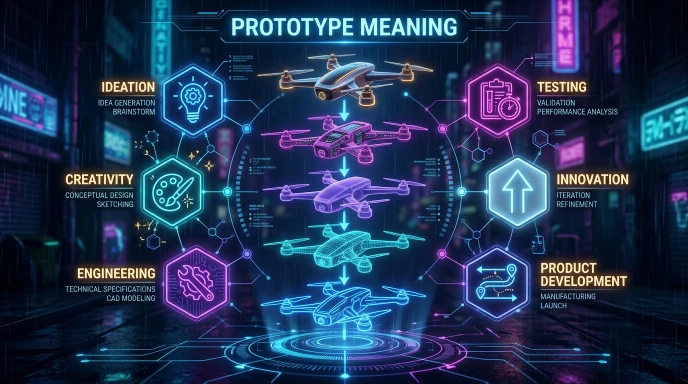
Grouping synonyms into categories helps learners understand their meanings and choose the most suitable word for different situations.
- Reasons and explanations: reason, explanation, ground, basis, motive
- Starting points: origin, source, root, seed, spring
- Forces that create change: catalyst, trigger, spark, stimulus, impetus
- People or things that produce results: agent, producer, creator, maker, generator
- Influencing factors: factor, determinant, influence, incentive, means
- Actions that start events: instigator, provocation, occasion, occasioning, foundation
These categories help writers avoid repetition and choose words that best match the context.
Formal Synonyms for Cause
| Word | Example |
|---|---|
| Basis | The basis of the decision was research. |
| Factor | Several factors caused the change. |
| Source | The source of the issue was identified. |
| Motivation | Her motivation was personal growth. |
| Justification | He provided justification for his actions. |
Antonyms of Cause
- Effect (Noun): The result produced by a cause.
- Result (Noun): The outcome of an action or event.
- Outcome (Noun): The final result of a situation.
- Consequence (Noun): Something that happens because of an action.
- Product (Noun): Something created or produced by a process.
- Reaction (Noun): A response to an action or event.
- End (Noun): The final point or conclusion.
- Resolution (Noun): The solution or ending of a problem.
- Completion (Noun): The state of being finished.
- Achievement (Noun): A successful result.
Short Questions and Answers
- What does cause mean?
Cause means the reason why something happens or the thing that makes an event happen. - When should cause be used?
Use cause when explaining why something happened or what produced a result. - Is cause positive or negative?
It is generally neutral. It can describe good results, such as a cause of success, or bad results, such as a cause of illness. - How is it different from similar words?
Cause is a general word. Reason explains why something happened, trigger starts an event suddenly, catalyst speeds up change, origin refers to the beginning, and motive explains why a person acts.
Conclusion
Learning the word cause and its synonyms helps you communicate more clearly in English. Instead of repeating cause, you can use words such as reason, source, origin, trigger, catalyst, or factor to match different situations.
Understanding each synonym’s meaning, pronunciation, history, grammar, and usage makes your writing and speaking more accurate and engaging.
A richer vocabulary also helps students, professionals, bloggers, and content writers create stronger sentences and avoid repetition.
Practice using one new synonym every day in conversations or writing. Over time, you will build confidence, improve your English skills, and express your ideas with greater precision.
Explore more about!
- Synonyms for Ability: 30 Powerful Words to Know
- Synonyms for Exciting 30 Powerful Words to Improve
- Synonyms for Grow: 30+ Best Words to Use in English

I am a linguist with 17 years of experience in English language teaching, including postgraduate-level instruction. My expertise includes English grammar, and I contribute as a content and blog writer, producing scholarly and educational language resources.