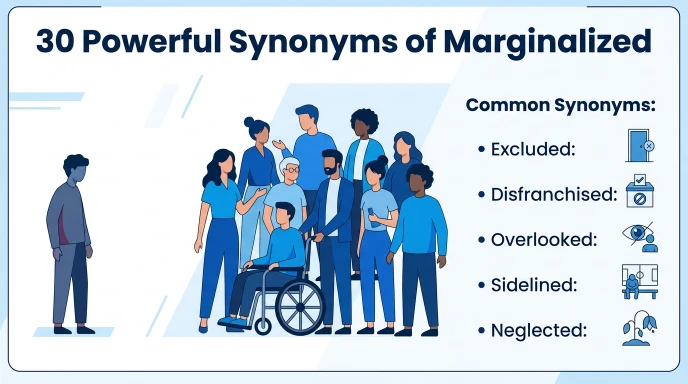
“Marginalized means excluded, disadvantaged, or pushed to the edge of society; synonyms include underprivileged, oppressed, neglected, and overlooked”
The word marginalized means being pushed to the edge of society and having less power, attention, or opportunity than others.
Imagine a student in a classroom whose ideas are never heard and who is often left out of group activities. That student may feel marginalized because they are not treated as an equal part of the group.
The word is commonly used in discussions about society, education, human rights, and fairness. Learning synonyms for marginalized helps English learners, students, and content writers express ideas more clearly and choose words with the right emotional meaning.
This article explains the meaning, grammar, pronunciation, history, and synonyms of marginalized with simple examples and useful vocabulary categories.
Meaning of Marginalized
Definition
Marginalized (Adjective / Verb – past participle):
Describes a person or group that is treated as less important, excluded, or given fewer chances in society.
Examples
- Many marginalized communities work hard to gain equal opportunities.
- The new program supports marginalized students.
Connotative Meaning
(Connotation: the emotional or cultural feeling connected to a word beyond its basic dictionary meaning.)
- Positive tone: Can suggest awareness, support, inclusion, and efforts to create fairness.
- Negative tone: Can suggest unfair treatment, exclusion, discrimination, or lack of power.
- Neutral tone: Can simply describe a group or person with limited social, economic, or political influence.
Etymology
- Source language: Latin through French and English.
- Root word: margin (from Latin margo, meaning “edge” or “border”).
- Original meaning: To place something at the edge or outside the main area.
Short History of the Keyword
- Old English (450–1100):
The exact word marginalized was not used in Old English. Similar ideas were expressed through words related to being outside, separated, or excluded. - Middle English (1100–1500):
English borrowed many French and Latin words. The root margin became connected with borders, edges, and outer spaces. - Modern English (1500–Present):
The word marginalize developed in the 20th century as a social and political term. Marginalized became widely used to describe people or groups who experience exclusion or reduced opportunities.
Pronunciation (US & UK – IPA)
US: /ˈmɑːrdʒɪnəˌlaɪzd/
UK: /ˈmɑːdʒɪnəlaɪzd/
Syllables
mar-gin-al-ized
(4 syllables)
Affixation Pattern of Marginalized
Root: margin
(meaning: edge or border)
Prefix: None
Suffix:
- -al → creates an adjective (marginal = related to the margin)
- -ize → creates a verb (marginalize = to treat as less important)
- -ed → shows past action or condition (marginalized = treated as less important)
Word Formation of Marginalized
Words formed from marginalized include:
- Margin (Noun): the edge or border of something.
- Marginal (Adjective): related to an edge or considered less important.
- Marginalize (Verb): to push someone or something to a lower position.
- Marginalization (Noun): the process of excluding or limiting people.
- Marginalized (Adjective): describing people who experience exclusion.
- Marginally (Adverb): slightly or to a small degree.
These forms show how the root word changes into different grammatical categories while keeping the main idea of being at the edge.
Synonyms of Marginalized
1. Excluded (Adjective)
US: /ɪkˈskluːdɪd/ | UK: /ɪkˈskluːdɪd/
Meaning: Not allowed to join, participate, or be included.
Examples:
- Some students feel excluded from school activities.
- The group was excluded from important discussions.
2. Ignored (Adjective)
US: /ɪɡˈnɔːrd/ | UK: /ɪɡˈnɔːd/
Meaning: Not noticed, considered, or given attention.
Examples:
- Her ideas were ignored during the meeting.
- Many important issues are ignored by society.
3. Overlooked (Adjective)
US: /ˌoʊvərˈlʊkt/ | UK: /ˌəʊvəˈlʊkt/
Meaning: Not given enough attention or consideration.
Examples:
- Small communities are often overlooked.
- His talent was overlooked for many years.
4. Neglected (Adjective)
US: /nɪˈɡlektɪd/ | UK: /nɪˈɡlektɪd/
Meaning: Not cared for or given proper attention.
Examples:
- The neglected area needed better services.
- The old building was neglected for decades.
5. Disadvantaged (Adjective)
US: /ˌdɪsədˈvæntɪdʒd/ | UK: /ˌdɪsədˈvɑːntɪdʒd/
Meaning: Having fewer advantages or opportunities than others.
Examples:
- The program helps disadvantaged children.
- Disadvantaged families often need extra support.
6. Underprivileged (Adjective)
US: /ˌʌndərˈprɪvəlɪdʒd/ | UK: /ˌʌndəˈprɪvəlɪdʒd/
Meaning: Having fewer social, economic, or educational opportunities.
Examples:
- The charity provides education for underprivileged children.
- Many underprivileged communities lack basic resources.
7. Oppressed (Adjective)
US: /əˈprest/ | UK: /əˈprest/
Meaning: Treated unfairly and controlled by a more powerful group.
Examples:
- The oppressed people fought for their rights.
- History shows many oppressed groups seeking freedom.
8. Discriminated (Adjective)
US: /dɪˈskrɪməˌneɪtɪd/ | UK: /dɪˈskrɪmɪneɪtɪd/
Meaning: Treated unfairly because of identity or personal characteristics.
Examples:
- Some workers were discriminated against because of their background.
- No one should be discriminated against at work.
9. Isolated (Adjective)
US: /ˈaɪsəˌleɪtɪd/ | UK: /ˈaɪsəleɪtɪd/
Meaning: Separated from others or left alone.
Examples:
- The remote village felt isolated from the city.
- Some elderly people become socially isolated.
10. Alienated (Adjective)
US: /ˈeɪliəˌneɪtɪd/ | UK: /ˈeɪliəneɪtɪd/
Meaning: Feeling separated, unwanted, or disconnected from others.
Examples:
- He felt alienated in his new community.
- Many young people feel alienated when they are not understood.
11. Disenfranchised (Adjective)
US: /ˌdɪsɪnˈfræntʃaɪzd/ | UK: /ˌdɪsɪnˈfræntʃaɪzd/
Meaning: Deprived of rights, power, or opportunities to participate.
Examples:
- The organization supports disenfranchised communities.
- Many disenfranchised people work for equal rights.
12. Powerless (Adjective)
US: /ˈpaʊərləs/ | UK: /ˈpaʊələs/
Meaning: Having little or no control, influence, or authority.
Examples:
- The powerless group struggled to make its voice heard.
- Many people feel powerless without proper support.
13. Voiceless (Adjective)
US: /ˈvɔɪsləs/ | UK: /ˈvɔɪsləs/
Meaning: Without the ability or opportunity to express opinions.
Examples:
- The campaign gives a voice to voiceless communities.
- Many voiceless people need support and representation.
14. Forgotten (Adjective)
US: /fərˈɡɑːtən/ | UK: /fəˈɡɒtən/
Meaning: Not remembered, noticed, or cared about.
Examples:
- Forgotten communities often need more attention.
- The old village was forgotten by many people.
15. Disregarded (Adjective)
US: /ˌdɪsrɪˈɡɑːrdɪd/ | UK: /ˌdɪsrɪˈɡɑːdɪd/
Meaning: Treated as unimportant or not considered.
Examples:
- Their concerns were disregarded by leaders.
- Important warnings should not be disregarded.
16. Unrecognized (Adjective)
US: /ˌʌnˈrekəɡnaɪzd/ | UK: /ˌʌnˈrekəɡnaɪzd/
Meaning: Not accepted, noticed, or officially acknowledged.
Examples:
- Her efforts remained unrecognized for years.
- Many workers have unrecognized skills.
17. Undervalued (Adjective)
US: /ˌʌndərˈvæljuːd/ | UK: /ˌʌndəˈvæljuːd/
Meaning: Not given enough importance, respect, or worth.
Examples:
- Care workers are often undervalued.
- His contribution was undervalued by the team.
18. Disempowered (Adjective)
US: /ˌdɪsɪmˈpaʊərd/ | UK: /ˌdɪsɪmˈpaʊəd/
Meaning: Made weaker by losing power, confidence, or control.
Examples:
- The unfair system left many people disempowered.
- Education can help disempowered groups gain confidence.
19. Subordinate (Adjective)
US: /səˈbɔːrdənət/ | UK: /səˈbɔːdɪnət/
Meaning: Having a lower position, rank, or importance.
Examples:
- The group was treated as subordinate by society.
- A subordinate role can limit decision-making power.
20. Inferior (Adjective)
US: /ɪnˈfɪriər/ | UK: /ɪnˈfɪəriə/
Meaning: Considered lower in value, status, or importance.
Examples:
- No person should be treated as inferior.
- Old beliefs sometimes made certain groups seem inferior.
21. Displaced (Adjective)
US: /dɪsˈpleɪst/ | UK: /dɪsˈpleɪst/
Meaning: Forced to leave a place or position.
Examples:
- Many displaced families need safe housing.
- The conflict created thousands of displaced people.
22. Excluded (Adjective)
US: /ɪkˈskluːdɪd/ | UK: /ɪkˈskluːdɪd/
Meaning: Left out from a group, activity, or opportunity.
Examples:
- No one should feel excluded from society.
- The policy helped include previously excluded groups.
23. Deprived (Adjective)
US: /dɪˈpraɪvd/ | UK: /dɪˈpraɪvd/
Meaning: Lacking basic needs, rights, or advantages.
Examples:
- Deprived communities often need more resources.
- Some children are deprived of quality education.
24. Disregarded (Adjective)
US: /ˌdɪsrɪˈɡɑːrdɪd/ | UK: /ˌdɪsrɪˈɡɑːdɪd/
Meaning: Ignored or treated as unimportant.
Examples:
- Their opinions were disregarded during the decision.
- Important voices should never be disregarded.
25. Marginal (Adjective)
US: /ˈmɑːrdʒɪnəl/ | UK: /ˈmɑːdʒɪnəl/
Meaning: Existing at the edge or having limited importance.
Examples:
- The group had only marginal influence in society.
- Marginal communities often need greater support.
26. Peripheral (Adjective)
US: /pəˈrɪfərəl/ | UK: /pəˈrɪfərəl/
Meaning: Located away from the center or main area.
Examples:
- Peripheral communities may receive fewer services.
- His role was peripheral in the project.
27. Outcast (Noun/Adjective)
US: /ˈaʊtˌkæst/ | UK: /ˈaʊtkɑːst/
Meaning: A person who is rejected or not accepted by a group.
Examples:
- He felt like an outcast at school.
- Society should support people who feel like outcasts.
28. Rejected (Adjective)
US: /rɪˈdʒektɪd/ | UK: /rɪˈdʒektɪd/
Meaning: Not accepted, approved, or welcomed.
Examples:
- The rejected group searched for a new community.
- She felt rejected after being ignored.
29. Discriminated (Adjective)
US: /dɪˈskrɪməˌneɪtɪd/ | UK: /dɪˈskrɪmɪneɪtɪd/
Meaning: Treated unfairly because of personal identity or background.
Examples:
- People should not be discriminated against because of their beliefs.
- Many groups have been discriminated against throughout history.
30. Marginalized (Adjective)
US: /ˈmɑːrdʒɪnəˌlaɪzd/ | UK: /ˈmɑːdʒɪnəlaɪzd/
Meaning: Pushed aside and given fewer opportunities or less influence.
Examples:
- The organization supports marginalized communities.
- Marginalized voices deserve attention and respect.
Prototype Meaning
The prototype meaning of marginalized is being pushed away from the center of society and having fewer chances, rights, or opportunities.
When people hear this word, they often imagine groups or individuals who are ignored, excluded, or treated unfairly.
The word usually connects with ideas of social inequality, lack of power, and the need for inclusion.
Prototype Categorization
Synonyms of marginalized can be grouped into different categories
. These categories help writers choose the most suitable word based on the situation and emotional meaning.
- Exclusion and Separation Words:
Excluded, isolated, rejected, outcast, displaced
These words focus on being separated from groups or society. - Lack of Power and Rights Words:
Powerless, voiceless, disenfranchised, disempowered
These words describe people who have limited influence or control. - Lack of Opportunity Words:
Disadvantaged, underprivileged, deprived, undervalued
These words focus on fewer resources, chances, or support. - Unfair Treatment Words:
Oppressed, discriminated, disregarded, ignored
These words describe harmful actions or unfair social conditions. - Social Position Words:
Marginal, peripheral, subordinate, inferior
These words describe a lower position or less importance.
Understanding these groups helps writers avoid repetition and select words that match the exact meaning, emotion, and context.
Antonyms of Marginalized
- Included (Adjective): Accepted as part of a group or activity.
- Empowered (Adjective): Given confidence, power, or ability to act.
- Respected (Adjective): Treated with honor and value.
- Accepted (Adjective): Welcomed and recognized by others.
- Privileged (Adjective): Having special advantages or opportunities.
- Supported (Adjective): Given help, care, or encouragement.
- Integrated (Adjective): Fully included in a community or system.
- Recognized (Adjective): Noticed and accepted as important.
Short Questions and Answers
- What does “marginalized” mean?
Answer: Marginalized means being excluded, ignored, or given fewer opportunities and less power. - When should “marginalized” be used?
Answer: Use marginalized when discussing people or groups who experience social, economic, or political exclusion. - Is “marginalized” positive or negative?
Answer: The word usually has a negative meaning because it describes unfair treatment, but it can appear in positive discussions about equality and support. - How is it different from similar words?
Answer: Marginalized is a broad term for being pushed aside, while oppressed focuses on unfair control, and excluded focuses on being left out.
Conclusion
Learning the word marginalized and its synonyms improves vocabulary by helping learners describe social situations with accuracy and care.
These words strengthen writing and speaking because they allow people to express different levels of exclusion, disadvantage, and inequality.
Understanding pronunciation, history, tone, and meaning helps English learners choose the right word for each context. A strong vocabulary also helps writers avoid repetition and create clearer messages.
Practicing words like marginalized every day builds English confidence and improves communication skills. By learning synonyms, learners can understand complex topics and express ideas in a more thoughtful and powerful way.
Read more about!
- Synonyms for Grow: 30+ Best Words to Use in English
- Synonyms for Innovative: 30+ Best Words to Use in English
- Synonyms for Then :30 Powerful Words to Improve

I am a linguist with 17 years of experience in English language teaching, including postgraduate-level instruction. My expertise includes English grammar, and I contribute as a content and blog writer, producing scholarly and educational language resources.