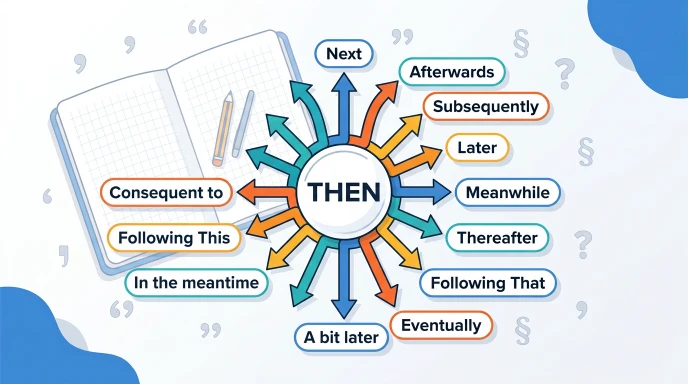
“Discover 30 powerful synonyms for ‘then’ to make your writing more engaging, fluent, and professional.”
The word then is a common English word that shows time, order, or a result. For example, when someone says, “I finished my homework, then I watched a movie,” the word then shows what happened next.
We use then every day in conversations, stories, instructions, and writing because it helps connect ideas clearly
English learners often use then many times, but learning its synonyms can make their speaking and writing more interesting.
Content writers also need a variety of words to create smooth and engaging sentences.
This article explains the meaning of then, its grammar, history, pronunciation, and useful synonyms. You will learn how different words can replace then depending on time, sequence, or situation.
Meaning of Then
Definition
Then (Adverb):
At that time, after that, next, or as a result of something happening.
Examples
- I was young then, and I loved playing outside.
- Finish your work, then you can relax.
Connotative Meaning
(Connotation means the feeling or idea connected with a word beyond its basic dictionary meaning.)
- Positive Tone: Can suggest progress, a planned action, or a happy future moment.
- Negative Tone: Can suggest delay, past problems, or consequences in some situations.
- Neutral Tone: Simply shows time, order, or connection between events.
Etymology
- Source Language: Old English.
- Original Word: þanne / þonne.
- Original Meaning: At that time, after that, or in that case.
Short History
- Old English (450–1100): The word then came from Old English þanne and þonne, which were used to show time and conditions.
- Middle English (1100–1500): The spelling changed gradually from forms like than and thanne to the modern form then.
- Modern English (1500–Present): Then became a common adverb used for time, sequence, results, and logical connections.
Pronunciation (US & UK – IPA)
US: /ðen/
UK: /ðen/
Syllables
then (1 syllable)
Affixation Pattern of Then
Root: then
Prefix: None
Suffix: None
Word Formation of the Keyword
- Then (Adverb) – shows time, order, or result.
- Thence (Adverb – Related form) – from that place or point.
- Thereafter (Adverb – Related meaning) – after that time.
- Then-current (Adjective) – existing at that time.
- Until then (Phrase) – before that time.
Synonyms of Then
1. Afterwards (Adverb)
US: /ˈæftərwərdz/ | UK: /ˈɑːftəwədz/
Meaning: After an event or at a later time.
Examples:
- We went for dinner afterwards.
- She apologized afterwards for her mistake.
2. Later (Adverb)
US: /ˈleɪtər/ | UK: /ˈleɪtə/
Meaning: At a time after the present or after another event.
Examples:
- I will call you later.
- They discussed the problem later in the day.
3. Next (Adverb)
US: /nekst/ | UK: /nekst/
Meaning: Coming immediately after something else.
Examples:
- First read the instructions, next start the activity.
- She was the next person to arrive.
4. Subsequently (Adverb)
US: /ˈsʌbsɪkwəntli/ | UK: /ˈsʌbsɪkwəntli/
Meaning: After something else has happened.
Examples:
- He lost his job and subsequently moved away.
- The rules changed subsequently.
5. Thereafter (Adverb)
US: /ˌðerˈæftər/ | UK: /ˌðeərˈɑːftə/
Meaning: After that time or event.
Examples:
- The company improved thereafter.
- He lived peacefully thereafter.
6. Following (Preposition/Adjective)
US: /ˈfɑːloʊɪŋ/ | UK: /ˈfɒləʊɪŋ/
Meaning: Coming after something in time or order.
Examples:
- The following day was very busy.
- She received a message following the meeting.
7. Nextly (Adverb – Rare)
US: /ˈnekstli/ | UK: /ˈnekstli/
Meaning: In the next position or at the next time.
Examples:
- The topic will be discussed nextly in the lesson.
- The nextly planned step was successful.
8. Later on (Adverb Phrase)
US: /ˈleɪtər ɑːn/ | UK: /ˈleɪtə ɒn/
Meaning: At a future time after now or after another event.
Examples:
- We can talk about it later on.
- She found the answer later on.
9. Eventually (Adverb)
US: /ɪˈventʃuəli/ | UK: /ɪˈventʃuəli/
Meaning: Finally, after some time.
Examples:
- He eventually found a solution.
- The team eventually won the match.
10. Finally (Adverb)
US: /ˈfaɪnəli/ | UK: /ˈfaɪnəli/
Meaning: At the end of a process or sequence.
Examples:
- Finally, they completed the project.
- She finally understood the lesson.
11. Afterward (Adverb)
US: /ˈæftərwərd/ | UK: /ˈɑːftəwəd/
Meaning: At a later time after something happens.
Examples:
- We finished the meeting and went home afterward.
- She felt better afterward.
12. Laterwards (Adverb – Rare)
US: /ˈleɪtərwərdz/ | UK: /ˈleɪtəwədz/
Meaning: At a later time.
Examples:
- They talked about the issue laterwards.
- The decision was explained laterwards.
13. Next (Adverb)
US: /nekst/ | UK: /nekst/
Meaning: Immediately following something in order.
Examples:
- Complete this task next.
- The next chapter explains the topic.
14. Soon (Adverb)
US: /suːn/ | UK: /suːn/
Meaning: After a short time.
Examples:
- I will return soon.
- The project will start soon.
15. Shortly (Adverb)
US: /ˈʃɔːrtli/ | UK: /ˈʃɔːtli/
Meaning: After a short period of time.
Examples:
- The teacher will arrive shortly.
- The results will be announced shortly.
16. Immediately (Adverb)
US: /ɪˈmiːdiətli/ | UK: /ɪˈmiːdiətli/
Meaning: At once or without delay.
Examples:
- Please call me immediately.
- The problem was fixed immediately.
17. Instantly (Adverb)
US: /ˈɪnstəntli/ | UK: /ˈɪnstəntli/
Meaning: Happening at the exact moment or very quickly.
Examples:
- The lights turned on instantly.
- She instantly recognized her friend.
18. Afterwards (Adverb)
US: /ˈæftərwərdz/ | UK: /ˈɑːftəwədz/
Meaning: After an event or action.
Examples:
- We had coffee afterwards.
- He explained everything afterwards.
19. Later on (Adverb Phrase)
US: /ˈleɪtər ɑːn/ | UK: /ˈleɪtə ɒn/
Meaning: At a later point in time.
Examples:
- We will discuss this later on.
- She changed her opinion later on.
20. Subsequently (Adverb)
US: /ˈsʌbsɪkwəntli/ | UK: /ˈsʌbsɪkwəntli/
Meaning: Happening after something else.
Examples:
- The company grew and subsequently became famous.
- He completed his studies and subsequently started working.
21. Thereupon (Adverb)
US: /ˌðerəˈpɑːn/ | UK: /ˌðeərəˈpɒn/
Meaning: Immediately after that event or action.
Examples:
- He received the message and thereupon made a decision.
- The judge announced the result and thereupon ended the case.
22. Nextly (Adverb-Rare)
US: /ˈnekstli/ | UK: /ˈnekstli/
Meaning: In the next place or at the next time.
Examples:
- Nextly, we will discuss the main idea.
- The nextly planned activity was successful.
23. Following that (Adverb Phrase)
US: /ˈfɑːloʊɪŋ ðæt/ | UK: /ˈfɒləʊɪŋ ðæt/
Meaning: After that particular event or action.
Examples:
- We finished the meeting; following that, we went home.
- Following that, the team started a new project.
24. From then on (Adverb Phrase)
US: /frəm ðen ɑːn/ | UK: /frəm ðen ɒn/
Meaning: Starting from that time and continuing afterward.
Examples:
- From then on, she practiced English every day.
- He became more careful from then on.
25. At that point (Adverb Phrase)
US: /æt ðæt pɔɪnt/ | UK: /æt ðæt pɔɪnt/
Meaning: At a particular time or stage.
Examples:
- At that point, they decided to stop.
- I did not understand the problem at that point.
26. At that time (Adverb Phrase)
US: /æt ðæt taɪm/ | UK: /æt ðæt taɪm/
Meaning: During a specific period in the past or future.
Examples:
- I was living in London at that time.
- Many people used letters at that time.
27. Thereafterward (Adverb – Rare)
US: /ˌðerˈæftərwərd/ | UK: /ˌðeərˈɑːftəwəd/
Meaning: After that time or event.
Examples:
- The rules changed thereafterward.
- Life became easier thereafterward.
28. Afterwards (Adverb)
US: /ˈæftərwərdz/ | UK: /ˈɑːftəwədz/
Meaning: At a later time after something happens.
Examples:
- They talked about the plan afterwards.
- She completed her work and rested afterwards.
29. Thenward (Adverb – Rare)
US: /ˈðenwərd/ | UK: /ˈðenwəd/
Meaning: Toward or from that time.
Examples:
- The story moved thenward into a new stage.
- Events changed quickly thenward.
30. Henceforth (Adverb)
US: /ˌhensˈfɔːrθ/ | UK: /ˌhensˈfɔːθ/
Meaning: From this time forward.
Examples:
- Henceforth, all employees must follow the new rules.
- The decision changed their lives henceforth.
Note: The word then has limited true synonyms because it mainly works as a time and sequence marker. Many alternatives are phrases rather than single words. For a high-quality vocabulary article, phrases like after that, from that point onward, at that moment, later, next, and afterward are often more natural replacements than rare forms.
Prototype Meaning
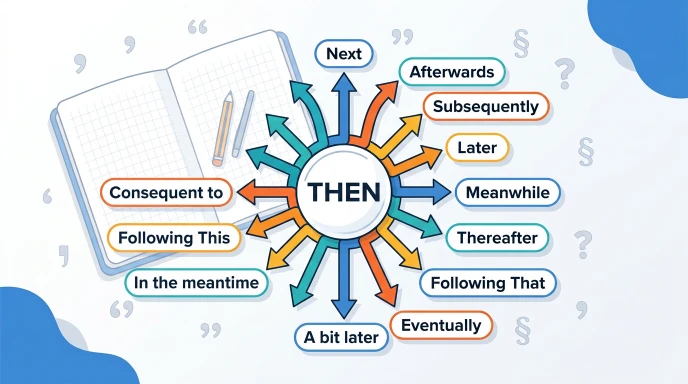
What Is the Prototype Meaning of Then?
The prototype meaning of then is showing a time, order, or event that happens after another event. When people hear the word then, they usually imagine a sequence of actions, such as “first do this, then do that.” It helps connect ideas and shows what happens next in a story, conversation, or instruction. The word can also refer to a specific time in the past, such as “I was young then.” Because of its simple and flexible meaning, then is one of the most frequently used words in English.
Prototype Categorization
The synonyms and related expressions of then can be grouped into different categories:
- Sequence and Order: next, afterwards, following that, subsequently
- These words show what happens after another action.
- Past Time Reference: at that time, back then, during that period
- These expressions describe a specific moment in the past.
- Future or Continuing Time: henceforth, from then on, thereafter
- These words show something continuing from a certain point.
- Immediate Results: thereupon, immediately, instantly
- These words show that something happens quickly after another event.
- Later Events: later, later on, eventually, shortly
- These words describe actions that happen after some time.
Categorizing synonyms helps writers choose the correct word for each situation. For example, next is useful for instructions, while thereafter is better for formal writing. Choosing the right synonym makes communication clearer and more natural.
Antonyms of Then
- Before (Adverb/Preposition): At an earlier time or prior to something.
- Earlier (Adverb): Happening before a particular time.
- Previously (Adverb): Before the current time or event.
- Formerly (Adverb): In the past but not now.
- Prior (Adjective/Adverb): Existing or happening before something else.
- First (Adverb/Adjective): Coming before all others in order.
- Earlier on (Adverb Phrase): At an earlier stage or time.
- Already (Adverb): Before a particular moment.
Short Questions and Answers
• What does then mean?
Answer: Then means at that time, after that, next, or as a result of something happening.
• When should then be used?
Answer: Use then when you want to show time, sequence, or a connection between two events. It is commonly used when explaining steps or telling stories.
• Is then positive or negative?
Answer: Then is neutral. Its meaning depends on the situation. It can describe happy memories, future plans, or negative events.
• How is then different from similar words?
Answer: Then is a general word used for time and order. Words like afterwards, next, and subsequently are more specific and may sound more formal or focused on sequence.
Conclusion
Learning the word then and its synonyms helps English learners improve their vocabulary and communication skills. Although then is a small word, it plays an important role in connecting ideas, showing time, and creating clear sentences. Understanding different alternatives allows speakers and writers to avoid repetition and choose words that match the situation. Students, teachers, and content writers can make their English more natural by practicing these expressions. Learning pronunciation, meanings, history, and usage also builds confidence. Daily vocabulary practice is a simple way to remember new words and improve fluency. By mastering then and its synonyms, learners can express time and sequence more effectively in English.
Read more about!
- Synonyms for Grow: 30+ Best Words to Use in English
- Synonyms for Used in English: 30 Words You Should Know
- Synonyms for Innovative: 30+ Best Words to Use in English

I am an American author, and I write books about power, strategy, and human behavior. My writing style is simple but deep, and I try to explain how people think and act in real-life situations.
I studied classical studies, and before becoming a writer, I worked in different fields which helped me understand people and life better.
My most famous books include The 48 Laws of Power, The Art of Seduction, and Mastery. These books are widely read by business people, leaders, and students around the world.