The word curious means wanting to know or learn more about something.
Imagine a child seeing a rainbow for the first time and asking many questions about how it appears in the sky.
That child is curious because they want to understand something new. The word is commonly used in daily conversations because people often talk about interests, questions, discoveries, and the desire to learn.
Learning synonyms for curious helps English learners and content writers improve their vocabulary and express different levels of interest more clearly.
Some words describe a healthy desire for knowledge, while others show unusual interest or investigation.
This article explains the meaning of curious and its synonyms with examples, grammar details, pronunciation, word history, and semantic categories.
Understanding these differences helps learners choose the right word for speaking and writing.
Meaning of Curious
Definition
Curious (Adjective):
Wanting to know or learn something; interested in discovering new information.
Examples
- The student was curious about how machines work.
- She is curious to learn about different cultures.
Connotative Meaning
(Connotation means the emotional feeling or idea connected with a word beyond its basic dictionary meaning.)
- Positive tone: Shows interest, intelligence, creativity, learning, and a desire to explore.
- Negative tone: Can suggest being nosy, interfering, or asking about private matters.
- Neutral tone: Simply describes a person who wants to know more.
Etymology
- The word curious comes from the Latin word curiosus, meaning “careful, eager to know, or interested.”
- It entered English through Old French curios, which meant “careful or inquisitive.”
- The original meaning was connected with careful attention and a desire for knowledge.
Short History
- Old English (450–1100):
The exact word “curious” was not commonly used, but English had words related to careful observation and interest. - Middle English (1100–1500):
The word entered English through French influence and was used to describe careful, skillful, or unusual things. - Modern English (1500–Present):
Curious became mainly connected with wanting to know, asking questions, and exploring new ideas.
Pronunciation (US & UK – IPA)
US: /ˈkjʊriəs/
UK: /ˈkjʊəriəs/
Syllables
cu-ri-ous
Affixation Pattern of Curious
- Root: cur (from Latin cura, meaning “care”)
- Prefix: None
- Suffix: -ous (forming adjectives meaning “full of” or “having the quality of”)
Word Formation of Curious
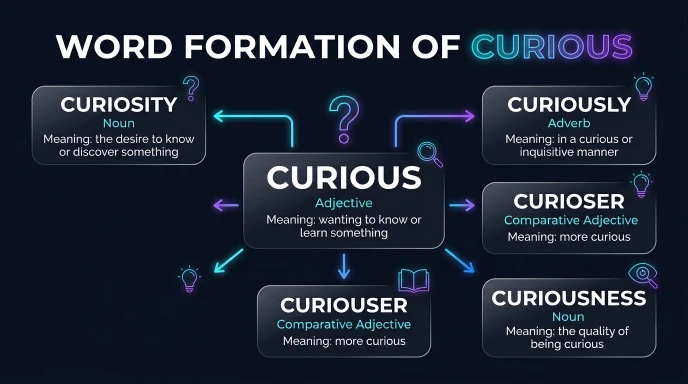
- Curious (adjective): wanting to know or learn.
- Curiosity (noun): the desire to know or learn something.
- Curiously (adverb): in a curious way.
- Curiousness (noun): the state of being curious.
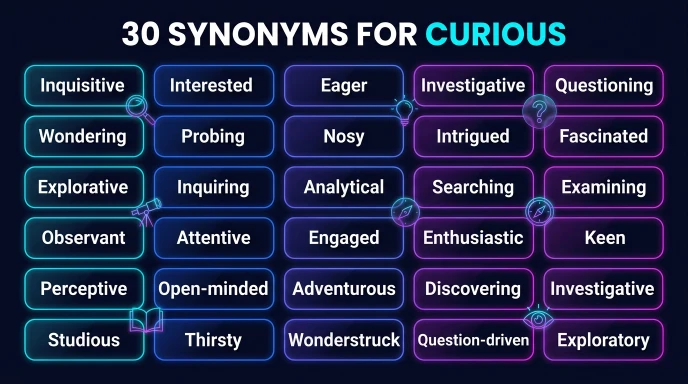
Synonyms of Curious
1. Inquisitive (Adjective)
US IPA: /ɪnˈkwɪzətɪv/ | UK IPA: /ɪnˈkwɪzətɪv/
Meaning: Showing a strong desire to learn or ask questions.
Examples:
- The inquisitive student asked many questions.
- Her inquisitive nature helped her discover new ideas.
2. Interested (Adjective)
US IPA: /ˈɪntrəstɪd/ | UK IPA: /ˈɪntrestɪd/
Meaning: Wanting to know more about something.
Examples:
- He is interested in science.
- She became interested in learning languages.
3. Eager (Adjective)
US IPA: /ˈiːɡər/ | UK IPA: /ˈiːɡə/
Meaning: Very excited and ready to learn or do something.
Examples:
- The students were eager to start the lesson.
- She was eager to explore new places.
4. Investigative (Adjective)
US IPA: /ɪnˈvestɪɡətɪv/ | UK IPA: /ɪnˈvestɪɡətɪv/
Meaning: Trying to discover facts by careful examination.
Examples:
- He has an investigative mind.
- The journalist used investigative methods.
5. Questioning (Adjective)
US IPA: /ˈkwestʃənɪŋ/ | UK IPA: /ˈkwestʃənɪŋ/
Meaning: Asking questions or showing doubt.
Examples:
- Her questioning attitude helped solve the problem.
- He gave a questioning look.
6. Interested (Adjective)
US IPA: /ˈɪntrəstɪd/ | UK IPA: /ˈɪntrestɪd/
Meaning: Feeling attention or concern about something.
Examples:
- I am interested in history.
- They are interested in the new project.
7. Wondering (Adjective)
US IPA: /ˈwʌndərɪŋ/ | UK IPA: /ˈwʌndərɪŋ/
Meaning: Thinking about something because you want to know the answer.
Examples:
- She was wondering why he left early.
- I am wondering how this works.
8. Searching (Adjective)
US IPA: /ˈsɜːrtʃɪŋ/ | UK IPA: /ˈsɜːtʃɪŋ/
Meaning: Looking for information or answers.
Examples:
- He has a searching mind.
- She asked searching questions.
9. Explorative (Adjective)
US IPA: /ɪkˈsplɔːrətɪv/ | UK IPA: /ɪkˈsplɒrətɪv/
Meaning: Interested in exploring and discovering new things.
Examples:
- Children have an explorative nature.
- His explorative research found new information.
10. Adventurous (Adjective)
US IPA: /ədˈventʃərəs/ | UK IPA: /ədˈventʃərəs/
Meaning: Willing to try new experiences.
Examples:
- She has an adventurous spirit.
- His adventurous personality led him to travel.
11. Nosey (Adjective)
US IPA: /ˈnoʊzi/ | UK IPA: /ˈnəʊzi/
Meaning: Too interested in other people’s private matters.
Examples:
- The nosey neighbor asked many personal questions.
- He can be nosey about other people’s lives.
12. Prying (Adjective)
US IPA: /ˈpraɪɪŋ/ | UK IPA: /ˈpraɪɪŋ/
Meaning: Trying to discover information that is private.
Examples:
- She avoided prying questions.
- His prying behavior annoyed others.
13. Analytical (Adjective)
US IPA: /ˌænəˈlɪtɪkəl/ | UK IPA: /ˌænəˈlɪtɪkəl/
Meaning: Using careful thinking to understand something.
Examples:
- He has an analytical approach to problems.
- Her analytical skills helped find the answer.
14. Observant (Adjective)
US IPA: /əbˈzɜːrvənt/ | UK IPA: /əbˈzɜːvənt/
Meaning: Good at noticing and understanding details.
Examples:
- The observant child noticed the small change.
- She is very observant during experiments.
15. Attentive (Adjective)
US IPA: /əˈtentɪv/ | UK IPA: /əˈtentɪv/
Meaning: Paying close attention to something.
Examples:
- The attentive student listened carefully.
- He was attentive to every detail.
16. Studious (Adjective)
US IPA: /ˈstuːdiəs/ | UK IPA: /ˈstjuːdiəs/
Meaning: Showing interest and dedication in learning.
Examples:
- She is a studious learner.
- His studious habits improved his grades.
17. Inquiring (Adjective)
US IPA: /ɪnˈkwaɪərɪŋ/ | UK IPA: /ɪnˈkwaɪərɪŋ/
Meaning: Seeking information by asking questions.
Examples:
- The child had an inquiring mind.
- She asked an inquiring question.
18. Probing (Adjective)
US IPA: /ˈproʊbɪŋ/ | UK IPA: /ˈprəʊbɪŋ/
Meaning: Trying to discover deeper information.
Examples:
- The reporter asked probing questions.
- His probing research revealed important facts.
19. Researching (Adjective/Verb)
US IPA: /rɪˈsɜːrtʃɪŋ/ | UK IPA: /rɪˈsɜːtʃɪŋ/
Meaning: Studying something carefully to find information.
Examples:
- She is researching ancient history.
- His researching skills are excellent.
20. Investigating (Adjective/Verb)
US IPA: /ɪnˈvestəɡeɪtɪŋ/ | UK IPA: /ɪnˈvestɪɡeɪtɪŋ/
Meaning: Examining something to discover facts.
Examples:
- The police are investigating the case.
- He enjoys investigating scientific questions.
21. Curious-minded (Adjective)
US IPA: /ˈkjʊriəs ˌmaɪndɪd/ | UK IPA: /ˈkjʊəriəs ˌmaɪndɪd/
Meaning: Having a mind that wants to learn and explore.
Examples:
- A curious-minded person asks useful questions.
- She is curious-minded and creative.
22. Creative (Adjective)
US IPA: /kriˈeɪtɪv/ | UK IPA: /kriˈeɪtɪv/
Meaning: Able to create new ideas.
Examples:
- His creative thinking solved the problem.
- She has a creative approach to learning.
23. Wondering (Adjective)
US IPA: /ˈwʌndərɪŋ/ | UK IPA: /ˈwʌndərɪŋ/
Meaning: Thinking about something because you want an answer.
Examples:
- I was wondering about the results.
- She was wondering how the machine worked.
24. Seeking (Adjective)
US IPA: /ˈsiːkɪŋ/ | UK IPA: /ˈsiːkɪŋ/
Meaning: Looking for knowledge or information.
Examples:
- He is seeking new opportunities.
- The student is seeking answers.
25. Open-minded (Adjective)
US IPA: /ˌoʊpənˈmaɪndɪd/ | UK IPA: /ˌəʊpənˈmaɪndɪd/
Meaning: Willing to consider new ideas.
Examples:
- She is open-minded about different cultures.
- An open-minded person learns quickly.
26. Receptive (Adjective)
US IPA: /rɪˈseptɪv/ | UK IPA: /rɪˈseptɪv/
Meaning: Willing to accept new ideas or information.
Examples:
- The students were receptive to new methods.
- He is receptive to suggestions.
27. Exploratory (Adjective)
US IPA: /ɪkˈsplɔːrətɔːri/ | UK IPA: /ɪkˈsplɒrətəri/
Meaning: Done to discover or learn more about something.
Examples:
- The team started an exploratory study.
- Exploratory research can reveal new facts.
28. Fascinated (Adjective)
US IPA: /ˈfæsəneɪtɪd/ | UK IPA: /ˈfæsɪneɪtɪd/
Meaning: Extremely interested and attracted by something.
Examples:
- She was fascinated by space.
- The children were fascinated by the experiment.
29. Captivated (Adjective)
US IPA: /ˈkæptɪveɪtɪd/ | UK IPA: /ˈkæptɪveɪtɪd/
Meaning: Completely interested or attracted by something.
Examples:
- The audience was captivated by the story.
- He was captivated by the new discovery.
30. Enthusiastic (Adjective)
US IPA: /ɪnˌθuːziˈæstɪk/ | UK IPA: /ɪnˌθjuːziˈæstɪk/
Meaning: Showing strong interest and excitement.
Examples:
- She is enthusiastic about learning languages.
- The students were enthusiastic about the project.
Prototype Meaning
The most typical meaning of curious is having a strong desire to know or learn something.
When people hear the word curious, they usually imagine someone asking questions, exploring new ideas, or trying to understand how something works.
The main idea is interest, discovery, and a desire for knowledge.
Prototype Categorization
- Learning and knowledge synonyms: inquisitive, inquiring, studious, researching, analytical.
These words describe people who want to gain information and understand topics deeply. - Exploration synonyms: explorative, exploratory, adventurous, seeking.
These words describe a desire to discover new places, ideas, or experiences. - Attention and observation synonyms: observant, attentive, questioning.
These words focus on noticing details and paying close attention. - Positive interest synonyms: interested, eager, fascinated, captivated, enthusiastic.
These words show excitement and enjoyment. - Negative curiosity synonyms: nosey, prying.
These words describe curiosity that crosses personal boundaries.
Categorizing synonyms helps writers choose the best word for each situation. For example, “inquisitive” sounds positive in education, while “nosey” suggests unwanted interest. Choosing the correct synonym improves accuracy and makes communication clearer.
Part 3 will continue with:
- Antonyms of curious
- Short Questions and Answers
- Conclusion
- Meta Description
Antonyms of Curious
- Uninterested (Adjective): Not showing interest or attention toward something.
- Indifferent (Adjective): Having no strong interest, feeling, or concern.
- Unconcerned (Adjective): Not worried or interested about something.
- Bored (Adjective): Feeling tired or uninterested because something is not engaging.
- Ignorant (Adjective): Lacking knowledge or information about something.
- Careless (Adjective): Not paying enough attention to details.
- Closed-minded (Adjective): Not willing to accept new ideas or opinions.
- Passive (Adjective): Not actively seeking information or involvement.
Short Questions and Answers
- What does curious mean?
Curious means wanting to know, learn, or discover something. It describes a person who asks questions and seeks information. - When should curious be used?
Use curious when describing someone who wants to understand something, explore new ideas, or learn more about a topic. - Is curious positive or negative?
Curious is usually positive because it shows interest, intelligence, and a desire to learn. However, it can become negative when it means being too interested in private matters. - How is curious different from similar words?
Curious is a general word for wanting to know more. Inquisitive often suggests asking questions, interested shows attention or care, and nosey suggests unwanted curiosity.
Conclusion
Learning the word curious and its synonyms helps English learners build a stronger vocabulary and communicate ideas more accurately.
These words allow speakers and writers to describe different types of curiosity, from positive learning and exploration to careful investigation and personal interest.
Understanding pronunciation, meanings, tone, and history helps learners choose the right word for each situation. Using different synonyms also reduces repetition and makes writing more engaging.
A rich vocabulary improves speaking confidence, writing skills, and overall English communication. Practicing new words every day through reading, conversations, and writing is a simple way to continue improving language ability.
Explore more about!

I am a British-American author, speaker, and motivational thinker. I focus on leadership and inspiration.
My main idea is that great leaders and successful organizations start with “why”.
I studied cultural anthropology and communication. My well-known books include Start With Why, Leaders Eat Last, and The Infinite Game.