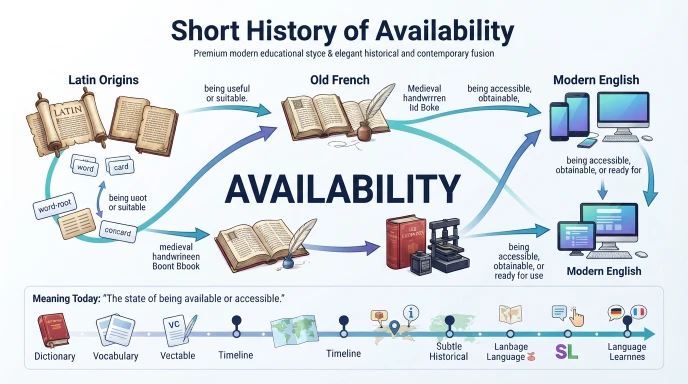
Availability means the state of being free, ready, accessible, or possible to obtain. Imagine you want to book a hotel room for a weekend trip. Before making a reservation, you ask, “Is there any room available?” You are checking the room’s availability.
This word is common because we use it when talking about people, time, products, services, jobs, resources, and opportunities. Learning synonyms of availability helps English learners express ideas more clearly and naturally. It also helps content writers avoid repeating the same word in articles and other content.
In this guide, we will explore the meaning, grammar, pronunciation, history, and emotional tone of availability. We will also study 30 useful synonyms with simple meanings and examples. These words will help you choose the right expression for different situations.
Meaning of Availability
Availability (Noun):
The state of being free, ready, accessible, or able to be used or obtained.
Examples
- The availability of hotel rooms is limited during the holiday season.
- Please check my availability before scheduling the meeting.
Connotative Meaning
Positive tone:
- Suggests access, opportunity, readiness, convenience, or choice.
- Can create a feeling that something is easy to obtain or use.
Negative tone:
- May suggest limited supply, lack of access, or difficulty when availability is low.
- In some situations, constant availability may suggest pressure to always be ready.
Neutral tone:
- Simply describes if someone or something is free, ready, accessible, or obtainable.
Connotation (the feeling or idea that a word suggests beyond its basic dictionary meaning).
Etymology
- Source: The word availability comes from available, which entered English through Old French from Latin roots.
- Latin: avail is related to Latin valēre, meaning “to be strong, be useful, or have value.”
- Available: Developed with the sense of being useful, accessible, or ready for use.
- Availability: The noun form developed to describe the state or condition of being available.
Short History of Availability
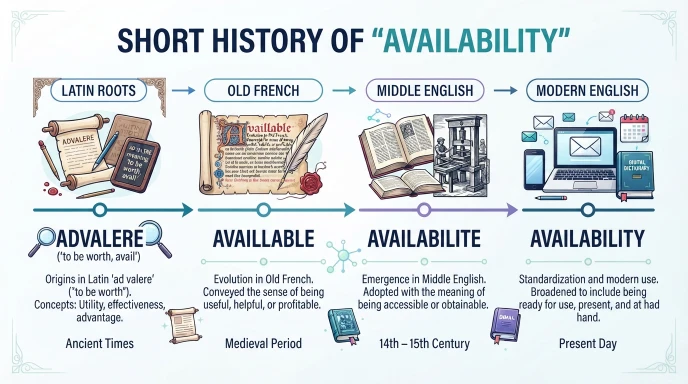
Old English (450–1100):
The exact modern word availability was not used in Old English. English used other words and expressions to describe being ready, useful, free, or obtainable. Latin and Germanic vocabulary later influenced the development of related English terms.
Middle English (1100–1500):
After the Norman Conquest, French and Latin had a strong influence on English vocabulary. Words related to avail developed meanings connected with usefulness, benefit, and effectiveness. These forms helped create the later word available.
Modern English (1500–Present):
Available became widely used to describe something that could be obtained, used, or accessed. The noun availability developed as a way to describe the condition of being available. Today, the word is common in business, technology, education, travel, employment, healthcare, and everyday communication.
Pronunciation (US & UK – IPA)
US: /əˌveɪləˈbɪləti/
UK: /əˌveɪləˈbɪləti/
Syllables: a-vail-a-bil-i-ty
Affixation Pattern of Availability
Root: avail
Prefix: a- (part of the historical formation of “avail,” rather than a freely productive modern prefix in this word)
Suffix: -able, -ity
Word Formation
- Avail — verb: to be useful or helpful.
- Available — adjective: ready, free, or obtainable.
- Availability — noun: the state of being available.
- Unavailable — adjective: not available.
- Unavailability — noun: the state of not being available.
- Availably — adverb: in an available manner; uncommon in everyday English.
Synonyms of Availability
1. Accessibility (Noun)
US IPA: /əkˌsesəˈbɪləti/ | UK IPA: /əkˌsesəˈbɪləti/
Meaning: The quality of being easy to reach, enter, use, or obtain.
Examples:
- The website improved its accessibility for new users.
- Better accessibility gives students easier access to learning materials.
2. Readiness (Noun)
US IPA: /ˈredinəs/ | UK IPA: /ˈredinəs/
Meaning: The state of being prepared and ready for use or action.
Examples:
- The team’s readiness helped the event start on time.
- We checked the equipment’s readiness before the meeting.
3. Access (Noun)
US IPA: /ˈækses/ | UK IPA: /ˈækses/
Meaning: The ability or right to enter, use, or obtain something.
Examples:
- Students have access to the online library.
- The new system gives customers easy access to information.
4. Supply (Noun)
US IPA: /səˈplaɪ/ | UK IPA: /səˈplaɪ/
Meaning: The amount of something that is available for use or purchase.
Examples:
- The store has a large supply of fresh products.
- The water supply is available throughout the day.
5. Stock (Noun)
US IPA: /stɑːk/ | UK IPA: /stɒk/
Meaning: The amount of a product that is available for sale.
Examples:
- The shop has the new phones in stock.
- The product is currently out of stock.
6. Presence (Noun)
US IPA: /ˈprezəns/ | UK IPA: /ˈprezəns/
Meaning: The state of being present or existing in a particular place.
Examples:
- The manager’s presence was required at the meeting.
- The presence of staff made the service easier to access.
7. Provision (Noun)
US IPA: /prəˈvɪʒən/ | UK IPA: /prəˈvɪʒən/
Meaning: The act of providing something that is needed or wanted.
Examples:
- The provision of clean water is essential.
- The hotel made provision for extra guests.
8. Opportunity (Noun)
US IPA: /ˌɑːpərˈtuːnəti/ | UK IPA: /ˌɒpəˈtjuːnəti/
Meaning: A suitable chance to do or obtain something.
Examples:
- The course gives students an opportunity to learn new skills.
- She used the opportunity to apply for the position.
9. Obtainability (Noun)
US IPA: /əˌteɪnəˈbɪləti/ | UK IPA: /əˌtəʊnəˈbɪləti/
Meaning: The quality of being possible to obtain or acquire.
Examples:
- The obtainability of the materials made the project easier.
- Researchers examined the obtainability of reliable information.
10. Attainability (Noun)
US IPA: /əˌteɪnəˈbɪləti/ | UK IPA: /əˌteɪnəˈbɪləti/
Meaning: The quality of being possible to achieve or reach.
Examples:
- The team discussed the attainability of its goals.
- They considered the attainability of the proposed target.
The best synonym depends on the exact situation. Access focuses on the ability to use something, stock focuses on products, and readiness focuses on preparation.
11. Accessibility (Noun)
US IPA: /əkˌsesəˈbɪləti/ | UK IPA: /əkˌsesəˈbɪləti/
Meaning: The state of being easy to reach, use, enter, or obtain.
Examples:
- The website improved its accessibility for users.
- Better accessibility makes public services easier to use.
12. Readiness (Noun)
US IPA: /ˈredinəs/ | UK IPA: /ˈredinəs/
Meaning: The state of being prepared and ready for use or action.
Examples:
- The team’s readiness helped them start the project quickly.
- We checked the equipment’s readiness before the event.
13. Presence (Noun)
US IPA: /ˈprezəns/ | UK IPA: /ˈprezəns/
Meaning: The state of being present or existing in a particular place.
Examples:
- The manager’s presence was important during the meeting.
- The presence of fresh products increased customer interest.
14. Supply (Noun)
US IPA: /səˈplaɪ/ | UK IPA: /səˈplaɪ/
Meaning: The amount of something that is available for use or purchase.
Examples:
- The store has a good supply of fresh food.
- A limited supply can cause prices to rise.
15. Stock (Noun)
US IPA: /stɑːk/ | UK IPA: /stɒk/
Meaning: The amount of a product that a business has available for sale or use.
Examples:
- The shop has the new phones in stock.
- Customers were told that the item was out of stock.
16. Provision (Noun)
US IPA: /prəˈvɪʒən/ | UK IPA: /prəˈvɪʒən/
Meaning: The act of providing something that is needed.
Examples:
- The hotel made provision for extra guests.
- The provision of clean water is essential.
17. Opportunity (Noun)
US IPA: /ˌɑːpərˈtuːnəti/ | UK IPA: /ˌɒpəˈtjuːnəti/
Meaning: A suitable chance to do or obtain something.
Examples:
- The course gives students an opportunity to learn new skills.
- She took the opportunity to apply for the job.
18. Access (Noun)
US IPA: /ˈækses/ | UK IPA: /ˈækses/
Meaning: The ability or right to enter, use, or obtain something.
Examples:
- Students have access to the online library.
- Internet access is important for modern education.
19. Attainability (Noun)
US IPA: /əˌteɪnəˈbɪləti/ | UK IPA: /əˌteɪnəˈbɪləti/
Meaning: The quality of being possible to achieve or obtain.
Examples:
- The team discussed the attainability of its goals.
- The plan was designed with affordability and attainability in mind.
20. Obtainability (Noun)
US IPA: /əˌteɪnəˈbɪləti/ | UK IPA: /əˌtəʊnəˈbɪləti/
Meaning: The quality of being possible to obtain or acquire.
Examples:
- The obtainability of the materials made the project easier.
- Researchers considered the obtainability of reliable data.
21. Openness (Noun)
US IPA: /ˈoʊpənəs/ | UK IPA: /ˈəʊpənəs/
Meaning: The state of being open, accessible, or ready to receive people or ideas.
Examples:
- The openness of the service makes it easy to use.
- Her openness to new ideas helped the team.
22. Accessibility (Noun)
US IPA: /əkˌsesəˈbɪləti/ | UK IPA: /əkˌsesəˈbɪləti/
Meaning: The quality of being easy to reach, enter, use, or obtain.
Examples:
- The library improved its accessibility.
- Better accessibility helps more people use the service.
23. Convenience (Noun)
US IPA: /kənˈviːniəns/ | UK IPA: /kənˈviːniəns/
Meaning: The quality of being easy or suitable to use.
Examples:
- Online shopping offers great convenience.
- The store’s location adds convenience for customers.
24. Feasibility (Noun)
US IPA: /ˌfiːzəˈbɪləti/ | UK IPA: /ˌfiːzəˈbɪləti/
Meaning: The possibility that something can be done or achieved.
Examples:
- The team studied the feasibility of the project.
- They checked the feasibility of the proposed plan.
25. Usability (Noun)
US IPA: /ˌjuːzəˈbɪləti/ | UK IPA: /ˌjuːzəˈbɪləti/
Meaning: How easy and practical something is to use.
Examples:
- The designer improved the usability of the website.
- Good usability makes an app easier for customers.
26. Availability of Resources (Noun Phrase)
US IPA: /əˌveɪləˈbɪləti əv rɪˈsɔːrsɪz/ | UK IPA: /əˌveɪləˈbɪləti əv rɪˈzɔːsɪz/
Meaning: The amount of useful materials, money, people, or tools that can be used.
Examples:
- The project depends on the availability of resources.
- The team checked the availability of resources before starting.
27. On-Hand Supply (Noun Phrase)
US IPA: /ˌɑːn ˈhænd səˈplaɪ/ | UK IPA: /ˌɒn ˈhænd səˈplaɪ/
Meaning: Something that is currently available and ready to use.
Examples:
- The hospital keeps an on-hand supply of essential materials.
- We need an on-hand supply of paper for the office.
28. Provisioning (Noun)
US IPA: /prəˈvɪʒənɪŋ/ | UK IPA: /prəˈvɪʒənɪŋ/
Meaning: The process of providing or preparing something for use.
Examples:
- The provisioning of new accounts was completed quickly.
- Cloud provisioning makes new resources available to users.
29. Serviceability (Noun)
US IPA: /ˌsɝːvɪsəˈbɪləti/ | UK IPA: /ˌsɜːvɪsəˈbɪləti/
Meaning: The condition of being suitable and ready for continued use or service.
Examples:
- Engineers checked the serviceability of the equipment.
- Regular maintenance improves the serviceability of machines.
30. Supply Readiness (Noun Phrase)
US IPA: /səˈplaɪ ˈredinəs/ | UK IPA: /səˈplaɪ ˈredinəs/
Meaning: The state of having needed supplies ready and available.
Examples:
- The company checked its supply readiness before the busy season.
- Good supply readiness helps prevent shortages.
Prototype Meaning
The prototype meaning of availability is the state in which a person or thing is free, ready, accessible, or obtainable when needed.
When people hear the word, they often think about something that can be used, bought, accessed, or obtained at a particular time. For example, a hotel room can have availability, a person can have availability for a meeting, and a product can be available in a store.
Prototype Categorization
- People and Time: Availability, readiness, free time, openness
- Products: Stock, supply, on-hand supply
- Services: Access, accessibility, usability
- Resources: Supply, provision, availability of resources
- Possibility: Feasibility, attainability, obtainability
- Technology: Accessibility, provisioning, usability
- Equipment: Serviceability, readiness
Categorizing these words helps writers choose a more exact synonym. For example, stock works well for products, while readiness works better for preparation. Accessibility focuses on ease of use or access, while feasibility focuses on if something can be done.
Antonyms of Availability
- Unavailability (Noun): The state of not being available.
- Absence (Noun): The state of not being present.
- Inaccessibility (Noun): The condition of being difficult or impossible to reach or use.
- Scarcity (Noun): A situation in which something is difficult to find or obtain.
- Shortage (Noun): A situation in which there is less of something than needed.
- Unpreparedness (Noun): The state of not being ready.
- Isolation (Noun): The state of being separated from others.
Conclusion
Learning availability and its related synonyms can make your English stronger and more flexible. Words such as accessibility, readiness, supply, stock, provision, feasibility, usability, and serviceability describe different forms of being available.
Understanding these differences helps English learners choose words with greater accuracy. It also helps writers avoid repeating the same word in articles, essays, emails, and professional content. Knowing pronunciation, tone, history, related words, and antonyms gives you a deeper understanding of the keyword.
Regular vocabulary practice can improve both speaking and writing skills. Try using one new synonym each day in a sentence. With consistent practice, you can build a wider vocabulary, communicate your ideas more clearly, and develop greater confidence in English.
Explore more about!
- Synonyms for Confidence: 30 Words to Expand Your Vocabulary
- 30 Synonyms for Curious to Improve
- 30 Synonyms for “Pride” to Level Up Your Writing

I am an American author, and I write books about power, strategy, and human behavior. My writing style is simple but deep, and I try to explain how people think and act in real-life situations.
I studied classical studies, and before becoming a writer, I worked in different fields which helped me understand people and life better.
My most famous books include The 48 Laws of Power, The Art of Seduction, and Mastery. These books are widely read by business people, leaders, and students around the world.