Abhor means to hate or strongly dislike something. Imagine a person who sees animal cruelty and feels deep anger and disgust. They do not simply dislike it. They strongly reject it because they believe it is wrong. In this situation, the word abhor fits naturally.
The word is useful when ordinary words like “dislike” or “hate” are not strong enough to express a person’s feelings. Learning synonyms for abhor helps English learners understand different levels of dislike and choose words that fit the situation.
It also helps content writers avoid repetition and make their writing more precise. In this article, we explore the meaning, examples, grammar, pronunciation, etymology, history, emotional tone, and semantic categories of abhor. We also examine 30 useful synonyms with simple examples.
Meaning of Abhor
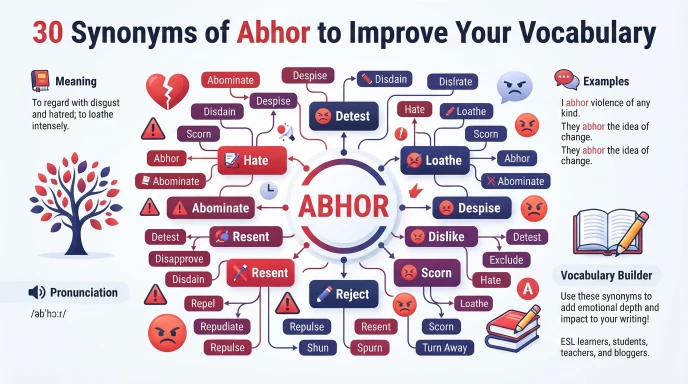
Abhor describes a very strong feeling of dislike, hatred, or disgust toward something.
Definition
Abhor (Verb):
To strongly hate, dislike, or feel deep disgust toward someone or something.
Examples
- I abhor cruelty toward animals.
- She abhors dishonesty in the workplace.
Connotative Meaning
Connotation means the feeling or idea that a word suggests beyond its basic dictionary meaning.
- Positive tone: Abhor can have a positive moral tone when it shows strong opposition to cruelty, injustice, or harmful behavior.
- Negative tone: The word itself expresses a very strong negative feeling of hatred or disgust.
- Neutral tone: In a factual context, abhor can simply describe an intense dislike without showing approval or disapproval of the subject.
Etymology
- Abhor comes from Latin abhorrēre.
- The Latin word meant “to shrink back from” or “to shudder at.”
- It was formed from ab-, meaning “away from,” and horrēre, meaning “to tremble” or “shudder.”
- The word entered English through Old French and developed its modern sense of strongly hating or rejecting something.
Short History of the Keyword
Old English (450–1100):
The exact word abhor was not part of everyday Old English vocabulary. However, Old English had several words for fear, hatred, disgust, and rejection. These words helped express strong emotional reactions.
Middle English (1100–1500):
After the Norman Conquest, many French and Latin words entered English. Abhor developed in English during this period through French influence. Its meaning remained connected with strong dislike, fear, and rejection.
Modern English (1500–Present):
In Modern English, abhor became a formal and powerful verb. It is often used in literature, essays, journalism, speeches, and formal discussions. Today, it commonly describes a deep dislike of actions, ideas, behavior, or situations.
Pronunciation (US & UK – IPA)
US: /əbˈhɔːr/
UK: /əbˈhɔː/
Syllables
ab-hor
Affixation Pattern of Abhor
- Root: horr- / hor- — connected with the idea of trembling or shuddering
- Prefix: ab- — meaning “away from”
- Suffix: None
- Base form: abhor
- Third-person singular: abhors
- Present participle: abhorring
- Past tense: abhorred
- Past participle: abhorred
- Noun: abhorrence
- Adjective: abhorrent
- Adverb: abhorrently
The word family contains several grammatical forms. Abhor is a verb, abhorrence is a noun, abhorrent is an adjective, and abhorrently is an adverb.
Synonyms of Abhor
1. Hate (Verb)
US: /heɪt/ | UK: /heɪt/
Meaning: To strongly dislike someone or something.
Examples:
- I hate being treated unfairly.
- She hates cruelty.
2. Detest (Verb)
US: /dɪˈtest/ | UK: /dɪˈtest/
Meaning: To dislike something or someone very strongly.
Examples:
- He detests dishonesty.
- They detest unnecessary violence.
3. Loathe (Verb)
US: /loʊð/ | UK: /ləʊð/
Meaning: To feel intense dislike or disgust.
Examples:
- She loathes rude behavior.
- I loathe wasting food.
4. Despise (Verb)
US: /dɪˈspaɪz/ | UK: /dɪˈspaɪz/
Meaning: To strongly dislike someone or something and have little respect for it.
Examples:
- He despises dishonest people.
- She despises cruelty.
5. Dislike (Verb)
US: /dɪsˈlaɪk/ | UK: /dɪsˈlaɪk/
Meaning: To not like someone or something.
Examples:
- I dislike rude comments.
- She dislikes crowded places.
6. Detest (Verb)
US: /dɪˈtest/ | UK: /dɪˈtest/
Meaning: To feel very strong dislike.
Examples:
- They detest corruption.
- He detests unfair treatment.
7. Hate (Verb)
US: /heɪt/ | UK: /heɪt/
Meaning: To have an extremely negative feeling toward something.
Examples:
- She hates violence.
- I hate dishonesty.
8. Reject (Verb)
US: /rɪˈdʒekt/ | UK: /rɪˈdʒekt/
Meaning: To refuse to accept or support something.
Examples:
- We reject discrimination.
- She rejected the unfair proposal.
9. Condemn (Verb)
US: /kənˈdem/ | UK: /kənˈdem/
Meaning: To strongly criticize something as wrong or unacceptable.
Examples:
- Leaders condemned the violent attack.
- She condemns dishonest behavior.
10. Repudiate (Verb)
US: /rɪˈpjuːdieɪt/ | UK: /rɪˈpjuːdieɪt/
Meaning: To strongly reject or refuse to accept something.
Examples:
- He repudiated the false accusation.
- The organization repudiated the harmful idea.
11. Disdain (Verb)
US: /dɪsˈdeɪn/ | UK: /dɪsˈdeɪn/
Meaning: To regard someone or something with strong dislike or lack of respect.
Examples:
- She disdains dishonest behavior.
- He disdains people who abuse their power.
12. Scorn (Verb)
US: /skɔːrn/ | UK: /skɔːn/
Meaning: To strongly reject or mock someone or something because you have little respect for it.
Examples:
- They scorned the unfair rule.
- She scorns dishonest behavior.
13. Abominate (Verb)
US: /əˈbɑːməneɪt/ | UK: /əˈbɒmɪneɪt/
Meaning: To hate something intensely.
Examples:
- He abominates cruelty.
- She abominates acts of violence.
14. Detest (Verb)
US: /dɪˈtest/ | UK: /dɪˈtest/
Meaning: To dislike something with great intensity.
Examples:
- She detests lies.
- He detests unfair treatment.
15. Despise (Verb)
US: /dɪˈspaɪz/ | UK: /dɪˈspaɪz/
Meaning: To strongly dislike and have contempt for something.
Examples:
- He despises betrayal.
- She despises cruel actions.
16. Loathe (Verb)
US: /loʊð/ | UK: /ləʊð/
Meaning: To feel powerful dislike or disgust.
Examples:
- I loathe unnecessary arguments.
- She loathes dishonesty.
17. Abominate (Verb)
US: /əˈbɑːməneɪt/ | UK: /əˈbɒmɪneɪt/
Meaning: To regard something with intense hatred or disgust.
Examples:
- The writer abominates cruelty.
- They abominated the practice.
18. Oppose (Verb)
US: /əˈpoʊz/ | UK: /əˈpəʊz/
Meaning: To disagree with or act against something.
Examples:
- Many people oppose animal cruelty.
- She opposes the unfair policy.
19. Resist (Verb)
US: /rɪˈzɪst/ | UK: /rɪˈzɪst/
Meaning: To fight against or refuse to accept something.
Examples:
- They resist unfair treatment.
- He resisted the harmful influence.
20. Shun (Verb)
US: /ʃʌn/ | UK: /ʃʌn/
Meaning: To deliberately avoid someone or something.
Examples:
- She shuns dishonest people.
- He shunned negative influences.
21. Avoid (Verb)
US: /əˈvɔɪd/ | UK: /əˈvɔɪd/
Meaning: To stay away from someone or something.
Examples:
- I avoid people who behave badly.
- She avoids unnecessary conflict.
22. Abandon (Verb)
US: /əˈbændən/ | UK: /əˈbændən/
Meaning: To leave or give up something completely.
Examples:
- They abandoned the harmful practice.
- He abandoned his old habits.
23. Refuse (Verb)
US: /rɪˈfjuːz/ | UK: /rɪˈfjuːz/
Meaning: To say no to something or decline to accept it.
Examples:
- She refused to support the unfair plan.
- He refused to accept dishonest behavior.
24. Disapprove (Verb)
US: /ˌdɪsəˈpruːv/ | UK: /ˌdɪsəˈpruːv/
Meaning: To believe that something is wrong or unsuitable.
Examples:
- Her parents disapprove of cheating.
- He disapproves of rude behavior.
25. Detest (Verb)
US: /dɪˈtest/ | UK: /dɪˈtest/
Meaning: To strongly dislike or hate something.
Examples:
- I detest cruelty.
- She detests false promises.
26. Repel (Verb)
US: /rɪˈpel/ | UK: /rɪˈpel/
Meaning: To cause someone to feel strong dislike or disgust.
Examples:
- Cruel behavior repels many people.
- The smell repelled the visitors.
27. Disgust (Verb)
US: /dɪsˈɡʌst/ | UK: /dɪsˈɡʌst/
Meaning: To cause a strong feeling of dislike or sickness.
Examples:
- The cruel act disgusted everyone.
- His behavior disgusts me.
28. Abhor (Verb)
US: /əbˈhɔːr/ | UK: /əbˈhɔː/
Meaning: To feel extreme dislike or hatred toward something.
Examples:
- Many people abhor cruelty.
- She abhors injustice.
29. Protest (Verb)
US: /prəˈtest/ | UK: /prəˈtəst/
Meaning: To publicly express strong disagreement with something.
Examples:
- Workers protested against unfair treatment.
- The group protested the decision.
30. Deplore (Verb)
US: /dɪˈplɔːr/ | UK: /dɪˈplɔː/
Meaning: To strongly disapprove of something and express regret about it.
Examples:
- She deplores violence.
- The organization deplored the unfair treatment.
Prototype Meaning
The most typical meaning of abhor is to feel an extremely strong dislike or disgust toward something. When people hear abhor, they often imagine a serious moral or emotional reaction.
For example, a person may abhor cruelty, injustice, violence, dishonesty, or discrimination. The word is much stronger than simple dislike and often appears in formal writing, speeches, literature, and discussions about behavior or values.
Prototype Categorization
Synonyms of abhor can be grouped by the type and strength of negative feeling they express:
- Strong hatred: hate, detest, loathe, despise, abominate
- Moral rejection: condemn, deplore, repudiate, reject
- Lack of respect: disdain, scorn
- Active opposition: oppose, resist, protest
- Avoidance: shun, avoid
- Disgust: disgust, repel
- Disapproval: disapprove, deplore
- Refusal: refuse, reject, abandon
This categorization helps writers select a word that matches the exact situation. Hate is common in everyday English. Detest and loathe express very strong dislike. Condemn focuses more on public or moral criticism. Shun focuses on avoiding someone or something. Deplore is useful in formal writing when expressing strong disapproval.
Antonyms of Abhor
- Love (Verb): To feel strong affection or deep care for someone or something.
- Like (Verb): To enjoy or feel positive about someone or something.
- Admire (Verb): To respect or appreciate someone or something.
- Appreciate (Verb): To recognize the value or good qualities of something.
- Enjoy (Verb): To take pleasure or satisfaction from something.
- Accept (Verb): To receive or agree to something without rejection.
- Approve (Verb): To consider something acceptable or good.
- Welcome (Verb): To receive or accept something gladly.
Short Questions and Answers
- What does abhor mean?
Abhor means to strongly hate, dislike, or feel deep disgust toward someone or something. - When should abhor be used?
Use abhor when you want to express an extremely strong dislike, especially toward harmful, immoral, or unacceptable actions. - Is abhor positive or negative?
Abhor has a negative emotional meaning because it expresses intense dislike or hatred. - How is abhor different from dislike?
Dislike can describe a mild negative feeling, while abhor expresses a much stronger feeling of hatred or disgust. - How is abhor different from hate?
Hate is common in everyday English. Abhor is more formal and often emphasizes deep moral or emotional rejection. - Is abhor a verb?
Yes. Abhor is a verb. For example, “She abhors cruelty.”
Conclusion
Learning abhor and its synonyms can make your English vocabulary stronger and more precise. Words such as detest, loathe, despise, condemn, disdain, scorn, shun, oppose, deplore, and disgust help express different forms and levels of strong dislike.
Using these words correctly can improve both writing and speaking. It also helps you avoid repeating the same word in essays, articles, stories, and conversations. Understanding their tone is important because some words are common and informal, while others are more formal or focus on moral rejection.
Practice one or two new synonyms each day and create your own sentences with them. Regular vocabulary practice will improve your word choice, strengthen communication skills, and build confidence when using English in academic, professional, and everyday situations.
Explore more asbout!
- 30 Synonyms for “Pride” to Level Up Your Writing
- Energy Synonyms: 30 Words to Elevate Your Vocabulary
- Synonyms for “Availability”: Powerful Words to Expand

I am an American writer and speaker who focuses on habits, productivity, and self-improvement.
I study how small daily habits can create big changes in life. I try to write in a very simple and practical way so anyone can apply my ideas.
My most popular book is Atomic Habits, which is read around the world.