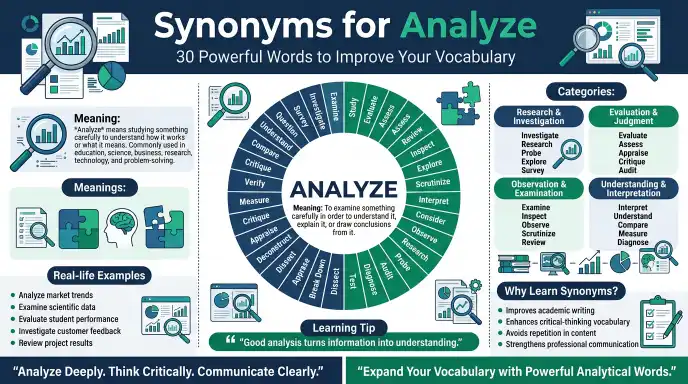
Analyze means to examine something carefully in order to understand it better. Imagine a student reading a story for class. Instead of only reading the words, the student looks at the characters, themes, and message.
The student is analyzing the text. People use the word analyze in education, science, business, research, and daily life when they need to study information closely.
Learning synonyms for analyze is useful for English learners and content writers because it helps improve vocabulary and makes writing more interesting.
Using different words can help you express ideas with greater accuracy and avoid repetition.
In this article, you will learn the meaning of analyze, its pronunciation, grammar, history, emotional tone, and 30 useful synonyms. You will also explore examples, semantic categories, antonyms, related words, and practical language tips.
Meaning of Analyze
Definition
Analyze (Verb):
To examine something carefully in order to understand its parts, meaning, or purpose.
Examples
- Scientists analyze data before making conclusions.
- She analyzed the report carefully.
Connotative Meaning
(Connotation: the emotional feeling or association connected to a word beyond its dictionary meaning.)
- Positive tone: Thoughtful, logical, intelligent, careful.
- Negative tone: May suggest overthinking in some situations.
- Neutral tone: Examining information closely.
Etymology
- Source language: Greek and French
- Derived from Greek analysis, meaning “a breaking up” or “loosening.”
- Entered English through French and Latin influences.
- Original meaning: To separate something into parts for study.
Short History of the Keyword
- Old English (450–1100): The word analyze did not exist in Old English.
- Middle English (1100–1500): Related forms of analysis entered scholarly language.
- Modern English (1500–Present): Analyze became common in science, education, and research.
Pronunciation (US & UK – IPA)
US: /ˈænəlaɪz/
UK: /ˈænəlaɪz/
Syllables
an-a-lyze
Affixation Pattern of Analyze
Root: analysis
Prefix: None
Suffix: -ize
Word Formation of the Keyword
- Analyze (Verb)
- Analysis (Noun)
- Analyst (Noun)
- Analytical (Adjective)
- Analytically (Adverb)
- Analyzed (Verb)
- Analyzing (Verb)
Synonyms of Analyze
1. Examine (Verb)
US: /ɪɡˈzæmɪn/ | UK: /ɪɡˈzæmɪn/
Meaning: To inspect something carefully.
Examples:
- The doctor examined the patient.
- We examined the results closely.
2. Study (Verb)
US: /ˈstʌdi/ | UK: /ˈstʌdi/
Meaning: To learn about something carefully.
Examples:
- Researchers study animal behavior.
- She studied the document.
3. Investigate (Verb)
US: /ɪnˈvestɪɡeɪt/ | UK: /ɪnˈvestɪɡeɪt/
Meaning: To look into something systematically.
Examples:
- Police investigate crimes.
- Scientists investigate causes.
4. Inspect (Verb)
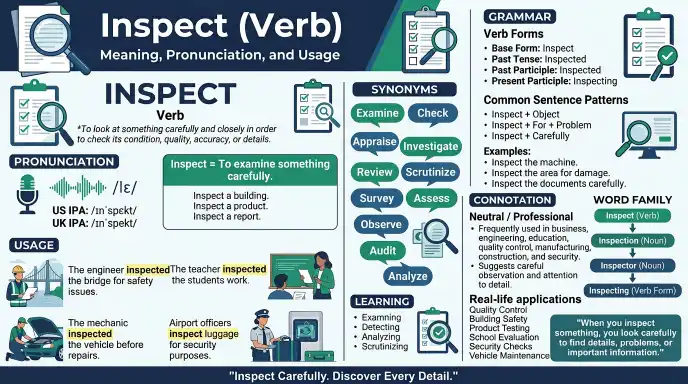
US: /ɪnˈspekt/ | UK: /ɪnˈspekt/
Meaning: To look at something carefully.
Examples:
- Workers inspected the bridge.
- She inspected the equipment.
5. Evaluate (Verb)
US: /ɪˈvæljueɪt/ | UK: /ɪˈvæljueɪt/
Meaning: To judge quality or value.
Examples:
- Teachers evaluate progress.
- We evaluated the plan.
6. Assess (Verb)
US: /əˈses/ | UK: /əˈses/
Meaning: To determine importance or quality.
Examples:
- Assess the risks carefully.
- The team assessed performance.
7. Review (Verb)
US: /rɪˈvjuː/ | UK: /rɪˈvjuː/
Meaning: To examine again.
Examples:
- Review your notes.
- The manager reviewed the report.
8. Scrutinize (Verb)
US: /ˈskruːtənaɪz/ | UK: /ˈskruːtɪnaɪz/
Meaning: To examine very closely.
Examples:
- The editor scrutinized the article.
- Officials scrutinized the records.
9. Explore (Verb)
US: /ɪkˈsplɔːr/ | UK: /ɪkˈsplɔː/
Meaning: To investigate or discover.
Examples:
- Researchers explored new ideas.
- We explored the topic.
10. Observe (Verb)
US: /əbˈzɜːrv/ | UK: /əbˈzɜːv/
Meaning: To watch carefully.
Examples:
- Scientists observe animals.
- She observed the process.
11. Probe (Verb)
US: /proʊb/ | UK: /prəʊb/
Meaning: To investigate deeply.
Examples:
- Journalists probed the issue.
- Investigators probed the facts.
12. Research (Verb)
US: /rɪˈsɜːrtʃ/ | UK: /rɪˈsɜːtʃ/
Meaning: To gather information systematically.
Examples:
- Students researched history.
- Scientists researched diseases.
13. Dissect (Verb)
US: /daɪˈsekt/ | UK: /daɪˈsekt/
Meaning: To break into parts for study.
Examples:
- Students dissected the specimen.
- Critics dissected the speech.
14. Interpret (Verb)
US: /ɪnˈtɜːrprɪt/ | UK: /ɪnˈtɜːprɪt/
Meaning: To explain meaning.
Examples:
- Scholars interpret texts.
- She interpreted the results.
15. Consider (Verb)
US: /kənˈsɪdər/ | UK: /kənˈsɪdə/
Meaning: To think carefully about.
Examples:
- Consider all options.
- They considered the evidence.
16. Appraise (Verb)
US: /əˈpreɪz/ | UK: /əˈpreɪz/
Meaning: To assess value or quality.
Examples:
- Experts appraised the property.
- We appraised the situation.
17. Audit (Verb)
US: /ˈɔːdɪt/ | UK: /ˈɔːdɪt/
Meaning: To examine records officially.
Examples:
- The firm audited accounts.
- Auditors audited the company.
18. Diagnose (Verb)
US: /ˌdaɪəɡˈnoʊs/ | UK: /ˌdaɪəɡˈnəʊz/
Meaning: To identify a problem.
Examples:
- Doctors diagnose illnesses.
- Engineers diagnosed the fault.
19. Deconstruct (Verb)
US: /ˌdiːkənˈstrʌkt/ | UK: /ˌdiːkənˈstrʌkt/
Meaning: To break down for understanding.
Examples:
- Students deconstructed the poem.
- Critics deconstructed the argument.
20. Question (Verb)
US: /ˈkwestʃən/ | UK: /ˈkwestʃən/
Meaning: To examine through inquiry.
Examples:
- Scientists question assumptions.
- She questioned the findings.
21. Test (Verb)
US: /test/ | UK: /test/
Meaning: To check performance or validity.
Examples:
- Engineers tested the design.
- Researchers tested the theory.
22. Compare (Verb)
US: /kəmˈper/ | UK: /kəmˈpeə/
Meaning: To examine similarities and differences.
Examples:
- Compare the two reports.
- We compared the results.
23. Measure (Verb)
US: /ˈmeʒər/ | UK: /ˈmeʒə/
Meaning: To determine size or amount.
Examples:
- Scientists measured growth.
- We measured progress.
24. Inspect Closely (Verb Phrase)
US: /ɪnˈspekt ˈkloʊsli/ | UK: /ɪnˈspekt ˈkləʊsli/
Meaning: To examine in detail.
Examples:
- Inspect closely before buying.
- They inspected closely for errors.
25. Deliberate (Verb)
US: /dɪˈlɪbəreɪt/ | UK: /dɪˈlɪbəreɪt/
Meaning: To think carefully before deciding.
Examples:
- The jury deliberated for hours.
- We deliberated on the proposal.
26. Inspect Thoroughly (Verb Phrase)
US: /ɪnˈspekt ˈθɜːrəli/ | UK: /ɪnˈspekt ˈθʌrəli/
Meaning: To check every detail.
Examples:
- Inspect thoroughly before use.
- The team inspected thoroughly.
27. Verify (Verb)
US: /ˈverɪfaɪ/ | UK: /ˈverɪfaɪ/
Meaning: To confirm accuracy.
Examples:
- Verify the information.
- She verified the facts.
28. Decode (Verb)
US: /diːˈkoʊd/ | UK: /diːˈkəʊd/
Meaning: To understand hidden meaning.
Examples:
- Scientists decoded the signals.
- He decoded the message.
29. Break Down (Verb Phrase)
US: /breɪk daʊn/ | UK: /breɪk daʊn/
Meaning: To divide into parts for understanding.
Examples:
- Break down the process.
- She broke down the data.
30. Evaluate Critically (Verb Phrase)
US: /ɪˈvæljueɪt ˈkrɪtɪkli/ | UK: /ɪˈvæljueɪt ˈkrɪtɪkli/
Meaning: To judge carefully and thoughtfully.
Examples:
- Evaluate critically before deciding.
- Students evaluated critically.
Prototype Meaning
The most typical meaning of analyze is to examine something carefully to understand it better.
When people hear this word, they often think of studying information, breaking ideas into parts, reviewing evidence, and finding deeper meaning or patterns.
Prototype Categorization
- Research Synonyms: Study, Research, Investigate, Explore
- Evaluation Synonyms: Assess, Evaluate, Appraise, Measure
- Observation Synonyms: Observe, Inspect, Examine, Scrutinize
- Problem-Solving Synonyms: Diagnose, Probe, Verify, Test
- Interpretation Synonyms: Interpret, Decode, Deconstruct, Break Down
Categorization helps writers choose the best synonym. For example, investigate is useful for research, while evaluate focuses on judgment and assessment.
Antonyms of Analyze
- Ignore (Verb): To pay no attention to.
- Overlook (Verb): To fail to notice.
- Neglect (Verb): To fail to examine properly.
- Guess (Verb): To form an opinion without careful study.
- Assume (Verb): To accept without proof.
- Misinterpret (Verb): To understand incorrectly.
Formal and Casual Sections
Formal Synonyms
- Evaluate
- Assess
- Investigate
- Appraise
- Audit
- Scrutinize
Casual Synonyms
- Look At
- Check
- Study
- Review
- Compare
- Think About
Related Words Section
- Analysis
- Analyst
- Analytical
- Evaluation
- Assessment
- Research
- Observation
- Investigation
- Interpretation
- Examination
Meaning and Example Sentence Table
| Word | Meaning | Example Sentence |
| Analyze | Examine carefully | Scientists analyze data. |
| Examine | Inspect closely | We examined the report. |
| Evaluate | Judge quality | She evaluated the plan. |
| Investigate | Look into deeply | Police investigate crimes. |
| Assess | Determine value | The team assessed risks. |
Short Questions and Answers
FAQ
- What does analyze mean?
Analyze means to examine something carefully to understand it better. - When should analyze be used?
Use it when studying information, data, problems, or ideas in detail. - Is analyze positive or negative?
It is usually neutral or positive because it suggests careful thinking. - How is it different from similar words?
Analyze focuses on breaking something into parts, while examine and review are broader terms.
Conclusion
Learning the word analyze and its synonyms can greatly improve your vocabulary and communication skills. These words help you describe careful thinking, research, observation, and evaluation with greater precision.
Using different synonyms makes your writing and speaking more varied and professional while reducing repetition.
Understanding pronunciation, history, connotation, and semantic categories also helps you choose the right word in different contexts.
if you are studying, researching, writing content, or solving problems, these synonyms will strengthen your English. Practice them regularly in daily conversations and writing exercises to build confidence and expand your vocabulary.
Explore more about!
- Synonyms for Unfair: 30 Words to Expand Your Vocabulary
- Anger Synonyms Boost Your Vocabulary
- Synonyms for Inspire and How to Use Them Correctly

I am a linguist with 17 years of experience in English language teaching, including postgraduate-level instruction. My expertise includes English grammar, and I contribute as a content and blog writer, producing scholarly and educational language resources.