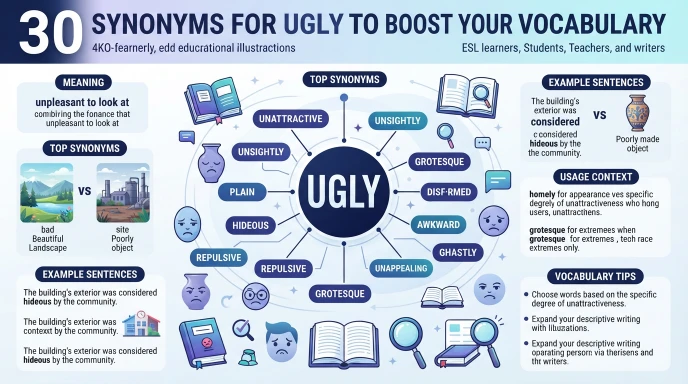
The word ugly means something that looks unpleasant, unattractive, or not pleasing to the eye. Imagine walking past an old building with broken windows, peeling paint, and trash around it.
Many people might describe that building as ugly. This word is commonly used in daily conversations, writing, and descriptions of people, places, objects, and situations.
Learning synonyms for ugly is important because using the same word repeatedly can make writing boring. English learners, students, teachers, and content writers can improve their vocabulary by knowing different words with similar meanings.
Each synonym can add a slightly different tone or meaning.
In this article, you will learn the meaning of ugly, its pronunciation, history, grammar, connotation, and 30 useful synonyms with examples. You will also discover categories, antonyms, related words, and common questions about the word.
Meaning of Ugly
Definition
Ugly (Adjective):
Something that is unpleasant to look at, unattractive, or offensive in appearance.
Examples
- The old house looked ugly after years of neglect.
- He thought the painting was ugly, but others liked it.
Connotative Meaning
(Connotation: the emotional or cultural feeling connected to a word beyond its basic meaning.)
- Positive tone: Rarely positive; sometimes used humorously among friends.
- Negative tone: Most common; suggests unattractiveness, unpleasantness, or dislike.
- Neutral tone: Can be neutral when describing facts or conditions without emotion.
Etymology
- Comes from Old Norse uggligr, meaning “fearful” or “dreadful.”
- Entered English through Scandinavian influence.
- Originally described something frightening before it came to mean unattractive.
Short History
- Old English (450–1100): Similar ideas were expressed with words meaning frightening or unpleasant.
- Middle English (1100–1500): The word ugly began appearing with meanings related to fear and unpleasant appearance.
- Modern English (1500–Present): Ugly became widely used to describe unattractive people, objects, places, and situations.
Pronunciation (US & UK – IPA)
US: /ˈʌɡ.li/
UK: /ˈʌɡ.li/
Syllables
ug-ly
Affixation Pattern of Ugly
Root: ugly
Prefix: None
Suffix: None
Word Formation
- Ugly (Adjective)
- Ugliness (Noun)
- Uglify (Verb)
- Uglified (Adjective/Verb Form)
- Uglifying (Verb)
Synonyms of Ugly
1. Unattractive (Adjective)
US: /ˌʌn.əˈtræk.tɪv/ | UK: /ˌʌn.əˈtræk.tɪv/
Meaning: Not appealing in appearance.
Examples:
- The building looked unattractive after the storm.
- He considered the design unattractive.
2. Plain (Adjective)
US: /pleɪn/ | UK: /pleɪn/
Meaning: Simple and not especially attractive.
Examples:
- The room was plain but comfortable.
- She wore a plain dress.
3. Homely (Adjective)
US: /ˈhoʊm.li/ | UK: /ˈhəʊm.li/
Meaning: Not attractive in appearance.
Examples:
- The character was described as homely.
- The village looked simple and homely.
4. Unsightly (Adjective)
US: /ʌnˈsaɪt.li/ | UK: /ʌnˈsaɪt.li/
Meaning: Unpleasant to look at.
Examples:
- The trash created an unsightly mess.
- An unsightly stain covered the wall.
5. Hideous (Adjective)
US: /ˈhɪd.i.əs/ | UK: /ˈhɪd.i.əs/
Meaning: Extremely ugly.
Examples:
- The costume looked hideous.
- They complained about the hideous color.
6. Repulsive (Adjective)
US: /rɪˈpʌl.sɪv/ | UK: /rɪˈpʌl.sɪv/
Meaning: Causing strong dislike.
Examples:
- The smell was repulsive.
- He found the scene repulsive.
7. Grotesque (Adjective)
US: /ɡroʊˈtesk/ | UK: /ɡrəʊˈtesk/
Meaning: Strange and unpleasant in appearance.
Examples:
- The sculpture looked grotesque.
- The movie showed grotesque creatures.
8. Horrid (Adjective)
US: /ˈhɔːr.ɪd/ | UK: /ˈhɒr.ɪd/
Meaning: Very unpleasant.
Examples:
- The wallpaper looked horrid.
- They lived in a horrid building.
9. Ghastly (Adjective)
US: /ˈɡæs.tli/ | UK: /ˈɡɑːst.li/
Meaning: Shockingly unpleasant.
Examples:
- The room had ghastly decorations.
- That outfit looks ghastly.
10. Disfigured (Adjective)
US: /dɪsˈfɪɡ.jɚd/ | UK: /dɪsˈfɪɡ.əd/
Meaning: Damaged in appearance.
Examples:
- The statue was disfigured by weather.
- The wall became disfigured over time.
11. Deformed (Adjective)
US: /dɪˈfɔːrmd/ | UK: /dɪˈfɔːmd/
Meaning: Misshapen or irregular.
Examples:
- The tree had a deformed trunk.
- The object looked deformed.
12. Shabby (Adjective)
US: /ˈʃæb.i/ | UK: /ˈʃæb.i/
Meaning: Old and in poor condition.
Examples:
- They lived in a shabby apartment.
- The furniture looked shabby.
13. Ragged (Adjective)
US: /ˈræɡ.ɪd/ | UK: /ˈræɡ.ɪd/
Meaning: Torn and worn out.
Examples:
- He wore ragged clothes.
- The flag looked ragged.
14. Dilapidated (Adjective)
US: /dɪˈlæp.ə.deɪ.t̬ɪd/ | UK: /dɪˈlæp.ɪ.deɪ.tɪd/
Meaning: In a state of decay.
Examples:
- The house was dilapidated.
- They repaired a dilapidated barn.
15. Crude (Adjective)
US: /kruːd/ | UK: /kruːd/
Meaning: Rough and poorly made.
Examples:
- The drawing looked crude.
- It was a crude design.
16. Awful (Adjective)
US: /ˈɔː.fəl/ | UK: /ˈɔː.fəl/
Meaning: Very bad or unpleasant.
Examples:
- The paint color was awful.
- They disliked the awful decoration.
17. Revolting (Adjective)
US: /rɪˈvoʊl.tɪŋ/ | UK: /rɪˈvəʊl.tɪŋ/
Meaning: Extremely unpleasant.
Examples:
- The sight was revolting.
- The room looked revolting.
18. Foul (Adjective)
US: /faʊl/ | UK: /faʊl/
Meaning: Offensive or unpleasant.
Examples:
- A foul smell filled the area.
- The water looked foul.
19. Nasty (Adjective)
US: /ˈnæs.ti/ | UK: /ˈnɑː.sti/
Meaning: Unpleasant or offensive.
Examples:
- The stain looked nasty.
- The weather became nasty.
20. Beastly (Adjective)
US: /ˈbiːst.li/ | UK: /ˈbiːst.li/
Meaning: Very unpleasant or ugly.
Examples:
- The decoration was beastly.
- He called the color beastly.
21. Unappealing (Adjective)
US: /ˌʌn.əˈpiː.lɪŋ/ | UK: /ˌʌn.əˈpiː.lɪŋ/
Meaning: Not attractive or interesting.
Examples:
- The menu looked unappealing.
- The room seemed unappealing.
22. Unpleasant (Adjective)
US: /ʌnˈplez.ənt/ | UK: /ʌnˈplez.ənt/
Meaning: Not enjoyable or attractive.
Examples:
- The view was unpleasant.
- They entered an unpleasant area.
23. Misshapen (Adjective)
US: /mɪsˈʃeɪ.pən/ | UK: /mɪsˈʃeɪ.pən/
Meaning: Not having a normal shape.
Examples:
- The fruit was misshapen.
- A misshapen object sat on the table.
24. Scarred (Adjective)
US: /skɑːrd/ | UK: /skɑːd/
Meaning: Marked with scars or damage.
Examples:
- The wall was scarred by fire.
- The surface appeared scarred.
25. Dingy (Adjective)
US: /ˈdɪn.dʒi/ | UK: /ˈdɪn.dʒi/
Meaning: Dark and dirty-looking.
Examples:
- The room felt dingy.
- They painted the dingy walls.
26. Drab (Adjective)
US: /dræb/ | UK: /dræb/
Meaning: Dull and lacking interest.
Examples:
- The office looked drab.
- She disliked the drab colors.
27. Gloomy (Adjective)
US: /ˈɡluː.mi/ | UK: /ˈɡluː.mi/
Meaning: Dark and depressing.
Examples:
- The building appeared gloomy.
- The street looked gloomy.
28. Unlovely (Adjective)
US: /ʌnˈlʌv.li/ | UK: /ʌnˈlʌv.li/
Meaning: Not beautiful.
Examples:
- The area looked unlovely.
- The painting seemed unlovely.
29. Offensive (Adjective)
US: /əˈfen.sɪv/ | UK: /əˈfen.sɪv/
Meaning: Causing dislike or discomfort.
Examples:
- The design was offensive to some viewers.
- The image looked offensive.
30. Monstrous (Adjective)
US: /ˈmɑːn.strəs/ | UK: /ˈmɒn.strəs/
Meaning: Extremely ugly or shocking.
Examples:
- The sculpture appeared monstrous.
- They described the building as monstrous.
Prototype Meaning
The most typical meaning of ugly is something that looks unpleasant, unattractive, or visually unappealing.
When people hear the word ugly, they often imagine a person, object, place, or situation that does not look beautiful or pleasant.
Prototype Categorization
- Mildly Unattractive: plain, homely, unappealing, unlovely
- Very Ugly: hideous, monstrous, ghastly, horrid
- Dirty or Neglected: shabby, dingy, dilapidated, ragged
- Strange Appearance: grotesque, deformed, misshapen
- Offensive or Disgusting: repulsive, revolting, foul, nasty
- Dull Appearance: drab, gloomy, crude
Categorization helps writers choose the most accurate synonym. For example, drab describes dullness, while hideous suggests extreme ugliness.
Antonyms of Ugly
- Beautiful (Adjective): Very pleasing to look at.
- Attractive (Adjective): Appealing in appearance.
- Pretty (Adjective): Pleasant and charming.
- Handsome (Adjective): Good-looking and attractive.
- Lovely (Adjective): Delightful and beautiful.
- Gorgeous (Adjective): Extremely beautiful.
- Elegant (Adjective): Graceful and stylish.
- Appealing (Adjective): Interesting and attractive.
- Charming (Adjective): Pleasant and delightful.
- Stunning (Adjective): Impressively beautiful.
Related Words
- Ugliness (Noun)
- Uglify (Verb)
- Appearance (Noun)
- Beauty (Noun)
- Attractive (Adjective)
- Unattractive (Adjective)
- Aesthetic (Adjective/Noun)
- Visual (Adjective)
Short Questions and Answers
- What does ugly mean?
- Ugly means unpleasant, unattractive, or not pleasing to look at.
- When should ugly be used?
- Use it when describing something visually unattractive or unpleasant.
- Is ugly positive or negative?
- It is usually negative because it expresses dislike or unattractiveness.
- How is it different from similar words?
- Ugly is a general term. Words like hideous are stronger, while plain is milder.
Formal and Casual Alternatives
Formal
- Unattractive
- Unsightly
- Unappealing
- Grotesque
- Dilapidated
Casual
- Ugly
- Nasty
- Awful
- Drab
- Shabby
Conclusion
Learning the word ugly and its synonyms can greatly improve your English vocabulary. Instead of repeating the same word, you can choose from many alternatives that fit different situations and tones.
This makes your writing more interesting, professional, and accurate. Understanding pronunciation, history, connotation, and related words also helps you use vocabulary correctly.
if you are a student, teacher, writer, or English learner, expanding your knowledge of synonyms strengthens both speaking and writing skills.
Practice using a few new words every day in conversations, essays, and reading activities. Over time, your confidence and vocabulary will grow, making English communication easier and more effective.
Explore more about!
- 30 Synonyms for ‘Solution’ to Boost Your Vocabulary
- 30 Synonyms for ‘Thankful’ to Boost Your Vocabulary

I am an American author, and I write books about power, strategy, and human behavior. My writing style is simple but deep, and I try to explain how people think and act in real-life situations.
I studied classical studies, and before becoming a writer, I worked in different fields which helped me understand people and life better.
My most famous books include The 48 Laws of Power, The Art of Seduction, and Mastery. These books are widely read by business people, leaders, and students around the world.