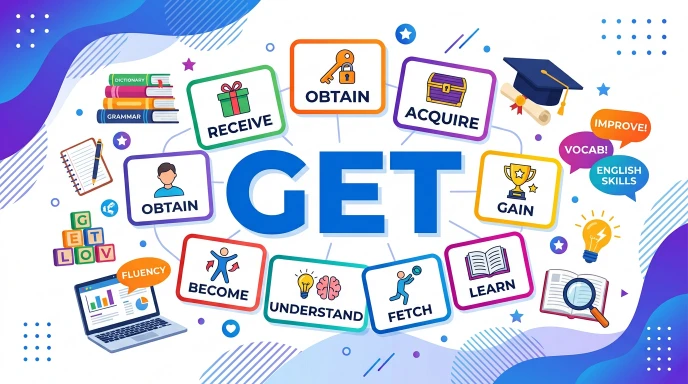
The word get is one of the most common verbs in English. People use it every day in conversations, emails, books, and social media. You can get a gift, get a job, get home, or get an idea. Because this one word has many meanings, it is useful in almost every situation.
However, using get too often can make your speaking and writing sound repetitive. Learning synonyms helps you choose the right word for the right context. It also makes your English sound more natural and professional. If you are an English learner, student, writer, or blogger, knowing better alternatives to get will improve your vocabulary. In this guide, you will learn the meaning of get, its pronunciation, history, grammar, and 30 powerful synonyms with simple definitions and easy examples.
Meaning of Get
Definition
Get (Verb):
To receive, obtain, become, understand, arrive, or bring something, depending on the context.
Examples
- I got a new laptop for my birthday.
- She gets home before sunset every day.
Connotative Meaning
(Connotation is the emotional feeling or idea that a word suggests in addition to its dictionary meaning.)
- Positive Tone: Get a prize, get promoted, get better.
- Negative Tone: Get sick, get lost, get hurt.
- Neutral Tone: Get a message, get home, get a book.
Etymology
- Source Language: Old Norse
- Original Word: geta
- Original Meaning: To obtain, reach, or be able to.
Short History
- Old English (450–1100): English mainly used other verbs like niman (take).
- Middle English (1100–1500): The Norse word geta entered English and became popular.
- Modern English (1500–Present): Get became one of the most common English verbs with many meanings and expressions.
Pronunciation (US & UK – IPA)
- US: /ɡɛt/
- UK: /ɡet/
Syllables
get
Affixation Pattern of Get
- Root: get
- Prefix: None
- Suffix: None
Word Formation of Get
- Get (Verb)
- Gets (Verb)
- Got (Past Tense Verb)
- Gotten (Past Participle – American English)
- Getting (Gerund/Noun)
- Getter (Noun)
Synonyms of Get
1. Obtain (Verb)
US: /əbˈteɪn/ | UK: /əbˈteɪn/
Meaning: To receive or gain something through effort.
Examples
- She obtained a scholarship after hard work.
- We obtained permission from the manager.
2. Receive (Verb)
US: /rɪˈsiːv/ | UK: /rɪˈsiːv/
Meaning: To accept or be given something.
Examples
- I received your email this morning.
- They received many gifts at the wedding.
3. Acquire (Verb)
US: /əˈkwaɪər/ | UK: /əˈkwaɪə/
Meaning: To gain something through learning, buying, or experience.
Examples
- She acquired valuable skills.
- The company acquired a new office.
4. Gain (Verb)
US: /ɡeɪn/ | UK: /ɡeɪn/
Meaning: To get something useful or valuable.
Examples
- He gained confidence after practice.
- The team gained more supporters.
5. Earn (Verb)
US: /ɝːn/ | UK: /ɜːn/
Meaning: To receive money or respect through work.
Examples
- She earns a good salary.
- He earned everyone’s trust.
6. Collect (Verb)
US: /kəˈlekt/ | UK: /kəˈlekt/
Meaning: To bring together or gather things.
Examples
- I collect old coins.
- She collected the documents.
7. Gather (Verb)
US: /ˈɡæðər/ | UK: /ˈɡæðə/
Meaning: To bring people or things together.
Examples
- We gathered useful information.
- The children gathered around the teacher.
8. Secure (Verb)
US: /sɪˈkjʊr/ | UK: /sɪˈkjʊə/
Meaning: To successfully obtain something important.
Examples
- She secured a new job.
- They secured enough funding.
9. Fetch (Verb)
US: /fetʃ/ | UK: /fetʃ/
Meaning: To go and bring something back.
Examples
- Please fetch a glass of water.
- He fetched his backpack from the car.
10. Bring (Verb)
US: /brɪŋ/ | UK: /brɪŋ/
Meaning: To carry something to a place.
Examples
- Please bring your notebook.
- She brought flowers to the party.
11. Attain (Verb)
US: /əˈteɪn/ | UK: /əˈteɪn/
Meaning: To achieve or reach something through effort.
Examples
- She attained her career goals.
- He attained a high score in the exam.
12. Achieve (Verb)
US: /əˈtʃiːv/ | UK: /əˈtʃiːv/
Meaning: To successfully reach a goal.
Examples
- They achieved success through hard work.
- She achieved excellent results.
13. Reach (Verb)
US: /riːtʃ/ | UK: /riːtʃ/
Meaning: To arrive at a place, level, or goal.
Examples
- We reached the station on time.
- He reached his dream after years of effort.
14. Win (Verb)
US: /wɪn/ | UK: /wɪn/
Meaning: To get victory, a prize, or a competition.
Examples
- She won the first prize.
- Our team won the match.
15. Capture (Verb)
US: /ˈkæptʃər/ | UK: /ˈkæptʃə/
Meaning: To take control of or successfully get something.
Examples
- The camera captured the moment.
- The army captured the city.
16. Pick Up (Phrasal Verb)
US: /pɪk ʌp/ | UK: /pɪk ʌp/
Meaning: To collect, receive, or learn something.
Examples
- I will pick up the package tomorrow.
- Children pick up new words quickly.
17. Learn (Verb)
US: /lɝːn/ | UK: /lɜːn/
Meaning: To get knowledge or a new skill.
Examples
- She learned Spanish last year.
- We learn something new every day.
18. Understand (Verb)
US: /ˌʌndərˈstænd/ | UK: /ˌʌndəˈstænd/
Meaning: To know the meaning of something.
Examples
- I understand your question.
- She understands English very well.
19. Catch (Verb)
US: /kætʃ/ | UK: /kætʃ/
Meaning: To get or stop something while it is moving.
Examples
- He caught the ball.
- We caught the last train.
20. Accept (Verb)
US: /əkˈsept/ | UK: /əkˈsept/
Meaning: To willingly receive or agree to something.
Examples
- She accepted the job offer.
- They accepted his apology.
21. Procure (Verb)
US: /prəˈkjʊr/ | UK: /prəˈkjʊə/
Meaning: To obtain something, especially with effort.
Examples
- The company procured new equipment.
- She procured all the required documents.
22. Acquire Possession of (Verb Phrase)
US: /əˈkwaɪər pəˈzeʃən əv/ | UK: /əˈkwaɪə pəˈzeʃən əv/
Meaning: To become the owner of something.
Examples
- He acquired possession of the old house.
- They acquired possession of valuable land.
23. Come By (Phrasal Verb)
US: /kʌm baɪ/ | UK: /kʌm baɪ/
Meaning: To obtain something, often with some difficulty.
Examples
- Good seats are hard to come by.
- Fresh water was easy to come by.
24. Pick (Verb)
US: /pɪk/ | UK: /pɪk/
Meaning: To choose or take something.
Examples
- Please pick a color.
- She picked the best book.
25. Take (Verb)
US: /teɪk/ | UK: /teɪk/
Meaning: To get or carry something from one place.
Examples
- Please take your umbrella.
- He took the last cookie.
26. Grab (Verb)
US: /ɡræb/ | UK: /ɡræb/
Meaning: To take something quickly.
Examples
- She grabbed her bag and left.
- Grab a chair before the meeting starts.
27. Snag (Verb)
US: /snæɡ/ | UK: /snæɡ/
Meaning: To get something quickly or unexpectedly.
Examples
- I snagged a cheap flight.
- She snagged the last ticket.
28. Gain Possession of (Verb Phrase)
US: /ɡeɪn pəˈzeʃən əv/ | UK: /ɡeɪn pəˈzeʃən əv/
Meaning: To become the owner of something.
Examples
- They gained possession of the property.
- He gained possession of the family business.
29. Lay Hold of (Verb Phrase)
US: /leɪ hoʊld əv/ | UK: /leɪ həʊld əv/
Meaning: To seize or obtain something.
Examples
- She laid hold of the opportunity.
- He laid hold of the rope.
30. Come Into (Phrasal Verb)
US: /kʌm ˈɪntuː/ | UK: /kʌm ˈɪntə/
Meaning: To receive or inherit something.
Examples
- She came into a large inheritance.
- He came into some extra money.
Prototype Meaning
The prototype meaning of get is to receive or obtain something. When people hear the word get, they usually think about receiving an object, a gift, money, or information. For example, “I got a letter today” or “She got a new phone.” This is the most common and easiest meaning of the word. From this basic idea, get also developed many other meanings, such as becoming, arriving, understanding, or bringing something.
Prototype Categorization
Grouping synonyms into categories helps learners choose the right word for the right situation. Instead of using get every time, you can select a more accurate synonym.
- Receiving Something: receive, obtain, acquire, procure, come by
- Achieving Success: achieve, attain, earn, gain, secure, win
- Taking Something: take, grab, fetch, pick, catch
- Learning or Understanding: learn, understand, pick up
- Owning Something: gain possession of, acquire possession of, come into
- Moving or Reaching: reach, bring
Choosing synonyms by category improves writing, avoids repetition, and makes communication more natural.
Antonyms of Get
- Lose (Verb): To stop having something.
- Give (Verb): To provide something to another person.
- Miss (Verb): To fail to receive or catch something.
- Reject (Verb): To refuse to accept something.
- Surrender (Verb): To give up possession or control.
- Forfeit (Verb): To lose something because of a mistake or rule.
- Release (Verb): To let something go.
- Discard (Verb): To throw something away.
- Drop (Verb): To let something fall or stop holding it.
- Return (Verb): To give something back.
Short Questions and Answers
- What does “get” mean?
Answer: Get means to receive, obtain, become, arrive, or understand something, depending on the context. - When should “get” be used?
Answer: Use get in everyday English when talking about receiving, obtaining, reaching, becoming, or understanding something. - Is “get” positive or negative?
Answer: It can be positive, negative, or neutral. Its meaning depends on the sentence. For example, get a reward is positive, get sick is negative, and get home is neutral. - How is “get” different from similar words?
Answer: Get is a general verb with many meanings. Words like receive, obtain, earn, and acquire have more specific meanings and are often better choices in formal writing.
Conclusion
The word get is one of the most useful and flexible verbs in English. It can describe receiving, obtaining, becoming, reaching, understanding, and many other actions. Learning its synonyms helps you express ideas more clearly and naturally. Using words such as receive, obtain, acquire, earn, and achieve makes your writing richer and more professional. It also helps you avoid repeating the same word again and again. If you are a student, English learner, blogger, or content writer, practicing these synonyms every day will improve your vocabulary, strengthen your speaking and writing skills, and build your confidence in English communication.
Read more about!
Synonyms for Rude: 40 Better Words to Use in English

I am an American author, and I write books about power, strategy, and human behavior. My writing style is simple but deep, and I try to explain how people think and act in real-life situations.
I studied classical studies, and before becoming a writer, I worked in different fields which helped me understand people and life better.
My most famous books include The 48 Laws of Power, The Art of Seduction, and Mastery. These books are widely read by business people, leaders, and students around the world.